![]()
PART I
What Brings Us Together
![]()
1. Wooderson’s Law
Up where the world is steep, like in the Andes, people use funicular railroads to get where they need to go—a pair of cable cars connected by a pulley far up the hill. The weight of the one car going down pulls the other up; the two vessels travel in counterbalance. I’ve learned that that’s what being a parent is like. If the years bring me low, they raise my daughter, and, please, so be it. I surrender gladly to the passage, of course, especially as each new moment gone by is another I’ve lived with her, but that doesn’t mean I don’t miss the days when my hair was actually all brown and my skin free of weird spots. My girl is two and I can tell you that nothing makes the arc of time more clear than the creases in the back of your hand as it teaches plump little fingers to count: one, two, tee.
But some guy having a baby and getting wrinkles is not news. You can start with whatever the Oil of Olay marketing department is running up the pole this week—as I’m writing it’s the idea of “color correcting” your face with a creamy beige paste that is either mud from the foothills of Alsace or the very essence of bullshit—and work your way back to myths of Hera’s jealous rage. People have been obsessed with getting older, and with getting uglier because of it, for as long as there’ve been people and obsession and ugliness. “Death and taxes” are our two eternals, right? And depending on the next government shutdown, the latter is looking less and less reliable. So there you go.
When I was a teenager—and it shocks me to realize I was closer then to my daughter’s age than to my current thirty-eight—I was really into punk rock, especially pop-punk. The bands were basically snottier and less proficient versions of Green Day. When I go back and listen to them now, the whole phenomenon seems supernatural to me: grown men brought together in trios and quartets by some unseen force to whine about girlfriends and what other people are eating. But at the time I thought these bands were the shit. And because they were too cool to have posters, I had to settle for arranging their album covers and flyers on my bedroom wall. My parents have long since moved—twice, in fact. I’m pretty sure my old bedroom is now someone else’s attic, and I have no idea where any of the paraphernalia I collected is. Or really what most of it even looked like. I can just remember it and smile, and wince.
Today an eighteen-year-old tacks a picture on his wall, and that wall will never come down. Not only will his thirty-eight-year-old self be able to go back, pick through the detritus, and ask, “What was I thinking?,” so can the rest of us, and so can researchers. Moreover, they can do it for all people, not just one guy. And, more still, they can connect that eighteenth year to what came before and what’s still to come, because the wall, covered in totems, follows him from that bedroom in his parents’ house to his dorm room to his first apartment to his girlfriend’s place to his honeymoon, and, yes, to his daughter’s nursery. Where he will proceed to paper it over in a billion updates of her eating mush.
A new parent is perhaps most sensitive to the milestones of getting older. It’s almost all you talk about with other people, and you get actual metrics at the doctor’s every few months. But the milestones keep coming long after babycenter.com and the pediatrician quit with the reminders. It’s just that we stop keeping track. Computers, however, have nothing better to do; keeping track is their only job. They don’t lose the scrapbook, or travel, or get drunk, or grow senile, or even blink. They just sit there and remember. The myriad phases of our lives, once gone but to memory and the occasional shoebox, are becoming permanent, and as daunting as that may be to everyone with a drunk selfie on Instagram, the opportunity for understanding, if handled carefully, is self-evident.
What I’ve just described, the wall and the long accumulation of a life, is what sociologists call longitudinal data—data from following the same people, over time—and I was speculating about the research of the future. We don’t have these capabilities quite yet because the Internet, as a pervasive human record, is still too young. As hard as it is to believe, even Facebook, touchstone and warhorse that it is, has only been big for about six years. It’s not even in middle school! Information this deep is still something we’re building toward, literally, one day at a time. In ten or twenty years, we’ll be able to answer questions like … well, for one, how much does it mess up a person to have every moment of her life, since infancy, posted for everyone else to see? But we’ll also know so much more about how friends grow apart or how new ideas percolate through the mainstream. I can see the long-term potential in the rows and columns of my databases, and we can all see it in, for example, the promise of Facebook’s Timeline: for the passage of time, data creates a new kind of fullness, if not exactly a new science.
Even now, in certain situations, we can find an excellent proxy, a sort of flash-forward to the possibilities. We can take groups of people at different points in
their lives, compare them, and get a rough draft of life’s arc. This approach won’t work with music tastes, for example, because music itself also evolves through time, so the analysis has no control. But there are fixed universals that can support it, and, in the data I have, the nexus of beauty, sex, and age is one of them. Here the possibility already exists to mark milestones, as well as lay bare vanities and vulnerabilities that were perhaps till now just shades of truth. So doing, we will approach a topic that has consumed authors, painters, philosophers, and poets since those vocations existed, perhaps with less art (though there is an art to it), but with a new and glinting precision. As usual, the good stuff lies in the distance between thought and action, and I’ll show you how we find it.
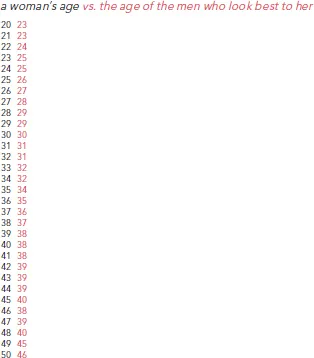
I’ll start with the opinions of women—all the trends below are true across my sexual data sets, but for specificity’s sake, I’ll use numbers from OkCupid. This table lists, for a woman, the age of men she finds most attractive. If I’ve arranged it unusually, you’ll see in a second why.
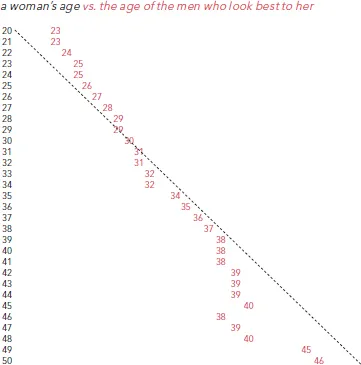
Reading from the top, we see that twenty- and twenty-one-year-old women prefer twenty-three-year-old guys; twenty-two-year-old women like men who are twenty-four, and so on down through the years to women at fifty, who we see rate forty-six-year-olds the highest. This isn’t survey data, this is data built from tens of millions of preferences expressed in the act of finding a date, and even from just following along the first few entries, the gist of the table is clear: a woman wants a guy to be roughly as old as she is. Pick an age in black under forty, and the number in red is always very close. The broad trend comes through better when I let lateral space reflect the progression of the values in red:
That dotted diagonal is the “age parity” line, where the male and female years would be equal. It’s not a canonical math thing, just something I overlaid as a guide for your eye. Often there is an intrinsic geometry to a situation—it was the first science for a reason—and we’ll take advantage wherever possible.fn1 This particular line brings out two transitions, which coincide with big birthdays. The first pivot point is at thirty, where the trend of the red numbers—the ages of the men—crosses below the line, never to cross back. That’s the data’s way of saying that until thirty, a woman prefers slightly older guys; afterward, she likes them slightly younger. Then at forty, the progression breaks free of the diagonal, going practically straight down for nine years. That is to say, a woman’s tastes appear to hit a wall. Or a man’s looks fall off a cliff, however you want to think about it. If we want to pick the point where a man’s sexual appeal has reached its limit, it’s there: forty.
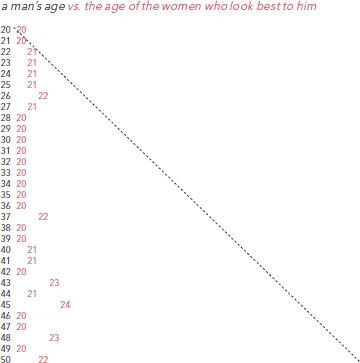
The two perspectives (of the woman doing the rating and of the man being rated) are two halves of a whole. As a woman gets older, her standards evolve, and from the man’s side, the rough 1:1 movement of the red numbers versus the black implies that as he matures, the expectations of his female peers mature as well—practically year-for-year. He gets older, and their viewpoint accommodates him. The wrinkles, the nose hair, the renewed commitment to cargo shorts—these are all somehow satisfactory, or at least offset by other virtues. Compare this to the free fall of scores going the other way, from men to women.
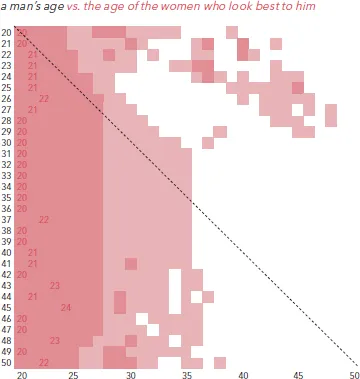
This graph—and it’s practically not even a graph, just a table with a couple columns—makes a statement as stark as its own negative space. A woman’s at her best when she’s in her very early twenties. Period. And really my plot doesn’t show that strongly enough. The four highest-rated female ages are twenty, twenty-one, twenty-two, and twenty-three for every group of guys but one. You can see the general pattern below, where I’ve overlaid shading for the top two quartiles (that is, top half) of ratings. I’ve also added some female ages as numbers in black on the bottom horizontal to help you navigate:
Again, the geometry speaks: the male pattern runs much deeper than just a preference for twenty-year-olds. And after he hits thirty, the latter half of our age range (that is, women over thirty-five) might as well not exist. Younger is better, and youngest is best of all, and if “over the hill” means the beginning of a person’s decline, a straight woman is over the hill as soon as she’s old enough to drink.
Of course, another way to put this focus on youth is that males’ expectations never grow up. A fifty-year-old man’s idea of what’s hot is roughly the same as a college kid’s, at least with age as the variable under consideration—if anything, men in their twenties are more willing to date older women. That pocket of middling ratings in the upper right of the plot, that’s your “cougar” bait, basically. Hikers just out enjoying a nice day, then bam.
In a mathematical sense, a man’s age and his sexual aims are independent variables: the former changes while the latter never does. I call this Wooderson’s law, in honor of its most famous proponent, Matthew McConaughey’s character from Dazed and Confused.
That’s what I like about these high school girls. I get older, they stay the same age.
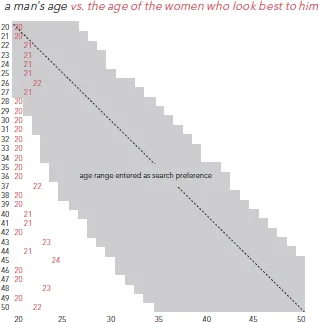
Unlike Wooderson himself, what men claim they want is quite different from the private voting data we’ve just seen. The ratings above were submitted without any specific prompt beyond “Judge this person.” But when you ask men outright to select the ages of women they’re looking for, you get much different results. The gray space below is what men tell us they want when asked:
Since I don’t think that anyone is intentionally misleading us when they give OkCupid their preferences—there’s little incentive to do that, since all you get then is a site that gives you what you know you don’t want—I see this as a statement of what men imagine they’re supposed to desire, versus what they actually do. The gap between the two ideas just grows over the years, although the tension seems to resolve in a kind of pathetic compromise when it’s time to stop voting and act, as you’ll see.
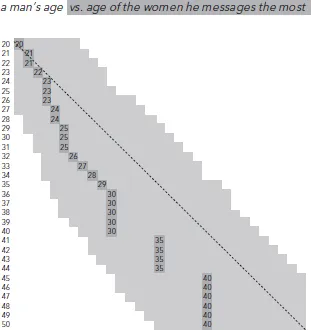
The next plot (the final one of this type we’ll look at) identifies the age with the greatest density of contact attempts. These most-messaged ages are described by the darkest gray squares drifting along the left-hand edge of the larger swath. Those three dark verticals in the graph’s lower half show the jumps in a man’s self-concept as he approaches middle age. You can almost see the gears turning. At forty-four, he’s comfortable approaching a woman as young as thirty-five. Then, one year later … he thinks better of it. While a nine-year age difference is fine, ten years is apparently too much.
It’s this kind of calculated no-man’s-land—the balance between what you want, what you say, and what you do—that real romance has to occupy: no matter how people might vote in private or what they prefer in the abstract, there aren’t many fifty-year-old men successfully pursuing twenty-year-old women. For one thing, social conventions work against it. For another, dating requires reciprocity. What one person wants is only half of the equation.
When it comes to women seizing the initiative and reaching out to men, because of the female-to-male attraction ratio we saw at the beginning of the chapter (1 year : 1 year), plus the nonphysical motivations that push women toward older men—economics, for example—women send more, rather than fewer, messages to a man as he gets older, up until the early thirties. From there, the amount of contact declines, but no faster than the general number of available females itself is shrinking. Think about it like this: imagine you could take a typical twenty-year-old guy, who’s just starting to date as an adult (definition: no SOLO cups present during at least one of courtship/consummation/breakup), and you could somehow note all the women who would be interested in him. If you could then track the whole lot over time, the main way he’ll lose options from that set is when some of them just stop being single because they...