In the age of "complex Tv", of social networking and massive consumption of transmedia narratives, a myriad short-lived phenomena surround films and TV programs raising questions about the endurance of a fictional world and other mediatized discourse over a long arc of time. The life of media products can change direction depending on the variability of paratextual materials and activities such as online commentaries and forums, promos and trailers, disposable merchandise and gadgets, grassroots video production, archives, and gaming. This book examines the tension between permanence and obsolescence in the production and experience of media byproducts analysing the affections and meanings they convey and uncovering the machineries of their persistence or disposal. Paratexts, which have long been considered only ancillary to a central text, interfere instead with textual politics by influencing the viewers' fidelity (or infidelity) to a product and affecting a fictional world's "life expectancy". Scholars in the fields of film studies, media studies, memory and cultural studies are here called to observe these byproducts' temporalities (their short form and/or long temporal extention, their nostalgic politics or future projections) and assess their increasing influence on our use of the past and present, on our temporal experience, and, consequently, on our social and political self-positioning through the media.
eBook - ePub
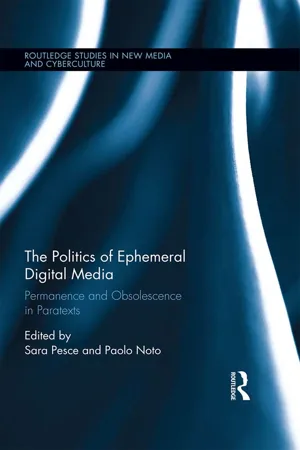
The Politics of Ephemeral Digital Media
Permanence and Obsolescence in Paratexts
- 254 pages
- English
- ePUB (mobile friendly)
- Available on iOS & Android
eBook - ePub
The Politics of Ephemeral Digital Media
Permanence and Obsolescence in Paratexts
About this book
Information
Understanding “Short Shelf-Life” Media
1 Short Shelf-Life Media
Ephemeral Digital Practices and the Contemporary Dream of Permanence
Introduction
In the contemporary culture of compulsive digitization and connectivity, the short-lived and the surplus emerge in many forms. The purpose of this chapter is to show how the enormous amount of extemporary and short products created, stored, and circulated online disguises concerns for decay that intersect with the overabundance of materials, therefore reflecting contemporary politics and discourse on the food supply, ecology, and recycling. I describe these media production practices and media use as “short-shelf life media.”
In the field of entertainment and information, a few examples of the short-lived and the surplus are: cell phone news and news on the web broadcast as cascades of content (placeless, without clear priorities, and updated every 30 minutes, as in the case of Wireless Application Protocol (WAP) news;1 bonus materials mushrooming around a film (extra film footage, commentary tracks, interactive games—included on DVDs and conceived as ancillary or spare); promos, hypes, and synergies activated by the industry before or during the projection of a film2 (conceived as fleeting, although their reiterated impact might be found on the web); the cluster of merchandise branding surrounding a show or a fictional character (challenging the notion of peripheral and superfluous); a number of secondary screen artifacts, including videogames and impromptu user-generated products such as fan videos, fake trailers, and mash-ups3 that can reactivate and enormously expand the primary text’s meaning and value; finally, forms of reproduction and use of items derived from the diegesis: “textual pieces” such as costumes, clothing, and objects imitated or bought and used to reenact and transform the fictional world, as in the case of cosplay—costumed role-playing inspired by a fictional character. Although not all of these phenomena appear in a strictly textual form—as in the case of toys and gadgets—they might all be included in the wide category of paratextual media. Their common denominator is the fact that they raise interest, excitement, or concern because of their modes of connecting to an epicenter or to a foundational entity: a core text—the film, TV show, serial episode, commercial, or piece of news.
The purpose of my analysis is not to discover what the paratexts do to the text, as Jonathan Gray does in his successful attempt to problematize what is to be considered primary and what is secondary and peripheral. Nor is it my primary concern to consider the durational and circulatory temporalities characterizing the “fugitive” nature of media viewing, as in Paul Grainge’s edited collection.4 It is, rather, to highlight the meaningful link between the workings of paratexts and certain collective behaviors that emerge “in a world marked by deepening political, economic, cultural and environmental insecurity.”5 There is a connection, I believe, between the use and production of media paratexts and specific hopes or anxieties connected to the individual’s sense of power or powerlessness when confronted with: 1. long arches of time and broad narrative architectures, 2. models of the performance of citizenship and ethos in the complex globalized geopolitical environment. All these concerns and behaviors revolve around a problematic temporality. They reveal a preoccupation for “short shelf life” that interlaces citizenship and media architectures, disclosing historical ambivalences regarding time consumption, future projections, and the preservation of past and present moments.
Responses to “short-shelf life” emerge in the daily use of digital media. The cases I have in mind are selected from the massive and varied repositories of user-generated film content, like those found on YouTube. I will analyze how these responses are embedded in the dissemination of cryptic or overt procedures of online film archiving, self-archiving, and video sharing, including amateur filmed documentation of catastrophic events. Scale and volume are crucial motors (not merely an effect) of these procedures. Storage, heritage, and patrimony are always, although not overtly, issues at stake. This, moreover, crucially constitutes a practice of memory emphasizing process and connection over information retrieval. In fact, metaphors of memory work as a process of morphing have inhabited recent popular cinema.6 Likewise, the popular conceptualization of the way we use the web emphasizes feeling, reexperiencing, and rewriting over data managing. The enormous number of practices, from which I draw examples, originate in the fabrication and consumption of cinema, television, and web industry products: films, TV series and shows, web series, commercials and other non-narrative content. These activities always involve the extraction of fragments and the treasuring of certain parts of texts. This is not only a grassroots phenomenon, but also an industrial, commercial, and institutional one: indeed, it reveals a “chain of production,” of maintenance and continuous reactivation of archival material, all of which involve a variety of agents.
The most revealing traits of these paratextual phenomena are a self-conscious contribution to the saturation of the media environment, as well as of experience,7 and a textual recoding—along this “chain of production”—that calls into question the experience of time and history. I suggest that these traits ought to be observed from the perspective of a changing epistemology of time and a changing culture of memory. I pose the questions of how the digitalized process of expansion, dissemination and anticipation of the text displace the predictability and the logic of the clock. And I also examine how brevity and extractability contribute to the fact that a single memorial object or a single memory practice dissolves with the use of digital media.
Therefore, my discussion of short-form and ephemeral media seeks to trigger a dialogue between film/media studies and memory studies, although it recognizes that economic, political, and strictly sociological viewpoints are also involved: especially those concerning consumerism in the global market, new forms of liberal citizenship, community, status, and affluence. The abundance and the scarce life expectancy of media paratexts are rooted in films’ chains of production and in a culture of remembering films—in particular in the pleasure produced by reactivativating excerpts of filmed materials. This “mushrooming” of film extraction practices needs to be placed in the context of a contemporary “memory boom” culture, which began in the last decades of the millennium,8 and furthermore in the context of the “traumatic culture” of the new century, permeated by an imaginary of perennial emergence.9
My perspective on short shelf-life media aims not solely to reveal the workings of paratexts as cultural performances that concern the projection into the future and treasuring of the past. I also wish to explain short-media against the background of a cultural concern for stability, where decomposition is a crucial value: an ecological value. The decomposition of organic matter is an important ecosystem process in many natural environments, to the same extent as innovative responses to resource variability in biodiverse ecosystems. Similarly, paratextual media are resources. Their resourcefulness entails renewal rates, detritus, and diversity, which benefit the survival not only of fictional environments, but also—the real object of my focus—of the consumer’s integrity.
Mediated Personal Memory Objects: Souvenirs, Collections, Compulsive Accumulation
Let us consider the numerous amateurish, professional, or semiprofessional forms of reuse of digitalized audiovisual content, such as (fan) vidding and fake trailers, mash-ups, remixes, and video essays, gag dubbings, demo reels, or animated Graphics Interchange Formats (GIFs). These objects are circulated on personal blogs (and facilitated by mobile apps such as Vine and Snapchat) through platforms of video-sharing including Youtube, Vimeo, Tumblr,10 Veoh, or Metacafe, or displayed on websites created by video content producers and publishers, as in the case of WatchMojo—which manufactures paratextual videos ranking, among other things, cinema and television shows.11 Part of this content is increasingly being incorporated into websites like Flickr12 or Pinterest, hosting not only images but also videos that are specifically conceived to allow for personal collections and act as personalized media catalogues. Moreover, some forms of reuse are disseminated and scored by fandom-oriented “meta-blogs” such as those dedicated to film series (e.g., Castlefanvideos, or The Best Lost Fan Videos). They can also be treasured by amateur archives like The Archive of Our Own or fan video archives like TV Fanvids Live Journal. These are all examples of paratextual media activities: they hint at a text, they comment on a text, they remember and treasure a text, but the text in its entirety is elsewhere. In short, we can note a circularity of paratextual media production, paratextual media archiving enabled by major video sharing platforms,13 and their re-archiviation according to personal, mnemonic criteria.
The “cultural drive” of these specific activities of online recirculation of audiovisual short materials has a lot to do with the “reinvention of government” and the “survivalism” characterizing new liberal citizenship, as mentioned above. It also includes a drive to monetize forms of archiving, albeit often indirectly. The valorization of individual resourcefulness is crucial for new liberal forms of citizenship, which include the appropriation of a variety of technologies for the management of the self. Television and digital hyperconnectivity are the technologies that play a role on a mass scale: reality TV, for example, has an agenda of advice, rules, demonstrations, games, experiments and tests that empower the citizen through the management of conduct and behavior.14 The use of appropriate technologies is effective for containing the perils of a globalized socioeconomic system, like the threat of deterioration—be it cultural, material, or environmental—and for keeping the rigors of the market under control.15 This can be explained via the context of a trauma culture induced by extremely mediatized natural cataclysms and terroristic attacks. As I will discuss later, this culture of trauma and vulnerability focuses on the issue of survival, implying the mobilization of private resources (skills, money, volunteerism) in order to manage and protect both the natural environment and ourselves. In all this, the citizen’s worth is enhanced by the active subject’s connective role, by the awareness of an agency working in a supranational governmental regime, and by an acknowledgment of the subject’s global reach.
In many senses, the cultural drive of recirculation described so far is shared by the agenda of other sources for the reuse of film content. Film industry archives, for example, make available short reels and discarded or neglected materials. This is the case of Paramount Stock Footage Collections, an online archive containing clips available for purchase, taken from contemporary or vintage cinematic footage—including material from classic films—that is sorted thematically. Governmental or educational archives like those of the Library of Congress or UCLA also preserve and circulate audiovisual material. Although these institutions are not involved in paratextual phenomena (since their scope is preserving integral texts), they are pushed by the same wide-ranging motivation I am describing here: the appeal, the interest, the worth of giving new life to past contents. Other examples include amateur web archives, like the British TV Ark—an online television museum, conceived as a tribute to historical television containing cult shows, advertisements, news and weather ...
Table of contents
- Cover Page
- Half Title Page
- Title Page
- Copyright Page
- Table of Contents
- Acknowledgments
- The Politics of Ephemeral Digital Media
- Contributors
- Index
Trusted by 375,005 students
Access to over 1.5 million titles for a fair monthly price.
Study more efficiently using our study tools.
Frequently asked questions
Yes, you can cancel anytime from the Subscription tab in your account settings on the Perlego website. Your subscription will stay active until the end of your current billing period. Learn how to cancel your subscription
No, books cannot be downloaded as external files, such as PDFs, for use outside of Perlego. However, you can download books within the Perlego app for offline reading on mobile or tablet. Learn how to download books offline
Perlego offers two plans: Essential and Complete
- Essential is ideal for learners and professionals who enjoy exploring a wide range of subjects. Access the Essential Library with 800,000+ trusted titles and best-sellers across business, personal growth, and the humanities. Includes unlimited reading time and Standard Read Aloud voice.
- Complete: Perfect for advanced learners and researchers needing full, unrestricted access. Unlock 1.5M+ books across hundreds of subjects, including academic and specialized titles. The Complete Plan also includes advanced features like Premium Read Aloud and Research Assistant.
We are an online textbook subscription service, where you can get access to an entire online library for less than the price of a single book per month. With over 1.5 million books across 990+ topics, we’ve got you covered! Learn about our mission
Look out for the read-aloud symbol on your next book to see if you can listen to it. The read-aloud tool reads text aloud for you, highlighting the text as it is being read. You can pause it, speed it up and slow it down. Learn more about Read Aloud
Yes! You can use the Perlego app on both iOS and Android devices to read anytime, anywhere — even offline. Perfect for commutes or when you’re on the go.
Please note we cannot support devices running on iOS 13 and Android 7 or earlier. Learn more about using the app
Please note we cannot support devices running on iOS 13 and Android 7 or earlier. Learn more about using the app
Yes, you can access The Politics of Ephemeral Digital Media by Sara Pesce, Paolo Noto, Sara Pesce,Paolo Noto in PDF and/or ePUB format, as well as other popular books in Media & Performing Arts & Film & Video. We have over 1.5 million books available in our catalogue for you to explore.