eBook - ePub
Customer Service In An Instant
60 Ways to Win Customers and Keep Them Coming Back
- 160 pages
- English
- ePUB (mobile friendly)
- Available on iOS & Android
eBook - ePub
Customer Service In An Instant
60 Ways to Win Customers and Keep Them Coming Back
About this book
The In An Instant series is a brand of user-friendly, engaging, and practical reference guides on core business topics, which capitalizes on the authors' extensive experience and knowledge, as well as interviews they have conducted with leading business experts. Written in an upbeat and engaging style, the series presents 60 tips and techniques with anecdotes, examples, and exercises that the reader can immediately apply to make their work life more efficient, effective, and satisfying.
Customer Service in an Instant offers techniques and tips for maintaining customer loyalty, finding new customers, understanding customer concerns, using technology to develop relationships, and developing essential skills for customer service success.
Frequently asked questions
Yes, you can cancel anytime from the Subscription tab in your account settings on the Perlego website. Your subscription will stay active until the end of your current billing period. Learn how to cancel your subscription.
At the moment all of our mobile-responsive ePub books are available to download via the app. Most of our PDFs are also available to download and we're working on making the final remaining ones downloadable now. Learn more here.
Perlego offers two plans: Essential and Complete
- Essential is ideal for learners and professionals who enjoy exploring a wide range of subjects. Access the Essential Library with 800,000+ trusted titles and best-sellers across business, personal growth, and the humanities. Includes unlimited reading time and Standard Read Aloud voice.
- Complete: Perfect for advanced learners and researchers needing full, unrestricted access. Unlock 1.4M+ books across hundreds of subjects, including academic and specialized titles. The Complete Plan also includes advanced features like Premium Read Aloud and Research Assistant.
We are an online textbook subscription service, where you can get access to an entire online library for less than the price of a single book per month. With over 1 million books across 1000+ topics, weâve got you covered! Learn more here.
Look out for the read-aloud symbol on your next book to see if you can listen to it. The read-aloud tool reads text aloud for you, highlighting the text as it is being read. You can pause it, speed it up and slow it down. Learn more here.
Yes! You can use the Perlego app on both iOS or Android devices to read anytime, anywhere â even offline. Perfect for commutes or when youâre on the go.
Please note we cannot support devices running on iOS 13 and Android 7 or earlier. Learn more about using the app.
Yes, you can access Customer Service In An Instant by Keith Bailey,Karen Leland in PDF and/or ePUB format, as well as other popular books in Business & Customer Relations. We have over one million books available in our catalogue for you to explore.
Information
Chapter 1
Assess Your
Working Style
Assess Your
Working Style
Your customer is a cautious type who craves facts and figures, your boss thrives on challenge and competition, and all you want is for everyone to just get along.
Service superstars understand that success means learning how to work with customers, coworkers, bosses, and vendorsâmany of whom have a different working style than their own.
Understanding the core working styles (and each oneâs attitude, approach, and expression) increases your ability to solve customer problems and decreases the amount of time it takes to get there. The place to start is by identifying your own individual working style.
Exercise:
How do you see yourself?
Consider each of the following attributes separately and assign a score to each one listed based on the following scale.
0 = Does not describe me at work.
1 = Describes me occasionally at work.
2 = Describes me a fair amount of the time at work.
3 = Describes me most of the time at work.
Keep in mind there are no right answers to these questions, so base your response on how you are today, not how you think you should be or would like to be in the future.
______Achieving (A)
______Cooperative (C)
______Decisive (A)
______Deliberate (A)
______Diplomatic (C)
______Efficient (A)
______Enthusiastic (B)
______Factual (D)
______Friendly (C)
______Gregarious (B)
______Humorous (B)
______Independent (A)
______Intense (A)
______Lively (B)
______Logical (D)
______Organized (D)
______Outgoing (B)
______Patient (C)
______Persuasive (B)
______Relaxed (C)
______Reserved (D)
______Serious (D)
______Supportive (C)
______Systematic (D)
Now count up the total score for each of the letters A, B, C and D and write in your scores below:
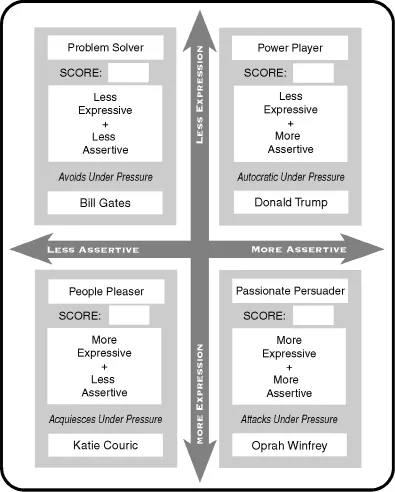
My total A score is .______A represents the Power Player.
My total B score is .______B represents the Passionate Persuader.
My total C score is .______C represents the People Pleaser.
My total D score is .______D represent the Problem Solver.
Research in the field of individual styles goes as far back as a Greek medical philosopher in the Roman Empire named Claudius Galen who developed a theory of personality based on the four humors. Since then, many famous researchers, consultants, and psychiatrists (chief among them Carl Jung) have studied and further developed the concept. One thing many agree on is that these styles measure two important aspects of a personâs behavior:
1. Assertiveness: This is expressed as confidence in the way you state your opinion, idea, position or claim, and the willingness to be strong and forceful as needed.
2. Emotional Expression: This is expressed as easily and strongly showing a great deal of feeling and emotion.
Each of the four core working styles has a different level of assertiveness and emotional expression.
The Four Core Working Styles
1. The Power Player (your A score): Power Players have a high degree of assertiveness but a lower degree of emotional expression
2. The Passionate Persuader (your B score): Passionate Persuaders have a high degree of both assertiveness and emotional expression
3. The People Pleaser (your C score): People Pleasers have a high degree of emotional expression but a lower degree of assertiveness
4. The Problem Solver (your D score): Problem Solvers have a low degree of both emotional expression and assertiveness.
Your primary working style describes the most common approach you take in dealing with people and situations at work. Although everyone tends to have a smattering of each style within them, usually one or two working styles act as your default position. The style in which you scored the most points is likely to be your primary working style.
If you have two scores that are the same or very close together, you can figure out your more dominant one by reading the specific descriptions for each style later in this book. If youâre still stumped then ask a coworker to fill out the questionnaireâthey can usually peg you on the spot.
Lastly, donât fall into the trap of thinking that one style is better than another. Everyone expresses him- or herself differently, and each style adds to the diversity of the workplace.

Chapter 2
Avoid Negative Filters
Stupid, jerk, lazy, liar, pushy, crazy, and crabbyânegative names you call customers in the privacy of your own mind, or occasionally out loud to a coworker.
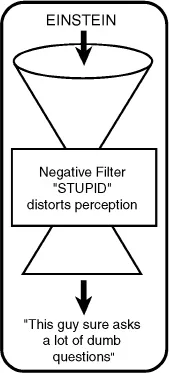
Negative filters get their start in life when you pin a not-so-nice label on a difficult customer. For example, you might decide that a customer, who keeps asking what seem to be obvious questions, is âstupid.â
Having a negative filter is like wearing rose-colored glasses. The difference is that negative filters donât paint a rosy picture, just the opposite; they foster a critical and unhelpful attitude that begins a downward spiral from which it can be hard to recover.
Once you have a negative filter in place, it distorts your perception. Your customer might be the next Einstein, but if youâve decided theyâre âstupid,â everything they do and say becomes evidence of how dumb they are.
Consider this conversation between a customer and an associate (with a âstupidâ negative filter) at a large, office supply warehouse:

Customer:âExcuse me, Iâm looking for a small drafting board.â
Associate:âTheyâre on aisle four.â A few moments later...
Customer:âI looked on aisle four and I canât see them.â
Associate:(huffing) âWell thatâs where they are. Theyâre bigâI donât see how you could miss them.â
Customer:âCould you show me?â
Associate:âWell, they are definitely there...okay (begrud...
Table of contents
- Title Page
- Copyright Page
- Dedication
- Acknowledgments
- Table of Contents
- Introduction
- Chapter 1. Assess Your Working Style
- Chapter 2. Avoid Negative Filters
- Chapter 3. Backtrack Key Words
- Chapter 4. Be Web Wise
- Chapter 5. Beware of Burnout
- Chapter 6. Bridge the Language Barrier
- Chapter 7. Build a Bridge
- Chapter 8. Choose Your Level of Conversation
- Chapter 9. Conquer Complaining Customers
- Chapter 10. Counter Coworker Conflict
- Chapter 11. Create Customer-Friendly Systems
- Chapter 12. Define Customer Needs
- Chapter 13. Deliver Constructive Criticism
- Chapter 14. Ditch Your Default Response
- Chapter 15. Evaluate Your Service Skills
- Chapter 16. Find and Fix E-mail Mistakes
- Chapter 17. Focus on Essence
- Chapter 18. Gather Feedback
- Chapter 19. Get to Know the People Pleaser
- Chapter 20. Go the Extra Mile
- Chapter 21. Handle Complaints With Care
- Chapter 22. Hire Some Help
- Chapter 23. Improve Your Listening Habits
- Chapter 24. Inspire a Learning Environment
- Chapter 25. Integrate Voicemail Excellence
- Chapter 26. Keep the Service Message Alive
- Chapter 27. Know Your Stress Response
- Chapter 28. Learn the Art of Complaining
- Chapter 29. Locate Your Stress Level
- Chapter 30. Make Your Service Tangible
- Chapter 31. Manage Abusive Customers
- Chapter 32. Master Body Language Basics
- Chapter 33. Navigate a Heated Conversation
- Chapter 34. Open to Feedback
- Chapter 35. Pace Your Way to Better Rapport
- Chapter 36. Pay Attention, Really
- Chapter 37. Play With the Passionate Persuader
- Chapter 38. Practice the Art of the Compliment
- Chapter 39. Provide Empathy
- Chapter 40. Raise Questions
- Chapter 41. Recover From Service Blunders
- Chapter 42. Redefine Your Service
- Chapter 43. Reframe Your Outlook
- Chapter 44. Respect the Power Player
- Chapter 45. Rev Up Your Recognition
- Chapter 46. Say â I, â Not â You â
- Chapter 47. Say No With Style
- Chapter 48. Set Expectations on the Spot
- Chapter 49. Strengthen Service Habits
- Chapter 50. Style Step
- Chapter 51. Switch Filters
- Chapter 52. Temper Your Telephone Tone
- Chapter 53. Think Through Outsourcing
- Chapter 54. Treat Your Colleagues as Customers
- Chapter 55. Tune Up Your Telephone Etiquette
- Chapter 56. Turn Service Into Sales
- Chapter 57. Understand the Problem Solver
- Chapter 58. Upgrade Your Influence
- Chapter 59. Walk Your Talk
- Chapter 60. Work Out a Working Styles Profile
- Conclusion
- About the Authors