Navigates the divergent cultural meanings of health, and its entanglement with morality in current political discourse
You see someone smoking a cigarette and say,"Smoking is bad for your health," when what you mean is, "You are a bad person because you smoke." You encounter someone whose body size you deem excessive, and say, "Obesity is bad for your health," when what you mean is, "You are lazy, unsightly, or weak of will." You see a woman bottle-feeding an infant and say,"Breastfeeding is better for that child's health," when what you mean is that the woman must be a bad parent. You see the smokers, the overeaters, the bottle-feeders, and affirm your own health in the process. In these and countless other instances, the perception of your own health depends in part on your value judgments about others, and appealing to health allows for a set of moral assumptions to fly stealthily under the radar.
Against Health argues that health is a concept, a norm, and a set of bodily practices whose ideological work is often rendered invisible by the assumption that it is a monolithic, universal good. And, that disparities in the incidence and prevalence of disease are closely linked to disparities in income and social support. To be clear, the book's stand against health is not a stand against the authenticity of people's attempts to ward off suffering. Against Health instead claims that individual strivings for health are, in some instances, rendered more difficult by the ways in which health is culturally configured and socially sustained.
The book intervenes into current political debates about health in two ways. First, Against Health compellingly unpacks the divergent cultural meanings of health and explores the ideologies involved in its construction. Second, the authors present strategies for moving forward. They ask, what new possibilities and alliances arise? What new forms of activism or coalition can we create? What are our prospects for well-being? In short, what have we got if we ain't got health? Against Health ultimately argues that the conversations doctors, patients, politicians, activists, consumers, and policymakers have about health are enriched by recognizing that, when talking about health, they are not all talking about the same thing. And, that articulating the disparate valences of "health" can lead to deeper, more productive, and indeed more healthy interactions about our bodies.
eBook - ePub
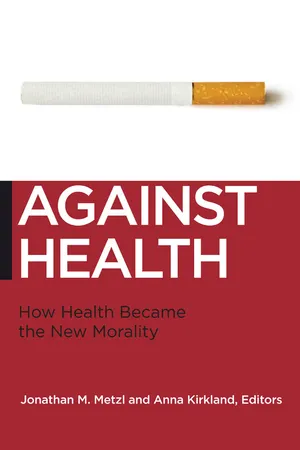
Against Health
How Health Became the New Morality
- 226 pages
- English
- ePUB (mobile friendly)
- Available on iOS & Android
eBook - ePub
Against Health
How Health Became the New Morality
About this book
Information
1
Introduction
Why Against Health?
How can anyone take a stand against health? What could be wrong with health? Shouldn’t we be for health?
On behalf of the authors, let me reply to these questions by proclaiming that we believe that anyone who feels ill before, during, or after reading this book should seek immediate medical attention. We believe in the germ theory of infectious illness. We believe in penicillin. We believe that physicians should wash their hands between patient visits. We are optimistic about the promise of stem cell research. We believe that the transition from the rigid sigmoidoscope to the lower abdominal MRI represents indisputable progress. We are for bike helmets, sunscreen, and enteric-coated tablets, and we are against the swine flu. Perhaps most of all, we believe that disparities in incidence and prevalence of disease are closely linked to disparities in income and social support. We believe that documents such as the Department of Health and Human Services’ “Healthy People 2010” prove beyond doubt that access to health care and availability of adequate health insurance remain unattainable goals for many Americans. We believe that such disparities need to be rectified, and we stand firmly behind recent expansions in healthcare coverage.
At the same time, we believe that defining the mission of this book solely as a call for redistribution of healthcare resources is to miss part of the point. That is because arguments supporting the reallocation of resources understandably assume that health is a fixed entity that can be transported from one setting to another. The rich have health, for instance, and the poor do not. While valid, such claims overlook the ways in which health itself is part of the problem that we mean to address.
As recent political debates in the United States have demonstrated, “health” is a term replete with value judgments, hierarchies, and blind assumptions that speak as much about power and privilege as they do about well-being. Health is a desired state, but it is also a prescribed state and an ideological position. We realize this dichotomy every time we see someone smoking a cigarette and reflexively say, “smoking is bad for your health,” when what we really mean is, “you are a bad person because you smoke.” Or when we encounter someone whose body size we deem excessive and reflexively say, “obesity is bad for your health,” when what we mean is not that this person might have some medical problem, but that they are lazy or weak of will. Or when we attend town-hall meetings or Tea Party mosh pits and reflexively shout down other people for not understanding health care, when what we mean is that these people must be principally or politically misguided. Or even when we see a woman bottle-feeding an infant and reflexively say, “breastfeeding is better for that child’s health,” when what we mean is that the woman must be a bad parent. In these and other instances, appealing to health allows for a set of moral assumptions that are allowed to fly stealthily under the radar. And the definition of our own health depends in part on our value judgments about others. We see them—the smokers, the overeaters, the activists, and the bottle-feeders—and realize our own health in the process.
I have developed a strategy to help answer the question, why against health? When I am posed this question by friends, relatives, or even patients, I reply by asking my interlocutors to, for one day, pay attention to the uses of health in their daily lives. Where does the term appear? I ask. To what means and to what ends? This brief exercise is meant to complicate assumptions about health as a transparent, universal good. Instead, even the most cursory examination of health in daily conversation, email solicitation, or media representation demonstrates how the term is used to make moral judgments, convey prejudice, sell products, or even to exclude whole groups of persons from health care.
For instance, if after reading this book you walk to the nearest newsstand in search of health-themed magazines, you will undoubtedly find such popular periodicals as Health, Healthy Living, or Men’s and Women’s Health. It will not take much browsing time to realize that these publications share the common assumption that health is intimately connected to, and ultimately defined by, a person’s appearance. These and other magazines commonly promote the message that healthy appearances embody a set of norms that are at once wholly mainstream and impossible to attain.
A recent issue of Health asks readers to consider whether, in the name of “beauty,” they would consider having plastic surgery on their toes, or whether they would consider getting facials on their “fannies” to reduce cellulite. The magazine opines on such topics as “the best jeans for your body,” “secrets to a good hair day,” and “in search of the perfect bra,” while inviting readers to share their weight-loss stories by divulging secret tips and by submitting before and after photographs that illustrate how their health has changed since their weight loss. Men’s Health meanwhile subdivides health into the categories of Sex, Fitness, and Nutrition and instructs readers on ways to obtain buns of steel or build “razor sharp abs” in an effort to “get noticed,” and then get laid, by the girl next door.1
Calling such language sexism or cultural narcissism would mobilize a particular critique. But calling it health allows these and other magazines to seamlessly construct certain bodies as desirable while relegating others as obscene. The result explicitly justifies particular corporeal types and practices, while implicitly suggesting that those who do not play along suffer from ill health. The fat, the flaccid, and the forlorn are unhealthy, the logic goes, not because of illness or disease, but because they refuse to wear, fetishize, or aspire to the glossy trappings of the health of others.
You might also log on to your computer only to be accosted by spam emails or pop-up Websites advertising a wide variety of tumescents that promise “sexual health.” You might learn that information about erectile dysfunction (ED) “can be an important first step toward better sexual health,” and that the second step involves ingestion of prescription Cialis™: “With CIALIS you can have the option of being ready fast… or have up to 36 hours to relax and take your time.”2 Or you might be directed to the Website of the “non-prescription all natural supplement” Ezerex, which promises a “rock-hard erection” in just twenty-five minutes: “EZEREX is made to act FAST like a prescription, but without all the unhealthy side effects!” The site further explains that the supplement “should be taken as part of a healthy lifestyle” and offers testimonials from men such as “David W.,” who exclaims, “I don’t have an ED problem but I do have a girlfriend who is 20 years younger than I am and she has an endless appetite for sex. I needed an edge and some extra help to keep up. EZEREX is her new best friend! Thank you.”3
Calling such claims phallocentrism might mobilize a particular critique. But calling them health allows the Websites to construct social physiologies in which health is marked by the ability to stand at osseous attention for seemingly unhealthy periods of time, while unsubtly suggesting that the inability to do so indicates some sort of disease.
A different notion of health appears when you turn on your television and see public health advertisements that implore you to stop smoking by appealing to the health of your children. One recent Michigan campaign shows children left alone in homes or in cars, where they are helplessly left to breathe the second-hand smoke of their parents. The children speak dejectedly into the camera about the impact of their passively attained nicotine habits. “I smoke while I’m watching cartoons,” says one girl in front of a television. “We smoke on the way to school,” add two sisters trapped in a car. “When you smoke around your kids,” the narrator explains, “it’s like they’re smoking.”4
Calling such appeals moralism might mobilize a particular critique, and to be sure, the ads importantly confront the pernicious effects of secondhand smoke. But calling them health allows these campaigns to make a much wider set of assumptions about people who smoke as being irresponsible or negligent parents, parents who leave their children alone in cars or slowly kill them via their own solipsistic addictions. Pleural health is closely aligned with decency in this formulation, while the disease of smoking decays the body as well as the soul.
Finally, you might be sitting in an airport where, in lieu of an explanation for your flight delay, you are handed a complimentary copy of the Wall Street Journal, which contains the front-page headline, “Lighten Up: Pepsi Sales Force Tries to Push ‘Healthier’ Snacks in Inner City.” According to the article, sales representatives for PepsiCo, Incorporated began a multimillion-dollar campaign to promote Baked Cheetos, Doritos, and Ruffles in the “inner city.” “32% of adult Americans are obese,” the article reads, and in response, PepsiCo hopes to encourage “inner-city African Americans and Latinos” to forgo the 25-cent packs of Flamin’ Hot Cheetos and Nacho Cheese Doritos known fondly as “quarters,” and to instead select lower-fat (and higher cost) offerings produced by the same company.5
Calling this approach racism or capitalism or any number of other -isms would mobilize a particular critique. But calling it health allows for a language of betterment that skillfully glosses over the structural violence done to minority and lower-income Americans, while at the same time suggesting that social and economic misfortune results from poor food choices. Calling it health also enables troubling slippages between the health of individual bodies and the health of economic ones, inasmuch as consumption of the very foods that (dubiously) help minority populations slim down also produce portly profits for PepsiCo Incorporated.6
The aim of this book might be divided into two parts, the first of which is exponentially easier than the second. First, we mean to unpack health and to explore the ideologies, structures, base pairs, and blind assumptions involved in its construction. Numerous theoretical tools hang at the ready in this regard. For instance, health might be critiqued through the work of the famed sociologist Erving Goffman as a type of stigmatizing rhetoric, defined in moments of “mixed encounter” in which marks of difference based on size, color, or ability create groups of normals and, by exclusion, groups of others. From a Goffmanian perspective, affirmation of one’s own health depends on the constant recognition, and indeed the creation, of the spoiled health of others.7
The work of the philosopher Ivan Illich similarly assists in critiquing health as a potentially colonizing rhetoric. Illich is arguably best known for his 1975 book Medical Nemesis, which argued that the medical establishment posed a “threat to health” through the production of clinical, social, and cultural “iatrogenesis.”8 In the 1980s, Illich expanded his critique to include the very definition of health itself. In a series of lectures titled “To Hell With Health,” Illich bemoaned the negative effects of excessive preoccupation with health and the countless American industries that gained financially from promoting such preoccupation. “To hell with health,” he is reported to have said. “It is the most cherished and destructive certitude of the modern world. It is a most destructive addiction.” Illich did not mean that people need not seek relief from ailments and illnesses. Rather, he argued that American society promoted a definition of health based on an unattainable ideal, one that made no room for suffering, aging, dying, or other natural processes.9
So too, the scholarship of Talcott Parsons, Irving Zola, and a number of other medical sociologists casts health as a normativizing rhetoric. Zola, for instance, championed the phrase “temporarily abled bodies” as a way to challenge dominant notions of health, and critiqued the “socio-political consequences of medical influence” in determining matters of corporeality, ability, and, ultimately, normalcy.10 And, of course, French sociologist Michel Foucault canonically promoted understanding health as a discourse of power, a discourse that is productive rather than repressive. From a Foucaultian perspective, American society’s incessant talk about health produces and regulates itself and its subjects, while making it increasingly difficult to get outside of health. Such biopower subjugates utterances that we do not agree with and utterances that we do, both of which serve to remove us ever more from the possibility of real resistance.11
More recently, Adele Clarke, Peter Conrad, and a number of other academics and social critics demarcate health as a paradoxically medicalizing rhetoric that propagates various forms of medical profit or influence in an often inverse relation to human betterment. Early medicalization literature claimed that categories of health atherosclerotically narrowed when categories of disease expanded like an angioplastician’s balloon. Clarke and colleagues track a more complex process of “biomedicalization” whereby biomedicine and technoscience conspire to define health as a moral obligation, a commodity, and a mark of status and self-worth. “In the biomedicalization era,” they write, “the focus is no longer on illness, disability, and disease as matters of fate, but on health as a matter of ongoing moral self-transformation.” Relatedly, public health scholar Deborah Lupton details ways in which public health policies “regulate” bodies by promoting definitions of health that represent “moral imperatives.”12
Finally, growing numbers of practitioners from within medicine and public health, as well as members of patient activist groups, critique health as a problematically consumerist rhetoric that reflects social and economic norms under the guise of scientific information. In his erudite essay written in defense of smoking, musician and social activist Joe Jackson maligns anti-smoking “hysteria” through claims similar to ones that appear in this book. “We have become not only excessively reverent towards doctors and scientists, but increasingly willing to allow them to dictate our lifestyles and laws,” Jackson writes. “Health is seen as an unqualified good. Who can be against ‘health’?”13 Meanwhile, physician H. Gilbert Welch argues that true health-care reform will only take place when America moves away from definitions of health that profit the “medical-industrial complex” of health professionals, pharmaceutical companies, biotechnology firms, manufacturers of diagnostic technologies, surgical centers, hospitals, and academic medical centers. “In the past, people sought health care because they were sick,” Welch writes. “Now the medical-industrial complex seeks patients.” In this system, “if health is the absence of abnormality, the only way to know you are healthy is to become a customer.”14
Engagement with these and other critiques of health forces a set of questions central to the intentions of thi...
Table of contents
- Cover Page
- Title Page
- Copyright Page
- Dedication
- Contents
- Acknowledgments
- 1 Introduction: Why “Against Health”?
- PART I: What Is Health, Anyway?
- PART II: Seeing Health through Morality
- PART III: Making Health and Disease
- PART IV: Pleasure and Pain after Health
- About the Contributors
- Index
Trusted by 375,005 students
Access to over 1.5 million titles for a fair monthly price.
Study more efficiently using our study tools.
Frequently asked questions
Yes, you can cancel anytime from the Subscription tab in your account settings on the Perlego website. Your subscription will stay active until the end of your current billing period. Learn how to cancel your subscription
No, books cannot be downloaded as external files, such as PDFs, for use outside of Perlego. However, you can download books within the Perlego app for offline reading on mobile or tablet. Learn how to download books offline
Perlego offers two plans: Essential and Complete
- Essential is ideal for learners and professionals who enjoy exploring a wide range of subjects. Access the Essential Library with 800,000+ trusted titles and best-sellers across business, personal growth, and the humanities. Includes unlimited reading time and Standard Read Aloud voice.
- Complete: Perfect for advanced learners and researchers needing full, unrestricted access. Unlock 1.5M+ books across hundreds of subjects, including academic and specialized titles. The Complete Plan also includes advanced features like Premium Read Aloud and Research Assistant.
We are an online textbook subscription service, where you can get access to an entire online library for less than the price of a single book per month. With over 1.5 million books across 990+ topics, we’ve got you covered! Learn about our mission
Look out for the read-aloud symbol on your next book to see if you can listen to it. The read-aloud tool reads text aloud for you, highlighting the text as it is being read. You can pause it, speed it up and slow it down. Learn more about Read Aloud
Yes! You can use the Perlego app on both iOS and Android devices to read anytime, anywhere — even offline. Perfect for commutes or when you’re on the go.
Please note we cannot support devices running on iOS 13 and Android 7 or earlier. Learn more about using the app
Please note we cannot support devices running on iOS 13 and Android 7 or earlier. Learn more about using the app
Yes, you can access Against Health by Jonathan M. Metzl,Anna Kirkland, Jonathan M. Metzl, Anna Kirkland in PDF and/or ePUB format, as well as other popular books in Social Sciences & Medical Theory, Practice & Reference. We have over 1.5 million books available in our catalogue for you to explore.