Shares the voices of students speaking out against the failures of urban education
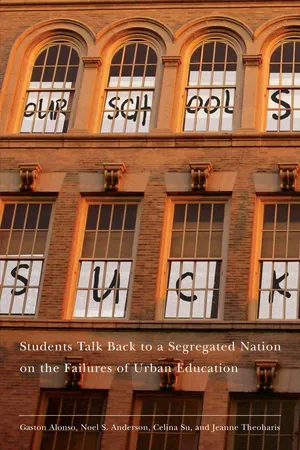
"Our schools suck." This is how many young people of color call attention to the kind of public education they are receiving. In cities across the nation, many students are trapped in under-funded, mismanaged and unsafe schools. Yet, a number of scholars and of public figures have shifted attention away from the persistence of school segregation to lambaste the values of young people themselves. Our Schools Suck forcefully challenges this assertion by giving voice to the compelling stories of African American and Latino students who attend under-resourced inner-city schools, where guidance counselors and AP classes are limited and security guards and metal detectors are plentiful—and grow disheartened by a public conversation that continually casts them as the problem with urban schools.
By showing that young people are deeply committed to education but often critical of the kind of education they are receiving, this book highlights the dishonesty of public claims that they do not value education. Ultimately, these powerful student voices remind us of the ways we have shirked our public responsibility to create excellent schools. True school reform requires no less than a new civil rights movement, where adults join with young people to ensure an equal education for each and every student.
eBook - ePub
Our Schools Suck
Students Talk Back to a Segregated Nation on the Failures of Urban Education
- 304 pages
- English
- ePUB (mobile friendly)
- Available on iOS & Android
eBook - ePub
Our Schools Suck
Students Talk Back to a Segregated Nation on the Failures of Urban Education
About this book
Information
Topic
DidatticaSubtopic
Vita studentesca1 Culture Trap
Talking about Young People of Color and Their Education
Ideas never contain in themselves all the reasons for their influence and their historical role. Thought alone can never produce those reasons, for this influence derives not simply from what they are, but from what they do, or better still, from what they get done in society.
—Maurice Godelier, The Mental and the Material (1986)
During the spring of 2006, Harvard sociologist Orlando Patterson took to the pages of the New York Times to decry the conditions of low academic achievement, persistent poverty, and violence plaguing Black communities. “The tragedy unfolding in our inner cities is a time-slice of a deep historical process that runs far back through the cataracts and deluge of our racist past,” he wrote. “Most black Americans have by now miraculously escaped its consequences. The disconnected fifth languishing in the ghettos is the remains.” Patterson focused his comments on those young men still “languishing in the ghettos” who fail to graduate from high school or to go to college because, according to him, they are immersed in the culture of the “cool pose.” For them, he noted, this culture “was simply too gratifying to give up. . . . It was almost like a drug, hanging out on the street after school, shopping and dressing sharply, sexual conquests, party drugs, hip-hop music and culture, the fact that almost all the superstar athletes and a great many of the nation’s best entertainers were black.” Patterson argued that while young whites “know when it is time to turn off Fifty Cent and get out the SAT book,” Blacks do not know. “Sadly, their complete engagement in this part of the American cultural mainstream, which they created and which feeds their pride and self-respect,” he concluded, “is a major factor in their disconnection from the socioeconomic mainstream.”1
Patterson’s writing was occasioned by the Urban Institute’s publication of a series of reports documenting the high percentage of Black and Latino young men who are “disconnected” from mainstream society. According to the reports, only half of Black men sixteen to twenty-four years old not attending school participate in the labor force, and close to 30 percent of this group are either on parole or probation or in jail or prison at any one time. Further, 10 percent of Black and 9 percent of Latino young men are “disconnected” from both school and work for over a year, with the rates of the incarcerated cohorts rising to 17 and 12 percent respectively. Moreover, despite the economic boom of the 1990s, Black young men without a high school diploma experienced a marked decline in labor force participation during the decade. The reports proposed various government-driven solutions to address the structural forces behind these indexes of “disconnection.” These forces included the flight of manufacturing jobs from urban areas and the underfunding of government-sponsored employment training programs. As such, the reports shone a light on the structural forces that relegate many young men of color to the margins of our society and on the ways government intervention could lessen their marginalization.2
According to Patterson, however, these reports simply highlighted “the failure of social scientists to adequately explain the problem, and their inability to come up with any effective strategy to deal with it.” The failure, Patterson argued, was rooted in “a deep-seated dogma that has prevailed in social science and policy circles since the mid-1960’s: the rejection of any explanation that invokes a group’s cultural attributes—its distinctive attitudes, values and predispositions, and the resulting behavior of its members—and the relentless preference for relying on structural factors like low incomes, joblessness, poor schools and bad housing.” In addition to denouncing the way social scientists had become “allergic to cultural explanations,” he also criticized the “recent rash of scholars with tape-recorders” busy collecting the “views and rationalizations” of Black young men. Whether running statistical regressions or conducting ethnographic fieldwork, Patterson argued, scholars need to recognize, once and for all, “what has long been obvious to anyone who takes culture seriously: socioeconomic factors are of limited explanatory power.” Only then will they understand that the indexes of “disconnection” documented by the Urban Institute are primarily rooted in African Americans’ cultural values and norms rather than in structural forces and that effective strategies to address such “disconnection” require the reform of those cultural values and norms rather than greater government intervention and spending.3
Patterson’s editorial was followed by the publication, by National Public Radio correspondent and Fox News commentator Juan Williams, of Enough, a book that embraced his call for more culture talk in the analysis of social phenomena. The book was “sparked” by the extended and heated controversy that surrounded a speech the comedian Bill Cosby delivered at a May 2004 NAACP commemoration of the fiftieth anniversary of the Supreme Court’s decision in Brown v. Board of Education.4 Interestingly, given the occasion and the NAACP’s own history, Cosby did not denounce the continued hypersegregation of the nation’s schools, which violates the integrationist spirit of Brown. Instead, as discussed in this book’s introduction, Cosby denounced those whom he referred to as “lower economic and lower middle economic people.” These people, Cosby told the audience, had willfully failed to take advantage of the educational and economic opportunities brought about by Brown and the civil rights movement. Instead, they had created a cultural milieu in which it was acceptable to have a “50 percent [school] drop out rate,” “people getting shot in the back of the head over a piece of pound cake,” boys “wear[ing] their hats on backwards, pants down around the crack,” and “knuckleheads” who “[didn’t] know it’s important to speak English” and who instead were “fighting hard to be ignorant.”5
In Enough Williams defends what he calls Cosby’s “love song to black America” by invoking the “cultural attributes” of his fellow African Americans. According to him, African Americans drop out of school and remain trapped in poverty because of their abandonment of the ideals of the civil rights movement and their embrace of a “culture of failure” that “celebrates [the] self-defeating behavior that keeps poor black people shackled in the twenty-first century.” As such, Williams’s book repeats Cosby’s evasion of the structural conditions that continue to segregate African American students into unfit and resource-starved schools.6
Williams’s reiteration of Cosby’s thesis was followed by the publication of another editorial in the pages of the New York Times. This time, the writer was the Times’s Bob Herbert, and the man whose views were being defended was Juan Williams. While usually voicing more progressive political views than Williams, Herbert noted that Williams’s Enough represented “a cry for a new generation of African-American leadership at all levels to fill the vacuum left by those who, for whatever reasons, abandoned the tradition of struggle, hard-won pride and self-determination.” In a manner reminiscent of the arguments mounted by Patterson, Cosby, and Williams, Herbert argued that “a depressing cultural illness” was sapping away African Americans’ willingness and ability to achieve educational success and move up the economic ladder. “The people who are laid low by this illness,” Herbert explained, “don’t snitch on criminals, seldom marry, frequently abandon their children, refer to themselves in the vilest terms (niggers, whores, etc.), spend extraordinary amounts of time kicking back in correctional institutions, and generally wallow in the deepest depths of degradation their irresponsible selves can find.”7
The year ended with the publication of another book warning about the cultural dysfunction of people of color. This time, though, the focus of the book was not African American but Latino youth. One Nation, One Standard: An Ex-liberal on How Hispanics Can Succeed Just Like Other Immigrant Groups was written by Herman Badillo, repeatedly identified in the book as “the United States’ first Puerto Rican-born Congressman.” Badillo, who also served as Bronx borough president, deputy mayor of New York City, and chairman of the Board of the City University of New York, is currently a fellow at the Manhattan Institute, a conservative think tank. In the book, he argues that “the primary determinant of any immigrant group’s success or failure in America is its attitude towards education.” The problem, according to Badillo, is that “Hispanics, as a culture, do place less stress on the importance of education than do other, more economically and socially successful immigrant groups.” Thus he contends that while Jewish and Asian immigrants have attained economic success because they place a “huge value on the importance of education,” Latinos have not attained similar success because they “have simply failed to recognize the overriding importance of education.”8
Latinos will succeed, Badillo cautions, only if they embrace “a total attitude adjustment regarding the importance of education.” By altering their cultural values, Latinos will attain academic and economic success just “like other immigrant groups.” Asian immigrants, after all, “have not been deterred by discrimination, language difficulties, ghettoization, or any other factor that supporters of the culture of dependency claim as excuses for a lack of progress among Hispanics.”9 This last passage may suggest that Badillo is more willing than the other voices surveyed above to acknowledge the structural barriers that remain in place in post–civil rights America. However, his suggestion that an “attitude adjustment” can overcome such barriers betrays the same culturalist perspective guiding those voices.
As 2006 came to an end, a chorus of voices lamented the presumed cultural values and norms of African Americans and Latinos. This chorus buried the structuralist explanations of the “disconnection” of young people of color—including their “disconnection” from the education system—and the policy solutions advanced by the Urban Institute earlier in the year. Like Patterson’s editorial, these voices recommended greater discipline, hard work, and personal responsibility from African American and Latino parents and children. This culture talk told the public that since in our post–civil rights era any individual who values “strong families, education, and hard work” can succeed,10 “socioeconomic factors are of limited explanatory power.”11 In this context, the “disconnection” that characterizes the lives of poor and working-class African Americans and Latinos is the result of a “depressing cultural illness.”12 This talk captures the prevailing common sense in American popular culture and social science regarding African American “culture” as deficient, dysfunctional, in need of explanation, and, at the same time, itself the explanation for all kinds of social ills. It also captures the increasing “ideological blackening”13 of Latinos, the nation’s fastest-growing nonwhite group, as part of the culturally pathological and racially coded “underclass” position usually associated in popular discourse with African Americans.
In the following chapters, African American and Latino students from public schools in Los Angeles and New York City testify against the way they are represented by this public discourse as well as against the conditions they encounter in their schools and communities. This chapter, however, focuses not on these students’ stories but rather on the stories that others tell about them. While many of the scholars, journalists, and public intellectuals surveyed here claim to care deeply about the schooling of today’s young people of color, in their talk one finds very little righteous denunciation of the conditions under which these young people receive an education. Rather, in their talk one finds well-crafted representations of these young people as immersed in a culture that undervalues and is often openly hostile to the educational process. Those representations, in turn, shape the way we as a society perceive and treat these young people. “Those texts that carry the weight of cultural authority as ‘reliable knowledge’ or ‘objective information’ (e.g. expert opinions or news reports),” communications scholar Mary Strine notes, “exert powerful influences on how common perceptions are formed and common sense is made.”14
The common sense made by the experts discussed in this chapter has given currency to one-dimensional and devastating perceptions of young people of color as anti-intellectual. In doing so, this common sense draws the public’s gaze away from the racially segregated, physically decaying, and crowded places where, as explained in the Introduction, instruction continues to occur. Instead, it draws the gaze toward students of color. It is the students, the expert voices emphasize, that are dysfunctional and in need of fixing rather than the school system or the social structures in which students find themselves.
In this chapter I place the culture talk that has burrowed itself into the pages of the New York Times and into the shelves of bookstores across the country in the context of the contemporary scholarship regarding the “racial achievement gap.” I begin by surveying three of the prevailing schools of thought on the causes of this “gap,” or the lower levels of academic achievement and higher dropout rates of African American and Latino youth relative to other groups. The first school of thought surveyed focuses on the social effects of the culture of the “cool pose” referenced by Patterson. According to this scholarship, the “cool pose” undermines the educational drive of those who embrace it. The second school of thought surveyed focuses directly on understanding the educational experiences of young people of color. African Americans, the scholarship tells us, have developed “oppositional identities” that lead them to view academic success as a form of “acting white.” Afraid of being ostracized by their peers for “acting white,” African American children choose not to succeed academically. The third school of thought surveyed is concerned that some children of immigrants are embracing these “oppositional identities” and fears of “acting white” and, by extension, also failing in school.15
I proceed to examine how the representation of African American and Latino youth popularized by this scholarly talk influences popular discussions regarding their education. These discussions have produced a political climate in which public policies increasingly focus on fixing the cultural values and norms that students are assumed to hold rather than on taking seriously young people’s own perspectives and the decrepit conditions under which they continue to be made to learn. By tracing the scholarly and popular roots of the “culture of failure” narrative and of the contemporary political climate, the chapter provides a context for understanding the popular representations, structural conditions, and public policies engaged by the students whose voices are presented in the ethnographic case studies that follow.
To understand the popularity of the “culture of failure” narrative, it is important to examine its academic roots as well as the relatively paltry evidence on which it is based. In doing so, in the next three sections I take issue with Patterson’s claim that contemporary scholars are “allergic to cultural explanations.” In fact, like the voices from 2006 discussed above, much of the scholarly talk regarding young people of color and their education remains either explicitly or implicitly trapped in long-standing assumptions and stereotypes about the cultures of communities ...
Table of contents
- Cover Page
- Title Page
- Copyright Page
- Contents
- Acknowledgments
- Introduction
- 1 Culture Trap
- 2 “I Hate It When People Treat Me Like a Fxxx-up”
- 3 “They Ain’t Hiring Kids from My Neighborhood”
- 4 “Where Youth Have an Actual Voice”
- Conclusion
- Methodological Appendix
- Notes
- Index
- About the Authors
- Backmatter
Trusted by 375,005 students
Access to over 1.5 million titles for a fair monthly price.
Study more efficiently using our study tools.
Frequently asked questions
Yes, you can cancel anytime from the Subscription tab in your account settings on the Perlego website. Your subscription will stay active until the end of your current billing period. Learn how to cancel your subscription
No, books cannot be downloaded as external files, such as PDFs, for use outside of Perlego. However, you can download books within the Perlego app for offline reading on mobile or tablet. Learn how to download books offline
Perlego offers two plans: Essential and Complete
- Essential is ideal for learners and professionals who enjoy exploring a wide range of subjects. Access the Essential Library with 800,000+ trusted titles and best-sellers across business, personal growth, and the humanities. Includes unlimited reading time and Standard Read Aloud voice.
- Complete: Perfect for advanced learners and researchers needing full, unrestricted access. Unlock 1.5M+ books across hundreds of subjects, including academic and specialized titles. The Complete Plan also includes advanced features like Premium Read Aloud and Research Assistant.
We are an online textbook subscription service, where you can get access to an entire online library for less than the price of a single book per month. With over 1.5 million books across 990+ topics, we’ve got you covered! Learn about our mission
Look out for the read-aloud symbol on your next book to see if you can listen to it. The read-aloud tool reads text aloud for you, highlighting the text as it is being read. You can pause it, speed it up and slow it down. Learn more about Read Aloud
Yes! You can use the Perlego app on both iOS and Android devices to read anytime, anywhere — even offline. Perfect for commutes or when you’re on the go.
Please note we cannot support devices running on iOS 13 and Android 7 or earlier. Learn more about using the app
Please note we cannot support devices running on iOS 13 and Android 7 or earlier. Learn more about using the app
Yes, you can access Our Schools Suck by Jeanne Theoharis,Gaston Alonso,Noel S. Anderson,Celina Su in PDF and/or ePUB format, as well as other popular books in Didattica & Vita studentesca. We have over 1.5 million books available in our catalogue for you to explore.