The end of slavery in the United States inspired conflicting visions of the future for all Americans in the nineteenth century, black and white, slave and free. The black child became a figure upon which people projected their hopes and fears about slavery’s abolition. As a member of the first generation of African Americans raised in freedom, the black child—freedom’s child—offered up the possibility that blacks might soon enjoy the same privileges as whites: landownership, equality, autonomy. Yet for most white southerners, this vision was unwelcome, even frightening. Many northerners, too, expressed doubts about the consequences of abolition for the nation and its identity as a white republic.
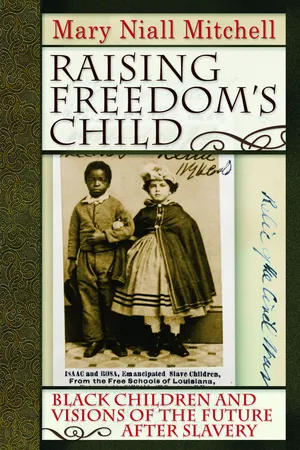
From the 1850s and the Civil War to emancipation and the official end of Reconstruction in 1877, Raising Freedom’s Child examines slave emancipation and opposition to it as a far-reaching, national event with profound social, political, and cultural consequences. Mary Niall Mitchell analyzes multiple views of the black child—in letters, photographs, newspapers, novels, and court cases—to demonstrate how Americans contested and defended slavery and its abolition.
With each chapter, Mitchell narrates an episode in the lives of freedom’s children, from debates over their education and labor to the future of racial classification and American citizenship.Raising Freedom’s Child illustrates how intensely the image of the black child captured the imaginations of many Americans during the upheavals of the Civil War era. Through public struggles over the black child, Mitchell argues, Americans by turns challenged and reinforced the racial inequality fostered under slavery in the United States. Only with the triumph of segregation in public schools in 1877 did the black child lose her central role in the national debate over civil rights, a role she would not play again until the 1950s.
eBook - ePub
Raising Freedom's Child
Black Children and Visions of the Future after Slavery
- 324 pages
- English
- ePUB (mobile friendly)
- Available on iOS & Android
eBook - ePub
About this book
Information
Topic
Storia1
Emigration
A Good and Delicious Country
It was in the summer of 1857 that William Green began thinking about Veracruz, Mexico. The prospect of travel from New Orleans to the Caribbean, if one had business there, was commonplace in the nineteenth century. But Green had very particular reasons for thinking about the Mexican coast that summer and wrote a letter about Mexico to his friend Léon Dupart in Mobile, Alabama. Having been informed by a mutual acquaintance that Dupart was leaving “on the next vessel bound to that coast,” Green wrote, “I thought it my duty to give you several advices on the industry that you ought to follow in that country.” Mr. Green urged Dupart to enlist in agricultural pursuits but bid him to be cautious about where to plant his crops. “On first arriving there,” he wrote, “you ought to buy a farm, and commence to cultivate the land, and have, if possible, the send of all the vegetables in the market, and some fruit also. Don’t buy the place too close to the river for if a flood should come it would destroy your crops of corn and cotton.” Green confessed he would like to go along, “but my business will prevent me from doing so now, time being so dull and I hardly make my month’s rent. I must stay, as I can’t get no person to represent me here.” Still, he saw an important role for himself in Dupart’s venture: “If you can not get the materials of farming, send out here, and I will send you them and seeds for the garden also, if you can’t get any I will send you some. Do not fail to answer this,” he urged, “for I will be ready at your request.”1
Though he aimed to suggest otherwise, William Green had little experience with settlement abroad. Thirteen at the time he wrote his letter about Mexico, William was a free boy of color attending school at the Catholic Institution in New Orleans, and his letter was an assignment written for his English composition class.2 The gentleman in “Mobile,” Léon Dupart, was one of his classmates in New Orleans. The destination of his letter, and of his friend, were imagined ones, just as all destinations are, in some way, imagined. The letter was not posted to Mobile, and Léon, it seems, did not go to Mexico. William’s scheme was crafted, nonetheless, from the actual goings-on around him.
Throughout the United States in the 1850s, free people of color were debating the prospect of migration to other countries to protest their treatment in the United States and fulfill their destiny as a people. Amid heated sectional debate over slavery, state and federal laws increasingly limited the small freedoms of free people of color in the United States. As their status became closer to that of slaves than of free men, their dreams of full equality in their native country began to dim. Some free men of color advocated going to Africa, others to Latin America and the Caribbean. From New Orleans, as William wrote his letter, a real migration was under way to Mexico. Hoping to find a better life outside of the United States, many free people of color from Louisiana made plans to settle in the state of Veracruz, near the Caribbean coast.
William’s own plans for settlement were no less important for being somewhat imaginary. The assigned task of writing about migration to Mexico carried within it pointed lessons about geography, racial identity, and the market. At a time when the small liberties of free people of color were swiftly evaporating, William’s teacher had asked him to design his own freedom. The assignment reflected, in part, the radical politics of the Catholic Institution’s leaders, who were French-speaking, intellectual free men of color inspired by the ideals of both the French and the Haitian revolution. With their letters, William Green and his schoolmates revealed the aspirations of the Afro-Creoles of New Orleans—transatlantic dreams of freedom drawn from political desire, racial identity, and economic ambition, as well as their sense of belonging to a broad Atlantic and Caribbean community of which the American South was only a part. In the free colored child’s map of the Atlantic World—a network of places and place-names linked by ties of trade, family, and race—we see, perhaps, most clearly the kind of future free people of color in the South envisioned on the eve of the Civil War.
Two places, in particular, played a part in the writings of William and his classmates: the state of Veracruz in the Republic of Mexico, and the black republic of Haiti. Each was, for a time, a space of opportunity upon which many free people of color projected their hopes for freedom from the slaveholding republic of their birth. Though we lack any comprehensive figures on migration to either Mexico or Haiti, one estimate suggests that between 1820 and 1862 some ten thousand free people of color left the United States bound for Haiti.3 Whereas the Haitian migration drew people from the North and the South, emigration to Mexico seems to have been limited largely to free blacks along the Gulf Coast. Yet as the children’s letters reveal, antebellum migrations were ideologically and politically significant both for the few who emigrated and for the many who did not.
Although most free people of color did not emigrate to Africa or the Caribbean, and most of their leaders did not advocate migration, free blacks in the 1850s and 1860s shared a common goal in their striving for political equality and freedom. The letters of the students at the Catholic Institution, such as William’s letter to Léon Dupart, narrated that search in both practical and ideological terms. In their concern for economic opportunity and survival, the students documented the political realities of the nineteenth-century Atlantic World. But in their hopefulness and enthusiasm, they reflected the aspirations of free people of color determined to find a place where they could be prosperous, equal citizens. The space that existed between nations was perhaps the most important part of their imagined journeys: that distance offered the chance to cross the sea in any direction, to chart their own course, to find (in the words of one of the writers) “a good and delicious country.”4 It was in the search for such a country that freedom’s child was born.
Despite the “failure” of the colonies established in Mexico and Haiti, both countries became well-worn places on the students’ imagined map of the Atlantic World. Reading their letters, we find that the Civil War did not mark the first time that these young free people of color anticipated racial equality and freedom. For in the late 1850s and early 1860s, on the pages of their letterbooks, these children had already begun to search for a country where they might be free from constraints—economic and political—placed upon them because of their race. Freedom was a notion the students learned to define for themselves, and its contours shifted over time as events unfolded at home and abroad. In the course of their political awakening, they learned that freedom was not a simple or a fixed notion but, rather, an idea shaped by circumstance. The students’ thinking about freedom developed both from consideration of emigration’s possibilities and from their experience as free people of color in the late antebellum South. In their letters about emigration, repression, and war the notion of freedom appears reduced to its purest, if never complete, form: an ideal to be reached through optimism and struggle.
Living in the port city of New Orleans, as William did, brought with it the anticipation of goods arriving from the North and around the Caribbean. But the ships that docked each day, on their way to the next port, also presented the possibility of departure, particularly for boys. All the surviving letters from the students at the Catholic Institution were the work of boys between the ages of twelve and seventeen, on the edge of seeking their fortune.5 Although this leaves us to wonder about the girls who attended the school, the boys were no doubt the focus of their teacher’s encouragement in terms of thinking about migration. Consider Léon Dupart’s very adult letter about Mexico to William Green in “Vicksburg, Miss.” “I have heard that you are about setting off for Mexico in three weeks,” he wrote. “If you want any clothes or some money, I will send them to you before your departure. I will send my boy with you, for him to learn a trade whatever that can give him some money.”6 Migration to Mexico might help a boy like himself earn his way in the world. He could become one of the future planters, artisans, and merchants required of any successful colony. Although most free people of color who left the United States in this period did so as part of a family, the importance of women’s labor was overshadowed, oftentimes, by the conviction of most free black leaders that the work of men would determine the fate of all those who emigrated.7 And, indeed, the boys wrote in the voices of future businessmen and patriarchs, often assuming in their imagined travels the burden of protecting and supporting their families. The boys considered other nations, searching for countries where they (as men of color) would be both free and powerful enough to care for their dependents.
From their perch in New Orleans, at the mouth of the Mississippi and the gateway to the Caribbean, these boys had already gained a certain perspective on the Atlantic World. They watched heavy steamers full of passengers and cargo docking from Ohio or bound for the West Indies. The shipping news, announcing ship arrivals and departures, ran daily in the New Orleans Daily Picayune. Léon concluded his letter, in fact, with a note about a shipment of produce from Cuba. “There is about six months that I am expecting one of my friends who has been in Havanna,” he wrote. “He told me that when he will arrive he will bring a great deal of fruit for me, if he bring all what he promised me, I will be very glad with him.”8 But Léon and his schoolfellows also witnessed the dark underside of the bustling economy in the South’s largest port: the trade in human beings. Although the Atlantic slave trade no longer brought Africans into U.S. ports (the legal transatlantic slave trade to the United States ended in 1807, though illicit trading continued), the domestic slave trade still flourished, fueling the spread of cotton cultivation in the West. The New Orleans slave market, the South’s largest, was westward expansion’s greatest engine.9 From what the students could see, it was commerce and cultivation—the movement of goods and the labor of people—that produced wealth and augmented power.
Although they rarely wrote about slavery or slaves (a topic most likely discouraged by their teachers to avoid the suspicions of white authorities that free people of color might collude with slaves), the students seem to have understood the importance of plantation slavery to the Atlantic economy, and the southern economy in particular. In fact, the only two references to slavery in the students’ writings before the Civil War pertained to an episode in the illicit Atlantic slave trade between Africa and the United States, a trade that was monitored and policed by British vessels.10 Léon Dupart wrote to his classmate “A. Frilot” about an item he had read in the New Orleans newspaper:
I have read last week in the newspapers that the British and the Americans fought upon the sea some weeks ago, because the Americans go to Africa, and take some negroes thence, whom they carry here to be sold to planters, but the British wait for [them] in the Gulf of Mexico, and the Spaniards too, because they do not want to see that. The British met them, they destroy them all, they searched their vessels, but (they) did not find anything in them. Now they cannot do that anymore, because the Spaniards and the British are watching them all around. They say before a long time, the British will declare them war here, because I heard a man, who lives by my house, saying that the men of war of both countries are fighting upon the sea.11
Frilot replied with his own account of “American merchant men stealing negroes from Africa.” He, too, had read the papers and related that when the English boarded the vessel, “they found many Africans in the hold. That is the reason, for what the English want to declare war to the Americans. The former do not want slaves at all.” In his postscript he wrote: “That is all I can relate to you my dear friend, because that is all I saw in the papers. For my part I would not care if they would come here.”12 Given the plight of free people of color in 1858, Frilot might have welcomed an English invasion. But it is not clear, at the close of the letter, whether “they” referred to a British occupation or the importation of Africans.
Either way, these letters betray an awareness of the role that slavery played both in the American economy and in international relations. These letters, and those of their classmates, make clear that they knowingly shared the land and seascapes of slaves and capitalists. And yet the boys’ letter writing was radical in its subversion of that slave-based system of Atlantic commerce. In their imaginations, the students effectively reversed the arrows of the slave trade using the same shafts—the lines marking the movement of people and goods—to tie communities of African Americans together, rather than to break them apart. Writing all these letters from within the confines of a racially divided slave society, and ultimately a nation in civil war, the students at the Catholic Institution constructed their own moral geography: that is, they mapped their prospects for freedom, testing ideas about a future in other nations outside of their own. Through place-names and correspondences, they constructed a world that was navigable not only in terms of travel and communication but also in terms of capital flows and political power. The teachers at the Catholic Institution clearly understood the importance of such an exercise. Drawing transatlantic lines of communication and trade in their letters, the free children of color at the Catholic Institution envisioned a black Atlantic community that transcended the boundaries of individual nations and, in the minds of the students, perhaps, transcended racial oppression as well.13
Free people of color were, in many ways, African America’s first emissaries for black freedom and its future. Their aim was to find or to build a nation where blacks could prosper, while also working to defeat the system of Atlantic slavery that kept full freedom beyond the reach of all people of African descent. Though there were slaveholding free blacks in the United States (a complicated social equation some historians have tried to explain), they were far outnumbered by those who did not own slaves.14 The majority of free blacks desired a nation without slavery. Such a plan, by its very nature, was farsighted, whether that nation was an adopted country in the Caribbean or their native United States. While they designed their political future in the context of adversity and oppression, it was a future rooted in a positive view of black people’s destiny in the world.15 In many instances, this destiny was explained in Old Testament terms, as the struggle of Africa’s sons in the deserts of oppression; in other cases, it came from a racial consciousness rooted in geography, history, and politics. In the writings of some, like black nationalist Martin Delany (to whom we shall return), it was a combination of both.16 In whatever language it was expressed, however, this dream of a better nation relied heavily upon the next generation. The aspirations of free people of color were most clearly articulated through the education of their children, free children of color whose future, like the future of the nation as a whole, was bound to the fate of chattel slavery in the United States.
The official name of the school William Green and Léon Dupart attended in New Orleans was the Société Catholique pour l’instruction des orphelins dans l’indigence (Catholic Society for the Education of I...
Table of contents
- Cover
- Title Page
- Copyright
- Dedication
- Contents
- Acknowledgments
- Introduction: Portrait of Isaac and Rosa
- 1. Emigration: A Good and Delicious Country
- 2. Reading Race: Rosebloom and Pure White, Or So It Seemed
- 3. Civilizing Missions: Miss Harriet W. Murray, Elsie, and Puss
- 4. Labor: Tillie Bell’s Song
- 5. Schooling: We Ought to Be One People
- Conclusion: Some Mighty Morning
- Notes
- Index
- About the Author
Trusted by 375,005 students
Access to over 1.5 million titles for a fair monthly price.
Study more efficiently using our study tools.
Frequently asked questions
Yes, you can cancel anytime from the Subscription tab in your account settings on the Perlego website. Your subscription will stay active until the end of your current billing period. Learn how to cancel your subscription
No, books cannot be downloaded as external files, such as PDFs, for use outside of Perlego. However, you can download books within the Perlego app for offline reading on mobile or tablet. Learn how to download books offline
Perlego offers two plans: Essential and Complete
- Essential is ideal for learners and professionals who enjoy exploring a wide range of subjects. Access the Essential Library with 800,000+ trusted titles and best-sellers across business, personal growth, and the humanities. Includes unlimited reading time and Standard Read Aloud voice.
- Complete: Perfect for advanced learners and researchers needing full, unrestricted access. Unlock 1.5M+ books across hundreds of subjects, including academic and specialized titles. The Complete Plan also includes advanced features like Premium Read Aloud and Research Assistant.
We are an online textbook subscription service, where you can get access to an entire online library for less than the price of a single book per month. With over 1.5 million books across 990+ topics, we’ve got you covered! Learn about our mission
Look out for the read-aloud symbol on your next book to see if you can listen to it. The read-aloud tool reads text aloud for you, highlighting the text as it is being read. You can pause it, speed it up and slow it down. Learn more about Read Aloud
Yes! You can use the Perlego app on both iOS and Android devices to read anytime, anywhere — even offline. Perfect for commutes or when you’re on the go.
Please note we cannot support devices running on iOS 13 and Android 7 or earlier. Learn more about using the app
Please note we cannot support devices running on iOS 13 and Android 7 or earlier. Learn more about using the app
Yes, you can access Raising Freedom's Child by Mary Niall Mitchell in PDF and/or ePUB format, as well as other popular books in Storia & Storia della guerra civile americana. We have over 1.5 million books available in our catalogue for you to explore.