2007 Alan Merriam Prize presented by the Society for Ethnomusicology
2007 PEN/Beyond Margins Book Award Finalist
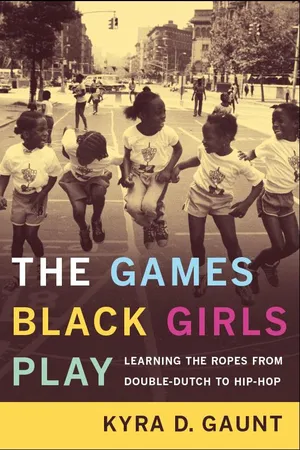
Explores how the traditions of black music are intertwined in the games black girls grow up with
When we think of African American popular music, our first thought is probably not of double-dutch: girls bouncing between two twirling ropes, keeping time to the tick-tat under their toes. But this book argues that the games black girls play—handclapping songs, cheers, and double-dutch jump rope—both reflect and inspire the principles of black popular musicmaking.
The Games Black Girls Play illustrates how black musical styles are incorporated into the earliest games African American girls learn—how, in effect, these games contain the DNA of black music. Drawing on interviews, recordings of handclapping games and cheers, and her own observation and memories of gameplaying, Kyra D. Gaunt argues that black girls' games are connected to long traditions of African and African American musicmaking, and that they teach vital musical and social lessons that are carried into adulthood. In this celebration of playground poetry and childhood choreography, she uncovers the surprisingly rich contributions of girls' play to black popular culture.
- 238 pages
- English
- ePUB (mobile friendly)
- Available on iOS & Android
eBook - ePub
About this book
Information
1
Slide
Games as Lessons in Black Musical Style
What if black girls’ musical play was a training ground for learning not only how to embody specific approaches to black musical expression, but also learning to be socially black? When I was trying to pin down a topic for my dissertation, I wanted to find a way to privilege women’s musical participation in African American popular music. I didn’t want to write about the misogyny and sexist lyrics that emerged with the L.A. style of hip-hop in 1988 when N.W.A.’s “Straight Outta Compton” went gold and put gangsta rap on the map. When I was searching for a topic in 1994, Coolio (“Fantastic Voyage”), Warren G and Nate Dogg (“Regulate”), and Snoop Doggy Dogg (“Gin and Juice”) broke through to the mainstream pop charts. Their videos were dominated by images of late-night parties with dozens of women captured with their “bootys” bobbing in the air by the down-low gaze of a male cameraman’s eye, while Snoop delivered his dope-ass rhymes. There was not much room around those sights and sounds to privilege women’s musical contributions to hip-hop or black popular music except where their bodies might be concerned. Female rappers Salt-N-Pepa were the exception that year, flipping the script by featuring male dancers as “video hos” in their top-forty hit single and video “Shoop,” featuring the female vocal quartet En Vogue. What if there were earlier musical experiences that gave women access to participating in a musical style consistently dubbed misogynist and sexist?
In a discussion with Judith Becker, my dissertation advisor, I explored the possibility that there might be a musical angle to reading women’s participation in hip-hop. I, along with many other African American women between the ages of eighteen and thirty, listened and danced to the music and a critical number of us knew and sang along with all the lyrics. It seemed to me that the beats, the distinct rhyming, the rhythmic patterns, and the polyphonic textures that made girls’ musical games sound and feel “black” were connected to hip-hop. Settling on studying African American girls’ games serendipitously became a real possibility while I was at an academic conference devoted to ethnomusicology.
Conferences about music are rarely about playing games or music in the literal sense. “Players” at conferences devote endless hours reading papers littered with references to this theory or that scholar with few visual aids, little or no eye contact with their “opponents,” and very few cases of actually creating music or having fun. The best game you can hope for is scoring points shooting down the other “players’” intention or inspiration during the Q&A session. “There always seems to be a need, in the academic arena, to score points against your opponent by submitting his every move to an ideological litmus test, or by targeting her for . . . an intellectual drive-by shooting” (Fox 1997, 13–14).
At the reception following the “scoring,” I heard the snap, crackle, and pop of a handclapping game being played down the hall. It reminded me of the sound of caps, those long, red strips of paper dotted with gunpowder, struck against the pavement of playgrounds with some small rock we found in the corner of a gutter. There were two girls rapt in the intentions of their percussive hand gestures. They executed uneven patterns combining clapping and chanting that didn’t fit the usually square, four-beat phrases of most games. Their rhythmic patterns slid back and forth between meters ambiguously. Both syncopation and metrical play were present. So too were the metrical ambiguity of cross-rhythms in their clapped patterns and the easy polyrhythmic embodiment of lyrics, syncopated melodies, and beats.
The black girls were fraternal twins accompanying their mother, Rose, who was freelancing as the caterer for the reception. By day, she was my classmate in my voice studio with George Shirley, the longest reigning black tenor with the Metropolitan Opera. Jasmine and Stephanie were nine years old and Rose had recently adopted them. When there’s nothing better to do or when the time or place limits what’s possible, hand-clapping games can do the trick.
Miss—Ma—ry—
Mack, Mack, Mack all dressed in
Black, Black, Black with sil- ver
Butt’ns, Butt’ns, Butt’ns all down her
Back, Back, Back
Mack, Mack, Mack all dressed in
Black, Black, Black with sil- ver
Butt’ns, Butt’ns, Butt’ns all down her
Back, Back, Back
The twins played a version of Mary Mack that had completely different melodic phrases than what I had known when I was a child. It sounded funkier, like a blues melody with handclapping punctuating the fourth beat of each line. In the third line (“Diamonds all down her back”) there was a distinctive nasalized bending of pitches into a descending blues scale characteristic of African American sacred and secular singing.
Ma- ry Mack (clap)
Dressed in black (clap)
Diam’nds all down her ba- a- a- ck (clap)
Dressed in black (clap)
Diam’nds all down her ba- a- a- ck (clap)
Soon the twins introduced me to a series of games I had never learned before. I wanted to know them! After all, these were black girls’ games, right? Although the oral nature of transmission allowed handclapping games like this and others to be found in integrated schoolyards, on Sesame Street, and as background footage in popular films, this game-song was part of a broader repertoire of games that featured nasalized blue notes syncopated against percussive movement and language that signified African American social dances, and that’s what made them “black.” I wanted to add these games to my repertoire of music (not just games) and run home to tell my girls about the latest music I had heard. To be a girl again, a black girl stepping on the cracks of my mama’s back. Playing all day. Ripping and running. Singing and chanting. But black girls may not know they are learning how to be musical through such play. It was just a game, right?
“Slide”: Embodying the Language of a Black Music
Handclapping games often feature a melodic tune, or chanted lyrics, that resemble an approach to rapping not only prominent in hip-hop culture, but one that has existed in African American music-making since slavery. For example, juba-patting, an embodied practice of handclapping, finger-snapping, thigh-and-chest slapping, and foot-stomping accompanied by a rhymed patter known as juba-rhyming, was an improvised nineteenth-century practice shared among slaves of African descent. This musically embodied practice was recounted in a travelogue about a visit to a Maryland plantation in 1859:
As soon as she joined the throng, Clotilda, without a moment’s pause, whirled herself among and through the crowd of dancers . . . and began to recite the following verses in a shrill sing-song voice, keeping time to the measure, as Ike had done, by beating her hands sometimes against her sides, and patting the ground with her feet. An interval of some seconds afforded time for the dancers to follow the direction given in each; but the beating of the hands and feet continued without intermission. (Hungerford 1859, 195–96)
The author James Hungerford captured the lyrics of Clotilda’s performance rendered under the song title “Juber Dance” as follows:
Laudy! how it make me laugh
Ter see de niggers all so saf’ [soft];
See um dance de foolish jig,
Un neber min’ de juber rig.
Juber!
[Negroes dancing every one after his or her own fashion, but keeping
time to the beat.]
Juber lef’ and Juber right;
Juber dance wid all yo’ might
Juber here an’ Juber dere,
Juber, Juber, ebery where.
Juber!
. . .
Dere’s ole Uncle Jack
Hab er pain in his back;
Ebery time he try ter skip
Den he hab ter get er limp.
Juber!
Guess I knows er nigger gal—
Dere she is, her name is Sal—
Un she hab to min’ de baby,
Show us how she rock de cradle.
Juber!
[A variety of swaying motions, intended to represent cradle-rocking in a ridiculous view. All, a daughter of Aunt Kate, and a nurse of a baby sister, indignantly, “I alwus said Clotidly wus crazy!”] . . .
Ter see de niggers all so saf’ [soft];
See um dance de foolish jig,
Un neber min’ de juber rig.
Juber!
[Negroes dancing every one after his or her own fashion, but keeping
time to the beat.]
Juber lef’ and Juber right;
Juber dance wid all yo’ might
Juber here an’ Juber dere,
Juber, Juber, ebery where.
Juber!
. . .
Dere’s ole Uncle Jack
Hab er pain in his back;
Ebery time he try ter skip
Den he hab ter get er limp.
Juber!
Guess I knows er nigger gal—
Dere she is, her name is Sal—
Un she hab to min’ de baby,
Show us how she rock de cradle.
Juber!
[A variety of swaying motions, intended to represent cradle-rocking in a ridiculous view. All, a daughter of Aunt Kate, and a nurse of a baby sister, indignantly, “I alwus said Clotidly wus crazy!”] . . .
Try de Juber reed again;
Try yo’ bes’, un try to win.
Juber forrud, Juber back;
Juber dis way, Juber dat;
Juber in, un Juber out;
Juber, Juber, all abbout.
Juber[!] (Hungerford 1859, 198)
Try yo’ bes’, un try to win.
Juber forrud, Juber back;
Juber dis way, Juber dat;
Juber in, un Juber out;
Juber, Juber, all abbout.
Juber[!] (Hungerford 1859, 198)
This excerpt highlights many of the lyrical features and social dancing associated with African American popular music and dance styles from the early twentieth century to the present. This kind of embodied music-making played a central role in social music during slavery and continues to play a role in formulating social experience in black communities today. For example, rhyming extemporaneously on topical subjects, calling instructions for the dance (like the line dancing of the Electric slide and the Cha-cha slide in contemporary settings since 2000), and embodying the percussion that accompanies the rhymed chants which are clearly linked in sound and behavior to the beat-boxing and rhyming of hip-hop culture.
There is one game-song from my childhood that I’ll always remember. “Miss Lucy” is a provocative game that includes all kinds of sexual innuendos about boys and having babies.
Mi-ss . . .
Lu-cy had a ba-by (clap clap)
She named it Tiny Tim (clap clap)
She put him in the bath-tub (clap clap)
To see if he could swim (clap clap) . . .
Lu-cy had a ba-by (clap clap)
She named it Tiny Tim (clap clap)
She put him in the bath-tub (clap clap)
To see if he could swim (clap clap) . . .
I vividly remember playing “Miss Lucy” at the bus stop on my way to elementary school: the linguistic play of double entendres and elisions created when certain syllables and words are just about to mean something sexual or scatological and then they suddenly shift into some benign reference that made “Miss Lucy” (the game and the ideas of a woman) fun and sexy to play with.
Be-hind the elevator (clap clap)
There was a piece of glass (clap clap)
Miss Lu-cy fell upon it and it went straight up her
Ask me no more questions (clap clap)
I’ll tell you no more lies (clap clap)
The boys are in the bathroom (clap clap) pulling up their
Fly me to the O-cean (clap clap)
(and so on . . .)
There was a piece of glass (clap clap)
Miss Lu-cy fell upon it and it went straight up her
Ask me no more questions (clap clap)
I’ll tell you no more lies (clap clap)
The boys are in the bathroom (clap clap) pulling up their
Fly me to the O-cean (clap clap)
(and so on . . .)
Back to the unknown game the twins first introduced to me. I said earlier that it wasn’t like “Mary Mack” nor “Miss Lucy.” The shifting meter of this game was more rhythmically complex than those. Slide or Numbers, as it is called, didn’t feature a song or chant except for the counting out loud that marked certain shifts in the clapping patterns and in time.
ONE (clap) · (clap) · (clap clap)! [1]
ONE (clap) two (clap)! ONE (clap) two (clap)! [2]
ONE (clap clap) TWO (clap clap)!
ONE (clap) two (clap)! ONE (clap) two (clap)! [2]
ONE (clap clap) TWO (clap clap)!
What stood out were nuances of their intonation, the articulation and inflection of each phoneme of the numbers was the song.
So much of African American languaging expressed in music, sports, play, and everyday social discourse is inflected and made meaningful through nonverbal linguistics and percussive enunciations of pitch and timbre.
If, as in the colloquial greeting, “Wha’s UH-up, girrl??!!!” one finds musical elements that intensify the meanings of words (such as lengthening sibilant and liquid consonants: esses and elles), nasalizing or changing the quality of a sound (timbre), or undulating the pitch within a syllable or word, why wouldn’t such an approach dominate nonverbal expression in musical contexts? The twins’ expressive chanting of the numbers had more of a story to tell me about embodying the structure of musical expression than I might have imagined.
ONE (clap) two (clap)! ONE (clap) two (clap)! [2]
ONE (clap clap) TWO (clap clap)!.
ONE (clap) TWO (clap) three (clap)! [3]
ONE (clap) TWO (clap) three (clap)!
ONE (clap clap) TWO (clap clap) three (clap clap)!
ONE (clap clap) TWO (clap clap)!.
ONE (clap) TWO (clap) three (clap)! [3]
ONE (clap) TWO (clap) three (clap)!
ONE (clap clap) TWO (clap clap) three (clap clap)!
The pattern of beats seemed to be expanding, while it also seemed to transform the earlier stated rhythms moving from a duple to a triplet feel and from duple to triplet meters and back again. The downbeat seemed to constantly shift, causing me to wonder if these games might offer some access to thinking about not only how syncopation is learned and unfolds, but how a metronomic sensibility—a strong sense of pulse and tempo—so often remarked upon about African and African American musical behavior, gets developed through ordinary practice.
Anthropologist Edward T. Hall asserted that nonverbal communication is the “essence of ethnicity . . . rooted in how one experiences oneself as a man or a woman” (Hall 1981, 82). Ethnomusicologists have failed to take embodiment and visual perceptions of embodiment, not to mention gender, into account in our analyses and inquiry into African American musical and social practice. What has tended to dominate the discussion is rhythm, not gendered bodies making and embodying rhythmic language and other musical expressions. If dance informs the surface features of music, as African American musicologist Olly Wilson asserted in 1985, where is the analysis and study of sounds and bodies as musical experience? The body language Stephanie and Jasmine expressed offered more clues for rethinking not only how we learn black musical aesthetics, but also how we learn to relate socially and identify with one another ethnically, through musical behaviors that reflect those concepts.
In nearly all handclapping games, there is a base from which all other movements seem to stem: each player claps separately on beats two and four, serving as the link between other gestures. Slapping the chest as if crossing the heart (what I call the “criss-cross” gesture) is another gesture generated individually. Slapping the upper thighs usually follows, with all this reminiscent of another earlier African American style of embodied play known as hamboning. Hamboning was prominent by the middle of the twentieth century, with several popular songs and lyrics making reference to the practice as “hand-boning” or “hand jive” during the era of rhythm and blues and rock ’n’ roll.
The game Slide or Numbers has a simple goal: carry out the complex and expanding pattern of gestures up to ten without messing up. In young girls’ interactions, it is common to label the levels of play: ones-eez, twos-eez, threes-eez, fours-eez, and so on. This kind of linguistic play is found occasionally in double-dutch and more often associated with playing jacks. In the latter, each code (ones-eez) signals how many jacks you need to pick up after each bounce of the rubbery ball. Though this language is rarely present in handclapping games, I use it to evoke the linguistics of girls’ play as I recall the delivery of performing Slide as I demonstrate my analysis of it.
Stephanie messed up. She forgot where they were in the game. The girls were supposed to be doing their fives-eez, but Stephanie clapped one too many, or one too few, times. So the twins started over, which gave me the opportunity to see the game from the beginning. Facing each other with one palm up to the sky and the other toward the ground, they clapped their palms together—then immediately slid them apart. At the same time, the slithery sound of the word “slide” rolled off their tongues, commencing with the sound of their clap and tracing their coordinated movement from the heels of their hands to the tips of their fingers—sliding movement, sliding language, and sliding sounds creating a synergy of onomatopoeia. The preparatory move reminded me of a conductor tapping her baton on the podium’s stand as a signal to the orchestra—and to the audience—that a performance is about to begin.
The girls’ individual claps were framed by the sounds of “high fives”—first between their right palms, and then their left. Altogether, these gestures created four even beats, reflecting a typical four-four measure of written music. Instead of counting “one-two-three-four,” they simply counted “one.” Then I could see how they embodied and created the triplet I had heard earlier: after making an individual clap in unison, the backs of their hands slapped together in mid-air, followed immediately by a clap shared by their palms. Here was the sense of two against three. For just a moment, a sense of polyrhythm or polymeter emerged before they started the pattern of their gestures over again. They maintained a steady pulse all the while.
The sound of the different claps—individual claps in unison, shared claps between opposing right and left palms (criss-cross), and the alternation from back to front between both opposing hands (back-front)—evoked timbres of sound that implied a subtle percussive melody. This added to the sense of the shifting meter in the game when the structure began to expand. In other words, the stronger sounds of the individual claps had a pitch that was relatively lower (suggesting downbeats) than the other two, higher-sounding types of clapping: the criss-cross pattern and the back-front gesture. And the criss-cross pattern of beats was stronger in emphasis than the back-front, which distinguished the difference between the sounds even further. Thus, certain phrasings or units of beats sounded like the alternation between a bass drum and a snare, as two beats or triplets in a quadruple meter. But further rhythmic complexity was created at subsequent levels of the game, such as at threes-eez, fours-eez, and fives-eez.
It had become clear to me, with the aid of the verbal instructions from Jasmine and Stephanie, that the basic structure of this handclapping game involved applying a rather simple and logical pattern—what was, in essence, the embodiment of an algorithm: the repetition of a formula or operation to accomplish some end. The embodied formula was composed of eight beats of clapping created from combinations of three basic moves.
The formula applied to these eight beats, which were divided into three units of movement, was to add an extra beat to every subsequent unit until you reach ten. In other words, doubling, tripling, quadrupling, etc., each of the three units, until the tenth level was reached and completed.
Once you understand and learn to master the motor skills involved in this “algorithm,” putting the game into motion with even strangers would be easy. On the first level, eight beats are performed, suggesting quadruple meter br...
Table of contents
- Cover Page
- Title Page
- Copyright Page
- Dedication
- Contents
- List of Musical Figures
- Acknowledgments
- Introduction
- 1 Slide: Games as Lessons in Black Musical Style
- 2 Education, Liberation: Learning the Ropes of a Musical Blackness
- 3 Mary Mack Dressed in Black: The Earliest Formation of a Popular Music
- 4 Saw You With Your Boyfriend: Music between the Sexes
- 5 Who’s Got Next Game? Women, Hip-Hop, and the Power of Language
- 6 Double Forces Has Got the Beat: Reclaiming Girls’ Music in the Sport of Double-Dutch
- 7 Let a Woman Jump: Dancing with the Double Dutch Divas
- Conclusion
- Appendix: Musical Transcriptions of Game-Songs Studied
- Bibliography
- Index
- Abote the Author
Trusted by 375,005 students
Access to over 1.5 million titles for a fair monthly price.
Study more efficiently using our study tools.
Frequently asked questions
Yes, you can cancel anytime from the Subscription tab in your account settings on the Perlego website. Your subscription will stay active until the end of your current billing period. Learn how to cancel your subscription
No, books cannot be downloaded as external files, such as PDFs, for use outside of Perlego. However, you can download books within the Perlego app for offline reading on mobile or tablet. Learn how to download books offline
Perlego offers two plans: Essential and Complete
- Essential is ideal for learners and professionals who enjoy exploring a wide range of subjects. Access the Essential Library with 800,000+ trusted titles and best-sellers across business, personal growth, and the humanities. Includes unlimited reading time and Standard Read Aloud voice.
- Complete: Perfect for advanced learners and researchers needing full, unrestricted access. Unlock 1.5M+ books across hundreds of subjects, including academic and specialized titles. The Complete Plan also includes advanced features like Premium Read Aloud and Research Assistant.
We are an online textbook subscription service, where you can get access to an entire online library for less than the price of a single book per month. With over 1.5 million books across 990+ topics, we’ve got you covered! Learn about our mission
Look out for the read-aloud symbol on your next book to see if you can listen to it. The read-aloud tool reads text aloud for you, highlighting the text as it is being read. You can pause it, speed it up and slow it down. Learn more about Read Aloud
Yes! You can use the Perlego app on both iOS and Android devices to read anytime, anywhere — even offline. Perfect for commutes or when you’re on the go.
Please note we cannot support devices running on iOS 13 and Android 7 or earlier. Learn more about using the app
Please note we cannot support devices running on iOS 13 and Android 7 or earlier. Learn more about using the app
Yes, you can access The Games Black Girls Play by Kyra D. Gaunt in PDF and/or ePUB format, as well as other popular books in Social Sciences & African American Studies. We have over 1.5 million books available in our catalogue for you to explore.