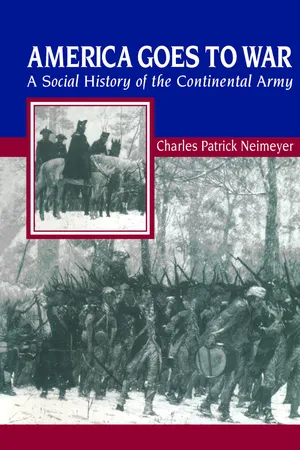
A unique and revealing analysis of the diverse body that made up the American revolutionary army
One of the images Americans hold most dear is that of the drum-beating, fire-eating Yankee Doodle Dandy rebel, overpowering his British adversaries through sheer grit and determination. The myth of the classless, independence-minded farmer or hard-working artisan-turned-soldier is deeply ingrained in the national psyche.
Charles Neimeyer here separates fact from fiction, revealing for the first time who really served in the army during the Revolution and why. His conclusions are startling. Because the army relied primarily on those not connected to the new American aristocracy, the African Americans, Irish, Germans, Native Americans, laborers-for-hire, and "free white men on the move" who served in the army were only rarely altruistic patriots driven by a vision of liberty and national unity.
Bringing to light the true composition of the enlisted ranks, the relationships of African-Americans and of Native Americans to the army, and numerous acts of mutiny, desertion, and resistance against officers and government, Charles Patrick Neimeyer here provides the first comprehensive and historically accurate portrait of the Continental soldier.
- 260 pages
- English
- ePUB (mobile friendly)
- Available on iOS & Android
eBook - ePub
About this book
Information
CHAPTER ONE
Few Had the Appearance of Soldiers: The Social Origins of the Continental Line
In 1776, Captain Alexander Graydon was sent into the Pennsylvania hinterlands on a recruiting trip for the Continental army. Finding no one willing to sign the terms of enlistment, he slipped across the Maryland border, hoping, he stated, “that [he] might find some seamen or longshoremen there, out of employ.”1 His efforts yielded only one recruit, a man deemed so valueless by his community that a local wag informed Graydon that the recruit “would do to stop a bullet as well as a better man, as he was truly a worthless dog.”2 Graydon later wrote that his problems with recruitment served “in some degree to correct the error of those who seem to conceive the year 1776 to have been a season of almost universal patriotic enthusiasm.” Louis Duportail, a French volunteer and chief engineer of the Continental army, noticed the same trend. “There is a hundred times more enthusiasm for this Revolution in any Paris cafe than in all the colonies together.”3 While both officers probably exaggerated the extent of patriotic decline, their assertions run counter to traditional historical accounts concerning the Continental army and those who comprised it.
While patriotism and political activism as motivating forces cannot be rejected in all cases, huge amounts of evidence point to an American army closely akin to its European cousins. That meant those who served long terms as soldiers were usually not those best connected to the communities that recruited them. Soldiers were obtained by any means available; their officers certainly did not consider their men to be avenging killer-angels hell-bent on defending liberty for all.
What inspired the Whiggish elite was not always the same as what motivated the average enlisted man. Thus officers like Anthony Wayne sometimes referred to their men as “Food for Worms…s , miserable sharp looking Caitiffs, hungry lean fac’d Villains.” Other officers lamented that their men were “the sweepings of the York streets,” or “a wretched motley Crew.”4 Senior officers, including George Washington, feared their own men. Washington was especially wary of foreigners who were attracted (as many were) to the large state and congressional bounties offered for service. He demanded that only natives form his headquarters guard. Joseph Galloway, General William Howe’s intelligence chief, once estimated that three-fourths of the Continental deserters who came into British-occupied Philadelphia were foreigners. Henry Lee went so far as to label the Pennsylvania battalions “the Line of Ireland.” Southern states used convicts as soldiers and were happy to get them. Prisoners of war were courted by both sides, and Washington unsuccessfully admonished his recruiters to stop accepting them. Nathanael Greene thought that the Carolina militia that opposed Cornwallis “were the worst in the world” and questioned whether the few who did not desert were not more interested in plunder than in what he deemed to be their patriotic duty.5 These observations were certainly not indicative of a patriot or classical “republican army.” Why were these officers so vehement in their condemnation of the men they commanded? If service connoted an implicit patriotism, why were Continental army recruits feared by their own officers? To answer these crucial questions, we must examine the colonial military tradition and the social origins of the American Continental soldier.
The Colonial Military Tradition
Long before the Revolution, the Virginia Assembly used to require that every male who was fit to carry a weapon to bring it to Sunday services so that he could participate afterward in militia drill. This law made sense since a sudden attack from Indians was considered a plausible occurrence. It appeared with the passage of time, however, that growing economic demands and a recession of an active Indian threat caused a distinction to develop between those who served long terms as soldiers and those engaged in commercial and economic enterprise. The comments of Lieutenant Governor William Bull of South Carolina to the British Board of Trade underscored the dilemma of propertied citizens rather well. Bull reported that although he thought the local militia was an effective force, their participation in extended military activities was ‘inconsistent with a Domestick or Country Life.”6
Struggles between European powers in North America forced the English colonial militias out of their principal role of fighting the local Indian threat and sometimes employed them against French or Spanish interests hundreds and, on occasion, thousands of miles from their homes. There were few compelling reasons for men of business (commercial or agricultural) to leave their secure locales for some far-flung battlefield. George Burrington, a prewar royal governor, was even instructed “to take especial care that neither the frequency nor the unreasonableness of remote marches, musterings,. & trainings be an unnecessary impediment to the affairs of the inhabitants.”7 Before Burrington’s instructions, a report sent to the royal government suggested that the entire militia system be abolished because
we learn from Experience that in a free Country [the militia] is of little use. The people in the Plantations are so few in proportion to the lands they possess, that servants being scarce, and slaves so excessively dear, the men generally under a necessity there to work hard themselves in order to provide the Common necessities of Life for their Families, so that they cannot spare a day’s time without great loss to their Interest …s wherefore a militia there would become …s burthensome to poor people…s . But besides it may be questioned how far it would consist with good Policy to accustom all the able Men in the Colonies to be well exercised in Arms.8
Those in power did not fear a standing army as much as they feared that those who were held in repression might one fine day turn their guns and training on their oppressors. Rather, militias worked best in local defensive situations. Despite a 1746 law that allowed the North Carolina militia to come to the aid of the authorities of Virginia and South Carolina, they were not required to do so. Fines were levied only if militiamen failed to aid in the defense of North Carolina. When some North Carolina militia companies received orders to march against the Cherokees in 1759, they refused to move because it meant leaving the colony. Governor Arthur Dobbs informed William Pitt that 420 out of the 500 men recruited to fight the Cherokees eventually deserted.9
Over time, colonial governments revised the requirements for vested citizens to serve and increased the number of exemptions to “Persons of Estates” so that in practice “no Man of an Estate is under any Obligation to Muster, and even the Overseers of the Rich are likewise exempted; the whole Burthen lyes upon the poorest sort of people.”10 While the number of exemptions varied from time and place according to the military exigencies of each colony, the new system favored the most powerful members of the community and squarely placed the burden of serving on the least powerful.
A comparison between the North Carolina Militia Act of 1774 and the original Carolina militia law (drafted by John Locke in 1669) reveals this transition. Whereas Locke’s original law required “all inhabitants and freemen of Carolina, above 17 years of age and under 60” to bear arms, the 1774 law exempted many categories of freeholders such as clergymen, overseers, millers, judges, commissioners, lawyers, river pilots, constables, and so on (persons deemed necessary to run the community in both war and peace) from service. Furthermore, since Carolina had so few whites compared to blacks, no overseer of more than five taxable slaves was required to perform military service. Indeed, overseers in this category who thought it was their patriotic duty to participate in colonial military affairs were fined 40 shillings.11
Exemptions expanded at such a rate that only one-half of the ablebodied white males in a typical North Carolina county attended muster drills in 1772.12 The well-to-do who declined to serve could afford to pay the militia fine, which was modest in any case. People who fell into the exempted categories were, by no means, always rich or even members of the upper class (overseers, for example, were not particularly well-to-do), but they did have one thing in common: all were connected in some way with the commercial or legal functioning of the community.
Changes in the militia system were, by the latter half of the eighteenth century, inevitable. The colonies had grown too complex for the situation to be otherwise. Because the militias tended to be motivated only when their parochial interests were threatened, and large numbers of citizens were exempted by the community anyway, colonial recruiters turned to those groups of men who “fell outside” the class of people required normally to do a turn or two in the militia. These were Native Americans, mulattos, African Americans, white indentured servants, and “free white men on the move,” sometimes known as itinerant laborers. These were also men who, if given the opportunity, were most willing to part temporarily with their civil liberties—if they were accorded any to begin with—in exchange for the steady wage of a soldier. They were precisely the same people against whom the militia system tended to discriminate. “In actuality,” a principle function of the militia often “turned out to be protecting the propertied and the privileged in colonial society from the unpropertied and unprivileged.”13 Recruiting thus tended to avoid circumstances that put the privileged community at risk from those they wanted to control. Long-term soldiering, therefore, fell to those not connected to the community or militia structure but disadvantaged enough to be lured away from low-paying jobs.
“The lower sort” was allowed to carry weapons most often when the theater of conflict was far from the local community. By their removal as soldiers in a distant campaign, itinerants, indigents, immigrants, racial outcasts, and others considered “surplus population” by the propertied during wartime served two purposes. First, the unpropertied fulfilled the political and military obligation of a community to provide soldiers without having to draft men of means. Second, using the lower sorts as soldiers on distant campaigns removed a potentially threatening source of discontent from one’s own area. Moreover, the very real prospect that the poorer sorts and not the propertied would face death or mutilation on the battlefield must have played into the picture as well. An example of this system at work occurred in New York in 1711. On this occasion, soldiers were easily recruited by the New York Assembly for an expedition against Canada. They voted to provide “350 Christian volunteers, 150 Long Island Indians, and 100 Palatine Germans.” One hundred additional Germans were eventually added to man frontier posts. Germans and Indians had been long exempt from militia duty, and some had been arrested earlier for disorderly conduct by local constabularies. Nevertheless, the New York Assembly went to these groups first when soldiers were required for a long, distant campaign.14 These same groups eventually formed ethnic buffer communities between Native American tribes and Anglo-American communities in the East.
Likewise, during the Seven Years’ War, Virginia sent men most easily spared from the economic infrastructure. George Washington complained in 1754 that these men were “loose, Idle Persons [who were] quite destitute of House and Home.” General James Abercromby thought that the soldiers who formed his army were the “rif-raf of the continent,” homeless men who came from parts unknown to him.15 Those called “rif-raf” by Abercromby became “patriots” to colonial recruiters.
Who were these “loose people” described by Washington and Abercromby? Did the pattern observed in colonial militias also appear when the Continental army was formed? Common soldiers in the eighteenth century, regardless of the army for which they fought, generally came from the lowest strata of society. Descriptions of eighteenth-century soldiers included “the sweeping from jails, ginmills, and poorhouses, oafs from farms beguiled into ‘taking the King’s shilling,’ adventurers and unfortunates who might find a home” in a regiment.16 While this thesis was supported by the comments of Continental officers, an in-depth analysis by at least one recent scholar revealed that the social structure of some eighteenth-century military organizations was more complex than previously supposed. For instance, new evidence has revealed that “the majority of British conscripts and German mercenaries (who formed the bulk of the British expeditionary force sent to quell the rebellion) did not come from the permanent substratum of the poor, but were members of the working classes who were temporarily unemployed or permanently displaced, and thus represented the less productive, but by no means useless, elements of society.”17 Was the same true for Continental recruits as well?
Two overarching and interrelated prewar social trends help to explain the origins of the Continental army: an expanding population and immigration. During the eighteenth century, British North America had experienced a tenfold increase in population (from 250,000 in 1700 to 2.5 million in 1775). The colonies, especially the middle and southern regions, had absorbed a great many immigrants after 1700. Some scholars have estimated that from 1720 to 1770, most colonial counties increased their population densities by a factor of three. As the larger and denser population pressed against the local land supply, the result was an exhaustion of available, undivided, cultivatable land. An ensuing land shortage caused an increase in the concentration of wealth as large landowners and speculators sold at high prices. Those who lacked land or the capital to purchase it were denied basic economic opportunities. Thus many a man who came of age in 1770 faced the hard choice of migrating or accepting either a nonagricultural trade or lower standard of living. Land availability shrank in some older New England towns to extraordinarily low levels. “A degree of social polarization,” noted historian Kenneth Lockridge, “accompanied the concentration of wealth. For a time the proportion of men labeled ‘gentlemen’ increased faster than ever before, as did the proportion of men accepting poor relief, both proportions continuing to grow until the Revolution.”18 Like a rubber band stretched at both ends, the ranks of rich and poor increased as the Revolution approached.
In Kent, Connecticut, for instance, where prewar economic opportunity was once bright, the situation was “darkened” by the time of the Revolution “by the pressure of population …s against a limited land supply.”19 An early eighteenth-century anonymous writer who called himself “Amicus Patriae” noted that “many of our old towns are too full of inhabitants for husbandry; many of them living upon small shares of land…s . And also many of our people are slow in marrying for want of settlements.”20
In fact, a popular prewar trend among New England youth was for young men to work for their families until their late teens, then for themselves, until about age twenty-six when they either married or moved on. Payment for services was usually rendered “in kind,” which meant that young male family members were hired out by their fathers to fulfill a debt or establish credit. Hard currency rarely exchanged hands. For a father to provide inheritance for all his children, he had the choice of dividing up his small holdings into even smaller portions (which ran the chance of “spoiling the whole” and lowering the standard of living for everyone) or he could hire out his children as labor to earn enough money or credit to purchase holdings for all. The ability of fathers to hire out sons was “indispensable to the functioning of the family economy.” What was also created by this system was a pool of temporarily poor young men waiting for some sort of familial release, inheritance, or time to build up enough capital to purchase a small holding for themselves.21 Mostly unskilled, these young laborers were exactly the type of men who might be attracted to the hard currency and steady wages offered by an army recruiter.
Immigration was a second powerful prewar social factor and added to the problem of land shortage. It increased the number of “loose people” moving here and there in search of employment. An estimated 700,000 immigrants arrived in North America from the beginning of British settlement to 1760. This figure suggests that a yearly average of 4,500 people arrived to increase the continental swel...
Table of contents
- Cover Page
- Title Page
- Copyright Page
- Dedication
- Contents
- Illustrations
- Preface
- Prologue
- Chapter One Few Had the Appearance of Soldiers: The Social Origins of the Continental Line
- Chapter Two The Most Audacious Rascals Existing: The Irish in the Continental Army
- Chapter Three A True Pell-Mell of Human Souls: The Germans in the Continental Army
- Chapter Four Changing One Master for Another: Black Soldiers in the Continental Army
- Chapter Five Scalp Bounties and Truck Houses: The Struggle for Indian Allies in the Revolution
- Chapter Six To Get as Much for My Skin as I Could: The Soldier as Wage Laborer
- Chapter Seven Running Through the Line Like Wildfire: Resistance, Punishment, Desertion, Mutiny in the Continental Army
- Conclusion
- Notes
- Selected Bibliography
- Index
Trusted by 375,005 students
Access to over 1.5 million titles for a fair monthly price.
Study more efficiently using our study tools.
Frequently asked questions
Yes, you can cancel anytime from the Subscription tab in your account settings on the Perlego website. Your subscription will stay active until the end of your current billing period. Learn how to cancel your subscription
No, books cannot be downloaded as external files, such as PDFs, for use outside of Perlego. However, you can download books within the Perlego app for offline reading on mobile or tablet. Learn how to download books offline
Perlego offers two plans: Essential and Complete
- Essential is ideal for learners and professionals who enjoy exploring a wide range of subjects. Access the Essential Library with 800,000+ trusted titles and best-sellers across business, personal growth, and the humanities. Includes unlimited reading time and Standard Read Aloud voice.
- Complete: Perfect for advanced learners and researchers needing full, unrestricted access. Unlock 1.5M+ books across hundreds of subjects, including academic and specialized titles. The Complete Plan also includes advanced features like Premium Read Aloud and Research Assistant.
We are an online textbook subscription service, where you can get access to an entire online library for less than the price of a single book per month. With over 1.5 million books across 990+ topics, we’ve got you covered! Learn about our mission
Look out for the read-aloud symbol on your next book to see if you can listen to it. The read-aloud tool reads text aloud for you, highlighting the text as it is being read. You can pause it, speed it up and slow it down. Learn more about Read Aloud
Yes! You can use the Perlego app on both iOS and Android devices to read anytime, anywhere — even offline. Perfect for commutes or when you’re on the go.
Please note we cannot support devices running on iOS 13 and Android 7 or earlier. Learn more about using the app
Please note we cannot support devices running on iOS 13 and Android 7 or earlier. Learn more about using the app
Yes, you can access America Goes to War by Charles Patrick Neimeyer in PDF and/or ePUB format, as well as other popular books in History & Early American History. We have over 1.5 million books available in our catalogue for you to explore.