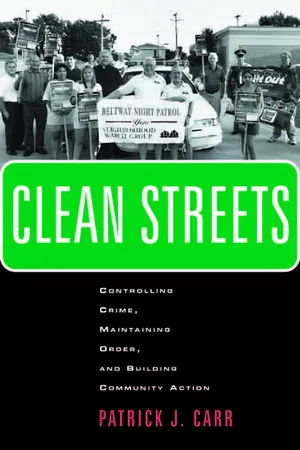
With the close proximity of gangs and the easy access to drugs, keeping urban neighborhoods safe from crime has long been a central concern for residents. In Clean Streets, Patrick Carr draws on five years of research in a white, working-class community on Chicago’s South side to see how they tried to keep their streets safe. Carr details the singular event for this community and the resulting rise of community activism: the shootings of two local teenage girls outside of an elementary school by area gang members. As in many communities struck by similar violence, the shootings led to profound changes in the community's relationship to crime prevention. Notably, their civic activism has proved successful and, years after the shooting, community involvement remains strong.
Carr mines this story of an awakened neighborhood for unique insights, contributing a new perspective to the national debate on community policing, civic activism, and the nature of social control. Clean Streets offers an important story of one community's struggle to confront crime and to keep their homes safe. Their actions can be seen as a model for how other communities can face up to similarly difficult problems.
eBook - ePub
Clean Streets
Controlling Crime, Maintaining Order, and Building Community Activism
- 209 pages
- English
- ePUB (mobile friendly)
- Available on iOS & Android
eBook - ePub
About this book
Information
1
Introduction

National Night Out—August 1999
Tuesday, August 3, 1999, was a typical hot August evening in Chicago. The air was heavy with the heat and humidity of the day, and in the Beltway neighborhood, many residents went about their business as usual. Some mowed, watered, or preened their precious patches of lawn, while others lolled about their porches listening to the White Sox game on the radio; children played in the side streets and parks, while some dog owners, still in their work clothes, walked their pets after returning from their day jobs. At the Beltway Public Library, the usual early-evening patrons borrowed books and videos, read the day’s newspapers, or surfed the World Wide Web on one of the library’s public access terminals.
Just after 6:30, the normal routine of the library is augmented by the arrival of a few dozen local residents. They do not arrive together but trickle in at a steady pace, shunning the books and periodicals stacked on the shelves to go into the main meeting room of the library. It is National Night Out, and the local neighborhood watch group, the Beltway Night Patrol, is marking the occasion by gathering its members and any other interested residents to march from the library to the Hastings Elementary School.1 There are two banners that will be carried at the head of the march. One bears the legend “Beltway Night Patrol: Your Neighborhood Watch Group,” and the other is the generic National Night Out plastic banner, replete with the corporate logos of local sponsors. There are other, smaller cardboard National Night Out posters stapled together and mounted on wooden poles for participants to carry, and they are distributed to anyone who wants to display one. Over on a side table, there is a cake to mark the occasion; it is inscribed with the legend “Welcome to National Night Out from Beltway Night Patrol.” The cake is covered to keep it fresh because it will serve as a treat after the march.
As the members of the Night Patrol arrive, they are warmly greeted by Bernadette Boniek, the president of the BNP; by Lydia Donovan, the head librarian and Night Patrol officer; and by Kitty Kelly, the team leader for the group. Both Bernadette and Kitty work full-time, and they have come more or less directly from work to the library. For Lydia, the library is her workplace, and she delights in combining work with civic activism. Bernadette, Lydia, and Kitty know everyone who comes into the room, and the atmosphere is one of uncontrived joviality. Bernadette and the other core members of the BNP are excited because there is a rumor that the new commander of the local police district will be attending “their march.” The local police district covers a large area, and there are several competing marches elsewhere. If the new commander does decide to march in Beltway, it will be a feather in the cap of the BNP, a fact not lost on any of the assembled members.
The local beat officers, Charles Simpson and John Straka, pull up to the library in their cruiser at about five minutes to seven, and they confirm to the BNP that Commander Riordan will be joining them for the march. The mood is now one of barely suppressed excitement, and Bernadette and her husband, George, tell people to gather outside the library in the parking lot for the march. The BNP members have now been joined by three people who represent the local Civic League, and by Father Rooney, the pastor of the local St. Martin’s parish. There are about twenty Beltway citizens present; most are active members of the BNP, while others are there because they have been recruited specifically for the National Night Out march. People are gathered in small clusters of two and three in the parking lot, and they chat as they await the word to march.
Commander Riordan pulls up to the parking lot a little before seven o’clock. He is an imposing figure, standing over six feet tall. The police officers present, now numbering five, are careful and courtly with their new boss. Bernadette and George usher people around one of the police cruisers for a photograph before they set off, and people pose with their placards and banners. Pictures taken, the BNP march for National Night Out begins.
Scarcely half a mile separates the Beltway library from the Hastings Elementary School, and the route chosen for the evening is suitably scenic and typical of the neighborhood. Once the group members leave the library they turn left on to Ridge Avenue, a busy north-south artery, and from there people walk the three blocks to the edge of Hastings Park. Hastings Park is a large expanse with several baseball diamonds, a multipurpose field used for soccer and football, and a newly renovated state-of-the-art fieldhouse. We turn right and walk along the edge of the westernmost baseball diamond toward the school, which is located at the eastern edge of the park. As we pass by, two Little League teams are warming up for their evening game. The sun is sliding down to dusk, and at this time of the year there are about ninety minutes of daylight left. Still, the evening is bright, even as the shadows cast by the pristine bungalows lengthen across the grass. The BNP members mostly stay on the sidewalks, although two police cruisers are escorting us. Commander Riordan eschews the comfort of the cruiser and walks with the BNP members. While most of the people walking do not seem intent or purposeful, there is a very specific purpose to the march and the route we take. The group passes the Hastings Park Fieldhouse, and a few interested spectators ask what people are marching for. Lydia explains that it is National Night Out and that the BNP is the local neighborhood watch. The inquisitive citizens nod and wish Lydia well.
Soon after the group passes the fieldhouse, the Hastings School looms into view. A black wrought iron fence surrounds the yellow brick building. On the southwestern edge of the schoolyard, there are three midsize outdoor basketball courts. Weeds and tufts of grass poke holes in the gray concrete of the yard, and the hoops are rusted and worn. Only one of the hoops has a net, and it is tattered and ready to fall off. A lawn borders the eastern edge of the school grounds, where the front door to the school is located. In stark contrast to the neat, green postage stamps that typify the rest of the neighborhood, the grass that borders the Hastings school is less lush and more unkempt. A forty-foot-high flagpole that serves as a monument of sorts dominates the southeastern corner of the school. The flagpole, and what it represents, is our destination. The flagpole proudly displays the Stars and Stripes, and it commemorates not the memory of the many Beltway residents past and present that served their country in the armed forces or those who were killed on active service. This monument is dedicated to the memory of two thirteen-year-old girls who died yards away from this spot a little less than four years ago.
The memorial to Melissa Harvey and Teresa Powell is spartan and stark. Scarcely an hour before the march, the small stone bearing their names that sits at the base of the flagpole was overgrown with crabgrass and weeds. On hearing about this, Lydia Donovan dispatched someone to make sure it was cleaned up before the march. Despite the hurried attempts at pruning, the simple block of polished granite and its surroundings betray an air of neglect. There are no flowers there, and the small privet bush that borders the back of the flagpole is in need of trimming. In fact, if you did not know that there was a memorial there, you would pass by unawares. Though small and hard to find, the monument, and what it commemorates, has great relevance for the Beltway neighborhood and for the present story of crime and social control.
Melissa Harvey and Teresa Powell were shot and killed as a result of a dispute between two rival gangs. Both gangs, the Black Knights and the Regal Vikings, claimed Beltway as their turf. The membership of the Black Knights was made up primarily of local Beltway youths, while the youth that were in the Regal Vikings did not hail from the immediate area. Both young women were eighth graders at the Hastings School at the time, and they died because they were sitting in a van, which was parked outside the school, with members of the Regal Vikings. One of the Black Knights, fifteen-year-old Richard Lindstrom, walked up to the passenger side of the van and fired six shots. Melissa, who was sitting in the passenger seat, and Teresa, who was sitting in the rear of the van just behind Melissa, were shot in the head and died almost instantly. Now, four years later, a few dozen Beltway citizens were walking in the heat of an August evening to the monument erected to the memory of these two teenagers.
As the group gathers around the monument, the jocular air of earlier is replaced by a somewhat more somber tone. Although almost no one present knew the girls personally, one of the teenagers who had come along professes to knowing Teresa and Melissa in passing, everyone joins Fr. Rooney in a short prayer that focuses on remembering the young women and pledging to keep the children of the neighborhood safe from danger. The silence as people stare at the monument is reverent and palpable. It is as if the BNP members are determined to remember the young women; their grim expressions underline this mood.
After Fr. Rooney finishes the prayer, people stand around quietly for a few moments before trekking back to the air-conditioned comfort of the library. The walk back is less purposeful than the earlier march to Hastings, and the group splinters into twos and threes. The conversation among the BNP members is slowly returning to more mundane topics—the record high temperatures of the previous weekend and the toll the heat has taken on people’s gardens, the latest shenanigans in the local Ward organization, or upcoming vacations that some plan to take. There is no overt mention of the two teenage girls, or of the silent prayers each person petitioned as they stood by the monument. This lack of reflection may seem strange, but it is in keeping with the stoic sensibilities of Beltwayites. There are no candlelit vigils, no flamboyant eulogies, but the resolution is the same as it would be in any other neighborhood that loses its children to gang violence: never let this happen again.
The rest of the evening at the library is more relaxed and upbeat. The BNP celebrates its third National Night Out with the commemorative cake, and for the group members it is a chance to reflect on some of their past accomplishments and, importantly, to impress the new commander. Commander Riordan does not stay long, as there are other calls to make, other neighborhood groups like the BNP to visit. Increasingly, the lot of the policeman, especially those in positions of authority, is intimately bound up with the citizens they serve. Community policing initiatives that seek to stimulate partnerships between citizens and police have been implemented in various forms in many major U.S. cities. Chicago has had one of the most enduring and widespread community policing programs in the form of the Chicago Alternative Policing Strategy (CAPS), which has been the model employed in the city since 1993. Thus, while it is not unusual for patrol officers, sergeants, and even commanders to socialize with community groups, a number of officers, particularly those who joined the Chicago Police Department before CAPS originated, still betray signs of unease.2 The beat officers, by contrast, seem at home chatting with BNP members, and Officer Simpson, in particular, is well respected by the watch group. Simpson often attends the BNP monthly meetings to give an update on any notable criminal activity in the area, and he seems genuine in his efforts to partner with the group.
After Bernadette thanks people for coming to the march and the cake is sliced and distributed, people begin to file away from the library. The police officers are among the first to leave, and one by one the members of the BNP exit the library, leaving Bernadette, Kitty, and Lydia to clean up and to turn out the lights in the meeting room. While they are somewhat disappointed by the turnout for the march—the BNP has an active member list of about thirty-five people—the women are happy at how the night’s events have gone. Most of all, they are pleased that they have had an opportunity to impress the new commander as one of the more active neighborhood watch groups in the district. On the whole, the BNP officers are satisfied with a job well done.
National Night Out in Beltway was on the surface an unremarkable event. But the event itself, and what it represents, is critically important for the story of crime and its control in the neighborhood. Why, then, did the BNP decide to march to the memorial for Melissa and Teresa for National Night Out? The choice that the BNP made to march to the Hastings School is no accident. Rather, it was an action that gives us the opportunity to give a context to the group, the neighborhood, and the struggle that many citizens face to keep their communities free from crime, violence, and disorder. Civic activism is more often stimulated by concrete events than by lofty ideals, and so it is in the case of the neighborhood watch group in Beltway.
The BNP exists in part because of the Powell-Harvey murders; the group was formed a little less than a year after the two young women were killed. On a mundane level, perhaps, on National Night Out the BNP wanted to commemorate the young women, and they used the occasion as a platform to do so. On a deeper level however, the BNP wanted to remind its members why they patrol each month, why they log every instance of graffiti and agitate to have it removed. Certainly, the murders marked a turning point in the neighborhood, the point at which residents had to confront the harrowing fact that five teenagers from their streets, from the same bungalows in which they themselves live and raise their own children, had committed this callous and brutal act. The murders were not only a turning point; they were a touchstone for the re-creation of community activism in the neighborhood. There were community activists in Beltway long before the Powell-Harvey murders, but the event gave a particular shape and form to what people did. It was no longer a case of being active in the PTA, whose goals are specifically school-based, or in the local Civic League, which deals more generally with country and home.3 The BNP and groups in similar neighborhoods usually form in response to specific threats and problems, and, while many fold within a year or two, some groups, as is the case with the BNP, persist beyond the first few years.4 At a time when levels of civic participation are lower than they have been in several decades, the BNP is somewhat of an anomaly in organizational terms.5
However, as I think the story of Beltway shows, the BNP is far from anomalous in terms of its raison d’être or for what it is trying to do. The desire to keep one’s neighborhood free of crime is one that is shared by citizens across class, race, and national boundaries. Few people would dissent from this basic aspiration, but for many it remains just that, an aspiration that most people do not act upon. Some citizens shun inaction or free ridership and actually attempt to actively keep their communities safe and crime-free. While this action can take many forms, it is important that we understand it not only as an intellectual exercise, but also as a way to examine how ordinary citizens try to keep crime and disorder at bay.
Beltway: A Story of Change
The following story is an account of just one neighborhood and its struggles to control crime and disorder. It is not simply the story of the BNP; the narrative itself begins a full three years before the BNP was formed. Rather, this book is about how the citizens of a typical neighborhood respond to crime and disorder. Beltway, while not typically a law-and-order community, has, over the five years I’ve studied it, succumbed to challenges and tragedies and to moral panics about youth violence that erupted and fizzled out before any lasting change could take place. In essence, this is a story of change, as Beltway went from a neighborhood that was immune to the violence that was commonplace in many Chicago communities to a place where the worst could happen. The story of change is not simply about the emergence of a gang problem in Beltway but about the changing social conditions that led to this development. Moreover, change in Beltway encompassed the response to the gang problem, and this work charts the difficulties residents faced trying to rebuild social control in their neighborhood.
I explain the change that has altered both Beltway’s ability to control youth and the shape and configuration of its response to the Powell-Harvey murders in terms of the factors that have impacted community-level or parochial social control. I argue that what led to the gang problem is the diminishing ability of family and community to enact effective social control, in the traditional sense of collectively supervising local teens and intervening when trouble occurs. So, too, the community response to gangs and crime must be mindful of the changes that have rendered traditional controls toothless and find new ways to efficaciously control crime and disorder. I call this new, hybrid form of community social control “the new parochialism,” and in what follows I draw on five years of work, from 1993 through 1998, to illustrate the conditions under which this new parochialism emerges. Further, I assess the implications of the new parochialism for how we think and talk about community control of crime and disorder. Before summarizing the contents of the chapters that follow, I think it is important to flesh out my concept of the new parochialism and to elaborate what I mean by informal social control.
Crime, Informal Social Control, and the New Parochialism
Crime is an inescapable part of life in many American cities, but most people would rather not live under these conditions. Circumstances vary from place to place, but nearly everyone shares the desire to live in an area free from crime.6 This was particularly true in the early 1990s, when I started my work in Beltway, because crime rates at the time, particularly those for youth crime, were peaking, and...
Table of contents
- Cover Page
- Title Page
- Copyright Page
- Dedication
- Contents
- Acknowledgments
- 1 Introduction
- 2 Welcome to Beltway
- 3 Getting Things Done Civic Engagement in Action
- 4 Looks Like Trouble Early Signs of Gangs and Violence
- 5 Gang Violence Can Happen Here The Hastings Murders and Their Aftermath
- 6 Coming Together Problem Solving and the Neighborhood Watch
- 7 Conclusion Civic Activism and the New Parochialism
- Appendix Getting In and Out of Beltway
- Notes
- References
- Index
- About the Author
Trusted by 375,005 students
Access to over 1.5 million titles for a fair monthly price.
Study more efficiently using our study tools.
Frequently asked questions
Yes, you can cancel anytime from the Subscription tab in your account settings on the Perlego website. Your subscription will stay active until the end of your current billing period. Learn how to cancel your subscription
No, books cannot be downloaded as external files, such as PDFs, for use outside of Perlego. However, you can download books within the Perlego app for offline reading on mobile or tablet. Learn how to download books offline
Perlego offers two plans: Essential and Complete
- Essential is ideal for learners and professionals who enjoy exploring a wide range of subjects. Access the Essential Library with 800,000+ trusted titles and best-sellers across business, personal growth, and the humanities. Includes unlimited reading time and Standard Read Aloud voice.
- Complete: Perfect for advanced learners and researchers needing full, unrestricted access. Unlock 1.5M+ books across hundreds of subjects, including academic and specialized titles. The Complete Plan also includes advanced features like Premium Read Aloud and Research Assistant.
We are an online textbook subscription service, where you can get access to an entire online library for less than the price of a single book per month. With over 1.5 million books across 990+ topics, we’ve got you covered! Learn about our mission
Look out for the read-aloud symbol on your next book to see if you can listen to it. The read-aloud tool reads text aloud for you, highlighting the text as it is being read. You can pause it, speed it up and slow it down. Learn more about Read Aloud
Yes! You can use the Perlego app on both iOS and Android devices to read anytime, anywhere — even offline. Perfect for commutes or when you’re on the go.
Please note we cannot support devices running on iOS 13 and Android 7 or earlier. Learn more about using the app
Please note we cannot support devices running on iOS 13 and Android 7 or earlier. Learn more about using the app
Yes, you can access Clean Streets by Patrick J. Carr in PDF and/or ePUB format, as well as other popular books in Social Sciences & Criminal Law. We have over 1.5 million books available in our catalogue for you to explore.