According to masculinities theory, masculinity is not a biological imperative but a social construction. Men engage in a constant struggle with other men to prove their masculinity. Masculinities and the Law develops a multidimensional approach. It sees categories of identity—including various forms of raced, classed, and sex-oriented masculinities—as operating simultaneously and creating different effects in different contexts.
By applying multidimensional masculinities theory to law, this cutting-edge collection both expands the field of masculinities and develops new thinking about important issues in feminist and critical race theories. The topics covered include how norms of masculinity influence the behavior of policemen, firefighters, and international soldiers on television and in the real world; employment discrimination against masculine cocktail waitresses and all transgendered employees; the legal treatment of fathers in the U.S. and the ways unauthorized migrant fathers use the dangers of border crossing to boost their masculine esteem; how Title IX fails to curtail the masculinity of sport; the racist assumptions behind the prison rape debate; the surprising roots of homophobia in Jamaican dancehall music; and the contradictions of the legal debate over women veiling in Turkey. Ultimately, the book argues that multidimensional masculinities theory can change how law is interpreted and applied.
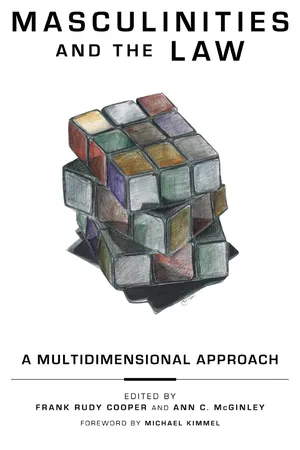
eBook - ePub
Masculinities and the Law
A Multidimensional Approach
- 315 pages
- English
- ePUB (mobile friendly)
- Available on iOS & Android
eBook - ePub
Masculinities and the Law
A Multidimensional Approach
About this book
Information
Theorizing Multidimensional Masculinities
1
Feminist Legal Theory Meets Masculinities Theory
Men and boys are gendered beings who operate in a gendered context and collectively experience both privilege and harm as a result of the social construction of what it means to be a boy or a man. Their collective privilege puts men as a group above women as a group, and infuses structures, culture, and policy with masculinities because men have historically held positions of power. At the same time, gender for men and boys does not operate uniformly, and is particularly affected by intersections with race, class, and sexual orientation. Within the collective of men and boys, there are hierarchies that reserve the highest privileges to only certain men and boys, and sometimes outweigh the benefits of manhood (Connell 2005; Dowd 2010).
“Masculinities” has multiple meanings. First, it is a structure that gives men as a group power over women as a group. Second, it is a set of practices, designed to maintain group power, that are considered “masculine.” Third, it is the engagement in or the “doing” of these masculine practices by men or women. Finally, the term refers to a body of theory and scholarship by gender experts in various fields of social science.
Understanding and examining masculinities is a relatively recent area of scholarship. “Gender” is more frequently associated with girls and women, while boys and men are often treated as if they are gender-less. This everyday, taken-for-granted quality of masculinities perpetuates inequality behind either a façade of universality and neutrality or a myth of gender difference (Kimmel 2004a).
In this chapter we explore the theoretical scope of masculinities scholarship, and suggest some of the ways it can contribute to the project of equality and justice. First, we discuss the history and development of masculinities scholarship. Although derivative of feminist theory, masculinities scholarship has largely evolved separately from feminist theory. Second, we summarize the core theoretical contributions of masculinities scholarship. Primarily derived from sociology and psychology, this scholarship suggests a series of insights for gender analysis. Third, we explore the relationship between feminist theory and masculinities scholarship. The pattern of separate evolution of these two areas creates challenges. In addition, at the point of convergence, it raises the question of whether the future direction of the field should be in creating integrated theory or ongoing separate development with interchange and coalition but not a singular grand theory. At a minimum, we suggest some ways that feminism can benefit from masculinities scholarship and that masculinities scholarship can benefit from feminist insights. Fourth, we examine the interrelations among multiple identity categories by considering the racialization of gender issues. Here we look through the lens of masculinities theory at the construction of gender hierarchy through race, and conclude that this focus requires that race be addressed as a feminist and masculinities issue. Finally, we engage in demonstrating how masculinities are practiced by exploring two substantive areas: education and work. The education example is a powerful reminder of the harm of separate theorizing and the benefits of convergence and complexity. The work example exposes how gender policing occurs in the context of a male-dominant occupation—firefighting—and suggests how a gender-informed analysis can point the way to reform.
History and Development
Different strands of feminist legal theory, such as inequality theory or special treatment theory or postmodern feminism, have, respectively, treated men as oppressors, or as “other” or have simply omitted attention to the situations of men (Levit 1996). The result is to essentialize men: “Feminist theory has examined men, patriarchy, and masculine characteristics predominantly as sources of power, domination, inequality, and subordination . . . In much feminist analysis, men as a group largely have been undifferentiated” (Dowd 2008, 201–4). One unintended consequence of this neglect of men and masculinities is that it implicitly presumes that the lives of men are the standard default position. This presumption “inadvertently re-enshrine[s] men as the neutral yardstick by which to measure women’s achievements” (Batlan et al. 2009, 127).
Early works in men’s studies owed inspiration to feminist theorizing. When contemporary feminism pointed out that the characteristics of men were the unexamined norm, this prompted interest in “men’s and boys’ identities, conduct, and problems” (Connell, Hearn, and Kimmel 2005, 1). Masculinities studies are expressly about “understanding how male identity is constructed and sustained” and exposing the ways in which “structures and cultures are gendered male” (Dowd 2008, 231, 233). As a fledgling discipline, most of the early literature in men’s studies was preoccupied with upper middle-class, white, professional men and heterosexual masculinity (Stoltenberg 1999, xii; Tolson 1977, 112, 143). Later constructions of masculinities recognized multiple different masculinities, shaped by different political and cultural circumstances, age, race, class, and sexuality. In both law and the social sciences, theorists have recognized that gender interacts and intersects with other identity characteristics and personal situations (Levit 2002).
Works in masculinities studies have examined how laws and institutions marginalize men who are battered, raped, or sexually harassed, men who want to be family caregivers, gender nonconforming men, and men of color in realms from the workplace to the criminal justice system. But masculinities studies show little interest in the female subject. While works in masculinities studies give somewhat more attention to feminist theory than to the contemporary situations of women, it is often primarily as an historical progenitor or source of methodology. Among the relatively few areas of intersection between masculinities studies and feminist theory have been issues regarding social constructivism, gender nonconformity, and LGBT (lesbian, gay, bisexual, and transgender) rights (Valdes 1995).
Core Contributions of Masculinities Scholarship
Masculinities scholarship, centered in sociology and psychology, has developed a rich body of work on gender theory (Connell 2005; Hearn 2004; Kimmel 2004a; Messerschmidt 2001; Pleck 1995). In this scholarship there is a core set of understandings, which can be summarized as follows:
1. Men are not universal or undifferentiated. . . .
2. Men pay a price for privilege. . . .
3. Intersections of manhood particularly with race, class, and sexual orientation are critical to the interplay of privilege and disadvantage, to hierarchies among men, and to factors that may entirely trump male gender privilege. . . .
4. Masculinity is a social construction, not a biological given. . . .
5. Hegemonic masculinity recognizes that one masculinity norm dominates multiple masculinities. . . .
6. The patriarchal dividend is the benefit that all men have from the dominance of men in the overall gender order. . . .
7. The two most common pieces defining masculinity are, at all costs, not to be like a woman and not to be gay. . . .
8. Masculinity is as much about relation to other men as it is about relation to women. . .
9. Men, although powerful, feel powerless. . . .
10. Masculinities study exposes how structures and cultures are gendered male. . . .
11. The spaces and places that men and women daily inhabit and work within are remarkably different. . . .
12. The role of men in achieving feminist goals is uncertain and unclear. . . .
13. The asymmetry of masculinities scholarship and feminist theory reflects the differences in the general position of men and women. (Dowd 2010, 57–65)
Seeing men in a non-essentialist way is a critical insight of this work. The naming of this scholarship as masculinities, plural, reflects the insight that gender is not constructed as a universal and does not operate in an undifferentiated way. Masculinities studies expose the hierarchies among men and the importance of men’s relationship to each other as a critical piece of the construction of gender (Dowd 2010). Much prior gender analysis, particularly feminist analysis, has assumed the primacy of male/female relationships, but masculinities scholarship exposes the coequal or even arguably greater significance of men’s relationship to other men, and that the relationship generally is characterized by hierarchy, not collaboration. That core understanding explains what might at first glance seem counterintuitive, that despite the attributes of power that adhere to men as a group, as individuals they frequently feel powerless (Kimmel 2004a, 2004b). The experience of powerlessness reflects the primacy of men’s relationship to each other.
Men’s relationship to each other is not stable. That is, men perform their gender daily, in countless encounters where their place vis-à-vis other men must be established (Pleck 1995). In the demonstration of manhood, the negative commands to not be like women and to not be gay are primary. These primary negative orientations, and the limits they impose, are the opposite of much popular culture that associates only positive qualities with manhood, such as strength, leadership, and courage. The negatives remain powerful, however, and men’s resistance to or attempts at redefining masculinity face strong limits because of these negatives (Gilmore 1990). They also operate to feed patriarchy, misogyny, racism, and homophobia (Hearn 2004).
There is a dominant masculinity functioning in male hierarchy that scholars have named hegemonic masculinity (Connell 2005). Consistent with the hierarchical relationships among men and the general dominance of men over women, there is a dominant masculinity that reinforces who is at the top of the masculine heap. As articulated by masculinities scholars, this embraces many familiar male stereotypes. What is most fascinating is how this hegemony functions. By its terms, it is supported by men who do not achieve it, and by women who are subordinated by it (ibid.). This is an essential characteristic of hegemony: it exists by virtue of the support of the dominated and subordinated, not by sheer force. It also changes over time, exposing its social construction. This dominant masculinity assures what masculinities scholars identify as the patriarchal dividend, how all men benefit from the reinforcement, central to hegemonic masculinity, of male dominance (ibid.). At the same time, the preferential place given to one form of masculinity exposes that masculinity, again, is not singular or universal. Race is perhaps the most powerful determinant of place in the hierarchy, in addition to sexual orientation and class. Race may nearly completely obliterate gender advantage, so that some men in reality do not exercise dominance in many, if any, contexts. Alternative, and subversive, masculinities exist based on these characteristics.
Masculinities sustain themselves through the dominance of men over men, but also, critically, they continue to construct themselves in a way that incorporates dominance over women (Hearn 2004). Because male norms infuse structures, culture, and policy, this continues to disadvantage women and certain men. Masculinities scholarship unpeels the layers and makes it easier to see the ways in which things are gendered male. Ironically, some of that structuring creates a price, not a privilege; it creates harm, not benefit (Dowd 2010). For instance, men and boys are the primary targets of male violence. Men’s socialization to deny emotions has a lifelong negative impact on relationships. Men’s role as breadwinners leaves them ill-equipped to be fathers that nurture their children. Harm is frequently translated into sacrifice that constructs negatives as positives, as signs of masculinity, thereby reinforcing the price paid as worthwhile (Kang, this volume). Part of that worth is the claim of superiority. Feminists have tended to focus on male privilege; masculinities scholarship reminds us that a price may be attached to that privilege; comprehending these costs will help us better understand how to dismantle inequality.
Gender for men is therefore constructed, not inherent, an insight that has been recognized for women as well. But it is constructed differently, asymmetrically, and thus men as a group find themselves as a group differently situated than do women in relation to equality. Men’s relationship to equality is different because they hold so much advantage as a group (Segal 1990). This is particularly evident in the patterns masculinities scholars have exposed in everyday life, including the different ways men and women inhabit space, whether in homosocial, single gender dominant, or mixed settings (Spain 1993). In order to achieve equality, the task of boys and men is different, including how they imagine their role in achieving equality for girls and women.
The value of these core insights is to expose the reality that boys and men suffer gender harms in addition to gender privilege, and that those harms should be addressed. The construction of masculinities brings a much richer picture of privilege, and therefore additional means to achieve long-held feminist goals. The presence of gender harms for boys and men suggests openings for collaboration rather than the persistence of presumed opposition. Nevertheless, since changing masculinities means relinquishing privilege, the task is more difficult in many respects than opening doors to attain equal freedom or personhood.
Finally, masculinities scholarship reinforces the antiessentialist reminder that inequalities are complex and interlocking. The hierarchical pattern of masculinities falls along a number of fault lines, but race is perhaps the strongest. Race arguably sometimes trumps the patriarchal dividend (Dowd 2010). Masculinities analysis has explored black masculinities as a subversive, alternative masculinity in response to white middle-class hegemonic masculinity. Feminist analysis has also grappled with the intersections of race and gender, with the critique of dominant theory as reflective of white women. This questioning has led to antiessentialism as a core tenet of feminist theory (Crenshaw 1989). The combination of these two approaches reminds us that masculine privilege is neither absolute nor universal, and gender subordination for women is differentiated along racial lines (Harris 1990). The exposure of race as a means to define patriarchy is not new, but the perspective and operation of race for men as well is a powerful reminder of the interlocking use of race as a component of gender subordination, a tool of hegemonic compliance and complicity. It also suggests that gender analysis should ask the race question; that is, it should look for and examine the operation of race in connection with gender, as well as asking whether race subordination is functioning in a primary way that requires that it be addressed as the core axis of inequality.
An example of this analysis is the juvenile justice system. The juvenile justice system, like the adult criminal justice system, has rarely been analyzed as a gender system. Yet clearly it is, as the juvenile justice system more accurately could be called the “boys’” justice system (or, depending on the analysis, the boys’ injustice system) (Dowd 2010). Most of the juveniles in the system are boys. Boys constitute roughly three-quarters of all arrests and convictions, and an even higher rate of residential placements. They stay in those placements nearly twice as long as girls. Overwhelmingly, the boys in the system are black, disproportionately so at both the arrest and conviction stages. One in three young black males is in the juvenile system in some form (ibid.).
Masculinities analysis is critical to understanding why boys commit more juvenile crime, and how they are treated in the system. It is also important in evaluating the goals of the system and, particularly, the consequences of the system. We evaluate the conduct of boys and girls differently, and charge and convict them differently. Boys are viewed through a lens that sees them as dangerous and scary—and because they are predominantly black boys, racialized masculinities affect how they live in a racialized system of policing and justice, as well as society’s goals for them (Messerschmidt 2001). The movement toward being “tough” on crime and imposing harsh sentences, such as “adult time for adult crime,” is largely a hybrid gendered and raced judgment. As explained below, this treatment is contrary to developmental data, and imposes outcomes that lack empirical effectiveness but feed social constructions (Scott and Steinberg 2008).
Boys’ masculinities include a process of shutting down emotion and taking risks in order to prove manhood. In adolescence, the traditional norms of manhood are at their peak, and alternative masculinities go underground. “A boy lives in a narrowly defined world of developing masculinity in which everything he does or thinks is judged on the basis of the strength or weakness it represents: you are either strong and worthwhile, or weak and worthless” (Kindlon and Thompson 1999, 78). The masculinity norms of viole...
Table of contents
- Cover Page
- Title Page
- Copyright Page
- Dedication
- Contents
- Acknowledgments
- Foreword by Michael Kimmel
- Introduction: Masculinities, Multidimensionality, and Law: Why They Need One Another
- PART I. THEORIZING MULTIDIMENSIONAL MASCULINITIES
- PART II. TELLING STORIES ABOUT (HEROIC) MASCULINITIES
- PART III. QUESTIONING SEGREGATION IN MASCULINE SPACES
- PART IV. CONSTRUCTING MASCULINITIES IN THE GLOBAL CONTEXT
- About the Contributors
- Index
Trusted by 375,005 students
Access to over 1.5 million titles for a fair monthly price.
Study more efficiently using our study tools.
Frequently asked questions
Yes, you can cancel anytime from the Subscription tab in your account settings on the Perlego website. Your subscription will stay active until the end of your current billing period. Learn how to cancel your subscription
No, books cannot be downloaded as external files, such as PDFs, for use outside of Perlego. However, you can download books within the Perlego app for offline reading on mobile or tablet. Learn how to download books offline
Perlego offers two plans: Essential and Complete
- Essential is ideal for learners and professionals who enjoy exploring a wide range of subjects. Access the Essential Library with 800,000+ trusted titles and best-sellers across business, personal growth, and the humanities. Includes unlimited reading time and Standard Read Aloud voice.
- Complete: Perfect for advanced learners and researchers needing full, unrestricted access. Unlock 1.5M+ books across hundreds of subjects, including academic and specialized titles. The Complete Plan also includes advanced features like Premium Read Aloud and Research Assistant.
We are an online textbook subscription service, where you can get access to an entire online library for less than the price of a single book per month. With over 1.5 million books across 990+ topics, we’ve got you covered! Learn about our mission
Look out for the read-aloud symbol on your next book to see if you can listen to it. The read-aloud tool reads text aloud for you, highlighting the text as it is being read. You can pause it, speed it up and slow it down. Learn more about Read Aloud
Yes! You can use the Perlego app on both iOS and Android devices to read anytime, anywhere — even offline. Perfect for commutes or when you’re on the go.
Please note we cannot support devices running on iOS 13 and Android 7 or earlier. Learn more about using the app
Please note we cannot support devices running on iOS 13 and Android 7 or earlier. Learn more about using the app
Yes, you can access Masculinities and the Law by Ann C. McGinley, Frank Rudy Cooper,Ann C. McGinley, Frank Rudy Cooper in PDF and/or ePUB format, as well as other popular books in Law & Gender & The Law. We have over 1.5 million books available in our catalogue for you to explore.