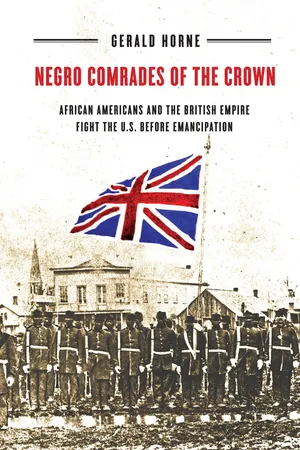
While it is well known that more Africans fought on behalf of the British than with the successful patriots of the American Revolution, Gerald Horne reveals in his latest work of historical recovery that after 1776, Africans and African-Americans continued to collaborate with Great Britain against the United States in battles big and small until the Civil War.
Many African Americans viewed Britain, an early advocate of abolitionism and emancipator of its own slaves, as a powerful ally in their resistance to slavery in the Americas. This allegiance was far-reaching, from the Caribbean to outposts in North America to Canada. In turn, the British welcomed and actively recruited both fugitive and free African Americans, arming them and employing them in military engagements throughout the Atlantic World, as the British sought to maintain a foothold in the Americas following the Revolution.
In this path-breaking book, Horne rewrites the history of slave resistance by placing it for the first time in the context of military and diplomatic wrangling between Britain and the United States. Painstakingly researched and full of revelations, Negro Comrades of the Crown is among the first book-length studies to highlight the Atlantic origins of the Civil War, and the active role played by African Americans within these external factors that led to it.
Listen to a one hour special with Dr. Gerald Horne on the "Sojourner Truth" radio show.
eBook - ePub
Negro Comrades of the Crown
African Americans and the British Empire Fight the U.S. Before Emancipation
- 365 pages
- English
- ePUB (mobile friendly)
- Available on iOS & Android
eBook - ePub
Negro Comrades of the Crown
African Americans and the British Empire Fight the U.S. Before Emancipation
About this book
Information
1
“Huzzah for Bermuda!”
George Washington was alarmed. He had just heard of events in Haiti which portended a shock to the entire slave system—and heartrending losses for slaveholders.1 It was a familiar tactic in the Americas2 for colonizing powers to ally with the enslaved of competing powers3—to the detriment of the latter.4 Washington’s republic had just endured the mass discontent of the enslaved and it was foreseeable that the evolution of events in Hispaniola could spell trouble for slaveholders within the hemisphere. Thus, one scholar argues that the revolt against British rule occasioned the “largest slave revolt in the Americas.”5 According to another account, perhaps 100,000 Negroes altogether—or a staggering 20 percent of the total black population—fled to the British side during the war. Between 1775 and 1787 the Negro population of Jamaica increased by some 60,000, suggestive of the demographic changes that were afoot in the hemisphere.6 Even if lower estimates are accepted, the point is that Africans were quite far from being in unanimous accord with the colonies’ revolt against London.
When London sought to shift the theater of conflict to the South, this was further testimony to the idea that the enslaved were akin to a fifth column.7 Southern militia often had to fret more about suppressing a servile insurrection than confronting redcoats.8 Supposedly, after witnessing how London used emancipation as a lure, Jefferson conceived of Africans as a captive nation willing to take any chance to eliminate their erstwhile masters.9
Samuel Johnson is renowned for asking querulously, “’Why is it that we hear the loudest yelps for liberty from the drivers of Negroes?’” Likewise, Londoners wondered why the colonists blanched at the idea of paying taxes, while not rejecting the umbrella of protection provided by British naval power that these duties supported—which had kept Spain and France at bay for more than a century, not to mention indigenes and the dreaded servile insurrection.10
Johnson was not singular in sensing that the much garlanded revolt against British rule was motivated by more mercantile concerns,11 specifically the growth of abolitionism12 represented by13 Somersett’s case. Unsurprisingly, when the Treaty of Paris was being solidified in 1783, ratifying U.S. sovereignty, the slaveholders dug in their heels, demanding the return of their human property—while, as abolitionism was deepening in London, Britain resisted just as adamantly.14 This trend was ratified further when in 1793, John Graves Simcoe, Upper Canada’s first lieutenant governor, played a leading rule in making Ontario the leading North American symbol of antislavery.15
During the constitutional convention in Philadelphia, George Mason rued the fact that a central weakness of the rebels was precisely what had helped to call their revolt into existence: slavery. Recalled were previous insurrections of the enslaved in Greece and Sicily and Oliver Cromwell’s ominous instructions to functionaries in Virginia to arm the slaves in case other means of submission of London’s foes failed. Even after independence the idea persisted that the enslaved might be the none-too-secret weapon in the hands of the opponents of slavery.16
The loss of the thirteen colonies would “liberate” London to a degree, making it less imperative to provide a full-throated defense of African enslavement—and provided Britain with a ready club with which to flay its former ward17—while allowing this European nation to seek concord with U.S. Negroes. Yet in order to pursue this course, London had to escape the charge of hypocrisy itself by moving more aggressively toward abolition.
Helping London escape this charge of hypocrisy was the repetitive revolts of enslaved Africans laboring under the Union Jack. A slave rebellion erupted in Abaco (the Bahamas) in 1789, then others erupted in Exuma, Cat Island, and Watlings Island in the period preceding abolition. European settlers in this southern neighbor of the U.S. ultimately came to fear that the well-armed West India Regiment would emulate Haiti and toss out the colonizers, which made the occupying power more susceptible to sweet reason.18 As early as 1770, Africans were fleeing to Hispaniola from the Turks and Caicos,19 providing kindling for revolution. Yet Haiti struck back most directly in the Bahamas in 1797 when Africans said to have roots in Hispaniola plotted to unite with their Bahamian counterparts to kill sentries, then arm the enslaved, attack forts, start diversionary fires, and capture Nassau as these incendiary storms were fought. Strikingly, when this plot was uncovered, the British colonizer chose to execute the so-called “French Negroes”—still sensitive to the already staggering racial ratios in their disfavor—but not their counterparts.20
Other colonies were sending similar signals. As early as 1791, the colonizers in Bermuda had noticed a “very manifest alteration in the behaviour of the Negroes here,” which was causing “great apprehensions.” The revolt in Haiti was thought to be the cause.21 The point was, however, that already in London stark nervousness was cascading in response to the revolt in Hispaniola and the premonition was rising that, perhaps, as for slavery, the jig was up.22
But it was not in London alone that pulses were racing and nerves were frazzling in response to tumult in Haiti. In the newly formed slaveholders’ republic, French refugees driven from the island were contemplating an armed invasion of their former home. That some in the U.S. thought this “military expedition … must be prevented”23 was more a function of the feared impact of poking a stick into a hornet’s nest than sympathy for abolitionism. “I am directed by the President,” said Alexander Hamilton in 1794 when it remained unclear who would prevail in Haiti, to announce that “those French privateers” that “were fitted out in our ports” were a “matter of real embarrassment and dissatisfaction”24—though “hostile expeditions”25 continued to be mounted targeting Haiti.
Still, these erstwhile Gallic allies often were bringing their most valuable human possessions with them to the U.S., and there was justifiable concern about what racial and political impact these Africans—who had witnessed Europeans fleeing in fearful panic as the enslaved revolted—would have on the peculiar institution in the U.S. itself. It was in 1798 that Pennsylvania governor Thomas Mifflin sought to bar “French Negroes” from his state. The chief executive brooked no ambiguity with his stern edict—“enforce it without delay,” he insisted, and he informed the U.S. president similarly.26
But as long as the nation itself tolerated enslavement of Africans it would be neither easy nor simple to bar slaves from entering the nation, particularly when accompanied by refugees from a nation that had boosted the U.S. itself into existence. It is estimated that 12,000 enslaved persons from Hispaniola arrived in the U.S. in the early 1790s,27 as the Caribbean colonizer fled northward and the U.S. sought to replenish its supplies that had been diminished by Africans fleeing the empire of slavery. In one six-month period in New Orleans—ending in early 1810—a reported 2,731 Europeans, 3,110 free Negroes, and 3,226 slaves arrived in New Orleans alone28 from Haiti.29
Slaveholders fleeing revolutionary turmoil came to wield significant influence in such port cities as New Orleans, Charleston, and Savannah.30 Often31 they were assimilated into the dominant reaches of the slaveholding class, solidifying this group’s more retrograde32 instincts. This made compromise with the growing abolitionist movement in London more difficult,33 not least since their well-honed Anglophobia often dovetailed with the instincts of the slaveholders’ republic.
Bernard Constantine, of French Hugenot origins—Toulouse, more specifically—came to North America to fight alongside the victorious rebels (he was at the pivotal battle of Yorktown), then took his bounty and bought a plantation in Saint Domingue, but was driven out by another successful revolt and did not arrive in Savannah in 1797 with happy thoughts about the abolitionism that was simultaneously sprouting in London.34 Edward Coppee arrived in Savannah with his parents as an infant in 1793, became a U.S. national in 1812, then in 1821 won the lottery for allocation of seized land from the Creek Nation. With this he was well on his way to joining the upper reaches of the local slaveholding elite.35
Africans too were pouring into Savannah in violation of a law passed in the mid-1790s designed precisely to bar importation of such chattel property from the Caribbean basin, as a way to limit the possible contagion from Haiti. In addition to being suspected of bearing “wicked designs,” the enslaved from the Caribbean were thought to also carry exotic diseases.36
Suggestive of the danger presented by these imports was that in several Georgia counties the militia were called upon to apprehend these slaves, quarantine them, then deport them.37 South Carolina too sought to bar the entry of putatively recalcitrant Negroes from the Caribbean, mostly to no avail.38 Why such unease? They “gave new ideas to our slaves,” said one pro-slavery apologist in South Carolina, which “could not fail to ripen into mischief” since these West Indians “had witnessed all the horrors” and, most important, the “dawning hope”39 of40 freedom.41
As42 1808 loomed, marking the possibility of restrictions on the African slave trade along with it, Charleston planters went on a buying spree, exhausting cash reserves and credit alike. It was inevitable that “French Negroes” could slip through43 the loosely meshed filter. But there was a price to be paid for accelerating the influx of Africans44 into port45 cities46 like Savannah; it was harder to maintain the kind of quality control that put a premium on importing the (supposedly) docile. Inevitably becoming part of the mix were those fleeing from Hispaniola with their human chattel and what they had witnessed there was the slaveholders’ worst nightmare. Thus, in 1806 the soon-to-be Senator Edward Telfair of Georgia, a scion of one of the most prominent families in the state, was warned of an incipient Negro uprising that contemplated mass murder.47 It was unclear if this group included Andrew Bryan, born enslaved in South Carolina, who became a pastor of the first Negro Baptist church in Savannah but was subsequently charged with plotting revolt and consequently arrested, beaten, and tossed into jail.48
The authorities in Louisiana seemed even more apprehensive about their changing demographic reality. It was in 1804, soon after the hoisting of the stars-and-stripes and the triumph of the Haitian Revolution, that Governor William Claiborne shakily informed James Madison of the local ramifications of trends in the Caribbean. Rather vainly he was seeking “to prevent the bringing in of slaves that have been concerned in the insurrections of St. Domingo.” Well aware of market forces, he knew that “many bad characters will be introduced. The citizens of Louisiana are greatly apprehensive of the West India Negroes,” he moaned, “but no effectual stop can at present be put to their introduction.”49 The legacy of Spanish and French colonialism was the continuing existence of militias of free men of color, which was hardly reassuring to those already spooked by Haiti. There was a real fear that these men in arms could lead an insurrecti...
Table of contents
- Cover Page
- Title Page
- Copyright Page
- Contents
- Introduction: Negroes—“British in Their Hearts?”
- 1 “Huzzah for Bermuda!”
- 2 “Base Fools!”
- 3 Can U.S. Negroes Commit Treason?
- 4 The Enslaved Torments the Slaveholder
- 5 “A Powerful Negro Army”
- 6 The British, Africans, and Indigenes versus the U.S.
- 7 Revolutionary Implications
- 8 Abolition of Private Property?
- 9 Africans Flee from “Republicanism”
- 10 London Sanctions Murder of U.S. Slaveholders?
- 11 Britain to Forge a Haiti in Texas?
- 12 Declare War on Britain to Avert Civil War in the U.S.?
- 13 Canada Invades—or Civil War in the U.S.?
- 14 A Paradise for U.S. Negroes in the British West Indies?
- Notes
- Index
- About the Author
Trusted by 375,005 students
Access to over 1.5 million titles for a fair monthly price.
Study more efficiently using our study tools.
Frequently asked questions
Yes, you can cancel anytime from the Subscription tab in your account settings on the Perlego website. Your subscription will stay active until the end of your current billing period. Learn how to cancel your subscription
No, books cannot be downloaded as external files, such as PDFs, for use outside of Perlego. However, you can download books within the Perlego app for offline reading on mobile or tablet. Learn how to download books offline
We are an online textbook subscription service, where you can get access to an entire online library for less than the price of a single book per month. With over 1.5 million books across 990+ topics, we’ve got you covered! Learn about our mission
Look out for the read-aloud symbol on your next book to see if you can listen to it. The read-aloud tool reads text aloud for you, highlighting the text as it is being read. You can pause it, speed it up and slow it down. Learn more about Read Aloud
Yes! You can use the Perlego app on both iOS and Android devices to read anytime, anywhere — even offline. Perfect for commutes or when you’re on the go.
Please note we cannot support devices running on iOS 13 and Android 7 or earlier. Learn more about using the app
Please note we cannot support devices running on iOS 13 and Android 7 or earlier. Learn more about using the app
Yes, you can access Negro Comrades of the Crown by Gerald Horne in PDF and/or ePUB format, as well as other popular books in Social Sciences & Military & Maritime History. We have over 1.5 million books available in our catalogue for you to explore.