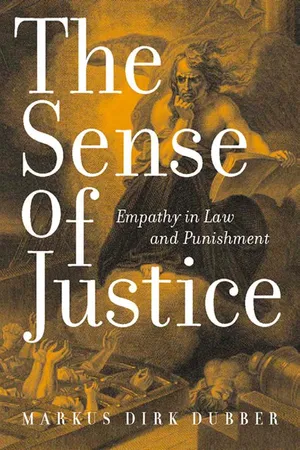
In The Sense of Justice, distinguished legal author Markus Dirk Dubber undertakes a critical analysis of the “sense of justice”: an overused, yet curiously understudied, concept in modern legal and political discourse. Courts cite it, scholars measure it, presidential candidates prize it, eulogists praise it, criminals lack it, and commentators bemoan its loss in times of war. But what is it? Often, the sense of justice is dismissed as little more than an emotional impulse that is out of place in a criminal justice system based on abstract legal and political norms equally applied to all.
Dubber argues against simple categorization of the sense of justice. Drawing on recent work in moral philosophy, political theory, and linguistics, Dubber defines the sense of justice in terms of empathy—the emotional capacity that makes law possible by giving us vicarious access to the experiences of others. From there, he explores the way it is invoked, considered, and used in the American criminal justice system. He argues that this sense is more than an irrational emotional impulse but a valuable legal tool that should be properly used and understood.
- 206 pages
- English
- ePUB (mobile friendly)
- Available on iOS & Android
eBook - ePub
About this book
Information
1 Uses and Abuses of the Sense of Justice
The sense of justice can be found throughout American discourse about law. Court opinions refer to it (but not statutes),1 so do newspaper columns.2 Legal textbooks encourage their readers to consult it,3 legal commentary invokes it,4 and, occasionally, even books are written about it—or its cousin, the moral sense5—though generally not by lawyers, at least not recently.6
People, including judges and law professors, tend to have unpleasant encounters with their sense of justice. That is, they tend to notice the sense of justice when it has been offended,7 affronted,8 or shocked,9 and when they come upon something repugnant,10 revolting,11 even nauseating,12 to it. Appropriately, the only book-length treatment of the sense of justice in the United States, from 1949, is actually about the sense of injustice.13
The Supreme Court once built an entire due process jurisprudence on the question whether a particular state action “offend[ed] ‘a sense of justice.’”14 This jurisprudence, however, is no more. The sense of justice today survives only in a remote corner of the vast due process universe, the “outrageous government misconduct” defense, a sort of minientrapment that hangs on by a thin thread, as a tenuous anachronism.15
The most vociferous critique of the sense of justice test came from within the Court itself. Justice Black waged a persistent, and ultimately successful, campaign against what he liked to call the “natural-law-due-process formula,” invoking a common, and generally uncomplimentary, association between the sense of justice and natural law. So in the 1947 case of Adamson v. California, Black thundered that the “natural-law-due-process formula … has been used in the past, and can be used in the future, to license [the Supreme] Court … to roam at large in the broad expanses of policy and morals and to trespass, all too freely, on the legislative domain of the States as well as the Federal Government.”16
Recently, the Justices’ sense of justice has been relegated from majority opinions to dissents. Dissenting in Rummel v. Estelle, an eighth amendment recidivism case, Justice Powell pointed out that “[a] statute that levied a mandatory life sentence for overtime parking … would offend our felt sense of justice.”17 Or take Justice Marshall’s desperate appeal, in his classic Furman v. Georgia dissent, to the hypothetical sense of justice of the no less hypothetical “average citizen,” which surely would conflict with capital punishment if she only knew more about it.18
Lower courts have been less careful to excise the sense of justice from their vocabulary, perhaps because their legitimacy has not been similarly questioned over the years. (They may be courts, but at least they’re not the U.S. Supreme Court.)19 There the sense of justice has popped up in all and sundry contexts, including but by no means limited to the review of criminal penalties20 and punitive damage awards,21 the expunging of arrest records,22 the recovery of a frivolous penalty in a tax case,23 a decision granting a motion to dismiss for improper venue,24 the applicability to the Act of State doctrine to the dissolution of corporations abroad,25 the dismissal of a motion to set aside a stipulation,26 the denial of workers’ compensation to an employee who had refused to get medical treatment,27 the opportunity for spouses to present evidence of a professional practice’s goodwill value in a divorce case,28 the propriety of a jury verdict override in a rear-ender case,29 the denial of an expert exam of clothing and hair samples,30 the rule that a personal representative of a decedent may not pursue a tort action if the sole beneficiary has settled,31 ineffective assistance of counsel,32 requiring a father to continue paying child support “to enrich the mother,”33 a husband to pay alimony to a remarried wife,34 or a married man to come to the aid of his overdosing paramour,35 prohibiting voir dire regarding issues in a case,36 sovereign immunity,37 extending murder liability to the owner of a pit bull who killed a two-and-a-half-year-old boy,38 and on and on.
Occasionally, lower courts still wield the sense of justice as an all-purpose weapon to condemn misconduct by the executive branch in the strongest possible terms. It is in these opinions that the Supreme Court’s sense of justice (“natural-law-due-process”) formula lives on, long after the Court itself has moved on to other, presumably more objective, standards. Recently, a California court had this to say to a prosecutor who had an investigator eavesdrop on the defendant’s conversations with his attorney in the courtroom:
We would be remiss in our oaths of office were we to discount or trivialize what occurred here. The judiciary should not tolerate conduct that strikes at the heart of the Constitution, due process of law, and basic fairness. What has happened here must not happen again. The prosecutor “… used methods that offend ‘a sense of justice.’ ” This is conduct which “… shocks the conscience.”39
The sense of justice, however, has proved just as useful as the sense of injustice. While the latter makes a formidable critical tool, the former exerts considerable powers of legitimation, not only in particular cases but also in support of sweeping principles of law. So a no-compete clause was held to be in accordance with “a fair sense of justice.”40 So was the rule preventing a criminal defendant from incriminating a deceased victim,41 the distinction between the right of custody and that of visitation,42 the principle that a borrower must pay interest,43 that the amount of contribution among co-tort feasors should be determined in relation to their negligence rather than equally distributed,44 that incapacity through accident excuses the failure to file a claims notice,45 that a woman is not an accomplice in an abortion performed on her,46 that the prosecutor has a duty to permit discovery,47 and, again, on and on.
Treatments of the insanity defense are particularly saturated with sense of justice talk. The defense requires both the presence of a sense of justice, in two ways, and its absence. “It is,” after all, “the sense of justice propounded by those charged with making and declaring the law—legislatures and courts—that lays down the rule that persons without substantial capacity to know or control the act shall be excused.”48 The application of this rule dictated by legislators’ and judges’ sense of justice in turn requires the sense of justice, this time the jury’s, for “[t]he jury is concerned with applying the community understanding of this broad rule to particular lay and medical facts. Where the matter is unclear it naturally will call on its own sense of justice to help it determine the matter.”49 The jury, in other words, exercises its sense of justice in assessing a particular defendant’s claim of insanity, and that’s a good thing:
Legal tests of criminal insanity are not and cannot be the result of scientific analysis or objective judgment. There is no objective standard by which such a judgment of an admittedly abnormal offender can be measured. They must be based on the instinctive sense of justice of ordinary men. This sense of justice assumes that there is a faculty called reason which is separate and apart from instinct, emotion, and impulse, that enables an individual to distinguish between right and wrong and endows him with moral responsibility for his acts. This ordinary sense of justice still operates in terms of punishment. To punish a man who lacks the power to reason is as undignified and unworthy as punishing an inanimate object or an animal. A man who cannot reason cannot be subject to blame. Our collective conscience does not allow punishment where it cannot impose blame.50
But what is insanity other than the lack of a sense of justice, or more precisely conscience or moral capacity, on the part of the defendant?51
And last, but certainly not least, the principle of racial integration, rather than separate-but-equal, flows from the sense of justice, at least in the view of a New Jersey trial judge in a public housing segregation case shortly after World War II:
Man’s sense of justice, coupled with an enlightened understanding of our common humanity, would dictate that if there be no segregation in the field of civil duty and sacrifice, there be none in the realm of human dignity and equality.52
Less dramatically, the sense of justice also has helped courts perform such everyday functions as interpreting statutes, contracts, and common law defenses, as well as finding facts. So it turns out that the scope of the “substantial impairment defense” in criminal law is to be determined in reference to the sense of justice,53 that contracts are to be read in light of the sense of justice,54 and that parenthood is to be recognized whenever a contrary finding would violate the sense of justice.55
Depending on the court (and the statute), the sense of justice either does or doesn’t control the statutory interpretation. When strict construction is required, for instance, then the statute must be construed strictly, even in violation of the sense of justice.56 In the interpretation of other statutes, by contrast, the “good sense of justice should prevail,”57 except in the face of the “clearest expression of legislative intent” to the contrary.58
Remarkably, while courts often consult their (or someone else’s) sense of justice, they don’t always get to heed its call.59 There’s not only the maxim of statutory interpretation requiring strict construction even in the teeth of a contrary sense of justice. More often than a maxim of interpretation it’s the judge’s institutional role as a member of the judiciary that stands between her and her sense of justice. So, for instance, a judge might write a crabby concurrence bemoaning the fact that she must apply the principle of contributory negligence in tort law despite what she perceives to be its inconsistency with the sense of justice. But there’s nothing she can do about it unless and until the legislature abandons the principle.60 These proclamations of impotence implicitly or explicitly rely on a narrow view of the judicial function as discovering, rather than creating law. As the first sentence of a Georgia opinion put it,
The law as it is written compels us in this case to arrive at a conclusion that shocks our sense of justice; but judges have the power only to declare the law, not to make it or amend it.61
As one might expect, the executive branch, and not only the legislature, can force a judge to go against her sense of justice. After laying out in considerable detail just why and how the court’s sense of justice demanded expunging a criminal record, a federal district court in the end decided to succumb to the realities of the bureaucratic state:
But, alas, with a full recognition of the foregoing we are also aware that to expunge the records in this case would set the stage for expungement in all similar cases where a verdict of...
Table of contents
- Cover Page
- Title Page
- Copyright Page
- Dedication
- Contents
- Acknowledgments
- Introduction: The Significance of the Sense of Justice
- 1 Uses and Abuses of the Sense of Justice
- 2 The Sense of Justice in Legal Thought
- 3 The Sense of Justice Misconceived
- 4 Rethinking the Sense of Justice
- 5 The Sense of Justice in Penal Law
- Conclusion: Law’s Empathy
- Notes
- Index
- About the Author
Trusted by 375,005 students
Access to over 1.5 million titles for a fair monthly price.
Study more efficiently using our study tools.
Frequently asked questions
Yes, you can cancel anytime from the Subscription tab in your account settings on the Perlego website. Your subscription will stay active until the end of your current billing period. Learn how to cancel your subscription
No, books cannot be downloaded as external files, such as PDFs, for use outside of Perlego. However, you can download books within the Perlego app for offline reading on mobile or tablet. Learn how to download books offline
Perlego offers two plans: Essential and Complete
- Essential is ideal for learners and professionals who enjoy exploring a wide range of subjects. Access the Essential Library with 800,000+ trusted titles and best-sellers across business, personal growth, and the humanities. Includes unlimited reading time and Standard Read Aloud voice.
- Complete: Perfect for advanced learners and researchers needing full, unrestricted access. Unlock 1.5M+ books across hundreds of subjects, including academic and specialized titles. The Complete Plan also includes advanced features like Premium Read Aloud and Research Assistant.
We are an online textbook subscription service, where you can get access to an entire online library for less than the price of a single book per month. With over 1.5 million books across 990+ topics, we’ve got you covered! Learn about our mission
Look out for the read-aloud symbol on your next book to see if you can listen to it. The read-aloud tool reads text aloud for you, highlighting the text as it is being read. You can pause it, speed it up and slow it down. Learn more about Read Aloud
Yes! You can use the Perlego app on both iOS and Android devices to read anytime, anywhere — even offline. Perfect for commutes or when you’re on the go.
Please note we cannot support devices running on iOS 13 and Android 7 or earlier. Learn more about using the app
Please note we cannot support devices running on iOS 13 and Android 7 or earlier. Learn more about using the app
Yes, you can access The Sense of Justice by Markus Dirk Dubber in PDF and/or ePUB format, as well as other popular books in Law & Jurisprudence. We have over 1.5 million books available in our catalogue for you to explore.