![]()
Part 1
Times Square Blue
October 1996
The great epochs of our life are where we win the courage to rechristen our evil as what is best in us.
—NIETZSCHE, Beyond Good and Evil, §116
I
Against the subway kiosk around the corner on Forty-second Street and Eighth Avenue, Ben still sets up his shoeshine stand, his bottles of polish and cans of stain, his brushes and cloths. Ben’s come-on is much what it was when I first noticed him in the late seventies. For every third or fourth woman in the passing bustle, with or without a boyfriend, it’s “Hey, there, beautiful!” or “Mmmm! Hi, sweetheart!” There’s never an obscenity or mention of a bodily part, other than perhaps “Umm, that’s nice!” or “Honey, you are somethin’!” But the hailing is clear and the inflection is drenched enough in both sensuality and sexuality to startle practically anyone, especially the white women with even a bit of naïveté left—or the men with them, who are really Ben’s mark, though anyone in leather shoes will do. Who does—who could—this black guy think he’s talking to like that? For when, surprised, woman or boyfriend turns, the head lifts, or the eyes look up, Ben—so faintly, and within the beat—shifts his tone from pander to preacher: “You are a truly fine woman, and it’s a pleasure to see you pass on the street! I’m so glad there’re women like you out today!” or “Sir, you have a beautiful woman there. You’re a lucky man. Respect her and treat her well!” Now people smile—men and women. (Maybe one in five—the women in groups or the single ones —doesn’t smile.) But it’s harmless, even charming, isn’t it? In his shorts and his sunglasses for Indian summer, he’s just this old black shoeshine man—who makes enough shining shoes so that pretty much annually he and his wife can fly over to spend the Christmas holidays with her family in Germany. “If the women smile, see, then the men gotta get their shoes shined, to show that they’re good sports and that they go along with it; and to put me back in my place just a little. It’s a game we play. That’s all. I got friends from all over the world that I made out here. People come back here every year, just to take their picture with me!”
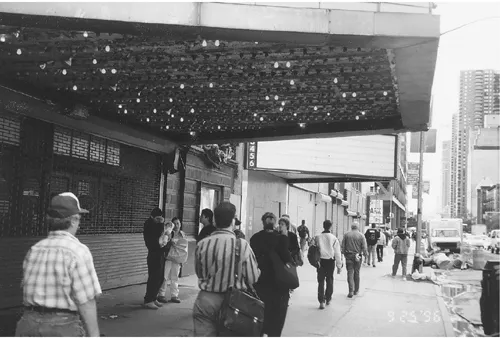
Looking west along the south side of Forty-second Street between Seventh and Eighth Avenues, beneath the marquee of another condemned movie theater.
For all the years I’ve watched others smile and smiled with them, something troubles me in all this. (Ben gives his age as seventy-two; but his hair’s still black. Most people wouldn’t put him at sixty.) It isn’t Ben. Back and forth over the boundary between unacceptable harassments and protestations of admiration, sometimes three or four times a minute, his agile leaps are a virtuoso performance by an astute observer of the streets (one moment leering fondly down at the prostitute ambling along the gutter and, an instant on, gazing with articulate awe up at the pedestal on which his interpellation has replaced her so quickly that the ride is, for her, even as it’s over, a moment on the city’s cultural Tilt-a-Whirl), and on a street that can boast of being the most famous in America: Forty-second Street.
What bothers me in Ben’s routine is where the boundary sits. Ben didn’t put it there. But does his witty and always slightly disorienting performance help erase it? Or does that performance inscribe it more deeply? Honestly, I can’t tell. Perhaps it does some of both. Let’s go around the corner.
In these autumn days of September and October, for those who recall the Deuce from even two or three years ago, walking along Forty-second Street from Eighth to Seventh Avenue is an odd experience. Once, more than half a dozen movie houses ran till near eleven P.M. Till ten, selling cameras, boom boxes, calculators, phone-answering machines, faxes, and camcorders, guys lingering in the glass doorways would ask you what you were looking for. When you stopped at the window, they’d cajole, “No, come on in! Come in. Come on inside. We’ve got it for you!”
Fast-food joints alternated with flashy clothing stores. On display dummies, striped, black, or polka-dotted fare sported gold chains and purple handkerchiefs blooming from breast pockets. In the middle of the block was Modell’s Sporting Goods. Toward the Eighth Avenue end, sandwiched between the subway arcade and the Georgia Chicken Kitchen, a mini-grocery sold sodas and beer at only a dime per can more than you’d pay around the corner.
Today they’re gone. Even the Jennie Holzer haikus that, for a season, decorated the silent marquees (“All art is either / revolution / or plagiarism”; “In Greenwich Village / a tourist asks directions / to Greenwich Village”) and the theater fronts turned into mournfully playful art (behind the glass doors of one, under little spotlights, shoes fixed to the floor led off between diaphanous white gowns; at another, in the display window a video projection of a huge red mouth lipped vaguely suggestive phrases: “I’ve got it for you. Come here, this is it. Here it is, what you’re looking for”) have been dismantled. Painted purple, orange, blue, and red, corrugated metal gates are down over all the storefronts from the block’s west end to . . . well, to about the three-quarters point. After that, there’s the New Victory Children’s Theater, just opened, its pyramidal entrance jutting into the sidewalk’s center. Already, east of the New Victory, across from the Disney Store, glass and gray facades striped with red and blue neon hint at Times Square’s new look. On the corner of Seventh, Ferarra’s sells coffee and pastry; Shade sells (of course) sunglasses and sun hats; and Dapy proffers a variety of tourist junk. On the other side of the street, the largest theater on the strip, the New Amsterdam, is currently being gutted. This is the work of the Forty-second Street Development Project, the best-known and most visible member of which is the Walt Disney Company.
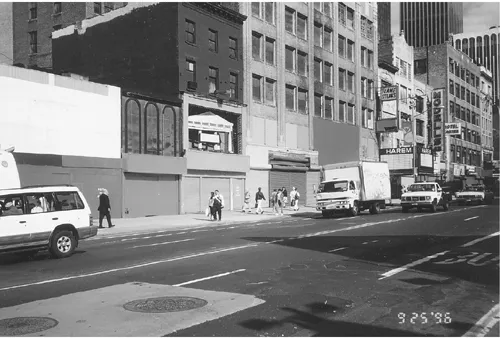
Standing just in from Eighth Avenue, at about eleven in the morning, September 25, 1996, looking east along Forty-second Street’s north face. Metal gates, painted orange, red, purple, and yellow, are down in front of the vacated stores, in preparation for demolition, which will start in a few months. Most of the stores here sold radios, calculators, camcorders, and electronic gadgets. At least one sold secondhand men’s magazines. The marquee of the Harem, a porn theater for more than a decade and scheduled for destruction, is visible to the right, just west of Modell’s Sporting Goods.
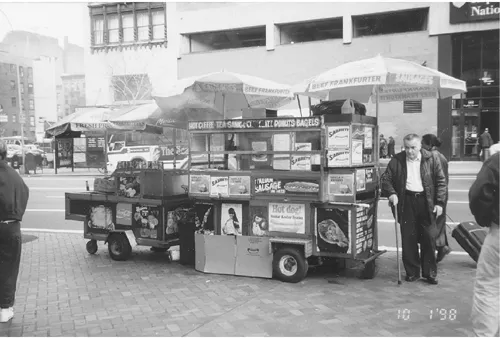
From eight-thirty to ten-thirty A.M. and, back the other way, from fourthirty to six-thirty P.M., thousands on thousands of working men and women pour across it. The rest of the time, today, it’s all but empty. A four-stool hot dog and knish stand still holds on under the right side of the Selwyn Theater marquee: the Grand Luncheonette. There over half a century, maybe it’s got another year. Across the street, office workers are still in and out of the twenty-threestory Candler Building. But the guys in their tank tops and baseball caps who used to hang out toward the Eighth Avenue end, in front of Ben’s portable stand, walking up beside you as you pass (sotto voce: “Loose joints, Valium, black beauties . . . ’Ludes . . . Sen’similla . . .” or whatever was going on the street that day), are gone.
Across the avenue, diagonally south of Ben’s corner, Anthony Campbell has worked as a taxi dispatcher at the Port Authority for ten years. At the curbside booth on the southwest corner of Forty-second Street and Eighth, just under the Port’s girdered marquee, sometimes he sits, sometimes he stands. Over pedestrian and car traffic noise, he shouts at the taxis, calls to the passengers: “Come on, right here! Yeah! That one—take that one.” In slow stretches, he can conduct things from his stool inside his booth. During heavy traffic hours, he’s up in the street and striding about, his gesturings and signalings providing him an aerobic workout. At the curb, the yellow cab file gets longer or shorter. Behind the chains, the passenger line lengthens and contracts. Has the shutting down of Forty-second Street changed the amount of taxi business? Campbell hesitated a moment, then spoke slowly and thoughtfully. “No, not really.” Well, has it changed the kind of people he gets cabs for? “No. It hasn’t. There’re not many changes so far.” What changes did he see for the future? “There may be some when it’s finished, once they get the new movies in.”
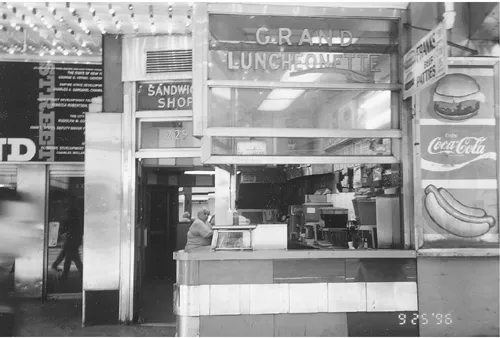
Established sometime around World War II, selling hot dogs, hamburgers, coffee, and knishes, the Grand Luncheonette operated under the right side of the Selwyn Theater marquee on the north face of Forty-second Street between Seventh and Eighth Avenues. It would be demolished when the Selwyn was pulled down.
What Campbell’s uninflected observations index is the consistency to the traffic in and out of the Port. The vast majority of that traffic is working folk who have to hoof it, morning and evening, across the strip or up and down Eighth Avenue to get to their job. Part of it is made up, yes, of tourists on their week or weekend in the city with a night or two at a Broadway show. But, at least at the taxi-taking level, they’re not the indigenous New Yorkers who used to come in on subway, city bus, or foot to see the movies or to buy from the electronics shops that dominated that so-famous block running off it to the east.
I stepped from the taxi dispatcher’s booth to one of the vendors, Christos, a stocky southern Mediterranean with a walrus mustache. I’ve been buying shish kebabs from his covered aluminum cart for a decade now. His meat is good. His licenses are up to date. Asking him the same questions I’d asked Mr. Campbell, I got much the same answers. But tell me, I persisted, what kind of people do you see out here on the corner?
Christos grinned. “You know the kind of people who hang out around here.”
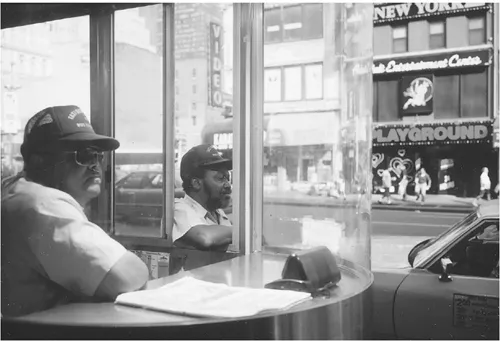
Taxi dispatcher Anthony Campbell stands by a dispatcher’s booth at the Port Authority, while a workmate sits, as cabs pull up to the curb.
A shish kebab wagon stands at the southwest corner of Forty-second Street and Eighth Avenue, on the corner of the Port Authority bus station.
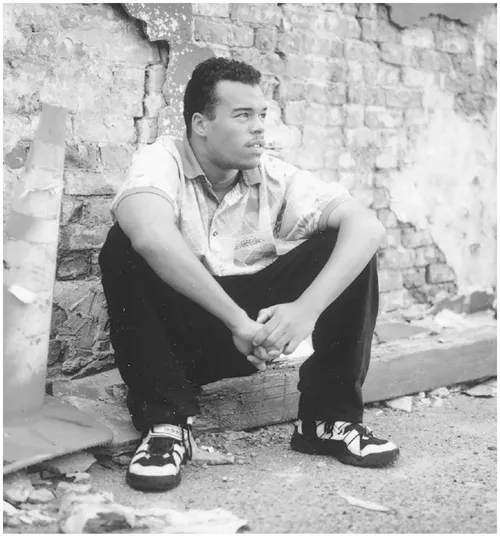
Sometimes you’ll find Darrell Deckard on that corner—a good-looking black man of twenty-six. Mother from Missouri, father from Georgia, Darrell (if you look in his direction long enough, and no cops are around) might reach between the legs of his baggy black jeans and casually squeeze his crotch in a way that could mean he was just scratching, but that also shows what’s under the denim. If you smile, he might smile back, come over, and start a conversation. What’s he doing out here?
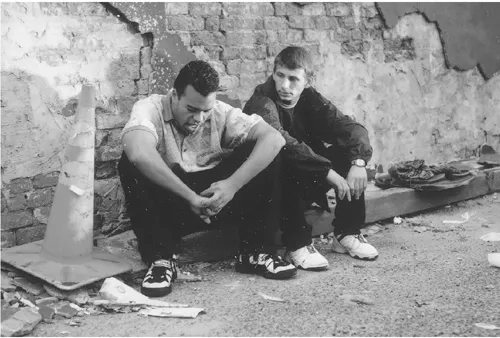
“I’m a hustler, man. What do you think I do?” Darrell is friendly, straightforward, sharp, and doesn’t beat around the bush. “Who’s got time for that? I’m out here sellin’ it, man, to make me some money! How long have I been here . . .? I’ve been working out here about two years.” What changes has Darrell seen since the Deuce closed down? “More police; and less money! People be scared now, you know what I’m sayin’? They stay home. Makes you wanna get a regular job. They be hustlers out now, but they can’t stay in one place.” (Darrell excused himself to help a guy having beeper trouble. A minute later he was back, after a quick confab with one of his regulars—a middle-aged black man in a white sweatshirt, white gym pants, and white cap, with gold-rimmed granny glasses.) “See, they got cops hidin’ in all the peep shows. They got the Public Morals Squad out here—whatever the fuck that means.” As we strolled half a block west to a parking lot in which to take his picture, Darrell collared a white friend, Dave—shorter, leaner, scruffier (and Dave’s eyes don’t look in quite the same direction): “Hey, man—run up there for me, and tell my guy that I’ll be back in a few minutes.” Which guy, Dave wanted to know. “Go on, man! Go on—you know who he is. You’ve seen me with him before.” So Dave ran off—and was back in five.
Forty-second Street hustlers Darrell Deckard and David Rosenbloom take a few minutes out from work, to sit by a parking lot wall near Ninth Avenue.
Darrell demanded: “Did you tell
’im?” “I told somebody!” Dave explained.
Twenty-eight, Dave hustles too. While we set up our camera, Darrell and Dave mimed karate moves at one another and joked about the specific sexual services each sold. At one point Darrell broke up. “Man, that nigger wants a hit of crack so bad . . . I stopped smoking it, myself, last week. But that nigger—” meaning very white Dave—“will do anything for his hit!” Anything, here, meant sitting down to let himself be photographed too, for the fifteen dollars we offered him for his time and his signature on the model release. Then Dave was gone!
What changes did Darrell see coming, once the renovations were complete? “You just have to wait, man. See what happens, know what I’m sayin’? There’s no way to tell.”
I cited what another young man had told me only a week ago on the same corner: Isn’t everything moving to Thirty-fourth Street, with the action going into the peep shows down there?
“No, man—that was before! This week the cops have been cracking down on people even there! That’s why I’m up here.” As we returned to the Eighth Avenue corner, Darrell looked around for his regular. “He must have found someone else. Well, I know him. He’ll be back. I’ll get ’im next time, don’t worry!” Darrell was off into the crowd.
As I got ready to stroll north, a dark hand fell on my shoulder. “Hey, man—upstairs, in the rest rooms?” It’s a scrawny, wholly unexceptional looking black man in his late thirties named Jeff. On the street, other than to note that he’s probably homeless, you wouldn’t give him a second look. In a public rest room, at Penn Station or at Port Authority, however, when he stands before a urinal, slouched a leisurely eight to ten inches back from the porcelain fixture, I’ve never seen anyone not at least glance in his direction—astonished, with opened mouth and blinking eyes. “They got the cops hidin’ in the booths, looking out at what goes on—or holin’ up in the service closets, looking through the slit in the door. Pulled me in twice last week. So you watch out there, now. Just thought you’d wanna know . . .”
Darrell Deckard on Forty-second Street.
“Thanks, Jeff . . .”
He shambled south.
For those interested in hard-edged figures: Darrell asks forty or fifty but will sneak into a peep show booth with you long enough for one of you to come for twenty—and he’s a very busy man. Jeff starts at twenty—and he probably makes a more consistent living.
The nostalgic approach sees all these silent red and green and purple window gates, these dead and wordless movie marquees, as the end of an era, marked by the dispersal of so many of the sexual businesses we haven’t really mentioned yet. It’s been a licentious and lively area since before the New York Times moved into Times Tower and, in 1904, persuaded the city to change the name from Longacre Square, before, in 1912, transferring to its current Forty-third Street location. An acquaintance with New York’s history suggests, however, that we are not so much at an end. Rather, we’re at the midpoint in a process parts of the city have undergone many times. Its fundamental principle was articulated succinctly by former police chief William McAdoo in 1906 (a year after Anthony Comstock shut down George Bernard Shaw’s Mrs. Warren’s Profession on Broadway and a year before he forced Richard Strauss’s Salomé to close at the Met, both after a single performance): “As everyone knows, the city is being rebuilt, and vice moves ahead of business.”
The opening of the old Metropolitan Opera House at Broadway and Seventh Avenue in 1883 first brought vice up from Mercer Street and the lower parts of Greenwich Village, where the rising rents were driving out the houses of prostitution, so that only industrial businesses could afford those downtown locations. In 1889 court testimony revealed that Nathan Niles, then president of the Tradesmen’s National Bank, owned a brothel on West Forty-third Street, run by the “French Madame,” Elize Purret. The same year the Times came, 1904, the Interborough Rapid Transit opened the subway system, with its nickel fare (no tokens—or metrocards—back then) that lasted into the fifties. Feeding into the city just to its west, with its opening in 1937, the Lincoln Tunnel only added to the value. With a smaller version first swinging wide its doors in 1950, the now block-long pair of Port Authority buildings simply assured that this would be the city’s incoming traffic center for years. With the theater district to the north and its central location on Manhattan Island, it was a developer’s dream.
...