Inside the life of a hacker and cybercrime culture.
Public discourse, from pop culture to political rhetoric, portrays hackers as deceptive, digital villains. But what do we actually know about them?
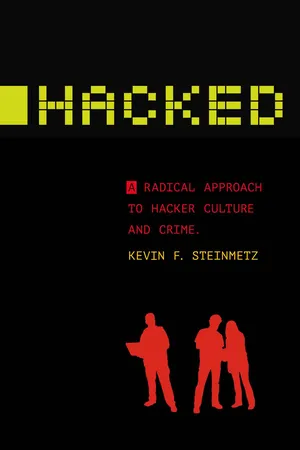
In Hacked, Kevin F. Steinmetz explores what it means to be a hacker and the nuances of hacker culture. Through extensive interviews with hackers, observations of hacker communities, and analyses of hacker cultural products, Steinmetz demystifies the figure of the hacker and situates the practice of hacking within the larger political and economic structures of capitalism, crime, and control.This captivating book challenges many of the common narratives of hackers, suggesting that not all forms of hacking are criminal and, contrary to popular opinion, the broader hacker community actually plays a vital role in our information economy. Hacked thus explores how governments, corporations, and other institutions attempt to manage hacker culture through the creation of ideologies and laws that protect powerful economic interests. Not content to simply critique the situation, Steinmetz ends his work by providing actionable policy recommendations that aim to redirect the focus from the individual to corporations, governments, and broader social issues.
A compelling study, Hacked helps us understand not just the figure of the hacker, but also digital crime and social control in our high-tech society.
- 288 pages
- English
- ePUB (mobile friendly)
- Available on iOS & Android
eBook - ePub
About this book
Information
Part I
Setting the Stage
1
The Front End of Hacking
To provide a holistic account of hacking, one should start from the beginning, so to speak. This analysis therefore begins by examining factors associated with growing up as a hacker (see also Bachmann 2010; Holt 2009, 2010a; Schell, Dodge, and Moutsatsos 2002; Schell and Holt 2010).1 Subsequent chapters will pull readers upward through levels of analysis, building towards a broad political economic, or structural, discussion of hacking.
Two areas of hackers as individuals are explored through semi-structured interview data with insights from ethnographic participant observation (see the book’s introduction). The first includes demographic characteristics including age, race, gender, perceived social class, and occupation. Developmental factors that potentially influential in participants’ maturation as hackers are then discussed. These factors involve educational experiences, perceived influences and levels of support provided by parents, as well as first exposures to technology, the concept of hacking, and the hacking community. As argued here, these factors are potentially significant catalysts toward becoming a hacker. Though other elements are explored, this analysis concludes that hacking is a heavily class-based phenomenon, with most hackers being culled from the ranks of the middle class. Tables 1.1 and 1.2 provide summaries for many of the background characteristics and developmental factors discussed in this study.
Demographic Characteristics
The analysis of hacker backgrounds begins with a description of general demographic characteristics: age, family status (marital status, children), self-perceptions of social class, occupation, and educational background. While the primary contribution of this chapter is to consider hacking as a middle-class phenomenon, this section includes expanded discussions of the race and gender disparities found within Union Hack and the hacker community more generally. Class is not the only form of social stratification and such flagrant disproportionalities in race and gender worthy of at least a momentary discussion in their own right. While the frequencies provided are based on the interview data, observational study of DEF CON 21 participants also supports the general demographic distribution in this sample. These findings also parallel previous research on the age, race, gender, marital status, and education of hackers (Bachmann 2010; Schell, Dodge, and Moutsatsos 2002; Schell and Holt 2010; Taylor 1999).
Table 1.2. Demographic and Background Characteristics (cont.)*
| Name | Socio-Economic Class Growing Up | Father’s Occupation | Mother’s Occupation | First Exposure to Computers or Similar Technology (Age or period) | First Exposure to Idea of Hacking (Age or period) | First Exposure to Hacker Community (Age or period) |
|---|---|---|---|---|---|---|
| Aidan | Middle | Automotive mechanic | Respiratory therapist | ~5–7 | ~12–14 | ~13 |
| Danny | Middle | Engineer (Ph.D.) | Jeweler | ~10–11 | Seventh grade | ~Seventh grade |
| Gilbert | Middle | Food scientist | Teacher | Elementary school | Before junior high | College |
| Harvey | Middle | “The professions” | Homemaker | ~6 | Before age 14 | Early 1980s |
| Jensen | Middle | CPA | Portrait artist | Grade school | During college | 1970s (with phone phreaking) |
| John | Middle | Stay-at-home parent | Lab technician | ~5–6 | Ninth grade | Twelfth grade |
| Keith | Middle | Computer programmer | Stay-at-home parent | ~6–7 | End of elementary school | ~24 |
| Miles | Upper-Middle | Middle-management | Stay-at-home parent | ~Kindergarten | ~12–16 | Late 1980s |
| Pete | Middle | Marine | Stay-at-home parent/book retail | ~6–8 | Childhood | ~16–17 |
| Raj | Upper-Middle | Medical doctor | Beautician | ~12 | ~7 | ~26 |
| Rick | Upper-Middle | Engineer | — | Elementary school | High school | High school |
| Roger | Middle | Software engineer | Office sales | ~8 | Teenage years | Teenage years |
| Russell | Middle | Automotive mechanic | Mortgage company employee | ~9–10 | ~12–14 | 21 |
| Susan | Lower-Middle to Middle | Computer engineer | Homemaker | ~4–5 | Unsure | College |
* Some participants were vague or unwilling to be specific on certain demographic characteristics. Thus, approximations are presented for some (designated by ‘~’). In addition, some participants did not volunteer certain information. In these instances, the entry is left blank.
Table 1.1. Demographic and Background Characteristics*
| Name | Age | Race/Ethnicity | Gender | Education | Occupation/Field | Marital Status | Has Children |
|---|---|---|---|---|---|---|---|
| Aidan | 27 | White | Male | Associate’s | Field technician | Married | No |
| Danny | 23 | White | Male | In college | Computer security** | Single | No |
| Gilbert | 24 | White | Male | Bachelor’s | System administrator | Single | No |
| Harvey | 41 | White | Male | Bachelor’s | Independent IT consultant | Married | No |
| Jensen | 61 | White | Male | Bachelor’s | Technician/contractor | Married | — |
| John | 30 | White | Male | Some college | Web hosting manager | Married | No |
| Keith | 27 | White | Male | In college | Technician | Single | No |
| Miles | 37 | White | Male | Some college | Security research scientist | Single | No |
| Pete | 35 | White | Male | Honorary doctorate (otherwise, no advanced degrees) | Computer security researcher | Divorced | Yes |
| Raj | 37 | Indian | Male | Master’s | Software development (customer-facing) | Single | No |
| Rick | 50 | White | Male | Bachelor’s | Software engineer | Married | Yes |
| Roger | 27 | White | Male | In college | Retail | Single | No |
| Russell | ~30 | White | Male | Bachelor’s | IT technician | Married | Yes |
| Susan | ~37 | White | Female | Bachelor’s | IT management | Divorced? | Yes |
* Some participants were vague or unwilling to be specific on certain demographic characteristics. Thus, approximations are presented for some (designated by ‘~’). In addition, some participants did not volunteer certain information. In these instances, the entry is left blank.
** As this participant is currently in school working towards a career goal, the occupation listed here is aspirational. Other participants in school, however, are currently employed in areas related to technology.
Age
The age of participants in this study ranged from 23 to 61 years old with an approximate average of 34.71 and a median of 32.5 (some participants only gave approximate ages). As evidenced here, the members of Union Hack come from a wide arrangement of generations—perhaps a relatively unique feature of a group subjected to criminological inquiry. The oldest subject interviewed was Jensen. With grey hair, an easy demeanor, and an intensely deep knowledge of hacker history and technological lore, he grew up in a time before computers, becoming acquainted with technology through radio and audio equipment. Danny was the youngest participant interviewed. At age twenty-three, he was a spirited and anarchistic hacker who was born in an age overrun with computer technology (the Internet was almost always a part of his life). Though Danny was the most junior of the hackers interviewed, that is not to say there are not younger hackers. As will be discussed, many hackers get involved in technology early in life. Many children and teenagers were observed participating in hacker culture during the course of the field research. Some of the older participants even brought their children to enculturate them into the hacker community. For ethical considerations, these minors were not interviewed.
As previously argued, not all hackers conform to the stereotypical image of the computer vandal. Those who have engaged in illegal activities or otherwise got themselves into trouble did so when they were much younger, typically during adolescent years through early twenties (see Yar 2005). Such results are unsurprising, however, as this is consistent with prior research on the age-crime curve (Gottfredson and Hirschi 1990). Self-identification with the hacker community also does not seem to correlate with level of involvement in criminal activity. In other words, self-identification as a hacker does not appear to hinge on previous or current involvement in computer crime. For those hackers who do engage in criminal activity later in the life course, there appears to be variation in frequency and duration of offending, with some drifting in and out of illicit activity over time.
Family Status
Hackers are often stereotyped as anti-social loners, spending hours in front of a computer monitor in lieu of human interaction. Ignoring that such a stereotype is rendered problematic by the presence of the hacker community (and evident in the volume of loquacious and sociable individuals I met over the course of the research), this perception is further eroded by the presence of marital and familial ties, like parenting, present among the interviewees and further noted in observations. Just like most other groups, hackers as social creatures who may seek affection, intimacy, camaraderie, and even familial bonding (Coleman 2010, 2013). In this study, five of the interview participants were married at the time of research with two being either divorced or separated from long-term relationships. Of the unmarried or never married, four are under the age of 30—an age group where being unmarried is more likely generally. Additionally, four of the interviewees had children. One of the interview participants, in fact, was the son of an older participant.
Socio-Economic Status
In a finding that will be revisited again towards the end of this chapter (and will reemerge in part 2 of this book), all of the interview participants in this study perceived themselves as members of the middle class or some variant thereof in this study. Of course, most persons—regardless of their actual socio-economic position in society—tend to regard themselves as middle class. It would make sense, however, that hackers tend to be of the middle class because of the relative privilege such economic positioning affords. In addition, the following two subsections concerning occupation and educational attainment are associated with such class positioning. Even among hackers who engage in illicit activity, middle-class stationing is apparent. Consistent with research on juvenile delinquency, white-collar crime, drug use, and other areas of criminological inqury, criminality is not the exclusive purview of the poor.
Occupation
At the time of research, ten interviewees were employed in legitimate technology sector occupations including systems administration, programming, and technician work. One participant was in school (otherwise unemployed) and working towards a job in computer security at the time of study. Two participants, while their jobs did not involve technical work directly, were employed in management and customer relations in technology industries. One participant held a non-technical retail job. In general, though, the participants held occupations compatible with their interests in technology and hacking. If they did not, then they at least professed a desire to work in such an area. While not an absolute, hackers have a tendency to gravitate toward white-collar jobs. Though only gleaned through observation, it appeared that younger hackers, however, much like their non-hacker peers, are still likely to work in menial or service sector jobs when employed. Such are the disadvantages of youth in the contemporary job market.
Educational Attainment
Unlike many populations characterized as criminal or deviant, the hackers in this study were relatively educated. All of the interviewees had acquired some form of higher education with the exception of one who subsequently was awarded with an honorary doctorate. At the time of the study, two persons had attended some college, three were enrolled in college, one had attained an Associate’s degree, six had Bachelor’s degrees, and one had a Master’s degree. These results are mirrored in the demographics research conducted by Michael Bachmann (2010) and Bernadette Schell, John Dodge, and Steve Moutsatsos (2002). The disproportionately high attainment of higher education degrees may be, at least partially, a result of economic privilege (see Reay et al. 2001). While many of the participants had some form of higher education, participation in these institutions is not necessary for inclusion in the hacker community. As Raj, one of the participants, explained, “The good thing about programming is that some of the best programmers I know don’t have a college degree. Some of the best hackers out there don’t have a college degree.” Regardless, there appears to be a connection between education attainment and participation in hacker culture.
Race
As noted in other studies, this examination similarly found a tremendous racial representation gap among hackers (Bachmann 2010; Schell, Dodge, and Moutsatsos 2002; Schell and Melnychuk 2010; Söderberg 2008; Taylor 1999). Thirteen interviewees were white with one person being of Indian (non-Native American) descent. The conclusion drawn here is that the majority of members of the hacker community appear to be white. Similarly, observations made during field research seem to support such conclusions. Of course, the distribution presented here also belies some of the diversity present in the community. While observational data seem...
Table of contents
- Cover
- Title Page
- Copyright Page
- Dedication
- Contents
- List of Figures and Tables
- List of Abbreviations
- Acknowledgments
- Introduction: Toward a Radical Criminology of Hackers
- Part I. Setting the Stage
- Part II. The Radical Turn
- Appendix: Field Research Lists
- Notes
- References
- Index
- About the Author
Trusted by 375,005 students
Access to over 1.5 million titles for a fair monthly price.
Study more efficiently using our study tools.
Frequently asked questions
Yes, you can cancel anytime from the Subscription tab in your account settings on the Perlego website. Your subscription will stay active until the end of your current billing period. Learn how to cancel your subscription
No, books cannot be downloaded as external files, such as PDFs, for use outside of Perlego. However, you can download books within the Perlego app for offline reading on mobile or tablet. Learn how to download books offline
Perlego offers two plans: Essential and Complete
- Essential is ideal for learners and professionals who enjoy exploring a wide range of subjects. Access the Essential Library with 800,000+ trusted titles and best-sellers across business, personal growth, and the humanities. Includes unlimited reading time and Standard Read Aloud voice.
- Complete: Perfect for advanced learners and researchers needing full, unrestricted access. Unlock 1.5M+ books across hundreds of subjects, including academic and specialized titles. The Complete Plan also includes advanced features like Premium Read Aloud and Research Assistant.
We are an online textbook subscription service, where you can get access to an entire online library for less than the price of a single book per month. With over 1.5 million books across 990+ topics, we’ve got you covered! Learn about our mission
Look out for the read-aloud symbol on your next book to see if you can listen to it. The read-aloud tool reads text aloud for you, highlighting the text as it is being read. You can pause it, speed it up and slow it down. Learn more about Read Aloud
Yes! You can use the Perlego app on both iOS and Android devices to read anytime, anywhere — even offline. Perfect for commutes or when you’re on the go.
Please note we cannot support devices running on iOS 13 and Android 7 or earlier. Learn more about using the app
Please note we cannot support devices running on iOS 13 and Android 7 or earlier. Learn more about using the app
Yes, you can access Hacked by Kevin F. Steinmetz in PDF and/or ePUB format, as well as other popular books in Social Sciences & Criminology. We have over 1.5 million books available in our catalogue for you to explore.