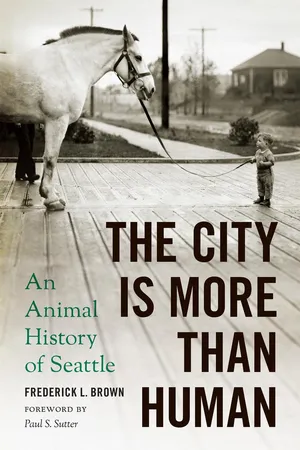
Winner of the 2017 Virginia Marie Folkins Award, Association of King County Historical Organizations (AKCHO) Winner of the 2017 Hal K. Rothman Book Prize, Western History Association Seattle would not exist without animals. Animals have played a vital role in shaping the city from its founding amid existing indigenous towns in the mid-nineteenth century to the livestock-friendly town of the late nineteenth century to the pet-friendly, livestock-averse modern city. When newcomers first arrived in the 1850s, they hastened to assemble the familiar cohort of cattle, horses, pigs, chickens, and other animals that defined European agriculture. This, in turn, contributed to the dispossession of the Native residents of the area. However, just as various animals were used to create a Euro-American city, the elimination of these same animals from Seattle was key to the creation of the new middle-class neighborhoods of the twentieth century. As dogs and cats came to symbolize home and family, Seattleites' relationship with livestock became distant and exploitative, demonstrating the deep social contradictions that characterize the modern American metropolis. Throughout Seattle's history, people have sorted animals into categories and into places as a way of asserting power over animals, other people, and property. In The City Is More Than Human, Frederick Brown explores the dynamic, troubled relationship humans have with animals. In so doing he challenges us to acknowledge the role of animals of all sorts in the making and remaking of cities.
- 352 pages
- English
- ePUB (mobile friendly)
- Available on iOS & Android
eBook - ePub
About this book
Information
NOTES
INTRODUCTION
1 Salmon Bay is perhaps the most prominent feature named for an animal today. Other such features exist, but are not widely known, such as Deadhorse Canyon and Wolf Bay.
2 Thrush, Native Seattle, 219–55; the X in Xwulch sounds like the German ch.
3 U.S. General Land Office, “Land Status and Cadastral Survey Records: Field Note Records,” cadastral survey field notes, 1862, Township 24 North, Range 3 East, available at Bureau of Land Management, www.blm.gov.
4 Scholars who address this paradox include Francione, Introduction to Animal Rights, 1; Howell, At Home and Astray, 176; Herzog, Some We Love, Some We Hate, Some We Eat, 7–10, 238–42; and Joy, Why We Love Dogs, Eat Pigs, and Wear Cows, 11–21.
5 Hoquet, “Animal Individuals,” 68.
6 I use the term pet throughout this book to refer to domestic animals kept primarily as companions or for other nonutilitarian reasons. I use the term livestock to refer to domestic animals kept primarily for their labor or for the production of meat, milk, eggs, honey, or wool. I am aware that the use of these terms runs the risk of reducing animals to the categories by which humans define them, yet the usage is difficult to avoid precisely because these categories are so important to the humans and animals considered here.
7 Recent overviews of urban history include Mohl and Biles, “New Perspectives in American Urban History,” 343–448; Katz, “From Urban as Site to Urban as Place.”
8 Cronon, Nature’s Metropolis; Hurley, Environmental Inequalities; Klingle, Emerald City; Sellers, Crabgrass Crucible; Isenberg, Nature of Cities; Miller, Cities and Nature.
9 Emel and Wolch, “Witnessing the Animal Moment,” 16.
10 Mason, Civilized Creatures; Kete, Beast in the Boudoir; Jones, Valuing Animals; Grier, Pets in America; Sanders, “Animal Trouble”; McNeur, Taming Manhattan; Wang, “Dogs”; Biehler, Pests.
11 Important edited volumes include Philo and Wilbert, Animal Spaces, Beastly Places; Wolch and Emel, Animal Geographies; and Brantz, Beastly Natures. See also, Wolch, “Anima Urbis”; Shaw, “A Way with Animals”; Coleman, “Two by Two.”
12 Philo, “Animals, Geography, and the City”; Anderson, “Animals, Science, and Spectacle in the City”; Jennifer Wolch, “Zoöpolis.”
13 Atkins, “Animal Wastes,” 46; Watts, “Afterword: Enclosure,” 293 (emphasis in the original). The concept of sorting is certainly akin to Bruno Latour’s notion that people struggle, fruitlessly, to purify nature and culture one from the other, when ultimately the two are inseparable (We Have Never Been Modern).
14 Philo, “Animals, Geography, and the City,” 52.
15 On space and place, see Lefebvre, La production de l’espace; Harvey, Condition of Postmodernity; Soja, Thirdspace; Smith, Uneven Development; Klingle, Emerald City, 4–5, 282n4.
16 Shaw, “A Way with Animals,” 11; Mitchell, Rule of Experts, 30, 45; Nash, “Agency of Nature, or the Nature of Agency?” 67–69.
17 Ingold, “On the Distinction between Evolution and History,” 11.
18 For instance, historian William H. Sewell Jr. argues that “agency, which implies consciousness, intention, and judgment, is a faculty limited exclusively to humans.” Comment in “Nature, Agency, and Anthropocentrism,” an online discussion about Ted Steinberg in “Down to Earth: Nature, Agency, and Power in History,” American Historical Review 107, no. 3 (2002), http://historycooperative.press.uiuc.edu/phorum/read.php?f=13&I=5&t=5. See also Gooding, “Of Dodos and Dutchmen,” 32–47.
19 One definition of agency in Merriam-Webster’s (10th ed.) is: “the capacity, condition, or state of acting or of exerting power.” One definition in the Oxford English Dictionary is: “The faculty of an agent or of acting; active working or operation; action, activity.”
20 This broad definition of agency, what some term the “agency of nature,” is used for example in the following: Mitchell, Rule of Experts, 30; Worster, “Seeing beyond Culture,” 1144. On actor-network theory, which proposes a broad definition of agency, see Latour, “Do Scientific Objects Have a History?” 76–91; Woods, “Fantastic Mr. Fox?” 199.
21 For a summary of many of these debates, see Kazez, Animalkind. See also Wasserman and Zentall, Comparative Cognition.
22 Smil, “Harvesting the Biosphere.”
ONE. BEAVERS, COUGARS, AND CATTLE
1 Curtis, Salishan Tribes of the Coast, 97–100; Miller, Lushootseed Culture, 11–13; Thrush, Native Seattle, 20–21; Eells, Indians of Puget Sound, 395, 410–11.
2 Entry dated May 12, 1833, Tolmie, Journals, 178–79.
3 Tolmie, Journals; Dickey, Journal of Occurrences.
4 Müller-Schwarze and Sun, Beaver.
5 Haeberlin and Gunther, Indians of Puget Sound, 25; Elmendorf, Structure of Twana Culture, 94; Larson and Lewarch, Archaeology of West Point, vol. 1, pp. 9–6 to 9–8.
6 Dickey, Journal of Occurrences, January 28, 1834, September 10, 1835.
7 Dickey, Journal of Occurrences, May 18, 1835.
8 Harmon, Indians in the Making, 13–42; Hyde, Empires, 89–145.
9 Vancouver, Voyage of Discovery, 2:229–30.
10 Boyd, Coming of the Spirit of Pestilence, 30–39, 57–58, 153–60, 262–78; Harris, Resettlement, 3–30; Klingle, Emerald City, 24; Igler, Great Ocean, 66–70.
11 Vancouver, Voyage of Discovery, 2:287.
12 U.S. Cour...
Table of contents
- Cover
- Title Page
- Copyright
- Dedication
- Contents
- Foreword: The Animal Turn in Urban History
- Introduction
- One Beavers, Cougars, and Cattle: Constructing the Town and the Wilderness
- Two Cows: Closing the Grazing Commons
- Three Horses: The Rise and Decline of Urban Equine Workers
- Four Dogs and Cats: Loving Pets in Urban Homes
- Five Cattle, Pigs, Chickens, and Salmon: Eating Animals on Urban Plates
- Conclusion
- Acknowledgments
- Appendix: Methodology
- List of Abbreviations
- Notes
- Bibliography
- Index
Trusted by 375,005 students
Access to over 1.5 million titles for a fair monthly price.
Study more efficiently using our study tools.
Frequently asked questions
Yes, you can cancel anytime from the Subscription tab in your account settings on the Perlego website. Your subscription will stay active until the end of your current billing period. Learn how to cancel your subscription
No, books cannot be downloaded as external files, such as PDFs, for use outside of Perlego. However, you can download books within the Perlego app for offline reading on mobile or tablet. Learn how to download books offline
Perlego offers two plans: Essential and Complete
- Essential is ideal for learners and professionals who enjoy exploring a wide range of subjects. Access the Essential Library with 800,000+ trusted titles and best-sellers across business, personal growth, and the humanities. Includes unlimited reading time and Standard Read Aloud voice.
- Complete: Perfect for advanced learners and researchers needing full, unrestricted access. Unlock 1.5M+ books across hundreds of subjects, including academic and specialized titles. The Complete Plan also includes advanced features like Premium Read Aloud and Research Assistant.
We are an online textbook subscription service, where you can get access to an entire online library for less than the price of a single book per month. With over 1.5 million books across 990+ topics, we’ve got you covered! Learn about our mission
Look out for the read-aloud symbol on your next book to see if you can listen to it. The read-aloud tool reads text aloud for you, highlighting the text as it is being read. You can pause it, speed it up and slow it down. Learn more about Read Aloud
Yes! You can use the Perlego app on both iOS and Android devices to read anytime, anywhere — even offline. Perfect for commutes or when you’re on the go.
Please note we cannot support devices running on iOS 13 and Android 7 or earlier. Learn more about using the app
Please note we cannot support devices running on iOS 13 and Android 7 or earlier. Learn more about using the app
Yes, you can access The City Is More Than Human by Frederick L. Brown in PDF and/or ePUB format, as well as other popular books in History & North American History. We have over 1.5 million books available in our catalogue for you to explore.