![]()
CHAPTER ONE
Eva Ryynänen
Karjalan Kukkiva Puu (The Flowering Tree of Karelia) and Continuity Uncovered
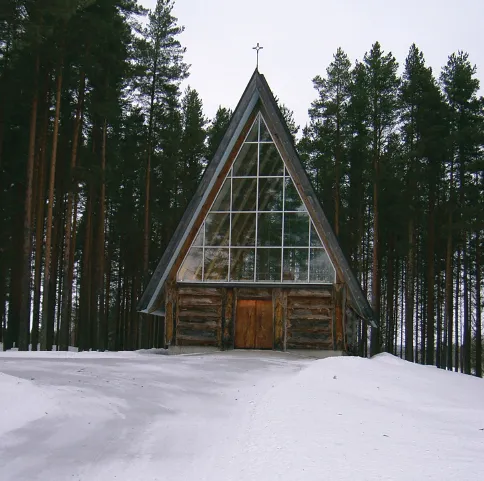
IN a quiet grove of towering pine trees, on a former farmstead on the outskirts of the village of Lieksa, in the Finnish district of North Karelia, stands a serene and welcoming church. Its creator, Eva Ryynänen (1915–2001), embraced wood as both an essential element of her personal religiosity and as a part of her Finnish national and cultural identity. In an overview of her art and philosophy that appeared several years after her death, Eva notes: “Maa on minun lähtökohtani. Ihminen on yhtä luonnon kanssa” (Simola, Tissari-Simola, and Repo 2004, 7), which translates as “The land is my source. The human being is one with nature.” The words maa and luonto employed in this statement possess a polysemy of great importance to Eva: maa means both “land” and “country,” so that Eva identifies her source simultaneously as both the natural landscape and the country of Finland in particular. Luonto means “nature” in the sense of the plants, animals, earth, and water that make up the deeply forested and lake-strewn landscape of North Karelia, as well as “nature” in the sense of a being’s personality and characteristics. To be one with both “nature” and with “one’s nature” is to fully realize oneself in the concrete context of one’s surroundings and one’s self. This, I will argue, is the fundamental message of Eva’s church (figure 1.1), her taitelijan temppeli (artist’s temple), built near her dairy-barn-turned-ateljé (workshop) on land that she lived on and loved for much of her long and richly rewarding career. As her statement implies, Eva’s religious views were broad and pantheistic, finding cultural expression in the Lutheranism of her society, but also always gesturing toward a view that recognized the inherent sacrality of tree or animal within the grand totality of the cosmos. As I hope to show in this chapter, Eva sought to uncover a continuity that binds Finns to a broader web of natural beings—all of whom, in their own way, acknowledge and offer praise to their Creator. To understand her work, I will touch upon the significance of forests and nature in modern Finnish culture and survey briefly some of the most ancient wooden expressions of sacred beings surviving in the Nordic-Baltic region. I will then offer a close examination of Eva’s remarkable church in light of this context and in relation to her career as one of the most successful artists in the medium of wood in twentieth-century Finland, a career summed up by the title of one of the important surveys of her work, Margit Laininen’s 1992 Karjalan Kukkiva Puu (The Flowering Tree of Karelia).
EUROPE’S MOST FORESTED COUNTRY
Forests, trees, and wood matter a great deal in the Nordic-Baltic region, geographically, economically, and culturally. This fact is particularly the case in Finland, where forests cover some 86 percent of the country’s overall terrain, earning it the title of Europe’s most forested country. Forestry represents the country’s second-largest industry, generating roughly 20 percent of its export revenues and more than 5 percent of its gross domestic product (Forest.fi 2009). Understandably then, forests have become important in the cultural representations of the country, both domestically and abroad.
It should be noted that this geographic and economic significance of forests masks to a certain degree the fact that the majority of Finns live today in urbanized environments, primarily in the southern tracts of the country. According to United Nations Common Database population estimates reported on the Globalis website, 61 percent of Finns live in urban areas, as compared with 83.4 percent of Swedes, 81 percent of Americans, and 89 percent of residents of the United Kingdom (United Nations 2009a; United Nations 2009b). The lower urbanization rate for the Finnish population does not mean, however, that Finland is “one huge forest with five million people hiding in it” as a 2009 New York Times article reported (2009). Arvo Peltonen (2002) points out that although the Finnish population distribution is sparse, at seventeen persons per square kilometer, the vast majority of the populace lives in areas where the population density hovers between thirty persons per square kilometer (the average for the entire southern coast region) to more than two hundred per square kilometer (the Greater Helsinki area). These statistics reflect the realities of life in this highly affluent, highly centralized Nordic nation, where an individual’s actual concourse with the forest may be limited to summer holidays, weekend mushroom or berry picking, and skiing vacations.
Figure 1.1. Eva Ryynänen’s chapel. The building as it stands today, on her farmworkshop Paateri, combines logs in a largely natural state with extensive glass to allow people inside the church to easily view the surrounding evergreen stand. Eva Ryynänen (Finnish, 1915–2001). Taitelijan Temppeli (1991). Wood, glass, steel. Lieksa, Finland.
Given the tendency of formal religion to address disparities between actual and ideal situations, forests and trees in particular can become very important in Nordic religious representations. Where urban life clearly represents the actual experience of many citizens, life in close association with the forest can be seen as an idyllic alternative existence, a respite from ordinary life. Heikki Ylikangas underscores this notion in his discussion of modern Finnish experiences of the forest: “Hän kokee sammumatonta kaipuuta sinne, missä ei ongelmia eli muita ihmisiä liiemmin ole, siis metsän yksinäisyyteen. Sinne hän pakenee …” (“The Finn experiences an unquenchable longing for a place where there are not too many problems, or in other words, people: that is, the solitude of the forest. There he flees …”; 1996, 41). Veikko Anttonen (1996a) describes the “Lutheranization” of the landscape, by which the shadows and isolation of the forest environment become a privileged site of personal reflection and transformation. The view of the forest as a refuge from the pressures and conflicts of ordinary social life, and as a privileged site of contemplation and meaning-making, lends the forest—and, by extension, trees and wood—powerful resonance for modern Nordic viewers, a resonance that underlies part of the effect and agenda of the artworks discussed below.
The personal significance of the forest suggested above exists in Finland alongside a specifically national significance as well. The forest as a national symbol has its roots in the nineteenth century and the intellectual milieu of political and cultural nationalism (Germundsson 2008; Lehtinen 2008; Mead 2008). As emerging Western nation-states searched for distinctive features of national history, culture, or economy to highlight in their self-portrayals to the wider world, Finland came to attach great significance to its natural landscape. The fact that outsiders regarded the country largely as wilderness contributed to this choice: the Italian traveler Giuseppe Acerbi, for instance, writes in the preface to his influential memoirs of his travels through Finland-Sweden in 1798–99 of the “novelty, the sublimity, and the rude magnificence of the northern climates” (1802, vi), elements that warranted a visit from someone even from the very center of European art and civilization, like himself. Johan Ludvig Runeberg’s poem “Vårt Land,” published as the preface to his Fänrik Ståhls Sägner of 1848 and eventually the text of Finland’s national anthem, makes warm and copious reference to the country’s natural terrain. Significantly, however, in its enumeration of the beauty of the natural landscape, the text makes no explicit mention of forests in any way. As Leea Virtanen has shown, nineteenth-century Finns tended to view the forest as unsightly and unavoidable, finding aesthetic value in the absence rather than the presence of trees. The notion of even sporadic plantings of trees near Finnish housing arose only in the latter half of the century, diffusing into the country as part of an aristocratic landscape aesthetic of forested parklands that had developed elsewhere on the continent (1994, 135).
By the end of the century, however, forestry had become a major industry in Finland, and images of forests and forest activities became increasingly more common and more positive in the arts and literature (DuBois 2005). Rural folk and lumberjacks became heroes of Finnish novels and plays, as in Aleksis Kivi’s Seitsemän Veljestä (1870), Teuvo Pakkala’s Tukkijoella (1899), and Johannes Linnankoski’s Laulu tulipunaisesta kukasta (1905). Zacharias Topelius’s Boken om Vårt Land (1875) enshrined the forest as part of the Finnish character and presented it as such to generations of Finnish schoolchildren. The image of the Nordic lumberjack became widely known in Scandinavian America as well, where the popularity of the image correlated with the historical reliance of immigrant Swedes and Finns on logging as a means of employment (Leary 2001). Images of Ole and Lena, Paul Bunyan and Husqvarna chain saws helped develop and sustain this trope of Nordic identity internationally, with significant popular, literary, and economic ramifications.
At the outset of the twentieth century, the forest and its most noticeable product, wood, also began to emerge as important elements in Finnish approaches to modern architecture, expressing national identity and an asserted Finnish “nature” in the loving embrace of wood as a medium (Pallasmaa 1994). In 1937 Alvar Aalto contributed to the rise of wood in functionalist architecture through the house he designed for Harry and Maire Gullichsen (Gaynor 1984, 37–43; Pallasmaa and Futagawa 1985). Aalto sought to echo nature in the forms and materials of his resulting Villa Mairea, incorporating wooden columns into his design that were meant to suggest the trunks of trees, and even wrapping steel columns in wood so as to make them appear more natural. The roof of the house’s sauna was covered in turf, and the interior spaces of the house made ample use of polished blond wood, cut in simple, smooth lines and covered with a clear finish. Local stone and brick were also employed in the interior, lending the home a rustic feel that contrasted with the villa’s refined lines and owners. The furnishings of the house were especially designed by Aalto’s wife, Aino. Her lamps, stools, chairs, and tables would eventually become the trademark items of Artek, an interior-decorating firm founded by the Aaltos and Gullichsens together with Nils-Gustav Hahl (Artek 2009). As Elizabeth Gaynor writes, “In Villa Mairea, Aalto achieved not only the bridge he sought between man and nature, but a harmony between man and manmade that was to have lasting impact on architecture in Finland and throughout the world” (1984, 41). Through Artek, Aino’s innovative designs literally became household items, eventually finding imitation in the works of many other Nordic designers, perhaps especially IKEA. Aalto’s furniture made frequent use of birch and pine, finished in clear synthetic coating, so that its color and grain would remain prominent. Eva Ryynänen’s church, as we shall see, draws on these associations broadly, linking the building both to notions of Finnish love of nature and to ideas of Finnish nationhood.
In terms of broader architectural planning, the Helsinki region’s postwar gardencity project Tapiola aimed to combine forest settings and urban life. Conceived of by Finnish social-welfare activist and philanthropist Heikki von Hertzen with a name drawn from the Finnish national epic Kalevala, Tapiola means “place of the forest god Tapio.” Yet the community was situated not in some distant Karelian forest tract but, rather, in convenient commuting distance from Helsinki. With its combination of apartment houses, single-family dwellings, and woodland, Tapiola represented for Finns of the twentieth century an idyllic fusion of the serene forest—now an established element of national identity and ideals—and the convenience and efficiency of stylish urban modernity. For Finns, it came to represent the core of what Frykman and Löfgren (1987), writing about Sweden, identify as the ideal of Nordic postwar modernity: a seamless unity between the technology and efficiency of the modern world on the one hand and the simplicity and humanity of the agrarian past on the other. As Frykman and Löfgren note, nature enjoyed a key place in Nordic postwar décors, but primarily as a clean, smooth, and lovely reworking of the rough surfaces and smells of the past. It is telling that the various municipal and architectural planners of Tapiola employ a name from the Finnish pagan past for this forest community, suggesting a linkage between the twentieth-century love of the forest and the ancient heritage and history of Finland.
In 1969 Helsinki’s church architecture came to partake of this new natural aesthetic through Temppeliaukio-kirkko, an underground church designed to occupy an open space in downtown Helsinki that had long been dominated by a single granite slab (Mehtälä 2003; see Figure I.4 in the introduction). Architects Timo Suomalainen (1928–) and his brother Tuomo Suomalainen (1931–1988) called for a pit to be blasted in the rock and for the resulting crater to be covered and fitted out as a church. Temppeliaukio-kirkko’s walls are formed of the natural granite of the once-unassailable rock, capped with a ceiling of copper and glass. Wooden furnishings inside the space lend it a warmth and intimacy that its creation would seem to make unlikely, and the resulting church has become one of the favorite tourist sites in Helsinki. On any given day, one can observe busloads of visitors from Europe, North America, and Asia all admiring the “rock church” for its technological innovativeness, beauty, and seeming acknowledgment of the essential sacrality of nature. The church’s unfinished pink and gray granite walls, as well as its furnishings of stone and wood, convey the idea that natural forms and objects are holy in and of themselves, even with minimal human alteration. Such treatments of natural materials in twentieth-century Nordic design and architecture became suggestive of the famed Nordic “Middle Way,” a humanized, privatized, aestheticized approach to socialism that embraced the common person and yet sought to propel this imagined citizen into the sleek and efficient modernity of postwar society (Reed 1998).
FORESTS, TREES AND SACRALITY IN THE PAGAN PAST
If twentieth-century architects and designers asserted an ancient esteem for wood and forests, their assertions were based in part on historical fact. At the end of the first century AD, the Roman writer Tacitus refers to sacred groves among the barbarian peoples to the north of the Roman empire (1999, chs. 39–40). The groves are sacrosanct: entry into them is strictly prohibited except in connection with specific ritual acts. Medieval texts as well as historical accounts from as late as the fourteenth century attest to the existence of sacred groves and trees in Nordic as well as Baltic tradition. In Baltic cultures, sacred groves were protected from all intrusion, and certain trees, particularly oaks, were regularly consulted for guidance regarding the future (Richardson 1998, 23). Bronze-Age Scandinavians buried their dead in oaken coffins already in the fourteenth century BC (41), and the Celts likewise considered the oak sacred (47). Examining the broader geographic and historical range of such practices, Anders Andrén notes accounts of oracular oaks that were associated with the Greek god Zeus at Dodona and consulted for more than a thousand years (2014, 39).
Basing his relations on travelers’ and missionaries’ reports, the eleventh-century Adam of Bremen describes the pagan temple at Uppsala (Bremen 2002, Book 4, xxvi, 207). A later hand (possibly Adam himself) includes a scholium that reads:
Near that temple there is a great tree whose limbs extend broadly and which remains green in both winter and summer; of what variety it is no one knows. (Bremen 2002, scholium 134)
The tree, evidently an evergreen, is said to stand near a spring used in divinatory rites. Adam also describes a sacred grove near the temple, which is said to have been the site of various sacrifices:
The bodies are hung in a sacred grove located near the temple. This grove is indeed so sacred to the gentiles that every single tree is believed to have become divine because of the death or rotting of the sacrificial victims. Dogs as well as horses hang there along with humans, whose suspended and mixed bodies have been described by a certain Christian eye-witness, some 72 years old. (Bremen 2002, Book 4, xxvii)
Anders Hultgård views these elements of Adam’s account as likely reflections of actual pre-Christian traditions at Uppsala (1997, 27).
Archaeological finds from the island of Frösö, Jämtland, Sweden, provide tangible evidence of pre-Christian tree rituals, at least in one locale. There, a sacrificial tree—a birch—regularly received the cremated remains of animal sacrifices until the tree was cut down and the site surmounted by a Christian church (Iregren 1989; Iregren 1999). Significantly, Frösö seems to have been an area of cultural hybridity, in which Norse ag...