eBook - ePub
The Secrets of Word-of-Mouth Marketing
How to Trigger Exponential Sales Through Runaway Word of Mouth
- 272 pages
- English
- ePUB (mobile friendly)
- Available on iOS & Android
eBook - ePub
The Secrets of Word-of-Mouth Marketing
How to Trigger Exponential Sales Through Runaway Word of Mouth
About this book
In the widely well-received first edition of The Secrets of Word-of-Mouth Marketing, author George Silverman provided readers step-by-step guidance with his innovative Decision Matrix for constructing a word-of-mouth marketing campaign that exponentially increases revenue. Now, extensively revised to reflect the profound changes in the marketplace--from new attitudes and communication methods, to new ways of relating to increasingly wary web and social media users--the second edition of this groundbreaking book shows readers how they can move beyond traditional approaches to identify potential buyers and compose the kind of message that inspires customers to spread the word about products and services. Featuring enlightening case studies and examples, The Secrets of Word-of-Mouth Marketing simplifies the process of choosing your delivery method, harnessing the power of influencers, and measuring results. Whether you're wondering how to navigate the latest digital media or interested in learning what Malcolm Gladwell got wrong, this helpful tool is still the ultimate word on word of mouth.
Information
Topic
CommerceSubtopic
Relations clientèlesCHAPTER 1
The Systematic Approach to Word of Mouth
If you are paying attention to what is going on in marketing, you will almost certainly feel disoriented and overwhelmed. I want to offer some perspective, reassurance, and encouragement. You are not alone. You are feeling the way everyone does in a revolution. And, we are experiencing several revolutions simultaneously.
The Digital-Information-Knowledge-Transportation-Communications-Internet-Marketing-Word-of-Mouth Revolutions
I’ll let you in on a little secret: No one fully knows what’s going on!
As writings during other revolutions show, it’s hard to see the significance of a revolution when you’re in the middle of it. It’s even harder to figure out what to do. History shows clearly that a significant number of people do nothing and get crushed by the people who panic, who are also crushed or, at least, badly injured. The ones who think and adapt usually survive. The visionaries prosper.
You cannot understand word-of-mouth marketing without the perspective of this broader context.
Some Perspective on Revolutions
There is a well-known pattern to attempts to gain perspective in the middle of revolutions, as shown in the following steps:
1. The insights, warnings, and predictions are ignored.
2. The predictors of the revolution are called ignorant, naïve, or crazy.
3. People in large organizations, who take the predictions seriously enough to investigate, are often fired.
4. The changes that start happening are denied outright.
5. The changes are said to be temporary signs of something else.
6. The changes are recognized, but they are called insignificant.
7. People say that the predicted changes were obvious and inevitable all the time.
8. People blame the experts for not seeing what was “obvious.”
9. The experts, of course, say that they knew it all along but no one would listen.
All of this rationalization and denial is compounded by some strong cognitive biases:

The Secret to Surviving and Prospering in a Revolution
I’ve learned that it’s important to resist the false choice between clinging to the status quo and jumping into the sea of change. The better choice is to fly above the sea of change. Not so high that you get into the clouds, but high enough that every little wave isn’t so distracting that you can’t see what’s ahead.
The most useful principle I’ve learned to cope with all the change and uncertainty from inside the revolutions is that we learn at the edge of our own incompetence and ignorance. We have to step right up to the edge of what we don’t know and become involved, but not submerged. In doing this, people feel stupid and inept, but people who try to avoid ever feeling stupid and inept don’t learn.
So, we’ll ask a lot of “stupid” questions and struggle with partial, inadequate answers, try a lot of things that don’t work out, and profit hugely from the few that do.
I’m reminding you of all this to try to immunize you. I hope you will embrace the struggle to understand a world that’s changing on so many levels at the same time.
In the first edition of this book, I made the following predictions that sounded wild at the time:
The Word of Mouth Marketing Association (WOMMA) was founded. New techniques were exchanged. Stories of intentional stimulation of word of mouth became commonplace. Ethical standards were issued. Agencies were founded. And, sadly, many opportunists and con artists became attracted to word-of-mouth marketing once they realized its power and potential for manipulation. In other words, the industry I predicted was formed.
When the first edition was published, limited media were available for implementing word-of-mouth marketing. I had to search for examples, using more pharmaceutical industry and teleconferencing techniques than I would have liked because only that industry had embraced word-of-mouth marketing—and the industry used my teleconferencing techniques as its main tool.
Now the number of options is overwhelming, even to people in the new word-of-mouth industry. By the time you read this book, there will be hundreds of new social networks, mash-ups, websites, apps, platforms, categories, techniques, gizmos, communication channels, and other media.
The current Information Revolution compares in impact with the Renaissance. We’re in the middle of an extended, expanding chain reaction, an explosion of technology that is feeding on itself, that shows every sign of continuing to accelerate unless society collapses from its complexity—one that allows us to build way beyond what we fully understand.
Instead, we need a conceptual approach, one developed from a perspective that doesn’t get lost in details. We need a systematic approach to word of mouth.
What Do I Mean by “Systematic”?
I’m going to lay out where to start, what questions to ask yourself, what’s important versus what might bog you down, where to find the answers, and how to proceed. The more complicated something gets, the more you need fundamental principles to guide you through the details—even those details that haven’t yet been invented!
We all want to get to the “nuts and bolts” right away because we want practical experience in the real world, and we have pressing things to accomplish. So, we jump right in before getting our bearings, before learning the key principles that are the secrets.
The Dot-Com Super Bowl
On January 31, 2000, at the height of the dot-com boom, about a dozen dot-coms aired 30-second commercials during Super Bowl XXXIV at a cost of $2.2 million each, the entire marketing budget for some, in the hope that—with hundreds of millions of people watching—they would put their unknown companies on the map and establish a corporate identity. I was appalled and publicly called it the worst case of advertising agency malpractice I had ever seen. Either their ad agencies knew better or they should have. In either case, the agencies were, in my opinion, negligent.
The dot-com bubble burst soon after. The Super Bowl advertisers found that they could not establish a corporate identity in a 30-second TV spot. They found that they could get everyone talking about their quirky commercials all right, but that wasn’t the same as getting people to rave about their products’ benefits. With one or two exceptions, all of the advertisers on that Super Bowl went out of business.
It became known as the Dot-Com Super Bowl and, in many people’s minds, it not only marked the end of the dot-com bubble, it marked the beginning of the end of the Old Marketing, perhaps symbolized best by the pets.com sock puppet.
Fortunately, the “too big to fail” mentality hadn’t caught on yet, so the dot-coms were allowed to “creatively destruct.” What nobody realized was that the dot-coms, ironically, were using the old media to sell the new media. Heck, they were the new media!
The New Media
The new media consists of more than technical improvements (i.e., the improved version of the old, like going from regular to high-definition TV). They are supplanting the old media because something is changing fundamentally.
It’s hard to believe, but in the few short years since that fateful Super Bowl XXXIV, the media and contents listed in Table 1.1 emerged. They weren’t even mentioned in the first edition of this book because either they didn’t exist or hadn’t caught on yet. Table 1.1 isn’t a complete list, and the categories are fluid and overlapping, but it does give you a flavor of how many new media have hit us in the last ten years. Note: Don’t get caught up in the details. No taxonomy has emerged. Some of these categories are new media; others new forms, packages, delivery systems of the old media. The point to understand is the staggering interconnected array of new “stuff” that has gradually hit all of us in only the last ten years, since the first edition of this book. The point is that we are flooded with new input—overloaded with new ways of getting content and overwhelmed by the content itself. Someone said we are trying to drink from the fire hose. No. We are blasted by dozens of fire hoses, and we are neither thirsty nor on fire.
Some of these categories have hundreds to thousands of individual examples: thousands of eBay merchants, rating sites, travel sites, mash-ups, and so on.
Remember when we all had AOL accounts, brick-like cell phones and dial-up modems, we used Yahoo as our search engine and asked our friends if they had email? That was right around 1997.
Gone—or almost gone—are faxes and faxback, hotlines, pagers, classified advertising, newspaper stock listings, physical dictionaries, encyclopedias, thesauruses, physical recording media such as floppy disks, records/cassettes/CDs/DVDs (almost), PDAs, camera film, simple bulletin boards/forums, dial-up modems, printed maps, traveler’s checks, telegrams, travel agents, and pay phones. Soon to be obsolete (or nearly so) are paper-based books, brick-and-mortar bookstores, handwritten prescriptions, land lines, paper money, major broadcast TV networks, and cords connecting anything.
Table 1-1
Emergence of New Media/Sources/Content/Forms, etc., Since 2001
Emergence of New Media/Sources/Content/Forms, etc., Since 2001
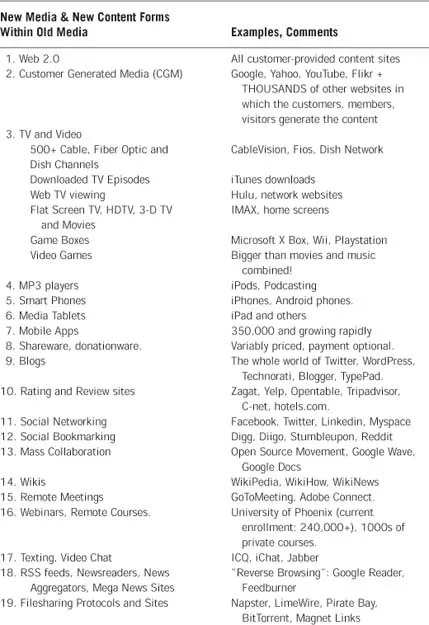
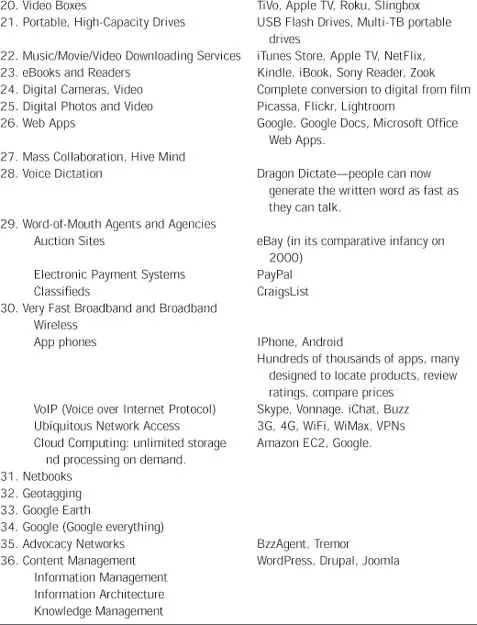
But their absence doesn’t create a lot of room. Every one has been replaced by a multitude of more accessible new forms to flood our senses.
It all comes down to: OVERLOAD
Notice that the new arrivals almost all increase our interactivity and connectedness, and, thereby, our overload. They also increase our ability—actually necessity—to engage in word of mouth. These changes have totally transformed the marketplace and marketing. Marketers at first thought that the Internet was a cheap way of delivering a brochure. Some still do.

SECRET
Involvement and collaboration is what it’s all about now.
SECRET
The new media have brought a level of overload that is unprecedented.
We went from the handwritten word to the printed word in centuries. Then, in a few decades, we moved from information scarcity and relative isolation to broadcasting. Now, we have moved from tuned-in to interactive and participatory in just a few minutes (Okay, a few years that felt like minutes).
You will have an enormous advantage over other marketers if...
Table of contents
- Cover Page
- Title Page
- Copyright Page
- Contents
- Acknowledgments
- Prologue: The Calf-Path
- Introduction
- Chapter 1: The Systematic Approach to Word of Mouth
- Chapter 2: Dominating Your Market by Easifying the Customer Decision Cycle
- Chapter 3: How to Use Word of Mouth to Easify the Decision Process
- Chapter 4: The Decision Process
- Chapter 5: Six Ms to Live By
- Chapter 6: The 2nd M: The Mavens
- Chapter 7: The 3rd M: Motivation
- Chapter 8: The 4th M: Means or Media
- Chapter 9: The 5th M: Measurement
- Chapter 10: The 6th M: Multiplication
- Chapter 11: (Almost) Everything I Learned About Marketing, I Learned in My Father’s Drugstore. Let Me Share It With You.
- Chapter 12: Constructing the Ultimate Word-of-Mouth Campaign
- Chapter 13: Six Steps to Harnessing Word of Mouth
- Chapter 14: Which Methods Work Best for What? A Word-of-Mouth Checklist
- Chapter 15: Word-of-Mouth Marketing for Specific Audiences and Circumstances
- Chapter 16: Tips, Techniques, and Suggestions That Will Make It Easier
- Epilogue: Let’s Talk
- Bibliography
- Recommended Reading
- Appendix
- Index
Trusted by 375,005 students
Access to over 1.5 million titles for a fair monthly price.
Study more efficiently using our study tools.
Frequently asked questions
Yes, you can cancel anytime from the Subscription tab in your account settings on the Perlego website. Your subscription will stay active until the end of your current billing period. Learn how to cancel your subscription
No, books cannot be downloaded as external files, such as PDFs, for use outside of Perlego. However, you can download books within the Perlego app for offline reading on mobile or tablet. Learn how to download books offline
Perlego offers two plans: Essential and Complete
- Essential is ideal for learners and professionals who enjoy exploring a wide range of subjects. Access the Essential Library with 800,000+ trusted titles and best-sellers across business, personal growth, and the humanities. Includes unlimited reading time and Standard Read Aloud voice.
- Complete: Perfect for advanced learners and researchers needing full, unrestricted access. Unlock 1.5M+ books across hundreds of subjects, including academic and specialized titles. The Complete Plan also includes advanced features like Premium Read Aloud and Research Assistant.
We are an online textbook subscription service, where you can get access to an entire online library for less than the price of a single book per month. With over 1.5 million books across 990+ topics, we’ve got you covered! Learn about our mission
Look out for the read-aloud symbol on your next book to see if you can listen to it. The read-aloud tool reads text aloud for you, highlighting the text as it is being read. You can pause it, speed it up and slow it down. Learn more about Read Aloud
Yes! You can use the Perlego app on both iOS and Android devices to read anytime, anywhere — even offline. Perfect for commutes or when you’re on the go.
Please note we cannot support devices running on iOS 13 and Android 7 or earlier. Learn more about using the app
Please note we cannot support devices running on iOS 13 and Android 7 or earlier. Learn more about using the app
Yes, you can access The Secrets of Word-of-Mouth Marketing by George Silverman in PDF and/or ePUB format, as well as other popular books in Commerce & Relations clientèles. We have over 1.5 million books available in our catalogue for you to explore.