![]()
The
New Alchemy
of Message
Making
“The secret to successful persuasion is knowing how to dissolve and eliminate resistance.”
—Harry Mills
![]()
1.
Secret Sauce
The Magic Recipe for Measuring Persuasive Impact
Our message-making needs reinvention
When it comes to messages, what worked in the past won’t work today. Two decades of destabilizing and accelerating change have profoundly changed the psychology of how, when and why customers respond to persuasive messages.
For the first time in history the customer holds the trump cards
Digital-driven technologies have armed buyers with anytime, anywhere access to the choices and information they need to call the shots.
Once customers gain power, they become increasingly skeptical, pay less attention and become less reverential to those who try to influence and sell to them.
Marketers and brands are becoming less influential
In our Google-driven world the influence brands, marketers and salespeople have over customer decisions is rapidly diminishing.
Trust in business is at an all-time low. Customers increasingly base their decisions on reviews from other users, web accessed expert opinions, and price comparison apps.
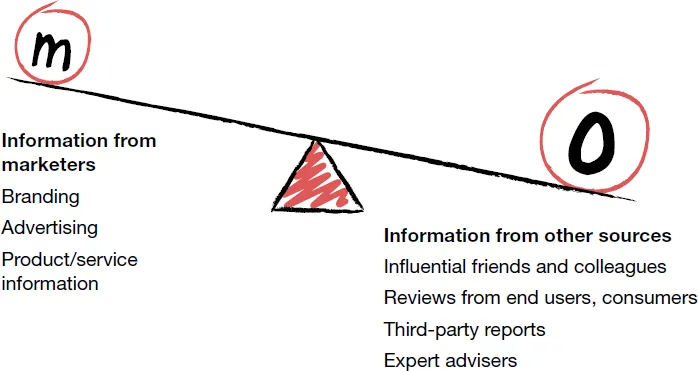
Stanford professor Itamar Simonson and best-selling author Emanuel Rosen in their book Absolute Value: What Really Influences Customers in the Age of (Nearly) Perfect Information write that customers are influenced by two sources of information which they label M and O.
M is shorthand for the information buyers get from marketing information sources. O is shorthand for the information buyers get from other sources. In a Google-driven world buyers’ decisions are being increasingly influenced by O.1
Customers increase their use of O when:
1. A buying decision is important.
2. A buying decision involves increased risk and uncertainty.
Why? Because customers inherently trust O sources more than M sources.2
M AND O POWER SHIFT
Are digital communication technologies rewiring our brains?
We live in a world where a phone originally invented as a talking device has become a “weapon of personal empowerment.”
In her book Decoding the New Consumer Mind, Kit Yarrow says the pervasiveness of digital technology has transformed our lives.3
In the new digital world she reports:
We skim and scan rather than read.
We’re bombarded and interrupted by a relentless barrage of information.
We’re conditioned to want everything faster.
We are increasingly addicted to stimulation and speed.
We’re becoming less and less tolerant of anything that requires patience.
4In his book iBrain: Surviving the Technological Alteration of the Modern Mind, Gary Small describes the new mental state we live in as “continuous partial attention.”5
We are drowning in a tsunami of information. Consulting company Excelacom reports 150 million emails are sent every minute across the Internet. In comparison, the U.S. Postal Service processes just 353,000 pieces of mail each minute—that’s about 0.2 percent the number of emails sent. And that’s not all. In the span of just one minute:
347,000 tweets are tweeted.
20.8 million messages are sent on WhatsApp.
527,760 photos are shared.
6The firehose
Shlomo Bernartzi, a professor at UCLA’s Anderson School of Management and author with Jonah Lehrer of The Smarter Screen uses the metaphor of a firehose to describe the deluge of data that characterizes our information age.
He tells us in ancient times the flow of data and messages that competed for our attention was more “like the drip of water from a leaky faucet.” By the middle of the 20th century the flow of information was more like a steady flow of water coming out of a kitchen faucet.
Since the 1980s computers have been increasing the quantity of information exponentially. The magnitude of data is now so great it is as if our kitchen faucet has been replaced by a high pressure firehose which sprays us in the face with a deluge of data.
A firehose unleashes 125 times more gallons per minute than a kitchen faucet. But we can’t drink it, because the mouth has fixed constraints. It doesn’t matter how much water flows by our face—we will never be able to gulp more than a few sips at a time.
When it comes to how much information our brains can process, the limiting factor is rarely what’s on the screen. The amount of information will almost always exceed the capacity of our mind to take it in. Instead we are limited by a scarcity of attention; by our inability to focus on more than a few things at the same time.7 This problem is compounded by our brain’s fundamental limitations and constraints.
According to psychological lore, when it comes to items of information the mind can cope with before confusion sets in, the “magic number” is seven.
In 1956, American psychologist George Miller published a paper in the influential journal Psychological Review arguing that the mind could cope with a maximum of only seven chunks of information. The paper “The Magical Number Seven, Plus or Minus Two, Some Limits on Our Capacity for Processing Information” has since become one of the most highly cited articles and has been judged by the Psychological Review as its most influential paper of all time.
But UNSW professor of psychiatry Gordon Parker says a re-analysis of the experiments used by Miller shows he missed the correct number by a wide mark. Professor Parker says a closer look at the evidence shows the human mind copes with a maximum of ...