eBook - ePub
Managing Channels of Distribution
The Marketing Executive's Complete Guide
- 288 pages
- English
- ePUB (mobile friendly)
- Available on iOS & Android
eBook - ePub
About this book
"Channels of distribution is one of the hottest areas in marketing and sales today. And no one understands the subject better than Ken Rolnicki! Managing Channels of Distribution supplies a much-needed source of knowledge and expertise that professionals can rely on. Based on case studies and real-life experience, the book explains the complexities of managing multiple channels -- distributors, dealers, manufacturer's reps, VARs, private labels, brokers, wholesalers, retailers, and all the rest. In the process, Rolnicki explores both macro and micro business influences that affect channel effectiveness. Special attention is paid to the frustrating areas of channel power and conflict, the dangerous issue of legalities, and the most critical topic of all -- the channel design sequence."
Chapter 1
Pivotal Marketing Channel Concepts
This is a book about indirect marketing channels. It is designed to help you become a “channelmaster,” one who can build and manage a strong, profitable network of channels that sell products and services for you and your company.
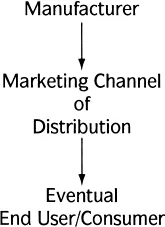
From an operational standpoint, a marketing channel is the path a product or service takes as it moves from the manufacturer to its end user or consumer. The very basic channel structure shown in Exhibit 1-1 was the rule in the years following World War II. In those days, the path between manufacturer and consumer was a straight one. A manufacturer faced only one decision: whether to use a direct or an indirect channel of distribution (COD).
If the manufacturer selected a direct channel, it hired a sales force to get the product on the shelves or into the hands of consumers. In the 1950s, for example, the only way to buy an IBM typewriter was to order one from IBM salespeople who called on offices. If the manufacturer was too small to hire a proprietary sales force, it opted for an indirect channel and hired a distributor to sell to end users. In the 1950s, sales agents, not employees, invited housewives to parties to purchase Tupperware products. Tupper ware sales agents and their parties were their indirect channel.
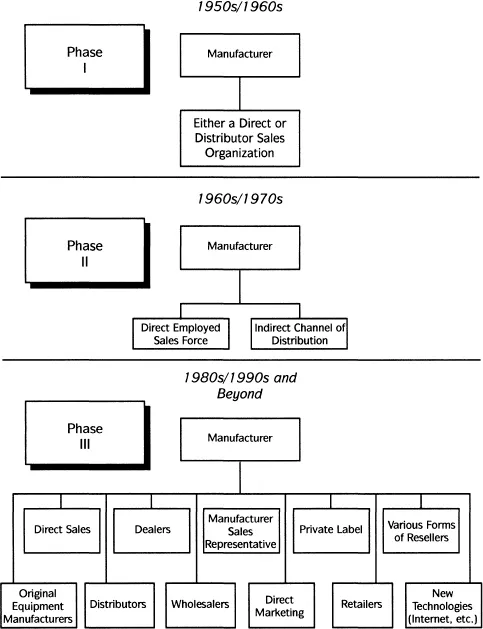
As time passed, the path between manufacturer and end user developed a thousand twists and turns. In fact, today it is less like a path and more like a wheel, with the manufacturer at the “hub” connected to the end user at the “tire” by dozens of direct and indirect channel “spokes.”
Exhibit 1-2 shows how the number and complexity of indirect channels has multiplied. Today, IBM's hub-spokes-wheel sales channel includes a direct sales force that sells mainframe computers; system integrators and value-added resellers that handle its minicomputers and midrange systems; and value-added resellers, dealers, resellers, and retailers that sell personal computers. The sheer number of choices makes creating and managing these channels challenging—even frustrating!
Exhibit 1-1. Basic channel structure.
Why Manufacturers Use Indirect Channels
The traditional, direct sales route offers a number of advantages to the manufacturer. For one thing, the manufacturer controls its sales force. The manufacturer's management can tell its salespersons where to sell, what to sell, how to sell, and how much to charge. Management can dictate activities that support the company image. And, of course, the sales force is completely committed to its employer. It sells the manufacturer's products and no one else's.
But a direct-employed sales force is not appropriate for every company and certainly isn't appropriate for every stage in a company's evolution. A small company may not be able to afford its own sales force. It may need to utilize an indirect channel until its sales and profit performance improve enough to afford the fixed expense of a direct sales force in the field. In addition, it would be unprofitable to have your direct salespeople spend time on smaller customers. Indirect channels of distribution can afford to engage the smaller customer by selling many other manufacturers’ product lines to that same customer group. By doing so, they spread the same cost of sales over several product lines.
Generally speaking, when a specific territory produces between $2 million and $2.5 million in annual sales, the expense of an employed salesperson can be justified. Of course, product line profitability has to be at an acceptable level. (Each company sets its own profit standards.) As a company increases in sales revenue and profit size, so do the commensurate channel choices available. Most companies eventually conclude that they must pursue indirect channels of distribution in order to survive and grow.
Exhibit 1-2. A chronicle of distribution marketing showing how the number and complexity of channels has multiplied.
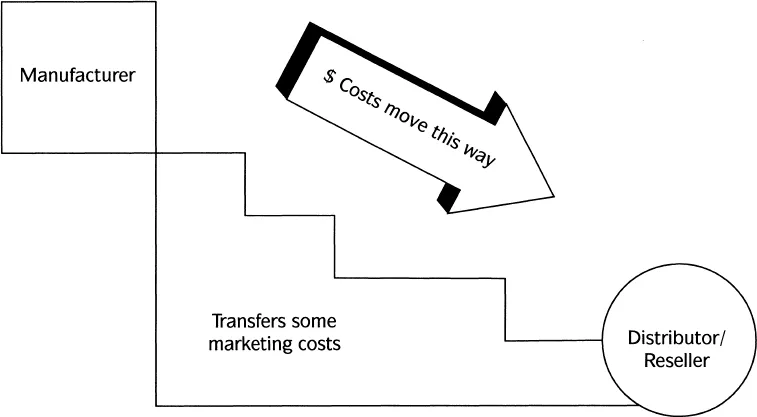
Manufacturers also use indirect channels because they save money. After all, distribution is a cost transfer business. By using distribution channels, the manufacturer can transfer some of the costs of doing business to distributors and resellers. Marketing costs are most typically transferred down through the channel, as Exhibit 1-3 shows (although you always incur some marketing costs for national and international efforts). These passed-down expenditures are typically apportioned as follows:
| Inventory | 40% |
| Sales | 30 |
| Order Handling | 20 |
| Credit | 10 |
| 100% |
Because many distributors are fragile, entrepreneurial businesses, it is essential to consider this expense mix when you create sales and marketing strategies and internal channel support systems. Selling via indirect channels can be justified by the number and importance of the assigned business tasks transferred to the distributor channel.
Why Customers Buy From Indirect Channels
End users purchase products and services from indirect channels because they offer a number of benefits:

Exhibit 1-3. Transferring market costs down through the channel.
Source: Frank Lynn Associates, Chicago.
Table of contents
- Cover Page
- Title Page
- Copyright Page
- Dedication Page
- Contents
- List of Exhibits
- Preface
- Acknowledgments
- Chapter 1 - Pivotal Marketing Channel Concepts
- Part I: Crafting your Channel
- Part II: Managing Your Channels
- Appendix A. Channel of Distribution Words of Wisdom Glossary
- Appendix B. International Laws Affecting Channel of Distribution Relations
- Index
Trusted by 375,005 students
Access to over 1.5 million titles for a fair monthly price.
Study more efficiently using our study tools.
Frequently asked questions
Yes, you can cancel anytime from the Subscription tab in your account settings on the Perlego website. Your subscription will stay active until the end of your current billing period. Learn how to cancel your subscription
No, books cannot be downloaded as external files, such as PDFs, for use outside of Perlego. However, you can download books within the Perlego app for offline reading on mobile or tablet. Learn how to download books offline
Perlego offers two plans: Essential and Complete
- Essential is ideal for learners and professionals who enjoy exploring a wide range of subjects. Access the Essential Library with 800,000+ trusted titles and best-sellers across business, personal growth, and the humanities. Includes unlimited reading time and Standard Read Aloud voice.
- Complete: Perfect for advanced learners and researchers needing full, unrestricted access. Unlock 1.5M+ books across hundreds of subjects, including academic and specialized titles. The Complete Plan also includes advanced features like Premium Read Aloud and Research Assistant.
We are an online textbook subscription service, where you can get access to an entire online library for less than the price of a single book per month. With over 1.5 million books across 990+ topics, we’ve got you covered! Learn about our mission
Look out for the read-aloud symbol on your next book to see if you can listen to it. The read-aloud tool reads text aloud for you, highlighting the text as it is being read. You can pause it, speed it up and slow it down. Learn more about Read Aloud
Yes! You can use the Perlego app on both iOS and Android devices to read anytime, anywhere — even offline. Perfect for commutes or when you’re on the go.
Please note we cannot support devices running on iOS 13 and Android 7 or earlier. Learn more about using the app
Please note we cannot support devices running on iOS 13 and Android 7 or earlier. Learn more about using the app
Yes, you can access Managing Channels of Distribution by Kenneth ROLNICKI in PDF and/or ePUB format, as well as other popular books in Business & Marketing. We have over 1.5 million books available in our catalogue for you to explore.