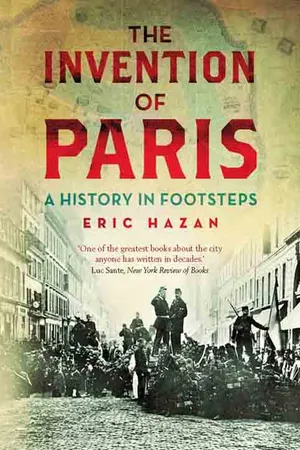
The Invention of Paris is a tour through the streets and history of the French capital under the guidance of radical Parisian author and publisher Eric Hazan.
Hazan reveals a city whose squares echo with the riots, rebellions and revolutions of the nineteenth and twentieth centuries. Combining the raconteur's ear for a story with a historian's command of the facts, he introduces an incomparable cast of characters: the literati, the philosophers and the artists - Balzac, Baudelaire, Blanqui, Flaubert, Hugo, Maney, and Proust, of course; but also Doisneau, Nerval and Rousseau.
It is a Paris dyed a deep red in its convictions. It is haunted and vitalized by the history of the barricades, which Hazan retells in rich detail. The Invention of Paris opens a window on the forgotten byways of the capital's vibrant and bloody past, revealing the city in striking new colors.
- English
- ePUB (mobile friendly)
- Available on iOS & Android
eBook - ePub
About this book
Information
PART ONE
Walkways
1
Psychogeography of the Boundary
The city is only apparently homogeneous. Even its name takes on a different sound from one district to the next. Nowhere, unless perhaps in dreams, can the phenomenon of the boundary be experienced in a more originary way than in cities. To know them means to understand those lines that, running alongside railroad crossings and across privately owned lots, within the park and along the riverbank, function as limits; it means to know these confines, together with the enclaves of the various districts. As threshold, the boundary stretches across streets; a new precinct begins like a step into the void – as though one had unexpectedly cleared a low step on a flight of stairs.
If you cross Boulevard Beaumarchais and turn down towards Rue Amelot, you are conscious of leaving the Marais for the Bastille quartier. If you pass the statue of Danton and follow the high back wall of the École de Médecine, you know you are leaving Saint-Germain-des-Près and entering the Latin Quarter. The boundaries between the districts of Paris are often drawn with this surgical precision. Sometimes the reference points are monuments – the rotunda of La Villette, the Lion of Denfert-Rochereau, the Porte Saint-Denis; sometimes the contours of the ground – the fold of the Chaillot hill on the plain of Auteuil, the gap between the Goutte d’Or and Buttes-Chaumont that marks the roads to Germany and Flanders; sometimes again major arteries, of which the Boulevards Rochechouart and Clichy are an extreme example, forming such a firm demarcation between Montmartre and Nouvelle-Athènes that it is not so much two districts that face each other here, but more like two worlds.
Not all of Paris’s inner boundaries are lines with no thickness. To pass from one quarter to another, you sometimes have to cross neutral zones, transitional micro-quarters. These often take the form of embedded pockets: the Arsenal triangle between the Boulevards Henri-IV and Bourdon – the starting point of Flaubert’s Bouvard and Pécuchet, on a bench with the thermometer at 33 degrees C – with its acute angle at the Bastille, and dividing the Saint-Paul quarter from the approaches to the Gare de Lyon; Épinettes, in the space between the Avenue de Saint-Ouen and the Avenue de Clichy, which ensures smooth passage from the Batignolles to Montmartre; or again, wedged between the Sentier and the Marais, the right-angled triangle of Arts-et-Métiers, whose apex is the Porte Saint-Martin and its hypotenuse the Rue de Turbigo, marked in the direction of the city centre by the bell tower of Saint-Nicholas-des-Champs.
These boundaries may be more vague, like the region of missions and convents centred on the Rue de Sèvres, which you have to cross in order to pass from Faubourg Saint-Martin to Montparnasse, and which old taxi-drivers call the Vatican. Or those streets beyond the Luxembourg that fill the space between the Latin Quarter and Montparnasse, between Val-de-Grâce and the Grande-Chaumière, between the allegory of quinine on Rue de l’Abbé-de-l’Épée and the heroic figure of Marshal Ney in front of the Closerie des Lilas. Already at the end of Ferragus, when the former head of the Devorants spends his days silently watching the boules players and sometimes lending them his cane to measure their shots, Balzac noted this
space which lies between the south entrance of the Luxembourg and the north entrance of the Observatoire – a space without a name, the neutral space of Paris. There, Paris is no longer; and there, Paris still lingers. The spot is a mingling of street, square, boulevard, fortification, garden, avenue, high-road, province, and metropolis; certainly, all of that is to be found there, and yet the place is nothing of all that, – it is a desert.2
Like the background of certain Dadaist photomontages, composed out of jostling fragments of city photographs, the most commonplace transitions sometimes have the most surprising shocks in store. Leaving the greyness of the Gare de l’Est along the former convent wall of the Récollets, what could be more surprising than to suddenly stumble on the sparkling water of the Canal Saint-Martin, the lock of La Grange-aux-Belles with its swing bridge and walkway hidden among the chestnut trees, and behind it the pointed slate roofs of the Hôpital Saint-Louis? And at the other end of Paris, the contrast between the bustle of the Avenue d’Italie and – just behind the Gobelins factory – the shady square marking the beginning of the Glacière quarter, with the stream of the Bièvre at its far end.
Certain quarters, even some of the oldest and most clearly defined, may contain an undefined part within them. For many Parisians, the Latin Quarter ends at the top of the Montagne Sainte-Geneviève, just as in Abélard’s day. Balzac located the Pension Vauquer in Rue Neuve-Sainte-Geneviève (now Tournefort), between the Latin Quarter and the Faubourg Saint-Marceau, ‘in the streets shut in between the dome of the Panthéon and the dome of the Val-de-Grâce, two conspicuous public buildings which give a yellowish tone to the landscape and darken the whole district that lies beneath the shadow of their leaden-hued cupolas’.3 Today, however, on the southern slope of the Montagne, the École Normale Supérieure, research institutes and student residences, the historic laboratories of Pasteur and the Curies, along with the Censier university, may well justify extending the Latin Quarter as far as the Gobelins.
Differences over boundaries can be far more serious, putting in question the very identity of the district in question. Where does Montmartre begin, when you leave the city centre heading north? History – the boundaries of the village before its annexation to Paris – agrees with common sentiment that Montmartre starts when you cross the route of the no. 2 Métro line, whose stations Barbès-Rochechouart, Anvers, Pigalle, Blanche and Clichy precisely mark the curve of the former wall of the Farmers-General. But Louis Chevalier, in his masterpiece Montmartre du plaisir et du crime, places the Montmartre boundary much lower, on the Grands Boulevards, including in his book both the Chaussée d’Antin, the Saint-Georges quarter, the Casino de Paris and the Faubourg Poissonnière.4 And quite apart from plaisir and crime, physical geography would support this dividing line, as the slopes of Montmartre begin well below the Boulevards Rochechouart and Clichy. The land starts to rise once you cross the ancient course of the Seine, a few dozen metres beyond the Grands Boulevards. Walter Benjamin, a peerless Paris pedestrian, noted how, when the flâneur has reached Notre-Dame-de-Lorette, ‘his soles remember: here is the spot where in former times the cheval de renfort – the spare horse – was harnessed to the omnibus that climbed the Rue des Martyrs towards Montmartre’.5
It might be objected that Montmartre is a special case, not just a quarter like any other, being both a district on the map of Paris and a historical–cultural myth, with a different boundary in each of these senses. But isn’t this ambiguity the very mark of quarters with a strong identity? And if such an identity is lacking, can one even talk of a quarter? Such questions lead, as we shall see, to a more general one: what, fundamentally, is a Paris quarter?
The administrative divisions – twenty arrondissements, with four quartiers in each – give the beginnings of a reply a contrario: a list of this kind, quite abstract and without any ranking, is only useful for the tax office and the police. But it is by no means certain that more subtle procedures would be able to define a basic urban unit for Paris, where the term ‘quarter’, despite its ancient roots in the language and its apparent simplicity, is far from denoting anything homogeneous and comparable. Saint-Germain-des-Près, the Plaine Monceau and the Évangile, for example, are all three of them Paris quarters – each has its history, its boundaries, its map, its architecture, its population and its activities. The first, developing over the centuries on the territory of the great abbey and grouping very ancient streets around the ‘modern’ intersection of the Boulevard Saint-Germain and the Rue de Rennes, has kept nothing of the postwar years in which it was so celebrated, and has fallen into the sterility of a museum. The second, planted out by the Pereire brothers in the mid nineteenth century – a ‘luxury quarter sprouting amid the wastelands of the old Plaine Monceau’ – is that of Nana, in her ‘Renaissance-style hôtel, with the air of a palace’. Marked by the memory of the academic ‘artistes pompiers’ who were among its original inhabitants – Meissonier, Rochegrosse, Boldini, Carrier-Belleuse – this is a typical residential quarter, and the successors of the business bourgeoisie of the Second Empire still occupy its neo-Gothic and neo-Palladian hôtels particuliers today. The Évangile, at the end of the world between the railway tracks of the Nord and the Est, is built on a bit of the former village of La Chapelle, where the contractors who carted out the Paris refuse came to dump their load. (‘Tumbrils carry off muck and filth, which is spilled into the nearby countryside: woe to any who find themselves neighbour to these infected mounds’, wrote Sébastien Mercier.6) The monstrous gasometers that lined the Rue de l’Évangile are no longer to be seen, but the Calvary photographed by Atget is still in place, and the covered market of La Chapelle is one of the most colourful in Paris.
The customary oppositions of east/west, Left Bank/Right Bank, or centre/periphery are too simplistic to account for this diversity, and sometimes out of date. We have to look elsewhere, especially in the city’s particular mode of growth. Nowhere else in Europe has a great capital developed in the same way as Paris, with such discontinuity and in so irregular a rhythm. And what gave the city this rhythm was the centrifugal succession of its walled precincts. Cities without walls – apart from those strictly organized on a rectangular grid, like Turin, Manhattan, or Lisbon as laid out by the Marquis de Pombal – grew up any which way, like the tentacles of an octopus, or a bacterial plaque multiplying in its culture. In London, Berlin or Los Angeles, the city limits and the shapes of districts are vague and variable: ‘The rampant proliferation of the immense megalopolis that is Tokyo gives the impression of a silkworm eating a mulberry leaf . . . The form of such a city is unstable, its border an ambiguous zone in constant movement . . . It is an incoherent space spreading without order or markers, its limits only poorly defined.’7
Paris, on the other hand, so often threatened, besieged, or invaded, has from the dawn of time been constrained by its city walls. This has always given it a more or less regular circular form, and it has only been able to extend in a succession of dense and concentric rings. From the wall of Philippe Auguste to the modern Périphérique, six different walls followed one another in the course of eight centuries – without counting reinforcement, retouching or partial correction. The scenario has always been the same. A new wall is constructed, with broad dimensions that afford free space around the area already built up. But this space is rapidly covered over. Available land within the walls becomes increasingly scarce, buildings are pressed together, plots filled up, and the growing density makes life difficult. Meanwhile, outside the walls, and despite the laws against it – a constant over many centuries and political regimes, but never respected (this is the zone non aedificandi, which Parisians little familiar with Latin quickly came to call simply the zone, a word still in use today8) – houses
with pleasant gardens are constructed in the faubourgs. When the intramuros concentration becomes intolerable, these faubourgs are absorbed into the city and the cycle begins again:
Philippe Auguste . . . imprisons Paris in a circular chain of great towers, both lofty and solid. For a period of more than a century, the houses press upon each other, accumulate, and raise their level in this basin, like water in a reservoir. They begin to deepen; they pile storey upon storey; they mount up on each other; they gush forth at the top, like all laterally compressed growth, and there is a rivalry as to which shall thrust its head above its neighbours, for the sake of getting a little air. The street grows narrower and deeper, every space is overwhelmed and disappears. The houses finally leap the wall of Philippe Auguste and scatter joyfully over the plain, without order and all askew, like runaways. There they plant themselves squarely, cut themselves gardens from the fields, and take their ease. Beginnin...
Table of contents
- Cover
- Title
- Copyright
- Dedication
- Contents
- A Few More Wrinkles: Preface to the English-Language Edition
- Acknowledgements
- Part One: Walkways
- Part Two: Red Paris
- Part Three: ‘Crossing the swarming scene ...’
- Index
Trusted by 375,005 students
Access to over 1.5 million titles for a fair monthly price.
Study more efficiently using our study tools.
Frequently asked questions
Yes, you can cancel anytime from the Subscription tab in your account settings on the Perlego website. Your subscription will stay active until the end of your current billing period. Learn how to cancel your subscription
No, books cannot be downloaded as external files, such as PDFs, for use outside of Perlego. However, you can download books within the Perlego app for offline reading on mobile or tablet. Learn how to download books offline
Perlego offers two plans: Essential and Complete
- Essential is ideal for learners and professionals who enjoy exploring a wide range of subjects. Access the Essential Library with 800,000+ trusted titles and best-sellers across business, personal growth, and the humanities. Includes unlimited reading time and Standard Read Aloud voice.
- Complete: Perfect for advanced learners and researchers needing full, unrestricted access. Unlock 1.5M+ books across hundreds of subjects, including academic and specialized titles. The Complete Plan also includes advanced features like Premium Read Aloud and Research Assistant.
We are an online textbook subscription service, where you can get access to an entire online library for less than the price of a single book per month. With over 1.5 million books across 990+ topics, we’ve got you covered! Learn about our mission
Look out for the read-aloud symbol on your next book to see if you can listen to it. The read-aloud tool reads text aloud for you, highlighting the text as it is being read. You can pause it, speed it up and slow it down. Learn more about Read Aloud
Yes! You can use the Perlego app on both iOS and Android devices to read anytime, anywhere — even offline. Perfect for commutes or when you’re on the go.
Please note we cannot support devices running on iOS 13 and Android 7 or earlier. Learn more about using the app
Please note we cannot support devices running on iOS 13 and Android 7 or earlier. Learn more about using the app
Yes, you can access The Invention of Paris by Eric Hazan, David Fernbach in PDF and/or ePUB format, as well as other popular books in History & French History. We have over 1.5 million books available in our catalogue for you to explore.