- 304 pages
- English
- ePUB (mobile friendly)
- Available on iOS & Android
eBook - ePub
About this book
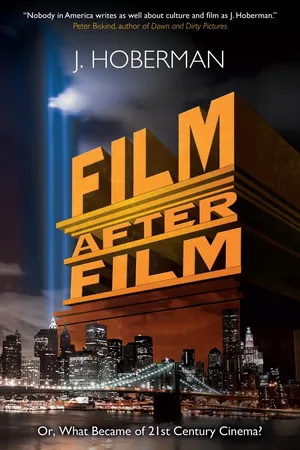
One of the world's most erudite and entertaining film critics on the state of cinema in the post-digital-and post-9/11-age. This witty and allusive book, in the style of classic film theorists/critics like Andr? Bazin and Siegfried Kracauer, includes considerations of global cinema's most important figures and films, from Lars von Trier and Jia Zhangke to WALL-E, Avatar and Inception.
Information
Subtopic
Film & VideoPART I:
A POST-PHOTOGRAPHIC CINEMA
A POST-PHOTOGRAPHIC CINEMA
I predict that all movies will be animated or computer-generated within fifteen years.
—Bruce Goldstein, “Flashback: The Year in Movies,” Village Voice (December 28, 1999)
It is in the nature of analogical worlds to provoke a yearning for the past … The digital will wants to change the world.
—D. N. Rodowick, The Virtual Life of Film (2007)
CHAPTER ONE
THE MYTH OF “THE MYTH
OF TOTAL CINEMA”
OF TOTAL CINEMA”
Can we speak of a twenty-first-century cinema? And if so, on what basis?1
In the immediate aftermath of World War II, the French film critic André Bazin offered a narrative in opposition to a then current notion that cinema developed in the spirit of scientific inquiry. Bazin characterized cinema as an idealistic phenomenon and cinema-making as an intrinsically irrational enterprise—namely, the obsessive quest for that complete representation of reality that he termed Total Cinema.
“There was not a single inventor who did not try to combine sound and relief with animation of the image,” Bazin maintained in “The Myth of Total Cinema.” Each and every new technological development—synchronous sound, full-color, stereoscopic or 3-D movies, Smell-O-Vision—served to take the cinema nearer to its imagined essence, which is to say that “cinema has not yet been invented!” Moreover, once true cinema was achieved, the medium itself would disappear—just like the state under true communism. Writing in 1946, Bazin believed that this could happen by 2000. In fact, something else occurred: the development of digital computer-generated imagery (CGI) broke the special relationship that existed between photography and the world.
The Myth of Total Cinema, the “recreation of the world in its own image,” was for Bazin a factor of cinema’s essence: the medium’s integral realism was predicated on the camera’s impartial gaze (the French word for lens is objectif), as well as the chemical reaction by which light left an authentic trace on photographic emulsion. In “The Ontology of the Photographic Image,” an essay published in 1945, Bazin had noted that “photography affects us like a phenomenon in nature … The photograph as such and the object in itself share a common being.” Because of this impartial, indexical connection between the photograph and that which was photographed (the profilmic subject or event), motion pictures produced an all-but-automatic image “unburdened” by artistic interpretation. Like a shadow or a bullet hole, a photograph was a form of evidence—a “hallucination that is also a fact.” Moreover, each photograph was derived from its own material evidence in the form of the negative image produced by the initial photo-chemical reaction. Such negatives might be altered, cropped in the course of printing, or even destroyed but, at least initially, the image existed as a recognizable physical entity—unlike the infinitely malleable binary code produced, however indexically, by a digital camera.2
The divorce between photography and the world was initially experienced as a crisis in photography. Thanks to Photoshop, the image editing program first introduced in 1990, as well as other forms of digital manipulation, the photographic became an element or subset of the graphic. Previously, as art historian Julian Stallabrass observed in the mid 1990s, “forging ordinary photographs involved great skill and, if all variants and the original negatives were not destroyed, could always be unmasked.” Digitalization, which made image manipulation easily accessible, was “a technique which lends itself to the production of useful lies.” Photography might retain “its powers of resemblance,” but it would lose “its veracity.”3
As the digitally manipulable photograph superseded the world as raw material for image-making, the existential crisis for motion pictures was even more intense: Bazin had imagined cinema as the objective “recreation of the world.” Yet digital image-making precludes the necessity of having the world, or even a really existing subject, before the camera—let alone the need for a camera. Photography had been superseded, if not the desire to produce images that moved. Chaplin was perhaps but a footnote to Mickey Mouse; what were The Birth of a Nation and Battleship Potemkin compared to Toy Story 3? With the advent of CGI, the history of motion pictures was now, in effect, the history of animation.4
CHAPTER TWO
THE MATRIX: “A PRISON
FOR YOUR MIND”
FOR YOUR MIND”
The process began in the early 1980s with two expensive and much-publicized Hollywood features—both of which, like certain animated cartoons of the 1920s, inserted “live actors” into virtual environments. One From the Heart (1982), Francis Ford Coppola’s experiment in electronic image-making, returned but $1 million on a $26-million investment and effectively destroyed his studio, while Disney’s Tron (1982) the first sustained exercise in computer-generated imagery, was a movie whose costly special effects and mediocre box-office returns would be credited with (or blamed for) delaying CGI-based cinema for a decade.1
Tron’s literalist representation of cyberspace predated William Gibson’s Neuromancer by several years, although the movie was actually closer to Alice in Wonderland or The Wizard of Oz in supposedly taking place inside a computer where all the characters, except the hacker Flynn (Jeff Bridges), were—in a longstanding Disney tradition—anthropomorphized computer code. As such, Tron might be considered a founding example of cyborg cinema, combining digital and photographic imagery. The movie’s most dramatic effect was the virtual tracking shot, in which a non-existent camera seemed to move through an imaginary landscape. More advanced and popular cyborgs, Steven Spielberg’s Jurassic Park (1993) and George Lucas’s The Phantom Menace (1999), seamlessly fused photography and CGI imagery to have real people interact convincingly onscreen with non-existent creatures, offering early clues to the new direction. So did the numerous popular discussions surrounding the production of digital personalities like Lara Croft, who made her first appearance in the 1996 video game Tomb Raider, or the resurrection of dead film stars, as in the 1995 episode of HBO’s aptly titled Tales from the Crypt, featuring “Humphrey Bogart,” or the Super Bowl XXXI commercial in which “Fred Astaire” danced with a Broom Vac.2
Both Jurassic Park and The Phantom Menace also engaged in a particular form of naturalization by inscribing CGI into prehistory, whether that of planet Earth or of the Star Wars saga. In his 2001 book, The Language of New Media, Lev Manovich made the provocative observation that the aesthetic underlying Jurassic Park is akin to Socialist Realism, which strove to project the radiant future socialist society into the familiar world of the present. Jurassic Park strives “to show the future of sight itself.”
Just as Socialist Realist paintings blended the perfect future with imperfect reality, Jurassic Park blends the future supervision of computer graphics with the familiar vision of the film image … The dinosaurs are present to tell us that computer images belong safely to a past long gone—even though we have every reason to believe that they are messengers from a future still to come.
The Phantom Menace, which was also projected digitally in some theaters, not only evoked but embodied the future of cinema. So, in another way, did Douglas Gordon’s 1993 video installation, 24 Hour Psycho—in which, wrenched from its natural context and re-presented as a re-animated (or perhaps, de-animated), glacially slow-motion digital image of itself, requiring a full day to watch, Hitchcock’s old-fashioned analog motion picture became an extreme object of contemplation.3
A cyborg production like 24 Hour Psycho further induces what some experience as a loss of temporal indexicality. Cinematographer and filmmaker Babette Mangolte has argued that digital image-making may be distinguished from photographic cinema in its intrinsic inability to embody temporal duration or a sense of “real time,” and that this is true even when photographic motion pictures are projected in digital form: “Why,” she wonders,
is the brightness of the LCD screen, the relentless glare of the digital image with no shutter reprieve, no back and forth between one forty-eighth of a second of dark followed by one forty-eighth of projected images, with no repetitive pattern as regular as your own heartbeat, unable to establish and construct an experiential sense of time passing and why could the projected image do it so effortlessly in the past and still can?
Mangolte’s question, posed in the 2003 anthology Camera Obscura, Camera Lucida, suggests that, for some, the essence of film—if not cinema—is not so much a matter of the photographic indexical as the presence of a material flicker; film may be defined by the rhythm of the motion picture projector, which is to say the sense of motion pictures as an apparatus or machine. In this sense, the Austrian avant-garde filmmaker Peter Kubelka’s 1958 Arnulf Rainer which, made without a camera, alternates clear and opaque 16mm footage, may be considered cinema’s Ground Zero and the series of frame-by-frame painted films with which Stan Brakhage ended his career an assertion of film’s material, a-photographic essence.4
Rather than indexicality of the photographic image, the new essence of cinema might be found in Andrei Tarkovsky’s notion of “imprinted time” or duration. Writing on the significance of the first Lumière actualités, Tarkovsky observed that
for the first time in the history of the arts, in the history of culture, man found the means to take an impression of time. And simultaneously the possibility of reproducing that time on screen as often as he wanted, to repeat it and go back to it. He acquired a matrix for actual time. Once seen and recorded, time could now be preserved in metal boxes over a long period (theoretically for ever) … Time, printed in its factual forms and manifestations: such is the supreme idea of cinema as an art.
It has often been observed that, with its absence of flicker and greater sense of continuity, the video image seems eternally “present.” What then is one to make of Christian Marclay’s 2010 installation The Clock, a digitally-projected assemblage of photographic motion pictures that, in its perfectly chronological, minute-to-minute temporal references, functions as a twenty-four-hour timekeeper? (The Clock’s thousands of clips include everything from High Noon and Easy Rider to Back to the Future and Pulp Fiction. No list can possibly do it justice.) In London, New York, Los Angeles, and elsewhere, The Clock demonstrated Tarkovsky’s assertion—albeit in a vulgar sense—as it held an audience spellbound and hyper-aware of time passing.5
Although the suspense inherent in many of the original clips undoubtedly contributed to The Clock’s power to fascinate the spectator, one might also observe that the heightened awareness of time, as well as The Clock’s utilitarian capacity to tell time in real time, provided a new sort of indexicality: The experience of watching a movie is forcibly literalized as the experience of watching a movie and this is further emphasized by the presence of so much familiar material. For many, much of The Clock is pre-saturated in personal memory or nostalgia.6
It may be argued that, as fashioned from pre-existing, often well-known movie and television clips and thus employing many beloved stars, The Clock was in fact a traditional motion picture or, at the very least, a celebration of motion pictures and their undying appeal. (It was praised by several New York art critics specifically for its presumed love for movies.) Nevertheless this epic projection was, of course, digital, and—like 24 Hour Psycho or other Gordon installations—only possible as a form of digital image-making. The Clock’s occasional cropping and stretching of the original material is a factor of the high-definition video format which demands a 16:9 aspect ratio. (Marclay employed further digital manipulation in making The Clock, sweetening some footage by removing voiceovers that implied a past tense,...
Table of contents
- COVER
- TITLE PAGE
- COPYRIGHT
- CONTENTS
- PREFACE
- PART I: A POST-PHOTOGRAPHIC CINEMA
- PART II: A CHRONICLE OFTHE BUSH YEARS
- PART III: NOTES TOWARD A SYLLABUS
- INDEX
Trusted by 375,005 students
Access to over 1.5 million titles for a fair monthly price.
Study more efficiently using our study tools.
Frequently asked questions
Yes, you can cancel anytime from the Subscription tab in your account settings on the Perlego website. Your subscription will stay active until the end of your current billing period. Learn how to cancel your subscription
No, books cannot be downloaded as external files, such as PDFs, for use outside of Perlego. However, you can download books within the Perlego app for offline reading on mobile or tablet. Learn how to download books offline
We are an online textbook subscription service, where you can get access to an entire online library for less than the price of a single book per month. With over 1.5 million books across 990+ topics, we’ve got you covered! Learn about our mission
Look out for the read-aloud symbol on your next book to see if you can listen to it. The read-aloud tool reads text aloud for you, highlighting the text as it is being read. You can pause it, speed it up and slow it down. Learn more about Read Aloud
Yes! You can use the Perlego app on both iOS and Android devices to read anytime, anywhere — even offline. Perfect for commutes or when you’re on the go.
Please note we cannot support devices running on iOS 13 and Android 7 or earlier. Learn more about using the app
Please note we cannot support devices running on iOS 13 and Android 7 or earlier. Learn more about using the app
Yes, you can access Film After Film by J. Hoberman in PDF and/or ePUB format, as well as other popular books in Media & Performing Arts & Film & Video. We have over 1.5 million books available in our catalogue for you to explore.