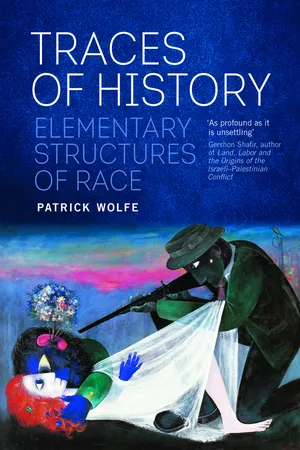
Traces of History presents a new approach to race and to comparative colonial studies. Bringing a historical perspective to bear on the regimes of race that colonizers have sought to impose on Aboriginal people in Australia, on Blacks and Native Americans in the United States, on Ashkenazi Jews in Western Europe, on Arab Jews in Israel/Palestine, and on people of African descent in Brazil, this book shows how race marks and reproduces the different relationships of inequality into which Europeans have coopted subaltern populations: territorial dispossession, enslavement, confinement, assimilation, and removal.
Charting the different modes of domination that engender specific regimes of race and the strategies of anti-colonial resistance they entail, the book powerfully argues for cross-racial solidarities that respect these historical differences.
- 304 pages
- English
- ePUB (mobile friendly)
- Available on iOS & Android
eBook - ePub
About this book
Information
CHAPTER ONE
In Whole and In Part
__________
The Racialisation of Indigenous
People in Australia
Historically speaking, Australia followed the United States, a chronology that involved a degree of replication. While the differences between these two White-Anglo settler colonies are as marked as the continuities, the colonisation of Australia was too closely bound up with Britain’s North American embarrassment to be considered separately. In terms of preaccumulation, settler policies in Australia were significantly informed by lessons learned in North America. An obvious example is the avoidance of chattel slavery. Of even greater significance for a discussion of race in Australia is the avoidance of Native sovereignty. As we shall see in this and other chapters, these twin absences, both reversing British colonial policy in North America, would have major consequences for the regime of race that settlers constructed in Australia.
As has often been noted, the dominant factor in the sequential relationship between Britain’s establishment of settler colonies in North America and Australia (New Holland) was the industrial revolution. This is not only because English factories relied on colonial production for their raw materials, a consideration that did not significantly motivate the initial invasion of Australia. Of much greater significance for Australia was the Malthusian demographic problem (the ominously named ‘redundant population’) that industrialisation, especially the element of enclosure, was presenting to authorities in Britain. Prior to losing the war of independence, Britain had been using its North American colonies, especially the southern ones, to export the largely urban surplus population that enclosure and industrialisation had generated, whether as convicted felons, as indentured labour or as paupers. After 1783, however, as Coupland put it, ‘independent America could no longer be used as a British dustbin’.1 The victorious republicans’ preferred source of exploitable labour being African rather than English, and vested with even fewer rights, the loss of the thirteen colonies had an immediate effect on the English landscape, as waterways crowded with prison hulks presented the most concrete domestic symptom of colonial defeat.2
Due no doubt to the scrupulous Eurocentrism that James Clifford has noted of him, Michel Foucault did not remark on the fullness with which the colonisation of Australia combined the narratives of his Madness and Civilization and Discipline and Punish.3 Even the watery containment of the median condition – ship of fools, convict hulk – was common to both transitions, that from North America to Australia and that from leprous marginality to the Great Confinement. Had Foucault been more alert to colonialism, he might have noted that the historical progression on from the hulks, or from an overcrowded Newgate Prison, did not only lead to Jeremy Bentham’s Panopticon. It also led to New South Wales and Van Diemen’s Land.
This is not to try to score points from Foucault. It is rather to stress the intimacy, noted in the Introduction, between colonialism and modernity. As we shall see throughout this book, race provided an expedient resolution to the logical affront that colonialism presented to liberal-democratic ideology. As incubators and developers of modernity, Australian settlers would be in the vanguard of a number of democratic movements, including those for women’s suffrage and trades-union rights.4 At the same time, they would dispossess and maltreat Aborigines with all the ruthlessness of settlers elsewhere. Lorenzo Veracini has perceptively assigned these two characteristics of settler discourse – egalitarianism among settlers combined with exterminism towards Natives – to settlers’ respective positioning in relation to metropolitan authority (the constraints of which they were united in resisting) and to Native territoriality (the claim to which they were united in suppressing).5
For Indigenous people, the concept of settler democracy can only be an oxymoron. Their attrition at the hands of that democracy reflects the core feature of settler colonialism, which is first and foremost a project of replacement. Settlers come to stay. In relation to Natives, as I have argued, settler colonialism is governed by a logic of elimination.6 In destroying to replace, this logic encompasses more than the summary liquidation of Indigenous people. In common with genocide as Raphaël Lemkin characterised it,7 settler colonialism has both negative and positive dimensions. Negatively, it strives for the dissolution of Native societies. Positively, the ongoing requirement to eliminate the Native alternative continues to shape the colonial society that settlers construct on their expropriated land base. In this positive sense, the logic of elimination marks a return whereby the Native repressed continues to structure settler-colonial society.
Thus elimination should be seen as an organising principal of settler-colonial society rather than a one-off (and superseded) occurrence. As Theodor Herzl, founding father of Zionism, observed in his allegorical manifesto/novel, ‘If I wish to substitute a new building for an old one, I must demolish before I construct.’8 In a kind of realisation that took place half a century later, the one-time deputy mayor of West Jerusalem, Meron Benvenisti, recalled, ‘As a member of a pioneering youth movement, I myself “made the desert bloom” by uprooting the ancient olive trees of al-Bassa to clear the ground for a banana grove, as required by the “planned farming” principles of my kibbutz, Rosh Haniqra.’9
Invasion is a structure, not an event.10 As we shall see in the chapters to come, the continuing operations of the logic of elimination can include officially encouraged miscegenation, the breaking-down of Native title into alienable individual freeholds, Native citizenship, child abduction, religious conversion, resocialisation in total institutions such as missions or boarding schools, and a whole range of cognate biocultural assimilations. All these strategies, including frontier homicide, are modalities of settler colonialism. All of them come back to the issue of land.
Territoriality
Territoriality, the fusion of people and land, is settler colonialism’s specific, irreducible element. Settlers’ seizure of Natives’ land is not simply a transfer of ownership. That can occur in a regular fashion within a system of ownership – by sale, inheritance, foreclosure and the like, rival claims being resolvable by appropriate arbitration. Rather than replacing one owner with another, settlers seek to replace an entire system of ownership with another. The settler/Native confrontation, in other words, is not between claims to ownership but between frameworks for allocating ownerships. It is between sovereignties, which are primordially external to one another. As Henry Reynolds observed, ‘There has always been an international dimension to the relationship between Aborigines and the colonists.’11 Given this externality, the settler legal system resolves issues of ownership within its jurisdictional limits. The question of its own externality is simply – and literally – beyond its power (ultra vires).
This is a straightforward matter that settler judiciaries typically express without qualms. To explain his denial of Indians’ capacity to dispose of fee simple in their ancestral patrimony, for instance, Chief Justice John Marshall informed the US Supreme Court in the landmark case of Johnson v. McIntosh that ‘this restriction may be opposed to natural right, and to the usages of civilized nations, yet, if it be indispensable to that system under which the country has been settled, and be adapted to the actual condition of the two people, it may, perhaps, be supported by reason, and certainly cannot be rejected by Courts of justice’ – by which, of course, he meant settler courts of justice.12 Marshall’s position was faithfully echoed in the Australian case of Coe v. Commonwealth, which was devoted to the question, and taken for granted in statements such as the High Court of Australia’s key decision in the Yorta Yorta case, which held that ‘rights or interests in land created after sovereignty [by which the justices meant settler sovereignty] and which owed their origin and continued existence only to a normative system other than that of the new sovereign power, would not and will not be given effect by the legal order of the new sovereign’.13
The point is not to deplore these judgements. Given the circumstances, it is hard to see what else the judges could have said. The point is that having nothing to say about Native sovereignty has precisely that effect – nothing (notice that the Yorta Yorta judges’ ‘new sovereign’ presupposed an old one). Marshall and the Australian judges (Gleeson, Gummow and Hayne) were not creating the basis on which the systems of ownership they adjudicated were founded. They were simply acknowledging that it was not up to them to question that basis. The law was not created by the law – in Carl Schmitt’s terminology, it was created exceptionally.14 Of itself, law does not conquer. It may express, legitimate, or even reinforce conquest, but these are elaborations on the datum of conquest, which is achieved by other means. To assume that Native sovereignty somehow evaporates in the aftermath of conquest is to go further than the judges, who remain silent on the matter.
Accordingly – and, it would seem, consistently with the judges’ accounts – tracking what happens to the externality of Native sovereignty in the wake of the settler/Native confrontation requires us to look outside the settler legal system, a requirement that takes us directly to the priority of force. Peoples do not surrender their collective inheritances voluntarily. Thus there is no shortage of data relating to the force with which Natives were dispossessed. But possession is not ownership, with which it may or may not coexist, as in the case of tenancies. Even within the terms of the settler legal system, therefore – let alone in terms of the Native ones or in the space between the two – mere dispossession does not vitiate ownership, as is evidenced by the special requirements attending provisions such as adverse possession.
Thus the salient question to arise from the territorial dispossession of Native peoples is not that of whether or not it happened, since there can be no doubting that. Rather, it is the question of the subsequent career of Native ownership, which mere dispossession does not compromise.15 The question, in other words, is one of strategy-analysis: How do settler societies deal with autonomous systems of ownership that are not susceptible to forcible seizure? This question acquires particular urgency in the context of a settler society’s need to establish a rule of law with sufficient legitimacy to secure a viable level of consent to a recently promulgated set of social norms among an ever-aggregating and often diversely recruited immigrant populace.
For their own internal purposes, therefore, quite apart from international considerations, settler societies seek to neutralise the extraneous sovereignties that conquered Natives continue to instantiate. The most direct way to achieve this is through the physical liquidation of the bearers of those sovereignties. This solution becomes increasingly less viable as Natives are contained within the frontier, conflicting as it does with the emergent settler social order’s requirement for the manifestation of due process. An alternative solution, exemplified in the US system of Indian treaties, is to secure a semblance of Native consent to a transfer of ownership – though this possibility was precluded in Australia, where Native ownership was not recognised. A third solution is physical removal and/or confinement, a merely temporary or provisional expedient if it takes place within the boundaries, existing or projected, of the settler nation-state.
A more permanent strategy is that of assimilation, whereby Natives’ externality is dissolved through their incorporation into settler society. By this means, settler societies do not seek to resolve the problem of alternative systems of ownership. Rather, by doing away with alternative owners, they seek to obviate it. Assimilation, if it were to succeed, offers a more effective antidote to Native sovereignty than simple denial, which merely defers the problem, thus risking the emergence of circumstances less favourable to denial, as in the case of the impact of post-war decolonisation on Australian Aboriginal policy. These shifting racial modalities reflect settler colonialism’s inability to replace Native society tout court. The quest to replace Native territoriality only maintains the refractory imprint of the Native counter-claim.
In their deployment, each of these strategies, which are not mutually exclusive, attests to the persistence of the problem of Natives’ exteriority to settler sovereignty. This persistence accounts for the structural dimension of invasion, which has to suppress – or, at least, contain – the Native alternative across time. As observed, the structures are not inert. They are constituted through events, through practices that colonisers repeatedly strive to maintain, in various shifting adaptations to Natives’ stubborn exteriority. As Elizabeth Strakosch and Alissa Macoun have observed, ‘the flipside of invasion being a structure not an event is that [settler] sovereignty is a constant performance claiming to be an essence.’16 Even in settler social discourse, albeit in the breach, Native sovereignty does not end with conquest any more than Native ownership ends with dispossession. Moreover, since Natives seek to exercise their countervailing sovereignties in whatever ways remain practicable, settler domestic discourse becomes refractorily politicised. As Philip Deloria observed of the post-frontier USA, ‘while military conflict was no longer an option, the struggle between Native people and the United States had not concluded. Across Indian country, the recognition of military defeat had pushed Native people to develop strategies for continuing the struggle’ (in which connection Deloria stresses the ‘struggle waged on the cultural front’).17 This continuity – the ongoing refusal of a unilateral extinguishment – is also the import of the oft-repeated, deeply unsettling Australian Indigenous maxim, ‘Always was, always will be, Aboriginal land’.
In seeking to suppress this autonomous counter-history, settler discourse is trapped into conceding institutional life to the very problem it seeks to eliminate. For something to be suppressed, it must first exist. By its very charter, an Aborigines Department or an Office of Indian Affairs attests to the persistence of the Native problem. Despite itself, it stands as an institutional trace of Native resistance, which it reluctantly acknowledges. During the era of the frontier, this is only to be expected. Territory, together with its Native population, remains to be conquered, so there remains an acknowl...
Table of contents
- Cover Page
- Halftitle Page
- Title Page
- Copyright Page
- Dedication
- Contents
- Introduction
- Chapter One: In Whole and In Part: The Racialisation of Indigenous People in Australia
- Chapter Two: The Two Minds of the South: Race and Democracy in the United States
- Chapter Three: Not About the Jews: Antisemitism in Central Europe
- Chapter Four: Whoever Says Brazil Says Angola: Africans, Natives and Colour in Brazil
- Chapter Five: The Red Race on Our Borders: Dispossessing Indians, Making the United States
- Chapter Six: The Red Race in Our Bosom: Racialising Indians in the United States
- Chapter Seven: Purchase by Other Means: Dispossessing the Natives in Palestine
- Chapter Eight: New Jews for Old: Racialising the Jewish State
- Conclusion: The Unfinished Business of Race
- Acknowledgements
- Select Bibliography
- Index
Trusted by 375,005 students
Access to over 1.5 million titles for a fair monthly price.
Study more efficiently using our study tools.
Frequently asked questions
Yes, you can cancel anytime from the Subscription tab in your account settings on the Perlego website. Your subscription will stay active until the end of your current billing period. Learn how to cancel your subscription
No, books cannot be downloaded as external files, such as PDFs, for use outside of Perlego. However, you can download books within the Perlego app for offline reading on mobile or tablet. Learn how to download books offline
Perlego offers two plans: Essential and Complete
- Essential is ideal for learners and professionals who enjoy exploring a wide range of subjects. Access the Essential Library with 800,000+ trusted titles and best-sellers across business, personal growth, and the humanities. Includes unlimited reading time and Standard Read Aloud voice.
- Complete: Perfect for advanced learners and researchers needing full, unrestricted access. Unlock 1.5M+ books across hundreds of subjects, including academic and specialized titles. The Complete Plan also includes advanced features like Premium Read Aloud and Research Assistant.
We are an online textbook subscription service, where you can get access to an entire online library for less than the price of a single book per month. With over 1.5 million books across 990+ topics, we’ve got you covered! Learn about our mission
Look out for the read-aloud symbol on your next book to see if you can listen to it. The read-aloud tool reads text aloud for you, highlighting the text as it is being read. You can pause it, speed it up and slow it down. Learn more about Read Aloud
Yes! You can use the Perlego app on both iOS and Android devices to read anytime, anywhere — even offline. Perfect for commutes or when you’re on the go.
Please note we cannot support devices running on iOS 13 and Android 7 or earlier. Learn more about using the app
Please note we cannot support devices running on iOS 13 and Android 7 or earlier. Learn more about using the app
Yes, you can access Traces of History by Patrick Wolfe in PDF and/or ePUB format, as well as other popular books in Sozialwissenschaften & Kolonialismus & Postkolonialismus. We have over 1.5 million books available in our catalogue for you to explore.