eBook - ePub
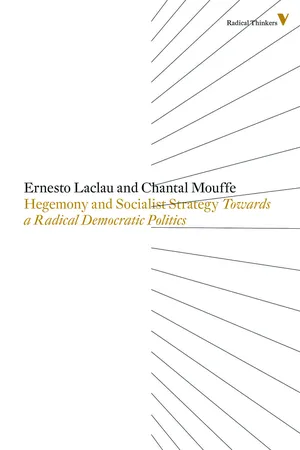
Hegemony and Socialist Strategy
Towards a Radical Democratic Politics
- 208 pages
- English
- ePUB (mobile friendly)
- Available on iOS & Android
eBook - ePub
About this book
In this hugely influential book, Laclau and Mouffe examine the workings of hegemony and contemporary social struggles, and their significance for democratic theory. With the emergence of new social and political identities, and the frequent attacks on Left theory for its essentialist underpinnings, Hegemony and Socialist Strategy remains as relevant as ever, positing a much-needed antidote against 'Third Way' attempts to overcome the antagonism between Left and Right.
Information
Topic
PhilosophySubtopic
Philosophy History & Theory1
Hegemony: The Genealogy of a Concept
We will start by tracing the genealogy of the concept of ‘hegemony’. It should be stressed that this will not be the genealogy of a concept endowed from the beginning with full positivity. In fact, using somewhat freely an expression of Foucault, we could say that our aim is to establish the ‘archaeology of a silence’. The concept of hegemony did not emerge to define a new type of relation in its specific identity, but to fill a hiatus that had opened in the chain of historical necessity. ‘Hegemony’ will allude to an absent totality, and to the diverse attempts at recomposition and rearticulation which, in overcoming this original absence, made it possible for struggles to be given a meaning and for historical forces to be endowed with full positivity. The contexts in which the concept appear will be those of a fault (in the geological sense), of a fissure that had to be filled up, of a contingency that had to be overcome. ‘Hegemony’ will be not the majestic unfolding of an identity but the response to a crisis.
Even in its humble origins in Russian Social Democracy, where it is called upon to cover a limited area of political effects, the concept of ‘hegemony’ already alludes to a kind of contingent intervention required by the crisis or collapse of what would have been a ‘normal’ historical development. Later, with Leninism, it is a keystone in the new form of political calculation required by the contingent ‘concrete situations’ in which the class struggle occurs in the age of imperialism. Finally, with Gramsci, the term acquires a new type of centrality that transcends its tactical or strategic uses: ‘hegemony’ becomes the key concept in understanding the very unity existing in a concrete social formation. Each of these extensions of the term, however, was accompanied by an expansion of what we could provisionally call a ‘logic of the contingent’. In its turn, this expression stemmed from the fracture, and withdrawal to the explanatory horizon of the social, of the category of ‘historical necessity’ which had been the cornerstone of Second International Marxism. The alternatives within this advancing crisis – and the different responses to it, of which the theory of hegemony is but one – form the object of our study.
The Dilemmas of Rosa Luxemburg
Let us avoid any temptation to go back to the ‘origins’. Let us simply pierce a moment in time and try to detect the presence of that void which the logic of hegemony will attempt to fill. This arbitrary beginning, projected in a variety of directions, will offer us, if not the sense of a trajectory, at least the dimensions of a crisis. It is in the multiple, meandering reflections in the broken mirror of ‘historical necessity’ that a new logic of the social begins to insinuate itself, one that will only manage to think itself by questioning the very literality of the terms it articulates.
In 1906 Rosa Luxemburg published The Mass Strike, the Political Party and the Trade Unions. A brief analysis of this text – which already presents all the ambiguities and critical areas important to our theme – will provide us with an initial point of reference. Rosa Luxemburg deals with a specific theme: the efficacy and significance of the mass strike as a political tool. But for her this implies consideration of two vital problems for the socialist cause: the unity of the working class and the path to revolution in Europe. Mass strike, the dominant form of struggle in the first Russian revolution, is dealt with in its specific mechanisms as well as in its possible projections for the workers’ struggle in Germany. The theses of Rosa Luxemburg are well known: while debate concerning the efficacy of the mass strike in Germany had centred almost exclusively on the political strike, the Russian experience had demonstrated an interaction and a mutual and constant enrichment between the political and economic dimensions of the mass strike. In the repressive context of the Tsarist State, no movement for partial demands could remain confined within itself: it was inevitably transformed into an example and symbol of resistance, thus fuelling and giving birth to other movements. These emerged at unpreconceived points and tended to expand and generalize in unforeseeable forms, so that they were beyond the capacity of regulation and organization of any political or trade-union leadership. This is the meaning of Luxemburg’s ‘spontaneism’. The unity between the economic and the political struggle – that is to say, the very unity of the working class – is a consequence of this movement of feedback and interaction. But this movement in turn is nothing other than the process of revolution.
If we move from Russia to Germany, Rosa Luxemburg argues, the situation becomes very different. The dominant trend is the fragmentation among diverse categories of workers, between the different demands of various movements, between economic struggle and political struggle. ‘Only in the sultry air of the period of revolution can any partial little conflict between labour and capital grow into a general explosion. In Germany the most violent, most brutal collisions between the workers and the employers take place every day without the struggle over-leaping the bound of the individual factories … None of these cases … changes suddenly into a common class action. And when they grow into isolated mass strikes which have without question a political colouring, they do not bring about a general storm.’1 This isolation and fragmentation is not a contingent event: it is a structural effect of the capitalist State, which is only overcome in a revolutionary atmosphere. ‘As a matter of fact the separation of the political and the economic struggle and the independence of each is nothing but an artificial product of the parliamentarian period, even if historically determined. On the one hand, in the peaceful, “normal” course of bourgeois society the economic struggle is split into a multitude of individual struggles in every undertaking and dissolved in every branch of production. On the other hand, the political struggle is not directed by the masses themselves in a direct action, but in correspondence with the form of the bourgeois State, in a representative fashion, by the presence of legislative representation.’2
In these conditions and given that the revolutionary outbreaks in Russia could be explained by factors such as the comparative backwardness of the country, the absence of political liberties, or the poverty of the Russian proletariat – were not the perspectives for revolution in the West postponed sine die? Here Rosa Luxemburg’s response becomes hesitant and less convincing as it assumes a characteristic course: namely, an attempt to minimize the differences between the Russian and the German proletariat, showing the areas of poverty and the absence of organization in various sectors of the German working class, as well as the presence of inverse phenomena in the most advanced sectors of the Russian proletariat. But what of those pockets of backwardness in Germany? Were they not residual sectors which would be swept away by capitalist expansion? And in that case, what guaranteed the emergence of a revolutionary situation? The answer to our question – Rosa Luxemburg does not at any point formulate it in this text – comes to us abruptly and unequivocably a few pages later: ‘(The social democrats) must now and always hasten the development of things and endeavour to accelerate events. This they cannot do, however, by suddenly issuing the “slogan” for a mass strike at random at any moment, but first and foremost, by making clear to the widest layers of the proletariat the inevitable advent of this revolutionary period, the inner social factors making for it and the political consequences of it.’3 Thus, the ‘necessary laws of capitalist development’ establish themselves as a guarantee for the future revolutionary situation in Germany. Everything is now clear: as there were no more bourgeois-democratic changes to be achieved in Germany (sic), the coming of a revolutionary situation could only be resolved in a socialist direction; the Russian proletariat – struggling against absolutism, but in a historical context dominated by the maturity of world capitalism which prevented it from stabilizing its own struggles in a bourgeois stage – was the vanguard of the European proletariat and pointed out to the German working class its own future. The problem of the differences between East and West, so important in the strategic debates of European socialism from Bernstein to Gramsci, was here resolved by being discarded.4
Let us analyse the various moments of this remarkable sequence. Concerning the constitutive mechanism of class unity, Rosa Luxemburg’s position is clear: in capitalist society, the working class is necessarily fragmented and the recomposition of its unity only occurs through the very process of revolution. Yet the form of this revolutionary recomposition consists of a specific mechanism which has little to do with any mechanistic explanation. It is here that spontaneism comes into play. One could think that the ‘spontaneist’ theory simply affirms the impossibility of foreseeing the direction of a revolutionary process, given the complexity and variety of forms which it adopts. Nevertheless, this explanation is insufficient. For what is at stake is not merely the complexity and diversity inherent in a dispersion of struggles – when these are seen from the point of view of an analyst or a political leader – but also the constitution of the unity of the revolutionary subject on the basis of this complexity and diversity. This alone shows us that in attempting to determine the meaning of Luxemburgist ‘spontaneism’, we must concentrate not only on the plurality of forms of struggle but also on the relations which they establish among themselves and on the unifying effects which follow from them. And here, the mechanism of unification is clear: in a revolutionary situation, it is impossible to fix the literal sense of each isolated struggle, because each struggle overflows its own literality and comes to represent, in the consciousness of the masses, a simple moment of a more global struggle against the system. And so it is that while in a period of stability the class consciousness of the worker – as a global consciousness constituted around his ‘historical interests’ – is ‘latent’ and ‘theoretical’, in a revolutionary situation it becomes ‘active’ and ‘practical’. Thus, in a revolutionary situation the meaning of every mobilization appears, so to speak, as split: aside from its specific literal demands, each mobilization represents the revolutionary process as a whole; and these totalizing effects are visible in the overdetermination of some struggles by others. This is, however, nothing other than the defining characteristic of the symbol: the overflowing of the signifier by the signified.5 The unity of the class is therefore a symbolic unity. Undoubtedly this is the highest point in Luxemburg’s analysis, one which establishes the maximum distance from the orthodox theoreticians of the Second International (for whom class unity is simply laid down by the laws of the economic base). Although in many other analyses of the period a role is given to the contingent – exceeding the moment of ‘structural’ theorization – few texts advance as much as Rosa Luxemburg’s in determining the specific mechanisms of this contingency and in recognizing the extent of its practical effects.6
Now, on the one hand, the analysis of Rosa Luxemburg has multiplied the points of antagonism and the forms of struggle – which we will from now on call the subject positions – up to the point of exploding all capacity for control or planning of these struggles by a trade-union or political leadership; on the other hand, it has proposed symbolic overdetermination as a concrete mechanism for the unification of these struggles. Here, however, the problems begin, since for Rosa Luxemburg this process of overdetermination constitutes a very precise unity: a class unity. Yet there is nothing in the theory of spontaneism which logically supports her conclusion. On the contrary, the very logic of spontaneism seems to imply that the resulting type of unitary subject should remain largely indeterminate. In the case of the Tsarist State, if the condition of overdetermination of the points of antagonism and the diverse struggles is a repressive political context, why cannot the class limits be surpassed and lead to the construction of, for example, partially unified subjects whose fundamental determination is popular or democratic? Even in Rosa Luxemburg’s text – notwithstanding the dogmatic rigidity of the author, for whom every subject has to be a class subject – the surpassing of classist categories appears at a number of points. ‘Throughout the whole of the spring of 1905 and into the middle of summer there fermented throughout the whole empire an uninterrupted economic strike of almost the entire proletariat against capital – a struggle which on the one hand caught all the petty-bourgeois and liberal professions, and on the other hand penetrated to the domestic servants, the minor police officials and even to the stratum of the lumpen proletariat, and simultaneously surged from the towns to the country districts and even knocked at the iron gates of the military barracks.’7
Let us be clear about the meaning of our question: if the unity of the working class were an infrastructural datum constituted outside the process of revolutionary overdetermination, the question concerning the class character of the revolutionary subject would not arise. Indeed, both political and economic struggle would be symmetrical expressions of a class subject constituted prior to the struggles themselves. But if the unity is this process of overdetermination, an independent explanation has to be offered as to why there should be a necessary overlap between political subjectivity and class positions. Although Rosa Luxemburg does not offer such an explanation – in fact, she does not even perceive the problem – the background of her thought makes clear what this would have been: namely, an affirmation of the necessary character of the objective laws of capitalist development, which lead to an increasing proletarianization of the middle sectors and the peasantry and, thus, to a straightforward confrontation between bourgeoisie and proletariat. Consequently the innovatory effects of the logic of spontaneism appear to be strictly limited from the beginning.8
The effects are so limited, no doubt, because the area in which they operate is extremely circumscribed. But also because, in a second and more important sense, the logic of spontaneism and the logic of necessity do not converge as two distinct and positive principles to explain certain historical situations, but function instead as antithetical logics which only interact with each other through the reciprocal limitation of their effects. Let us carefully examine the point where they diverge. The logic of spontaneism is a logic of the symbol inasmuch as it operates precisely through the disruption of every literal meaning. The logic of necessity is a logic of the literal: it operates through fixations which, precisely because they are necessary, establish a meaning that eliminates any contingent variation. In this case, however, the relation between the two logics is a relation of frontiers, which can expand in one or another direction but never overcome the irreducible dualism introduced into the analysis.
In reality, we here witness the emergence of a double void. Seen from the category of necessity, the duality of logics merges with the determinable/indeterminable opposition: that is to say, it only points to the operational limits of that category. But the same thing occurs from the point of view of spontaneism: the field of ‘historical necessity’ presents itself as a limit to the working of the symbolic. The limits are, in actual fact, limitations. If the specificity of this limitation of effects is not immediately evident, this is because it is thought of as a confluence of two positive and different explanatory principles, each valid in its own area, and not as what each of them is: the purely negative reverse of the other. The double void created by dualism hereby becomes invisible. However, to make a void invisible is not the same as to fill it up.
Before we examine the changing forms of this double void, we may for a moment place ourselves within it and practise the only game it allows us: that is, to move the frontiers separating the two opposed logics. If we broaden the area corresponding to historical necessity, the result is a well-known alternative: either capitalism leads through its necessary laws to proletarianization and crisis; or else these necessary laws do not function as expected, in which case, following the very logic of Luxemburgist discourse, the fragmentation between different subject positions ceases to be an ‘artificial product’ of the capitalist State and becomes a permanent reality. It is the zero-sum game intrinsic to all economistic and reductionist conceptions. If, on the contrary, we move the boundary in the opposite direction, to the point where the class nature of political subjects loses its nece...
Table of contents
- Cover
- Title Page
- Copyright
- Contents
- Preface to the Second Edition
- Introduction
- 1 Hegemony: The Genealogy of a Concept
- 2 Hegemony: The Difficult Emergence of a New Political Logic
- 3 Beyond the Positivity of the Social: Antagonisms and Hegemony
- 4 Hegemony and Radical Democracy
- Notes
Trusted by 375,005 students
Access to over 1.5 million titles for a fair monthly price.
Study more efficiently using our study tools.
Frequently asked questions
Yes, you can cancel anytime from the Subscription tab in your account settings on the Perlego website. Your subscription will stay active until the end of your current billing period. Learn how to cancel your subscription
No, books cannot be downloaded as external files, such as PDFs, for use outside of Perlego. However, you can download books within the Perlego app for offline reading on mobile or tablet. Learn how to download books offline
Perlego offers two plans: Essential and Complete
- Essential is ideal for learners and professionals who enjoy exploring a wide range of subjects. Access the Essential Library with 800,000+ trusted titles and best-sellers across business, personal growth, and the humanities. Includes unlimited reading time and Standard Read Aloud voice.
- Complete: Perfect for advanced learners and researchers needing full, unrestricted access. Unlock 1.5M+ books across hundreds of subjects, including academic and specialized titles. The Complete Plan also includes advanced features like Premium Read Aloud and Research Assistant.
We are an online textbook subscription service, where you can get access to an entire online library for less than the price of a single book per month. With over 1.5 million books across 990+ topics, we’ve got you covered! Learn about our mission
Look out for the read-aloud symbol on your next book to see if you can listen to it. The read-aloud tool reads text aloud for you, highlighting the text as it is being read. You can pause it, speed it up and slow it down. Learn more about Read Aloud
Yes! You can use the Perlego app on both iOS and Android devices to read anytime, anywhere — even offline. Perfect for commutes or when you’re on the go.
Please note we cannot support devices running on iOS 13 and Android 7 or earlier. Learn more about using the app
Please note we cannot support devices running on iOS 13 and Android 7 or earlier. Learn more about using the app
Yes, you can access Hegemony and Socialist Strategy by Chantal Mouffe,Ernesto Laclau in PDF and/or ePUB format, as well as other popular books in Philosophy & Philosophy History & Theory. We have over 1.5 million books available in our catalogue for you to explore.