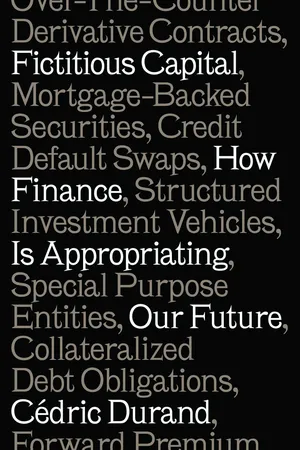
The 2007-08 credit crisis and the long recession that followed brutally exposed the economic and social costs of financialization. Understanding what lay behind these events, the rise of "fictitious capital" and its opaque logic, is crucial to grasping the social and political conditions under which we live. Yet, for most people, the operations of the financial system remain shrouded in mystery.
In this lucid and compelling book, economist C?dric Durand offers a concise and critical introduction to the world of finance, unveiling the truth behind the credit crunch. Fictitious Capital moves beyond moralizing tales about greedy bankers, short-sighted experts and compromised regulators to look at the big picture. Using comparative data covering the last four decades, Durand examines the relationship between trends such as the rise in private and public debt and the proliferation of financial products; norms such as our habitual assumptions about the production of value and financial stability; and the relationship of all this to political power.
Fictitious Capital offers a stark warning about the direction that the international economy is taking. Durand argues that the accelerated expansion of financial operations is a sign of the declining power of the economies of the Global North. The City, Wall Street and other centres of the power of money, he suggests, may already be caked with the frosts of winter.
- 176 pages
- English
- ePUB (mobile friendly)
- Available on iOS & Android
eBook - ePub
About this book
Information
CHAPTER ONE
Beyond Greed
In public debate, the question of financialisation has primarily been posed in moral terms. Recent scandals resulting from revelations about ill-practice in the big banks have brought this sector into great disrepute. Here, we will not attempt to redeem a profession whose contribution to the common good we would justifiably consider inversely proportional to the astronomical remuneration it awards itself. But as we shall see, no attempt to explain the crisis in terms of the immorality of financial actors will stand up to analysis.
A WHIFF OF SCANDAL
In the very heart of Wall Street, the con artist Bernie Madoff played a trick as old as the world itself on a number of powerful financial institutions, namely the Ponzi scheme. This former tennis player hoodwinked Santander, HSBC, Natixis, Royal Bank of Scotland, BNP Paribas, BBVA, Nomura Holdings, AXA, Crédit Mutuel, Dexia, Groupama and Société Générale, among others (just like millions of Russian savers and hundreds of thousands of Albanians were duped after the fall of the socialist regimes – helping them discover the joys of capitalism!). The Madoff affair is symptomatic of an atmosphere of blind confidence in the capacities of financial valorisation. However, there was nothing sophisticated about it, nor any direct link with the US real-estate bubble of the 2000s. In his March 2009 legal deposition, Madoff admitted that his stratagem consisted of depositing his clients’ money in the bank, and when they wished to withdraw it, he drew on the money in the ‘bank account that belonged to them or other clients to pay the requested funds’.1 All the same, this extreme chicanery – it was, after all, a matter of 17–20 billion dollars! – was just the tip of the iceberg of the fraud that was taking place. Indeed, in general it was the tricksters who got richest.
We can see that in the United States, on average and over time, neither small savers nor collective saving funds or pension funds are capable of realising profits through speculation. They cannot achieve capital gains superior to those corresponding to the movements of the market itself.2 There is no stock miracle for employees who put their savings into shares in order to save for their retirement. Neoclassical financial theory sees this as a proof of financial markets’ efficiency: indeed, its basic theorem stipulates that there is no possibility of arbitrage on the financial markets.3 To put it another way, the level of financial remuneration is always identical to the degree of risk and the maturity of the asset concerned; or, in more simple terms, there is no ‘money machine’ for guaranteeing self-enrichment, for example by borrowing at a lower rate and lending at a higher one. And yet that is exactly what carry trade entails, for it consists of borrowing at low rates in one currency in order to invest at higher rates in another. This practice, as lucrative as it is widespread,4 represents a mystery that standard financial theory is incapable of explaining, even when it does take into account the risks associated with the rare but abrupt variations in exchange rates.5
Of course, the neoclassical theorists of modern finance consider the behaviour of small shareholders erratic. Yet, in their view, the blips caused by the latter’s errors are immediately corrected by the action of smarter financial agents capable of beating the market – that is, hedge funds earning a lot more money than the average market movements. These funds are supposedly superior thanks to their small and very highly paid teams: ‘the greatest army of mathematicians, physicists and computer specialists ever brought together’.6 It is true that hedge funds mobilise all means at hand; for example, at the beginning of the 2010s, they began using personal assistance software, modelled on that used by elite athletes, in order to
help fund managers work out when they perform best. Do they make their best trades in the morning after two cups of coffee? Do they function better on their own in a quiet room rather than a big open-plan office, buzzing with people, or do they come back from a liquid lunch invigorated and inspired, ready to make their best decisions?7
The neoclassical theorists’ approach often neglects one fundamental aspect, however: that, as in top-level sports, the quest for performance at any price has the corollary of cheating. Having the best analyses available and the best understanding of the financial dynamics at work is, certainly, essential to pulling off the most successful operations. Yet we can also employ the good old ‘Huggy Bear method’. Even if this practice is illegal, access to private information is often key to one’s fortunes on the finance markets, and all the more so when there is little chance of getting caught. Hedge funds, like the big merchant banks to which they are linked, are often in a position to benefit from exclusive access to information that allows them to beat the market. Even if the hypothesis as to the information efficiency of the financial markets has carried off a clutch of Nobel Prizes, in reality it is imperfect information that drives finance.8
From the Butner Federal Correction Complex where he is sitting out a 150-year prison sentence, Bernie Madoff – who was until recently non-executive president of the NASDAQ – explained in no uncertain terms: insider trading ‘has been present in the market forever, but rarely prosecuted. The same can be said of front running of orders.’9 The crime of insider trading consists of engaging in transactions on stocks about which one has non-public information. ‘Front running’ involves exploiting one’s knowledge of clients’ past instructions in order to effect operations to one’s own benefit, either in advance of, in parallel to, or immediately after these instructions.
Although it is by definition difficult to evaluate the extent of these practices, an empirical study has confirmed their existence. The research undertaken by Fang Cai looked into futures transactions on Treasury Bonds at the Chicago Board of Trade, the Chicago market specialising in futures operations, between 2 September and 15 October 1998. This was the period of the collapse and then bailout of the Long-Term Capital Management (LTCM) hedge fund.10 In many regards, the LTCM case prefigured the problems encountered during the 2007–8 financial crisis. The board of the fund used complex mathematical methods for its operations – which in large part concerned derivative products – and its members included Myron Scholes and Robert Merton, two economists awarded the Nobel Prize in economics in 1997 for their contribution to financial theory and, more particularly, their determination of the value of derivative products. LTCM was also closely connected to the main investment banks on the New York exchanges. It was the fear of the chain reaction that would have resulted had LTCM gone bankrupt that led the New York FED to organise a salvage operation, to which fifteen major US and European banks contributed.
By the end of summer 1998, LTCM’s financial difficulties were widely known. Also known was the fact that the fund had massively gambled on a fall in US Treasury Bonds. Unfortunately for LTCM, the Treasury Bond prices greatly increased. In an attempt to avoid considerable losses and reduce this unfavourable exposure, LTCM had no choice but to buy a huge quantity of bonds on the futures markets. Given the sums at stake, these transactions had a significant impact on stock prices. Cai’s study manages to identify the orders given by LTCM and executed through the intermediary of the Bear Stearns bank. It shows that the agents charged with executing LTCM’s orders did not simultaneously place orders in their own name in order to profit from the opportunity. So there was no front running in the strict sense. This was probably because the agents did not want to violate the rules established by the regulator in charge of the futures markets, and because they wanted to preserve their good relations with Bear Stearns, which placed LTCM’s orders. Conversely, however, there was indeed front running in a wider sense. Since the futures market was at the time an open-outcry market, traders could interpret the noise, body language and hand signals of the agent in charge of LTCM’s operations and thus place orders for their own accounts before the LTCM orders were given. This informational advantage is expressed in the data showing an abnormal level of transactions in the one to two minutes preceding the transactions linked to LTCM, which contributed to aggravating the fund’s losses. Cai’s study challenges the hypothesis that the agents who make the financial markets work at a micro-level do not have informational advantages. In fact, this type of asymmetry is found even in the most open public markets.
In the wake of the 2007–8 crisis, several scandals confirmed that this problem was not limited to the market’s trading-floor operatives alone – far from it. They showed how the big banks and hedge funds had exploited their informational advantages. Thus, in 2013, SAC Capital – a $15bn hedge fund specialising in securities markets – was convicted of insider trading, having sold en masse its shares in two pharmaceutical companies, Wyeth and Elan, after becoming aware of the failure of tests into Alzheimer’s treatments.11
Following the Abacus scandal, Goldman Sachs implicitly recognised that it had engaged in forms of front running. Abacus was the name of a complex product, a mille-feuille of subprime real-estate credit derivatives created by the Paulson & Co. hedge fund in 2006 and sold by Goldman Sachs to institutional investors for a total of over $10bn. In 2007 it was again Paulson & Co. that selected the loans for the new version of Abacus. Since the hedge fund had been at liberty to choose even the most fragile products, it was particularly well placed to know that these products would collapse; it thus made a massive bet on these securities falling. However, Goldman Sachs did not inform its clients of the fact that Paulson was, indeed, behind the choice of the underlying loans, and even less that it had taken positions betting on their value falling.12 This case well illustrates the way in which complex merchant banks/hedge funds dominate finance at the expense of other actors – in this case, pension funds and other banks. IKB, a German bank specialising in the long-term financing of small and medium-sized businesses, and which was at that time partly state owned, had to be bailed out with public money in August 2007.
During this affair, Goldman Sachs preferred to reach an agreement with the SEC (the US financial markets commission) and pay a $550m fine rather than go to trial. The fine amounted to around fourteen days of the bank’s profits for that year. In contrast, the trader directly responsible for this product, Fabrice Tourre, was prosecuted and found guilty in summer 2013. His private email correspondence, revealed as part of the investigation, is extremely valuable in documenting the frame of mind of an actor directly implicated in producing the sub-prime crisis. At the beginning of 2007, a few months before the crisis broke, the young trader wrote that he was ‘standing in the middle of all these complex, highly leveraged, exotic trades [he] created without necessarily understanding all of the implications of those monstruosities!!! [sic]’. Conscious that ‘poor little subprime borrowers won’t last long’, he nonetheless sold bonds ‘to widows and orphans’. Ironically, however, he stated that he was not ‘feeling too guilty about this’ – after all, ‘the real purpose of [the] job is to make capital markets more efficient and ultimately provide the US consumer with more efficient ways to leverage and finance himself’.13
In a few lines, Tourre bluntly demonstrated the main virtue of the financial market efficiency hypothesis – namely, that it serves to justify the operations that bring colossal incomes to those who master the markets. The Abacus case moreover demonstrated that the role of the big investment banks and hedge funds is certainly not limited to correcting market distortions: it also consists of creating these distortions, in such a manner as to organise transfers of wealth. Despite the great pregnancy of the discourse on market efficiency, we arrive at what is altogether a rather prosaic conclusion: the institutions establishing themselves at the centre of the world’s financial system use and abuse their position and the exclusive information available to them in order to make money.
Looking beyond these instructive examples, revelations that the world’s biggest banks had mounted coordinated efforts to manipulate two essential financial markets – the money market and the currency market – affected the system’s very foundations. In the first case, the scandal had to do with the fixing of inter-bank interest rates (LIBOR): between 2005 and 2009, the main banks had been able to mask their vulnerability by underestimating the effective rates. Even better, given that contracts worth many hundreds of thousands of billions of dollars are linked to LIBOR, the big banks could make considerable financial gains by playing with these minimal differences – and they did so for more than two decades.14 The second case concerned the most important financial market: the currency market, with its daily exchange volume of some $5.3tn. Through coordinated movements over very short periods – less than 60 seconds – the big banks were able to manipulate the exchange rates of the main currencies to their own advantage.15
A ‘FLEXIBLE’ MORAL HAZARD
These scandals doubtless contributed to a moment of rationalisation in the financial markets and may lead to an improvement in their functioning, but they do not challenge those markets in any fundamental sense. So it is important to show that, even if greed and dishonesty did play a significant role in the crisis, the craze for sophisticated financial products and the financial bubble cannot be reduced to a question of individual morals or irresponsibility. At first glance, however, the subprime mechanism would seem to provide evidence in favour of that argument.
Right at the bottom of the financial chain, we find the sale of real-estate credit to households – debts that serve as the raw material for derivatives products and which contributed to feeding the bubble. The sharp rise in securitisation makes it possible to detach distributing credit from exposure to credit risk. Those who distribute credit among households re-sell the debt on the financial market, at which point they are remunerated through the payment of a commission. Once the resale has been realised, they are no longer linked in any way to the borrowers – so they have no reason to concern themselves with the latter’s capacity to repay the debt. The securitisation of credits leads to a slackening of inquiries into borrowers’ financial situation.16 Whereas borrowers are generally required to have assets and/or a regular flow of income, the United States in the 2000s saw a massive rise in NINJA loans: lending to those with ‘No Income, No Job, no Assets’. Since the traditional channels of credit were saturated and institutional investors were hungry for derivatives products, the banks set out in search of new clients. For borrowers, the options on offer may have seemed rather tantalising. Judge as you may: certain contracts did not anticipate any checking of borrowers’ resources; for the first ten years, the borrower only had to pay back interest; if they increased their total debt, they could also pay less than the monthly amount corresponding to the repayment of the interest and of the principal.17 Capping all this, home ownership also allowed people to obtain further credit for consumer purchases.
Combined with aggressive marketing, these advantageous credit conditions brought a considerable number of lower-income households into financial circuits linked to real estate. Thus, in the United States, the proportion of households that owned their own home rose from 64 per cent in the mid-1990s to 69 per cent in the mid-2000s, pushing up prices. Credit was issued imprudently on the basis that a continual rise in prices would in any case allow for its reimbursement in cases of default, i.e. via foreclosures. Here we arrive at the fundamental explanation of the problem: this type of loan is a typical example of a ‘moral hazard’, when agents take an excessive risk but without fully bearing the consequences. Bankers and brokers are encouraged continually to provide loans because they pocket commissions at each level of the securitisation chain, at the same time as they completely offload the risk by selling these securities on the markets.
Such a system was, of course, unsustainable. The series of defaults saw the proportion of homeowners fall back down to 65 per cent in 2013, and millions of families who were pursued by their creditors had to abandon their homes. A small number opted to make strategic...
Table of contents
- Cover Page
- Halftitle Page
- Title Page
- Dedication
- Copyright Page
- Contents
- List of Tables and Figures
- Acknowledgements
- Introduction: The Sign of Autumn
- Chapter One: Beyond Greed
- Chapter Two: Financial Instability
- Chapter Three: Fictitious Capital: The Genealogy of a Concept
- Chapter Four: The Contemporary Rise of Fictitious Capital
- Chapter Five: Financial Accumulation
- Chapter Six: Where Do Financial Profits Come From?
- Chapter Seven: Finance in Service of the Metamorphoses of Capital
- Chapter Eight: The Enigma of Profits Without Accumulation
- Epilogue
- Notes
- Index
Trusted by 375,005 students
Access to over 1.5 million titles for a fair monthly price.
Study more efficiently using our study tools.
Frequently asked questions
Yes, you can cancel anytime from the Subscription tab in your account settings on the Perlego website. Your subscription will stay active until the end of your current billing period. Learn how to cancel your subscription
No, books cannot be downloaded as external files, such as PDFs, for use outside of Perlego. However, you can download books within the Perlego app for offline reading on mobile or tablet. Learn how to download books offline
We are an online textbook subscription service, where you can get access to an entire online library for less than the price of a single book per month. With over 1.5 million books across 990+ topics, we’ve got you covered! Learn about our mission
Look out for the read-aloud symbol on your next book to see if you can listen to it. The read-aloud tool reads text aloud for you, highlighting the text as it is being read. You can pause it, speed it up and slow it down. Learn more about Read Aloud
Yes! You can use the Perlego app on both iOS and Android devices to read anytime, anywhere — even offline. Perfect for commutes or when you’re on the go.
Please note we cannot support devices running on iOS 13 and Android 7 or earlier. Learn more about using the app
Please note we cannot support devices running on iOS 13 and Android 7 or earlier. Learn more about using the app
Yes, you can access Fictitious Capital by Cédric Durand, David Broder in PDF and/or ePUB format, as well as other popular books in Economics & Economic Theory. We have over 1.5 million books available in our catalogue for you to explore.