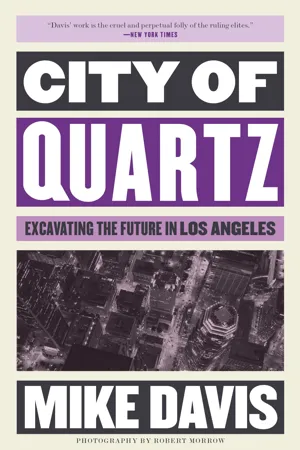
No metropolis has been more loved or more hated. To its official boosters, "Los Angeles brings it all together." To detractors, LA is a sunlit mortuary where "you can rot without feeling it." To Mike Davis, the author of this fiercely elegant and wide-ranging work of social history, Los Angeles is both utopia and dystopia, a place where the last Joshua trees are being plowed under to make room for model communities in the desert, where the rich have hired their own police to fend off street gangs, as well as armed Beirut militias.
In City of Quartz, Davis reconstructs LA's shadow history and dissects its ethereal economy. He tells us who has the power and how they hold on to it. He gives us a city of Dickensian extremes, Pynchonesque conspiracies, and a desperation straight out of Nathaniel West - a city in which we may glimpse our own future mirrored with terrifying clarity.
- 441 pages
- English
- ePUB (mobile friendly)
- Available on iOS & Android
eBook - ePub
About this book
Information
CHAPTER ONE
SUNSHINE OR NOIR?
LOS ANGELES INTELLECTUALS: AN INTRODUCTION
Los Angeles, it should be understood, is not a mere city. On the contrary, it is, and has been since 1888, a commodity; something to be advertised and sold to the people of the United States like automobiles, cigarettes and mouth wash. Morrow Mayo1
In the summer of 1989, a well-known fashion magazine constantly on the prowl for lifestyle trends reported from Los Angeles that ‘intellectualism’ had arrived there as the latest fad. From celebrities buying armloads of ‘smart-looking eyeglasses’ to the ‘people of L.A. who . . . have elevated intellectualism to a life style’, the city was supposedly booming with bookish behavior for its own sake: ‘There’s a real feeling here about becoming intellectual, removing superficiality, getting culture.’2 The magazine’s West Coast editor noted approvingly that the ‘new intellectualism’ was sweeping Los Angeles on the same wave of messianic hype that had brought its local predecessors, ‘the perfect body’ and ‘New Age spirituality’. Angelenos, moreover, had already recognized that the crucial point of the new pastime was that ‘books are for sale’ and that a surge of commodity fetishism and feverish entrepreneurship would accompany the laying on of Culture.3
As this anecdote implies, to evoke ‘Los Angeles intellectuals’ is to invite immediate incredulity, if not mirth. Better then, at the outset, to refer to a mythology – the destruction of intellectual sensibility in the sun-baked plains of Los Angeles – that conforms more to received impressions, and that is at least partially true. First of all, Los Angeles is usually seen as peculiarly infertile cultural soil, unable to produce, to this day, any homegrown intelligentsia. Unlike San Francisco, which has generated a distinctive cultural history from the Argonauts to the Beats, Los Angeles’s truly indigenous intellectual history seems a barren shelf. Yet – for even more peculiar reasons – this essentially deracinated city has become the world capital of an immense Culture Industry, which since the 1920s has imported myriads of the most talented writers, filmmakers, artists and visionaries. Similarly, since the 1940s, the Southern California aerospace industry and its satellite think-tanks have assembled the earth’s largest single concentration of PhD scientists and engineers. In Los Angeles immigrant mental labor is collectivized in huge apparatuses and directly consumed by big capital. Almost everyone is either on a corporate payroll or waiting hopefully at the studio gate.
Such relations of ‘pure capitalism’, of course, are seen as invariably destructive of the identity of ‘true’ intellectuals, still self-defined as artisans or rentiers of their own unique mental productions. Snared in the nets of Hollywood, or entrapped by the Strangelovian logic of the missile industry, ‘seduced’ talents are ‘wasted’, ‘prostituted’, ‘trivialized’, or ‘destroyed’. To move to Lotusland is to sever connection with national reality, to lose historical and experiential footing, to surrender critical distance, and to submerge oneself in spectacle and fraud. Fused into a single montage image are Fitzgerald reduced to a drunken hack, West rushing to his own apocalypse (thinking it a dinner party), Faulkner rewriting second-rate scripts, Brecht raging against the mutilation of his work, the Hollywood Ten on their way to prison, Didion on the verge of a nervous breakdown, and so on. Los Angeles (and its alter-ego, Hollywood) becomes the literalized Mahagonny: city of seduction and defeat, the antipode to critical intelligence.
Yet this very rhetoric (which infuses a long tradition of writing about Los Angeles, since at least the 1920s) indicates powerful critical energies at work. For if Los Angeles has become the archetypal site of massive and unprotesting subordination of industrialized intelligentsias to the programs of capital, it has also been fertile soil for some of the most acute critiques of the culture of late capitalism, and, particularly, of the tendential degeneration of its middle strata (a persistent theme from Nathanael West to Robert Towne). The most outstanding example is the complex corpus of what we call noir (literary and cinematic): a fantastic convergence of American ‘tough-guy’ realism, Weimar expressionism, and existentialized Marxism – all focused on unmasking a ‘bright, guilty place’ (Welles) called Los Angeles.
Los Angeles in this instance is, of course, a stand-in for capitalism in general. The ultimate world-historical significance – and oddity – of Los Angeles is that it has come to play the double role of utopia and dystopia for advanced capitalism. The same place, as Brecht noted, symbolized both heaven and hell. Correspondingly, it is the essential destination on the itinerary of any late twentieth-century intellectual, who must eventually come to take a peep and render some opinion on whether ‘Los Angeles Brings It All Together’ (official slogan), or is, rather, the nightmare at the terminus of American history (as depicted in noir). Los Angeles – far more than New York, Paris or Tokyo – polarizes debate: it is the terrain and subject of fierce ideological struggle.

ORANGES ON SIDEWALK
Temple-Beaudry district
With apologies for the schematic compression inevitable in so cursory a survey, I explore, first, the role played by successive migrations of intellectuals (whether as tourists, exiles or hired hands), in relation to the dominating cultural institutions of their time (the Los Angeles Times, Hollywood, and, most recently, an emergent university-museum mega-complex), in constructing or deconstructing the mythography of Los Angeles. I am interested, in other words, not so much in the history of culture produced in Los Angeles, as the history of culture produced about Los Angeles – especially where that has become a material force in the city’s actual evolution. As Michael Sorkin has emphasized, ‘L.A. is probably the most mediated town in America, nearly unviewable save through the fictive scrim of its mythologizers’.4
I begin with the so-called ‘Arroyo Set’: writers, antiquarians, and publicists under the influence of Charles Fletcher Lummis (himself in the pay of the Times and the Chamber of Commerce), who at the turn of the century created a comprehensive fiction of Southern California as the promised land of a millenarian Anglo-Saxon racial odyssey. They inserted a Mediterraneanized idyll of New England life into the perfumed ruins of an innocent but inferior ‘Spanish’ culture. In doing so, they wrote the script for the giant real-estate speculations of the early twentieth century that transformed Los Angeles from small town to metropolis. Their imagery, motifs, values and legends were in turn endlessly reproduced by Holly-wood, while continuing to be incorporated into the ersatz landscapes of suburban Southern California.
As the Depression shattered broad strata of the dream-addicted Los Angeles middle classes, it also gathered together in Hollywood an extra-ordinary colony of hardboiled American novelists and anti-fascist European exiles. Together they radically reworked the metaphorical figure of the city, using the crisis of the middle class (rarely the workers or the poor) to expose how the dream had become nightmare. Although only a few works directly attacked the studio system,5 noir everywhere insinuated contempt for a depraved business culture while it simultaneously searched for a critical mode of writing or filmmaking within it. Although some principal noir auteurs, like Chandler, went little further than generalized petty-bourgeois resentment against the collapse of the Southern California dream, most claimed Popular Front sympathies, and some, like Welles and Dmytryk, alluded to the repressed reality of class struggle. Despite the postwar witch hunt that decimated Hollywood progressives, noir survived through the 1950s to re-emerge in a new wave in the 1960s and 1970s. The huge popularity of Didion, Dunne, Wambaugh, Chinatown, Blade Runner, the Chandler and Cain remakes, and, finally, the arrival of the ‘post-noir’ of James Ellroy’s Los Angeles Quartet, stand as proof of the genre’s durability. Although recuperated as an ambience shorn of its 1940s radical affinities, noir has nonetheless remained the popular and, despite its intended elitism, ‘populist’ anti-myth of Los Angeles.
While the cinematic translation of the noir vision of Los Angeles engaged some of the finest European writers and directors resident in Hollywood in the 1940s (giving them an invaluable medium for political and aesthetic resistance), the relationship between the city and the community of anti-fascist exiles deserves separate consideration. It was a potent common moment in the cultural histories of Southern California and Europe, generating its own mythology that helped shape critical reaction to the postwar Americanization of Europe. Without necessarily subscribing to the ‘nightmare’ anti-myth of noir, the exile sense of Los Angeles was unremittingly pessimistic. Here was the ultimate city of capital, lustrous and superficial, negating every classical value of European urbanity. Driven by one epochal defeat of the Enlightenment to the shores of Santa Monica Bay, the most unhappy of the exiles thought they discerned a second defeat in Los Angeles as the ‘shape of the things to come’, a mirror of capitalism’s future.
It is hard to exaggerate the damage which noir’s dystopianization of Los Angeles, together with the exiles’ denunciation of its counterfeit urbanity, inflicted upon the accumulated ideological capital of the region’s boosters. Noir, often in illicit alliance with San Francisco or New York elitism, made Los Angeles the city that American intellectuals love to hate (although, paradoxically, this seems only to increase its fascination for postwar European, especially British and French, intellectuals). As Richard Lehan has emphasized, ‘probably no city in the Western world has a more negative image’.6 To repair this image, especially among the cultural elites, local corporate patrons have sponsored a third major immigration of intellectuals, comparable to the Hollywood-bound diaspora of the 1930s, but now dominated by architects, designers, artists and culture theorists.
As Los Angeles – propelled by financial, real-estate and military booms – has rushed forward to Manhattanize its skylines (increasingly with offshore capital), it has attempted to Manhattanize its cultural super-structure as well. The largest land developers and bankers have coordinated a major cultural offensive, whose impact has been redoubled, after decades of mere talk, by a sudden torrent of arts capital, including the incredible $3 billion Getty endowment, the largest in history. As a result, a wealthy institutional matrix has coalesced – integrating elite university faculties, museums, the arts press and foundations – single-mindedly directed toward the creation of a cultural monumentality to support the sale of the city to overseas investors and affluent immigrants. In this sense, the cultural history of the 1980s recapitulated the real-estate/arts nexus of early twentieth-century boosterism, although this time around with a promotional budget so large that it could afford to buy the international celebrity architects, painters and designers – Meier, Gr...
Table of contents
- Cover
- Title
- Dedication
- Copyright
- Contents
- Preface
- Prologue: The View from Futures Past
- Chapter One: Sunshine or Noir?
- Chapter Two: Power Lines
- Chapter Three: Homegrown Revolution
- Chapter Four: Fortress L.A.
- Chapter Five: The Hammer and the Rock
- Chapter Six: New Confessions
- Chapter Seven: Junkyard of Dreams
- Index
Trusted by 375,005 students
Access to over 1.5 million titles for a fair monthly price.
Study more efficiently using our study tools.
Frequently asked questions
Yes, you can cancel anytime from the Subscription tab in your account settings on the Perlego website. Your subscription will stay active until the end of your current billing period. Learn how to cancel your subscription
No, books cannot be downloaded as external files, such as PDFs, for use outside of Perlego. However, you can download books within the Perlego app for offline reading on mobile or tablet. Learn how to download books offline
Perlego offers two plans: Essential and Complete
- Essential is ideal for learners and professionals who enjoy exploring a wide range of subjects. Access the Essential Library with 800,000+ trusted titles and best-sellers across business, personal growth, and the humanities. Includes unlimited reading time and Standard Read Aloud voice.
- Complete: Perfect for advanced learners and researchers needing full, unrestricted access. Unlock 1.5M+ books across hundreds of subjects, including academic and specialized titles. The Complete Plan also includes advanced features like Premium Read Aloud and Research Assistant.
We are an online textbook subscription service, where you can get access to an entire online library for less than the price of a single book per month. With over 1.5 million books across 990+ topics, we’ve got you covered! Learn about our mission
Look out for the read-aloud symbol on your next book to see if you can listen to it. The read-aloud tool reads text aloud for you, highlighting the text as it is being read. You can pause it, speed it up and slow it down. Learn more about Read Aloud
Yes! You can use the Perlego app on both iOS and Android devices to read anytime, anywhere — even offline. Perfect for commutes or when you’re on the go.
Please note we cannot support devices running on iOS 13 and Android 7 or earlier. Learn more about using the app
Please note we cannot support devices running on iOS 13 and Android 7 or earlier. Learn more about using the app
Yes, you can access City of Quartz by Mike Davis in PDF and/or ePUB format, as well as other popular books in Social Sciences & North American History. We have over 1.5 million books available in our catalogue for you to explore.