The sex industry is an endless source of prurient drama for the mainstream media. Recent years have seen a panic over "online red-light districts," which supposedly seduce vulnerable young women into a life of degradation, and New York Times columnist Nicholas Kristof's live tweeting of a Cambodian brothel raid. The current trend for writing about and describing actual experiences of sex work fuels a culture obsessed with the behaviour of sex workers. Rarely do these fearful dispatches come from sex workers themselves, and they never seem to deviate from the position that sex workers must be rescued from their condition, and the industry simply abolished-a position common among feminists and conservatives alike.
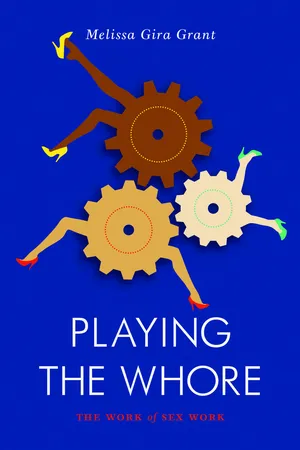
In Playing the Whore, journalist Melissa Gira Grant turns these pieties on their head, arguing for an overhaul in the way we think about sex work. Based on ten years of writing and reporting on the sex trade, and grounded in her experience as an organizer, advocate, and former sex worker, Playing the Whore dismantles pervasive myths about sex work, criticizes both conditions within the sex industry and its criminalization, and argues that separating sex work from the "legitimate" economy only harms those who perform sexual labor.
In Playing the Whore, sex workers' demands, too long relegated to the margins, take center stage: sex work is work, and sex workers' rights are human rights.
- 144 pages
- English
- ePUB (mobile friendly)
- Available on iOS & Android
eBook - ePub
About this book
Information
1
The Police
“An attractive blonde walks into a Fargo hotel room,” it begins, “followed by a mustached man in a black leather jacket. He asks what brought her to town.” The blonde in the low-slung jeans is about to sit down. You can just see her shoulder and the back of her head.
In another room, a man looks at a woman with long dark hair. She’s seated across from him, wrapped in a robe or a shirt. It’s hard to see in the glare of the bedside lamp. He stands and slips off his boxers. He asks if she would let him see hers. She drops the robe or the shirt from her shoulders a few inches, then excuses herself to go freshen up.
“You’ll be satisfied,” a third woman says. “This is my job.”
There’s always a television, and it’s playing a western, or the kind of old Hollywood picture with men dancing in topcoats and tails. In front of the flat screen, two women are cuffed. He’s ordered them to sit for questioning.
As he reaches for one of the women’s wrists, the man in the cop uniform says, “We’re just going to lock these cuffs, so they don’t get tight on you.” She asks, “Can I ask what I did wrong?”
“I’m not gon[na] lie,” writes a commenter under one of the videos, “… i jacked off to this.”
Though they resemble amateur pornography’s opening shots, you will not find these videos by searching YouPorn, PornHub, or RedTube. They’re published at JohnTV.com, which boasts “over sixty million views.” JohnTV is the project of “Video Vigilante” Brian Bates, who since 1996 has been trailing women he suspects to be “prostitutes” and “hookers” and shoots videos of them with men he tells us are their “johns.”
JohnTV posts are sorted into sections: Busts, Stings, and Pimp Profiles. These start with a mug shot—usually of a black man—followed by his name and criminal allegations. Bates claims he “often works with patrol officers” and members of the “Vice Unit on cases involving human trafficking.” He also goes solo, trailing people on streets, in parked cars, wherever he finds people he considers suspicious, attempting to catch men in the act and the women with them. For Bates, the camera isn’t just a tool for producing evidence: It’s his cover for harassing women he believes are selling sex, pinning a record on them online even when the law will not.
Bates didn’t shoot the six videos from Fargo. “This is the first time JohnTV has come across videos of this sort,” he gushes on his blog. “Usually these sorts of videos only appear on television after being highly edited by television programs such as COPS.” These six unedited videos are embeds from a North Dakota news outlet, where they ran with the headline, “Watch Local Prostitution Stings Unfold.” But they weren’t produced by reporters. The videos were created by the Fargo Police Department.
There’s so much to watch in the long minutes between negotiation and interrogation, and it repeats—the nervous customer asking if he’s going to get “full service” or if she “upsells,” the undercovers’ rehearsed excuses that they “just need, like, a five-minute shower” while they call for backup, then the sudden, crashing appearance of black vests and ball caps and guns drawn on undressed people, who are told to bend and kneel and spread their arms.
Prostitution stings are a law enforcement tactic used to target men who buy sex and women who sell it—or men and women who the police have profiled in this way. These days, rather than limit their patrol to the street, vice cops search the Web for advertisements they believe offer sex for sale, contact the advertisers while posing as customers, arrange hotel meetings, and attempt to make an arrest from within the relative comfort of a room with free Wi-Fi and an ice machine down the hall.
Whether these videos are locked in an evidence room, broadcast on the eleven o’clock news, or blogged by a vigilante, they are themselves a punishment. We could arrest you at any time, they say. Even if no one is there to witness your arrest, everyone will know. When we record your arrest, when you’re viewed again and again, you will be getting arrested all the time.
In the United States, one of the last industrialized nations which continues to outlaw sex for sale, we must ask: Why do we insist that there is a public good in staging sex transactions to make arrests? Is the point to produce order, to protect, or to punish?
No evidence will be weighed before the arrest video is published. Even if she was not one before, in the eyes of the viewer and in the memory of search engines, this woman is now a prostitute. As so few people arrested for prostitution-related offenses fight their charges, there is no future event to displace the arrest video, to restate that those caught on tape didn’t, as one of the women arrested in Fargo said, “do anything wrong.” The undercover police, perpetually arresting in these videos, enact a form of sustained violence on these women’s bodies. Even with a camera, it is not immediately visible.
To produce a prostitute where before there had been only a woman is the purpose of such policing. It is a socially acceptable way to discipline women, fueled by a lust for law and order that is at the core of what I call the “prostitute imaginary”—the ways in which we conceptualize and make arguments about prostitution. The prostitute imaginary compels those who seek to control, abolish, or otherwise profit from prostitution, and is also the rhetorical product of their efforts. It is driven by both fantasies and fears about sex and the value of human life.
The sting itself, aside from the unjust laws it enforces, or the trial that may never result, is intended to incite fear. These stings form just one part of a matrix of widespread police misconduct toward sex workers and people profiled as sex workers. In New York City, for example, 70 percent of sex workers working outdoors surveyed by the Sex Workers Project reported near daily run-ins with police, and 30 percent reported being threatened with violence. According to “The Revolving Door: An Analysis of Street-Based Prostitution in New York City,” when street-based sex workers sought help from the police, they were often ignored.
Carol told researchers, “If I call them, they don’t come. If I have a situation in the street, forget it. ‘Nobody told you to be in the street.’ After a girl was gang-raped, they said, ‘Forget it, she works in the street.’ She said, ‘I hope that never happens to your daughters. I’m human.’ ”
Jamie had an incident where she was “hanging out on the stroll … these guys in a jeep driving by … one guy in a car threw a bottle at me … I went to the cops [who told me] we didn’t have a right being in that area because we know it’s a prostitution area, and whatever came our way, we deserved it.”
Police violence isn’t limited to sex workers who work outdoors. In a parallel survey conducted by the Sex Workers Project, 14 percent of those who primarily work indoors reported that police had been violent toward them; 16 percent reported that police officers had initiated a sexual interaction.
This was in New York City, where the police department is notorious for violating civil rights in the course of law enforcement, but look globally, where violations of sex workers’ rights by police are also common—and well documented. In West Bengal, the sex worker collective Durbar Mahila Samanwaya Committee surveyed over 21,000 women who do sex work. They collected 48,000 reports of abuse or violence by police—in contrast with 4,000 reports of violence by customers, who are conventionally thought of as the biggest threat to sex workers, especially by campaigners opposed to prostitution.
Police violence against sex workers is a persistent global reality. As the economy collapsed in Greece, police staged raids on brothels, arrested and detained sex workers, forced them to undergo HIV testing, and released their photos and HIV status to the media. These actions were condemned by UNAIDS and Human Rights Watch. In China, police have forced sex workers they have arrested to walk in “shame parades,” public processions in which they are shackled and then photographed. Police published these photos on the Web, including one in which a cop humiliated a nude sex worker by pulling her hair back and brutally exposing her face to the camera. When the photo went viral, the outcry reportedly prompted police to suspend these public shaming rituals, though they continue to make violent arrests and raids.
One could hope that the photos and videos like these could make the pervasiveness of this violence real to the public. But to truly confront this type of violence would require us to admit that we permit some violence against women to be committed in order to protect the social and sexual value of other women.
Violence’s Value
I’ve stopped asking, Why have we made prostitution illegal? Instead I want an explanation for, How much violence against “prostitutes” have we made acceptable? The police run-ins, the police denying help, the police abuse—all this shapes the context in which the sting, and the video of it, form a complete pursuit of what we are to understand as justice, which in this case is limited to some form of punishment, of acceptable violence.
As I was working on this book I was invited to give a presentation to law students and fellows at Yale University. In my talk, I described these videos. Afterward, as I stood in the door about to leave, several students approached me individually to say that they thought my presentation would have been more persuasive if I had prefaced it by stating my “position on prostitution.”
“Do you need to know if I oppose prostitution,” I asked these students, “before you can evaluate how you feel about police abuse, about a persistent pattern of denying justice to people labeled ‘prostitutes’?” Are these videos to be understood only as documents of an acceptable form of violence, to be applied as a deterrent, to deliberately make prostitution less safe?
My presentation remains, with this addendum: these students taught me to see how narrowly and insistently people can focus their opposition to what they understand as “the system” of prostitution, so much so that even police violence against sex workers is collapsed into that system, how this violence appears inevitable. The stigma and violence faced by sex workers are far greater harms than sex work itself, yet this is illegible to those who only see prostitution as a self-enforcing system of violence. For them, prostitution marks out the far reach of what’s acceptable for women and men, where rights end and violence is justice. This is accepted as the cost of protecting those most deserving of protection. Opponents of sex work decry prostitution as a violent institution, yet concede that violence is also useful to keep people from it.
The Fargo videos invite the public to witness this violence against sex workers, a criteria we don’t admit to using to define their existence. Here we see evidence of their lives only as they are put on display the last critical minutes of a police tactic meant to exert control over sex workers’ abilities to move in public spaces, to make a living, to determine the conditions of their labor. These videos capture and relay the moment—an agreement made and money exchanged—that is nearly universally understood as defining prostitution, though it is also marked here with the particulars of the indoor, Internet-powered sex trade: Two people going behind closed doors, seated on floral bedcovers, and counting bills before getting down to business—and before the cuffs go on. In the prevailing view, this is the moment to which nearly all sex workers’ lives are reduced.
As seen from a motel room in Fargo, North Dakota, those lives are worth comparatively little to the public until they pass in front of the policeman’s camera.
The Carceral Eye
This is the social act to which the prostitute is reduced: the moment cash is handed to her; the moment she makes an agreement. It’s not a coincidence that this is what the law is most concerned with. In most cases, it’s not necessary for police to observe a sex act in progress in order to make an arrest. In fact, in some countries, like Canada and the UK, the sex act itself is not illegal. What is illegal in many jurisdictions is the “communication for the purposes of … solicitation” or even, “loitering with intent to solicit.”
Prostitution is, much of the time, a talking crime.
In some cities, it’s a walking crime. In Washington, DC, cops have the leeway to arrest people congregating in groups of two or more if they are doing so in areas decreed by the chief of police as “prostitution free zones.” In Queens, New York, transgender women report in significant numbers that they cannot walk freely in their own neighborhoods—from their apartments, to the train—without being followed by cops, who accuse them of being out “working”—whether they are or not. “I was just buying tacos,” a transgender Latina woman from Jackson Heights told Make the Road New York. “They grabbed me and handcuffed me. They found condoms in my bra and said I was doing sex work. After handcuffing me they asked me to kneel down and they took my wig off. They arrested me and took me away.”
Sex workers and anyone perceived to be a sex worker are believed to always be working, or, in the cops’ view, always committing a crime. People who are profiled by cops as sex workers include, in disproportionate numbers, trans women, women of color, and queer and gender nonconforming youth. This isn’t about policing sex. It’s about profiling and policing people whose sexuality and gender are considered suspect.
It’s not just that police need to appear “tough on crime,” to follow orders and keep certain people off the streets through harassment, profiling, and arrests. Appeals for stepped-up vice enforcement come not just from command but from feminist corners, too. Take the relatively recent swing in antiprostitution rhetoric, the assertions of even mainstream women’s rights organizations that rather than arrest those they call “prostituted women,” police ought to arrest “the johns,” “the demand.” This is how we find the National Organization for Women and Equality Now on the same side as those who commit violence against sex workers: cops … This is how we come to have a female prosecutor such as New York’s Nassau County district attorney Kathleen Rice celebrating the arrest of 106 men for allegedly buying sex in a single month—and leaving out of her press conference the arrests in that same month sex of twenty-three women for allegedly selling sex, omitting their mug shots from the blown-up poster board that was at her side in front of the news cameras. Women are still getting arrested in the course of busting johns.
District Attorney Rice is a near perfect model of what sociologist Elizabeth Bernstein describes as “carceral feminism,” a reliance on the law-and-order power of the state to bring about gender justice. Rather than couching crackdowns on sex work as fighting crime, now some feminists appeal to the police to pursue stings against the sex trade in the name of gender equality. We can’t arrest our way to feminist utopia, but that has not stopped influential women’s rights organizations from demanding that we try.
This is how District Attorney Rice is able to claim that when she arrests men she is “going after the demand,” but when she arrests women she is only “getting them into services.” How, exactly, is someone who is most used to having the police threaten them, or demand sex with them in exchange for not being arrested, then supposed to trust the police in any way, let alone to connect them to services which are already freely available? Is it that impossible to imagine there is a better party for reaching out to sex workers than the police? Have we so internalized law enforcement as the go-betweens, the regulators, and the bosses of sex workers that we can’t imagine prostitution without them?
We are using the policeman’s eye when we can’t see a sex worker as anything but his or her work, as an object to control. It’s not just a carceral eye; it’s a sexual eye. If a sex worker is always working, always available, she (with this eye, almost always a she) is essentially sexual. It’s the eye of the hotel room surveillance video but applied to our neighborhoods, our community groups, and our policies. Even the most seemingly benign “rehabilitation” programs for sex workers are designed to isolate them from the rest of the population. They may be described as shelters, but the doors are locked, the phones are monitored, and guests are forbidden. When we construct help in this way we use the same eye with w...
Table of contents
- Cover
- Title Page
- Copyright
- Epigraph
- Contents
- 1. The Police
- 2. The Prostitute
- 3. The Work
- 4. The Debate
- 5. The Industry
- 6. The Peephole
- 7. The Stigma
- 8. The Other Women
- 9. The Saviors
- 10. The Movement
- Acknowledgements
- Further Reading
Trusted by 375,005 students
Access to over 1.5 million titles for a fair monthly price.
Study more efficiently using our study tools.
Frequently asked questions
Yes, you can cancel anytime from the Subscription tab in your account settings on the Perlego website. Your subscription will stay active until the end of your current billing period. Learn how to cancel your subscription
No, books cannot be downloaded as external files, such as PDFs, for use outside of Perlego. However, you can download books within the Perlego app for offline reading on mobile or tablet. Learn how to download books offline
Perlego offers two plans: Essential and Complete
- Essential is ideal for learners and professionals who enjoy exploring a wide range of subjects. Access the Essential Library with 800,000+ trusted titles and best-sellers across business, personal growth, and the humanities. Includes unlimited reading time and Standard Read Aloud voice.
- Complete: Perfect for advanced learners and researchers needing full, unrestricted access. Unlock 1.5M+ books across hundreds of subjects, including academic and specialized titles. The Complete Plan also includes advanced features like Premium Read Aloud and Research Assistant.
We are an online textbook subscription service, where you can get access to an entire online library for less than the price of a single book per month. With over 1.5 million books across 990+ topics, we’ve got you covered! Learn about our mission
Look out for the read-aloud symbol on your next book to see if you can listen to it. The read-aloud tool reads text aloud for you, highlighting the text as it is being read. You can pause it, speed it up and slow it down. Learn more about Read Aloud
Yes! You can use the Perlego app on both iOS and Android devices to read anytime, anywhere — even offline. Perfect for commutes or when you’re on the go.
Please note we cannot support devices running on iOS 13 and Android 7 or earlier. Learn more about using the app
Please note we cannot support devices running on iOS 13 and Android 7 or earlier. Learn more about using the app
Yes, you can access Playing the Whore by Melissa Gira Grant in PDF and/or ePUB format, as well as other popular books in Politics & International Relations & Human Rights. We have over 1.5 million books available in our catalogue for you to explore.