- 144 pages
- English
- ePUB (mobile friendly)
- Available on iOS & Android
eBook - ePub
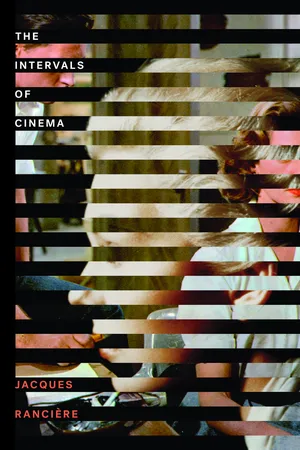
The Intervals of Cinema
About this book
The cinema, like language, can be said to exist as a system of differences. In his latest book the acclaimed philosopher Jacques Ranci?re relates cinema to literature and theatre. With literature, he argues, cinema takes its narrative conventions, while at the same time effacing its images and its philosophy; and it rejects theatre, while also fulfilling theatre's dream. Built on these contradictions, the cinema is the real, material space in which one feels moved by the spectacle of shadows. Thus for Ranci?re, the cinema is the always disappointed dream of a language of images.
Information
Subtopic
Art & PoliticsI. After Literature
1
Cinematic Vertigo: Hitchcock to Vertov and Back
Understanding the art of moving images means first understanding the relation between two movements: the visual unrolling of images specific to cinema; and the deployment and dissipation of semblances more broadly characteristic of the narrative arts. In the western tradition, the second aspect is dominated by the Aristotelian logic of inversion. The plot is a sequence of actions that seems to have a certain meaning and lead towards a certain end. But as the sequence unfolds, expectations are dashed: the alliance of causes produces an entirely different effect from the one anticipated; knowledge becomes ignorance and ignorance knowledge; success changes to disaster or misfortune to happiness. How can the unrolling of moving images be married to that particular logic for unveiling the truth behind appearances? I would like to show that the most perfect synchronization of the two movements includes a fault. And I will attempt to understand the philosophical meaning and political weight of that fault. So I will talk about the relation between vision, movement and truth. And by the same token I will have to talk about the relation between cinema, philosophy, literature and communism.
I will start with an auteur and a film that seem to unite in exemplary fashion the movement of cinematic images and the unveiling of a truth hidden behind appearances. Alfred Hitchcock, better than any other director, used the visual glamour of the moving image to serve plots constructed on the Aristotelian model, a sequence of acts to stimulate and toy with the audience’s expectations. And Vertigo is the pinnacle of that art. To summarize the plot briefly: the hero, Scottie, a former police officer, suffers from acrophobia. An old school friend hires him to shadow his wife, Madeleine, worried that she has become obsessed with her great-grandmother, who committed suicide, and may be tempted to follow her example. Scottie agrees and verifies Madeleine’s fascination with death. When Madeleine leaps into the San Francisco Bay, Scottie saves her from drowning. They spend the next day together, and the two profess their love for each other. But when she leads him into a bell tower, his fear of heights prevents him following her. Stuck on the ground, unable to climb the stairs, he sees her fall to her death. He has a breakdown, and after his release from a sanatorium, he meets a girl, Judy, who strongly resembles Madeleine. He undertakes to fashion her in the dead woman’s image. In the attempt he comes to understand that he has been duped: the woman he had been hired to follow was Judy disguised as Madeleine, and her pseudo-suicide concealed the murder of the real Madeleine by her husband.
At first the deployment of images in the film seems to coincide exactly with the logic of the story. This harmony is summarized from the outset by Saul Bass’s credits, in which a play of abstract spirals weaves a connection between three ovals that enclose suggestive physical features: a pert mouth, a distraught eye, a pretty chignon. The titles give the visual formula of the narrative logic which will bring three vertigos together: Scottie’s acrophobia, the murdering husband’s manipulation to make his wife appear suicidal, and lastly Scottie’s obsessive fascination with the false Madeleine. The whole visual apparatus seems oriented towards playing along with the intrigue at first, then in a second phase playing along with its exposure. In the first part, the mise en scène is determined by the capture of a gaze: in the restaurant, Kim Novak’s profile appears for a moment in isolation, cut off from any relation with her surroundings. It is both the profile of a woman inhabiting an ideal world and the cipher of an impenetrable secret. It marks the beginning of the inversion which is to transform the gaze of a detective investigating an obsession into a gaze itself obsessed with its object. The second part of the film follows an inverted version of the same path. It makes the development of Scottie’s ‘illness’ coincide with his dawning awareness of Madeleine’s simulated ‘illness’: by chasing his own illusion, by fashioning Judy visually in Madeleine’s image, Scottie discovers that Madeleine was only a role played by Judy. The visual obsession followed to the end leads to exposure of the intellectual intrigue.
This conjunction may rightly be considered perfection as an artistic mechanism: the romantic or symbolist story of the man fascinated by an image comes to be subjected exactly to the Aristotelian plot involving peripateia and recognition. Nevertheless that perfection hides a fault. There is good reason Gilles Deleuze found Hitchcockian cinema simultaneously the completion of the moving image system and the index of its crisis. Hitchcock, Deleuze tells us, invented the mental image in cinema. But the mental image means two things: from one angle, an over-image that encloses all the others. Hitchcock fits action images, perception images and affection images into a system of relations that frames and transforms them. But from another angle, the mental image is the image that has escaped from the directed frame of the moving image, evaded the formula of response to a received change with an executed change. For Deleuze, Scottie’s acrophobia in Vertigo and Jeff’s plastered leg in Rear Window symbolize that paralysis of the driving system – crisis of the movement-image leads to revelation of the time-image. The two characters change from active heroes into passive onlookers. In this they anticipate the ruin of the directed movement-image system and the cinematic advent of the contemplative stroll.
Deleuze is a little hasty however in identifying the ‘crisis’ of the action image with the ‘weakness’ that takes the character over to the contemplative side. There are in fact two sorts of ‘passivity’ and their effects are completely different. Scottie’s vertigo is not going to ruin the logic of the moving image. Indeed it is necessary to the success of the murder plot. But there is another sort of passivity too, which while also serving the plot has the potential to overload it: Scottie’s fascination with the character pretending to be fascinated by death. This is what I called the romantic or symbolist story interlaced with the Aristotelian story of the mechanism. The director’s art seeks to adjust them exactly to each other, making the first the instrument of the second. In the first part it is obsession, carefully orchestrated through a constant play of Madeleine’s appearances and disappearances, and through the acceleration and slowing of movement that the manipulation is able to continue. In the second part, it is the character’s mad wish to restore the exact image of the dead woman that leads him to discover the truth. But to describe the events thus is to over-simplify the visual story in the film. There are at least two episodes where the coincidence of the two logics is defective, because they tell us too much: one about the obsession, the other about the scheme.
The first of these occurs at the connecting-point between the two parts. It shows a nightmare Scottie has after Madeleine’s death. In it Hitchcock seems to be recalling the ‘surrealist’ dream composed by Salvador Dalí for Spellbound. The kernel of Scottie’s dream is the ancestress Carlotta’s bouquet of flowers, the one Scottie has seen in her portrait in the museum and which the false Madeleine has continuously recomposed. Here the bouquet explodes into a blizzard of petals before Scottie’s head separates from his body and glides through space towards the cemetery where an open grave awaits him and the Mission belfry where this time it is his own body that crashes onto the roof. The episode arouses a certain discomfort. Perhaps it had not been necessary to go to such lengths to make us aware of Scottie’s mental vertigo? This intensified representation of vertigo is certainly debilitating and reduces it to a bad dream to be forgotten. And what follows in the second part of the film is indeed a story of healing. Scottie will not throw himself off the belfry to join the dead woman. Nor will he imitate the hero of the Boileau-Narcejac novel D’entre les morts from which the film is derived. Instead he kills the false Madeleine when he tries to make her admit she is the real one, the dead woman – or death itself – with whom he is in love. Hitchcock and his script-writer have chosen a simpler relationship to the truth: the one that admits the scheme exists. But here we find the second narrative fault at the very moment the audience is discovering the truth. Instead of a single revelation scene there are two. Well before Scottie has understood the scheme by noticing Madeleine’s necklace around Judy’s neck and forcing her to confess, Judy herself has revealed everything to the audience by reliving the scene and writing a confession letter only to tear it up unsent. The sequence spoils the perfection of the plot by explaining the truth instead of letting us discover it with Scottie. And this narrative fault is accentuated by the visual weight of the way the truth is uncovered: by images of the murder we see are returning in Judy’s mind and the letter she writes to Scottie whose contents, moreover, are read by a voice-off – a method that seems a touch passé for a 1958 movie.

Vertigo, Alfred Hitchcock, Paramount Pictures, 1958
In this way the director feels obliged on two occasions, by dint of flashy effects, to break the possession storyline and dissociate the two ‘vertigos’: Machiavellian scheme and morbid fascination. The incongruity of these superfluous episodes becomes clear if we compare the film to the novel. The book only has a single revelation, delivered in the last chapter by Renée, who is the false Madeleine Judy in the film. It clearly favours one logic: fascination. The hero escapes from the role of witness to ‘suicide’; as a result the husband fails to benefit from his crime and dies trying to evade arrest. So the scheme has failed. A single reality is left: the hero’s passion for the dead woman, a passion that drives him to kill the false Madeleine to make her real and join her in death. The novel locates this attraction to death in a well defined context: the hero’s passion and the murder of the real Madeleine take place in the spring of 1940 as if in prelude to the German tanks about to converge on Paris. The discovery and killing of the false Madeleine take place in Marseille during the collapse of Nazism. But the plot of this ‘detective-thriller’ obeys an earlier model and one specific to literature: the story of the fascination with the image and the power lurking behind the image: death, the wish to return to the void. D’entre les morts belongs to a lineage of thrillers belatedly influenced by late nineteenth century literature and its inspiration Schopenhauer: behind the detective-thriller and Aristotelian logic – revelation of the truth dissipating appearances – lies the nihilist logic of illusion as the real truth of existence. Behind the vain insight into trivial schemes, there lies the real one, that of the blind wish to return to the void, to the inorganic. The illusion that inhabits the love-struck advocate of that woman falsely dead is a deeper truth than the secret of the murderous husband’s scheme. That still belongs to the lie of life itself, the lie with which life persuades us that it has a purpose. Truth obliges us to expose that lie to the point of admitting – of acquiescing to – the void. Such is the vertigo into which Boileau and Narcejac’s hero draws the false Madeleine. Everything happens as if the real Madeleine were dragging the woman who has usurped her identity into the abyss. The thriller plot thus recalls that of a late Ibsen play, Rosmersholm. From beyond the grave, Pastor Rosmer’s wife, who has been driven to suicide by the scheming of the underhand Rebecca, drags her husband into the same torrent, along with the woman who has taken her place. ‘Madeleine’s’ jump into the Seine or San Francisco Bay is the heir of that dive into the torrent of Rosmersholm, which itself inherited something from the plunge into the ‘supreme pleasure’ of emptiness sung by Wagner’s dying Isolde. Recognizing the truth behind life’s schemes is identical to recognizing the unconscious mechanism that leads life to destroy itself through its own derisory intrigues.
The nihilism that marked literature in the era of Ibsen, Strindberg and Maupassant, and that was adapted to their own purposes by the authors of thrillers and other so-called minor genres, is rejected by Hitchcock and his sceenwriter. Scottie will be released from his vertigo both literally and figuratively. He will unmask the murder plot and climb the belfry. He will not kill the false Madeleine; she will throw herself into the void. She will not be drawn into Scottie’s illness. She will be punished in a manner appropriate for a culprit. And she will return to nothingness – a fitting end for something that was always an illusion. With Judy’s confession, the director reveals himself as the supreme manipulator who invents illusions and vertigos at will. He will do it even at the cost of weakening the imaginative pull of the story. In The Wrong Man, Hitchcock appears in person at the beginning of the film to tell us what follows is a true story. This time by contrast, the redundant and overloaded episodes of Scottie’s nightmare and Judy’s admission are there to make us understand it is only fiction: the spiral patterns in the opening credits, Scottie’s acrophobia, Madeleine’s chignon, the vertiginous scheme, the plunges into water or the abyss – all arise from the same single manipulatory logic, combining the overall emotion of the plot with the feeling of each shot. This forces him to draw in bold but visually unsatisfactory strokes. Thus, the confession sequence mixes in an improbable fashion the points of view of Scottie, Madeleine and the truth that encloses them. This piece of ‘clumsiness’ reveals the handicap cinema has in relation to literature. As words are only words, they can always correct or alter the semblance they have created. Literature eagerly uses the power it derives from the insubstantiality of words to show the identity between the truth of life and its falseness. Cinema is in the opposite situation. It has the capacity to show everything words can say, to deploy all its visual force, all the power of palpable impression. But all this surplus power has a downside: the art of images struggles to achieve what the art of words can do: subtracting even when adding material. In cinema, an addition remains an addition. So correcting apparent appearances is always a risky operation. Think of John Ford’s The Man Who Shot Liberty Valance, made four years after Vertigo. We have seen the bandit fall after the inexperienced lawyer Tom Stoddard fires a shot at him. Later we learn the truth when the same scene is reshot from the other side of the square and we see the bandit was actually shot by the hidden Tom Doniphon. But this truth comes too late: it cannot annul what we have already seen and thus acquires the aspect of an interpolation. In Vertigo, the situation is better because we had not seen what happened at the top of the belfry. Nevertheless the importunate truth presented to the audience cuts across the direct linear deployment of semblances. The film then has to go on about Scottie’s obsessive wish to make Judy the same as Madeleine, and about the false, fabricated character of the obsession. The filmmaker, who so far has been using Scottie’s ‘madness’ to play with the audience, now has to make the audience complicit in the game he is playing with his character.
The terms of the problem are simple enough. Either we accept the ‘literary’ and ‘nihilistic’ law of identity between the deployment of semblances and the pathway to truth; or we reject it as inappropriate to the means available to the art of moving images. Another way then has to be found to ensure homogeneity of the two logics. The surrealist way is to decree sovereignty of the dream over the appearances of real life. But we know what its weakness is: dream images always have to be signalled as dream images with arbitrary combinations of objects in the same shot, or arbitrary ordering of a sequence of shots. Here again, too much richness is damaging: the dream rhetoric destroys the dream. So Hitchcock is reducing surrealism to a functional role in illustrating nightmares. But the character’s nightmare and confusion are declared fictional, shown to be considered products of the director’s artifice. So we get neither the falseness of life nor the reality of the dream. All we have is the machinery of fiction placing the powers of the cinematograph under the control of the old Aristotelian logic of realism. The director introduces himself as the manipulator of manipulation, the well-meaning conjuror who invents and melts simultaneously into a single continuum the wonders of confusing true with false and dissipating that confusion.1
But that gap between literary nihilism and the straightforward faith of cinematic artifice perhaps masks a more complex relationship cinema has ...
Table of contents
- Cover
- Title Page
- Copyright
- Contents
- Preface
- I. After Literature
- II. The Frontiers of Art
- III. Politics in Film
- Origin of Texts
Trusted by 375,005 students
Access to over 1.5 million titles for a fair monthly price.
Study more efficiently using our study tools.
Frequently asked questions
Yes, you can cancel anytime from the Subscription tab in your account settings on the Perlego website. Your subscription will stay active until the end of your current billing period. Learn how to cancel your subscription
No, books cannot be downloaded as external files, such as PDFs, for use outside of Perlego. However, you can download books within the Perlego app for offline reading on mobile or tablet. Learn how to download books offline
Perlego offers two plans: Essential and Complete
- Essential is ideal for learners and professionals who enjoy exploring a wide range of subjects. Access the Essential Library with 800,000+ trusted titles and best-sellers across business, personal growth, and the humanities. Includes unlimited reading time and Standard Read Aloud voice.
- Complete: Perfect for advanced learners and researchers needing full, unrestricted access. Unlock 1.5M+ books across hundreds of subjects, including academic and specialized titles. The Complete Plan also includes advanced features like Premium Read Aloud and Research Assistant.
We are an online textbook subscription service, where you can get access to an entire online library for less than the price of a single book per month. With over 1.5 million books across 990+ topics, we’ve got you covered! Learn about our mission
Look out for the read-aloud symbol on your next book to see if you can listen to it. The read-aloud tool reads text aloud for you, highlighting the text as it is being read. You can pause it, speed it up and slow it down. Learn more about Read Aloud
Yes! You can use the Perlego app on both iOS and Android devices to read anytime, anywhere — even offline. Perfect for commutes or when you’re on the go.
Please note we cannot support devices running on iOS 13 and Android 7 or earlier. Learn more about using the app
Please note we cannot support devices running on iOS 13 and Android 7 or earlier. Learn more about using the app
Yes, you can access The Intervals of Cinema by Jacques Rancière, John Howe in PDF and/or ePUB format, as well as other popular books in Media & Performing Arts & Art & Politics. We have over 1.5 million books available in our catalogue for you to explore.