"Docherty is not only is a brilliant critic of those forces that would like to transform higher education into an extension of the market-place... he is also a man of great moral and civic courage, who under intense pressure from the punishing neoliberal state has risked a great deal to remind us that higher education is a civic institution crucial to creating the formative cultures necessary for a democracy to survive, if not flourish."
- Henry Giroux, McMasters University
"Docherty engages with the secular university in its present crisis, reflecting on its origins and on its role in the future of democracy. He tackles the urgent issue of inequality with a compelling denunciation of the ways of entrenched privilege; he offers a view of governance and representation from the perspective of those who are silenced; and exposes the fundamental damage done to thought by management-speak. Docherty is moral, passionate and committed and this is a fierce and important book."
- Mary Margaret McCabe, King?s College London
There is a war on for the future of the university worldwide. The stakes are high, and they reach deep into our social condition.
On one side are self-proclaimed modernisers who view the institution as vital to national economic success. Here the university is a servant of the national economy in the context of globalization, its driving principles of private and personal enrichment necessary conditions of 'progress' and modernity.
Others see this as a radical impoverishment of the university's capacities to extend human possibilities and freedoms, to seek earnestly for social justice, and to participate in the endless need for the extension of democracy.
This book analyses the former position, and argues for the necessity of taking sides with the latter. It does so with a sense of urgency, because the market fundamentalists are on the march. The fundamental war that is being fought is not just for scholars, but for a better – more democratic, more just, more emancipatory – form of life.
Choose sides.
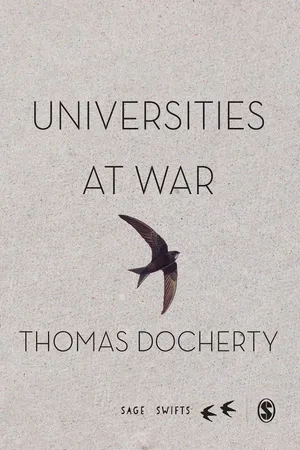
- 160 pages
- English
- ePUB (mobile friendly)
- Available on iOS & Android
eBook - ePub
Universities at War
About this book
Information
1 Force or the Body Politic and the ‘Sovereignty of Nature’
I obeyed, I suppose, an innate feeling … which held that hierarchies founded on privilege and money were the worst offence against nature.(François Mitterrand, Ma Part de Vérité, quoted in Short, Mitterrand, p. 261)
1.1 The Anatomy of Campus Violence
The university, as an institution that is both in the world and of the world, has a particular relation with force. That relation is not just to be found in its physics laboratories, those spaces on the campus where we explore the forces that constitute the world and worldliness, the way that the world and indeed our universe hangs together by a play of material forces (mass, density, gravitational pull, atomic energy and so on). I mean more than this. The university has a relation to what we can call the politics of force, to the ways in which force shapes the polity. What, then, is the proper relation of the worldly University to civil society itself?
In the wake of the student revolutions of 1968, Hannah Arendt produced an extended essay, On Violence. There, she pondered the relations of violence to power, strength, authority and, crucially, force itself. She ponders carefully the precise meanings of these terms and indicates that ‘Force, which we often use in daily speech as a synonym for violence, especially if violence serves as a means of coercion, should be reserved, in terminological language, for the “forces of nature” or the “force of circumstances” (la force des choses), that is, to indicate the energy released by physical or social movements’.1
This is useful here: at one level, it is precisely the ‘forces of nature’ that, in various and extremely sophisticated ways, our physics laboratories deal with, and it is the force des choses – the force of circumstances – that engage our social sciences and even our humanities and arts in diverse ways. At a fundamental level, then, the university and its faculties must take an interest in force: natural force in its laboratories and material cultural and historical forces, inter-personal forces, in its libraries and seminars.
I explore here the nature of the relations that obtain between the university institution and force as such, and I examine how an interest in force relates to the other categories that interested Arendt in the study of violence that, for her in 1968, is so centred on student protest movements. I will also engage some issues regarding contemporary student movements in relation to this. Above all, however, my abiding interest is in relating the force of nature to questions of sociocultural power and authority and in how these can be articulated by a university that is avowedly worldly, in and of the material world.
Arendt was writing in the wake of student uprisings in the United States and across Europe in 1968. Those uprisings, though having various local specific inflections (such as conflicts over access to women’s dormitories for male students in Nanterre), had one very specific initial fountainhead: unease with American involvement in the Vietnam War. They also had a steady supply of energy, in the students who mobilized across campus and cities in great numbers. As Patrick Seale and Maureen McConville put it in their contemporaneous book (with photographs by Chris Marker), French Revolution 1968:
Students are far better equipped for insurrection that most adults recognize. They have time to plot; freedom from bread-and-butter constraints; the confidence of their class and education; faculty buildings in which to meet; above all, energy – the energy to march from one end of Paris to the other, to fight all night, and still be fit enough to draft, print and distribute a revolutionary tract before dawn. Adults are no match for such demonic stamina.2
That was in 1968. Some 50 years later, the position of the student has dramatically changed, as has the socially widespread understanding of what the university is for in a civil society. The more recent version of the student –our contemporary – has been stripped of much of this dynamic energy and force: she or he is seen increasingly as potential ‘human capital’, essentially as an operative of the systems of capital and resource management (including human resource management) in societies that are centred primarily on market economics.
The essential physical and imaginative dynamism of the Paris 1968 student has been supplanted by the dynamism of money and of a particular contemporary version of society as one based on ‘growth’ or what Robert and Edward Skidelsky call ‘politically orchestrated insatiability’ in their study of How Much is Enough?3 The growth in question is measured not only by how much the individual contributes to GDP, but also by how much she or he earns in their private capacity as an employee in work. Richard Wilkinson and Kate Pickett, in The Spirit Level, call the belief in an axiomatic good of growth itself into question: ‘Economic growth, for so long the great engine of progress, has, in the rich countries, largely finished its work’.4 When the political establishment continue to regard growth as the foundation of all measures of the good life, we end up with ‘segregation by poverty and wealth’, where ‘the rich are willing to pay to live separately from the poor’ (p. 162), with the concomitant breakdown of the social sphere itself.
Disregarding such arguments, we now face a situation where, in succinct polemical terms, the student of today has become increasingly treated as a valuable resource (or fodder) for the ongoing smooth operations of the neo-liberal economic machinery that constitutes and governs our current ‘advanced’ or rich societies where economic growth has supplanted any idea of a good life as a foundation for the social or public realm. The situation, however, is not limited to advanced economies only but is also being exported and imitated elsewhere. Commenting on the United Kingdom’s post-2010 ‘experiment’ following the Browne Review’s substantial step towards full privatization of the sector, Stefan Collini writes that ‘the fate of British universities cannot be considered in isolation’. The pressures that the so-called ‘market democracy’ has put on the university are damaging British institutions, certainly, but
unfortunately, the UK has put itself in charge of the pilot experiment [and] … Other countries are looking on with a mixture of regret and apprehension: regret because the university system in this country has been admired for so long, apprehension because they fear similar policies may soon be coming their way.5
In the market-driven audit culture that dominates the present conception of what the university is for, students do not have ‘time to plot’, rather all their time is ‘accounted’ for. So-called continuous assessment has converted learning time into a constantly pressurized surveillance of continual examination; preparation for that examination is itself accounted for in ‘contact-hour’ time, which has to be maximized (quantity, being measurable, trumping quality in this). Far from being free of ‘bread-and-butter’ issues, student debt, constantly exacerbated by a process whereby the costs of general education of the population are transferred to individuals as personal debt, is a constantly increasing worry. To counter that, students now are increasingly part-time, given that they have to try to find paid employment simply to sustain them in their period of study. And all for what? The promised ‘graduate financial dividend’ may indeed be there for some, but in a world of increasingly precarious employment, many will find the economic yield less substantial than the initial investment of time and energy – or they’ll join that high dream of capitalism and become the unpaid intern, or, worse still, the intern who pays for their own internship, and thus pays for the privilege of working.
The gains of modern technology are also now invading the very idea of the university as a place for people to meet, the kind of literal ‘body politic’ of a collegium. As faculty are increasingly enjoined to deploy computing technology as if it were an axiomatically good teaching-aid, lectures are podcast, seminar notes are posted on-line and, in many cases, students no longer need to be physically present as a material bodily force in a classroom. The identity of a scholarly community – a community shaped by the interplay of forces among a collective – is atomized and neutralized by the elimination of communal space and its dissolution into separate individualized cells. The classroom itself is in danger of becoming a purely virtual space, an Amazon resource that substitutes the real or historical engagement of the market with a virtual and atomized individualism: the virtual replaces the virtuous. Collegial force is dissipated through the technology, and the idea and even the very existence of a collegium, such as the students of 1968 would have known it in le grand amphi, the Great Amphitheatre of the Sorbonne in 1968, is diminished.
All of these changes are changes in the dynamics of force and energy, not just of individual students but also of the university itself. It is not simply the case that students have become less politically engaged – the frequent lament of soixante-huitard faculty; rather it is the case that the university institution, as a force within civil society, has been systematically diminished.
In 1968, however, the protests happened with a tremendous release of forceful energy, and they were countering the violence of US involvement in Vietnam and what was seen at the time as the incipient triumph of what Eisenhower had christened the ‘military-industrial complex’. This is the context for Arendt’s writings on violence, and it is worth looking at the speech in which Eisenhower coined his resonant phrase. His speech, the last he made as US President, on 17 January 1961, delivered an austere warning.6 He pointed out that it is only very recently that the United States had established an arms industry at all, but that the industry has grown massively, such that ‘the very structure of our society’ is affected by it and by the ‘grave implications’ that are entailed in the development of such massive technologies of force. The situation is now one where, as he put it, the ‘solitary inventor’ has been ‘overshadowed by task forces of scientists in laboratories and testing fields’. The research required for developments in this area is so sophisticated that it has had to become intensely professionalized.
The consequence of this is that the university sector itself, as the locus of that professionalization, is radically changed. In Eisenhower’s words, ‘the free university, historically the fountainhead of free ideas and scientific discovery, has experienced a revolution in the conduct of research’. This revolution is one in which what we would now call ‘research-grant capture’ has become, in and of itself, often more important than the actual research being done: ‘Partly because of the huge costs involved, a government contract becomes virtually a substitute for intellectual curiosity’, he states.
Eisenhower is seeing here, somewhat prophetically, what eventually does happen in the university sector. Two things come about. First, money, in and of itself, becomes a key determinant of ‘what Universities are for’. This is a kind of madness, according to Edward and Robert Skidelsky in their consideration of economics in relation to ‘the good life’: ‘Making money cannot be an end in itself – at least for anyone not suffering from acute mental disorder’ (p. 5). Secondly, government-grant capture aligns the forces of the state with the forces of the university, in ways that threaten the founding propriety of the Haldane Principle, designed to ensure that universities do not become government propaganda machines.
In the light of this emerging state of affairs, Eisenhower issues his sternest warning:
The prospect of domination of the nation’s scholars by Federal employment, project allocations, and the power of money is ever present – and is gravely to be regarded. Yet in holding scientific research and discovery in respect, as we should, we must also be alert to the equal and opposite danger that public policy could itself become the captive of a scientific-technological elite.
This, very interestingly, is also close to a position adopted, much earlier, by Hannah Arendt. In 1946, she received a copy of a text written by her former mentor, Karl Jaspers, in her New York home. The text was his revised Idea of the University, a text rewritten and redesigned essentially to help detoxify the German tertiary sector after the atrocities of its politicization under Nazism.
Arendt admired the book, and pointed out that, given that a revived university sector would be extremely expensive, then the state should bear the costs. However, she added that, notwithstanding this, it would be good – even necessary – that the professoriate does not become civil servants. She was profoundly aware of the dangers – as had been seen under Nazism in Germany – of having a tertiary sector whose forces united with, or were forced to identify with, those of government. Indeed, article 5, section 3 of the German constitution formally enshrines the strict separation required: ‘Kunst und Wissenschaft, Forschung und Lehre sind frei. Die Freiheit der Lehre entbindet nicht von der Treue zur Verfassung’. That is, ‘Arts and science, research and teaching shall be free’. However, this guarantee of freedom – with subtle nicety – does not absolve the teacher or learner from the separate duties of citizenship: ‘The freedom of teaching shall not release anyone from allegiance to the constitution’.
In his presidential valedictory speech, Eisenhower is aware of how the military-industrial complex can lead to a skewing of the proper relations among the government, the university and general society or culture, by eliding the separation between one’s duty as a citizen and one’s scholarly duty to follow where intellectual curiosity leads, and by making the latter subservient to the former. Indeed, the relation of science to government had been an abiding concern for Eisenhower. In an earlier address, given to a symposium in basic research sponsored by the National Academy of Sciences and other private organizations, and entitled ‘Science: Handmaiden of Freedom’, he argued that ‘the search for fundamental knowledge can best be undertaken in areas and in ways determined primarily by the scientific community itself. We reject a philosophy that emphasizes more dependence upon a centralized approach and direction. Regimented research would be, for us, catastrophe’.7 Eisenhower’s presidency, at least insofar as it touched upon science and research into issues of force, is governed by ...
Table of contents
- Cover
- Half Title
- Publisher Note
- Title Page
- Copyright Page
- Acknowledgements
- Contents
- About the Author
- Preface and Acknowledgements
- Acknowledgements
- Introduction
- 1 Force or the Body Politic and the ‘Sovereignty of Nature’
- 2 Debts and Duties or of Time and Trust in the University
- 3 Citizens, Denizens and Cosmopolitans
- 4 Of Governance and Government
- Index
Trusted by 375,005 students
Access to over 1.5 million titles for a fair monthly price.
Study more efficiently using our study tools.
Frequently asked questions
Yes, you can cancel anytime from the Subscription tab in your account settings on the Perlego website. Your subscription will stay active until the end of your current billing period. Learn how to cancel your subscription
No, books cannot be downloaded as external files, such as PDFs, for use outside of Perlego. However, you can download books within the Perlego app for offline reading on mobile or tablet. Learn how to download books offline
Perlego offers two plans: Essential and Complete
- Essential is ideal for learners and professionals who enjoy exploring a wide range of subjects. Access the Essential Library with 800,000+ trusted titles and best-sellers across business, personal growth, and the humanities. Includes unlimited reading time and Standard Read Aloud voice.
- Complete: Perfect for advanced learners and researchers needing full, unrestricted access. Unlock 1.5M+ books across hundreds of subjects, including academic and specialized titles. The Complete Plan also includes advanced features like Premium Read Aloud and Research Assistant.
We are an online textbook subscription service, where you can get access to an entire online library for less than the price of a single book per month. With over 1.5 million books across 990+ topics, we’ve got you covered! Learn about our mission
Look out for the read-aloud symbol on your next book to see if you can listen to it. The read-aloud tool reads text aloud for you, highlighting the text as it is being read. You can pause it, speed it up and slow it down. Learn more about Read Aloud
Yes! You can use the Perlego app on both iOS and Android devices to read anytime, anywhere — even offline. Perfect for commutes or when you’re on the go.
Please note we cannot support devices running on iOS 13 and Android 7 or earlier. Learn more about using the app
Please note we cannot support devices running on iOS 13 and Android 7 or earlier. Learn more about using the app
Yes, you can access Universities at War by Thomas Docherty,Author in PDF and/or ePUB format, as well as other popular books in Education & Higher Education. We have over 1.5 million books available in our catalogue for you to explore.