- 288 pages
- English
- ePUB (mobile friendly)
- Available on iOS & Android
eBook - ePub
About this book
In his classic sequence of films, Patrick Keiller retraces the hidden story of the places where we live, the cities and landscapes of our everyday lives. This collection explores the surrealist perception of the city; the relationship of architecture to film; how cities change over time, as well as an urgent portrait of post-crash Britain. The View from the Train establishes Keiller as one of the most perceptive writers and thinkers about the city, landscape and politics.
Information
Subtopic
Film & Video1
The Poetic Experience of Townscape and Landscape
The desire to transform the world is not uncommon, and there are a number of ways of fulfilling it. One of these is by adopting a certain subjectivity, aggressive or passive, deliberately sought or simply the result of a mood, which alters experience of the world, and so transforms it.
There is nothing particularly new or unusual about this. The subjectivity involved is that of the wandering daydreamer – Edgar Allan Poe’s in ‘The Man of the Crowd’; Baudelaire’s flâneurs and dandies; Apollinaire’s Baron d’Ormesan, the inventor of amphionism; Louis Aragon and his contemporaries in Le Paysan de Paris. The thrill they all seek is the frisson Aragon termed ‘a feeling for nature’, their realm is the street, and the common object of their speculation the phenomenon of place.
I began to pursue the ‘feeling for nature’ several years ago. My starting point was that of an architect, and my motivation the desire to find, already existing, the buildings that I wanted to build but for a number of reasons was unable to.
The more I looked the more I found, and the more I found the more I looked, but gradually my interest shifted from the instant transformation of a building (object), to the discovery of a deeper sensation of place (space) akin to the stimmung that Nietzsche discovered during his last euphoria in Turin, and that so affected de Chirico.
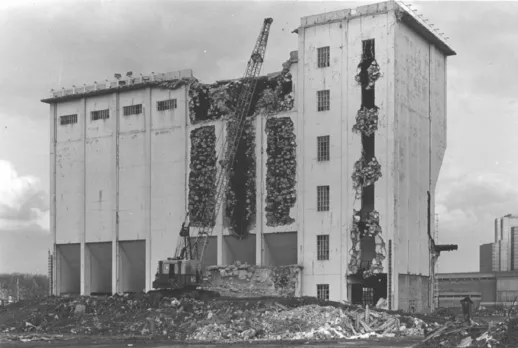
Coal hopper, Nine Elms Lane, London SW8, 1979
The present-day flâneur carries a camera and travels not so much on foot as in a car or on a train. There are several reasons for this, mostly connected with the decline of public life and urbanism (another kind of flâneur lives on in fiction – the private investigator – though his secrets are well hidden behind the street fronts), but also because there is something about a photograph or a shot in a film that exactly corresponds to the frisson that Aragon identified. As early as 1918, in his first published writing, he wrote: ‘Likewise on the screen objects that were a few moments ago sticks of furniture or books of cloakroom tickets are transformed to the point where they take on menacing or enigmatic meanings.’1
I became a sort of architectural photographer and film-maker, trying to produce photographs and film footage that interpreted the objects of my desire as I saw them. It occurred to me that a common aspect of these interpretations was a kind of analogy that saw the places I ‘discovered’ and photographed in terms of other places that I knew, or knew of, and it also occurred to me that much of this experience of other places was gained from looking at photographs and films. The image of a place on the screen is transformed in exactly the same way as the objects to which Aragon refers – by the photography itself, by the images that precede and follow it, and by the narrative.
To a certain extent, I began to look at places as potential photographs, or better still, film images, and even the still photographs took on the character of film stills.
This visual material deliberately depicts places that are nearly or altogether devoid of human presence and activity, but which because of this absence are suggestive of what could happen, or what might have happened. They are places in which events might take place, and the events are seen rather as possible contemporary myths. But the myths have a history – maybe they are history – and this history can be constructed as a narrative – a reconstruction of a past daydream or the construction of a new one – which links still images or provides a setting for the film, in the same way as the locations provide a setting for the action in other films. The aim is to depict the place as some sort of historical palimpsest, and/or the corollary of this, an exposition of a state of mind.
Such is a summary of the development of this activity up to now. What follows is an attempt to map out the tradition that has supported this development. There are different aspects to this: the literature of the wandering daydreamer, whom I perhaps inaccurately term the flâneur; the visual arts tradition of the reinterpretation of everyday objects and landscapes, which might be termed Surrealist realism, though it probably has more to do with photography as a way of seeing than any particular mode of thought; and a way of depicting places in literature and film where they are inextricably bound up with the state of mind of the characters who inhabit or observe them.
The Flâneur
The flâneur as a literary motif appears in two modes, or rather can be seen as signifying two types of experience. The first of these is that of a wanderer, perhaps a dandy, who takes the city as his salon, strolling from café to bar in search of amusement and perhaps romance. His chance encounters are largely with people; his haunts chosen for the company they provide, rather than any melancholy architectural quality, and the oneiric quality of his experience is largely the result of his surrender to the randomness of urban life.
The other type of flâneur drifts through the city as if it were the substance of a dream, marvelling at the transformations that this brings about. He may meet others, he may fall passionately in love, but this is not his motive, it merely enhances his experience by enabling it to be shared.
There is also the lonely life of the street photographer, who acts the flâneur in the hope of recording little glimpses of the marvellous with his camera. His is a difficult task, for poetic insights so rarely survive their capture on the emulsion. But I digress.
Edgar Allan Poe wrote, in 1840, a short story, ‘The Man of the Crowd’. The narrator, a convalescent, sits in a coffee house in London observing the thronging pedestrians passing the window. With that new vision often granted to those recently recovered from illness, he is enjoying finding distinct types among the passers-by, when an old man who fits none of these captivates his curiosity. He leaves the coffee house and follows the man as he wanders through the streets with no aim other than to be constantly in a crowd. The afternoon turns to evening, and the evening to night. Still the old man walks on and still the narrator follows fascinated, trying to discover what the old man is about. On the evening of the following day he gives up his pursuit, knowing that it will never end: ‘ “This old man,” I said at length, “is the type and the genius of deep crime. He refuses to be alone. He is the man of the crowd.”’ While Poe’s attitude to the old man is far from any sympathetic identification, here I believe for the first time we see some recurring themes in ‘urban dream’ writing: the narrator’s convalescent state, a heightened state of awareness: ‘one of those happy moods which are so precisely the converse of ennui – moods of the keenest appetency, when the film from the mental vision departs’2 – and his resultant rather alienated observation through the window of what came to be called ‘modern life’; his subsequent pursuit of an enigma; the description of the streets through which they pass, the low-life – they enter a gin-palace at dawn – and above all the emerging sensitivity to the erotic implications of crowds.
Poe’s reputation in Europe was considerably enhanced by Baudelaire, who praised and translated his works. He quotes ‘The Man of the Crowd’ in ‘The Painter of Modern Life’. Baudelaire’s writing is full of awareness of ‘the poetry of modern life’, the life of the streets and boulevards and other public places, but specific references to townscape are rare. His encounters are with people, or spirits, but not places. In the letter to Arsène Houssaye, which serves as the preface to Paris Spleen, he writes of his desire to create the poetic prose of which the book is composed: ‘It was, above all, out of my exploration of huge cities, out of the medley of their innumerable interrelations, that this haunting ideal was born.’3
Apollinaire produced the most demonstrative of flâneur writings. In The Wandering Jew the story is not unlike ‘The Man of the Crowd’, but here the enigma guides the narrator through Prague until it transpires that he is several centuries old.
The most prophetic of Apollinaire’s stories here is ‘The False Amphion’, one of the Stories and Adventures of Baron d’Ormesan.4 The Baron is an old acquaintance of the narrator, who thinks he is a tourist guide, but the Baron, on the contrary, has invented a new art form, amphionism:
‘The instrument of this art, and its subject matter, is a town of which one explores a part in such a way as to excite in the soul of the amphion, or neophyte, sentiments that inspire in them a sense of the sublime and the beautiful, in the same way as music, poetry and so on …’
‘But,’ I said laughingly, ‘I practice amphionism every day. All I have to do is go for a walk …’
‘Monsieur Jourdain,’ cried Baron d’Ormesan, ‘what you say is perfectly true! You practice amphionism without knowing it.’
Now this is all very ironic, but the irony is directed not at the idea of poetic wandering, but at the Baron’s insistence that the art consists of composing the journeys, rather than on the one hand building the buildings, or on the other concretising the poetic experience of wandering among them – in other words, that the art depended on the sensibility of the artist, not what he did with it. The Baron’s adventures are full of similar misunderstandings, such as the film-makers who, for the sake of realism in their film, pay a man to actually murder a couple.
The point about subjective transformations of townscape is that they do depend on a certain state of mind, which can be adopted deliberately (this is why I write of ‘aggressive’ subjectivity), but not by an audience (and probably best not at all, for it is best to take one’s reveries as they come).
Tourism
This was certainly the case on 14 April 1921, the date of the first Surrealist event. Organised by André Breton, it was to consist solely of direct experience of the city. The Surrealists had already explored brothels and the ‘cretinous suburbs’ as well as the flea market, but they had not yet demonstrated their discoveries to the public.
The new itinerary would ‘put in unison the unconscious of the city with the unconscious of men’, and was to take in St Julien-le-Pauvre, the Parc des Buttes-Chaumont, the Gare St Lazare and the Canal de l’Ourcq. The first expedition, advertised throughout Paris, to St Julien-le-Pauvre, was a complete failure. It rained and no tourists turned up, and the rest of the tours were cancelled.5
It was more than thirty years before anyone tried anything like this again. Once more in Paris, in the early 1950s, the Lettrist group developed the techniques of ‘drifting’ and ‘psychogeography’. Drifting was a free-association in space. Drifters would follow the streets, go down alleys, through doors, over walls, up trees – anywhere that they found desirable. Later ‘mass drifts’ involved teams linked by walkie-talkie radio. Psychogeography was the correlation of the material obtained by drifting. It was used in making ‘emotional maps’ of parts of the city, and in other ways.
In 1958, the Lettrists evolved into the Situationist International, and in 1968 their polemic was influential in les événements. Drifting was still a preoccupation. In Ten Days That Shook the University, an account of the election and subsequent propagandist exploits of a Situationist-inspired group who in 1966 gained a short-lived control of the students’ union of Strasbourg University, there is a strip cartoon of two cowboys riding through a landscape:
‘What’s your scene man?’ asks one.
‘Reification,’ the other replies.
‘Yeah? I guess that means pretty hard work with big books and piles of paper on a big table.’
‘Nope. I drift. Mostly I just drift.’6
Drifting, it seems, has reconstituted itself as a myth.
Le Paysan de Paris
Louis Aragon began writing Le Paysan de Paris in 1924, three years after the ill-fated touristic event. It is constructed about descriptions of two places: the Passage de l’Opera, in whose bars he and his contemporaries drank and talked, and the Parc des Buttes-Chaumont, which t...
Table of contents
- Cover
- Title Page
- Copyright
- Contents
- Introduction: The View from the Train
- 1. The Poetic Experience of Townscape and Landscape
- 2. Atmosphere, Palimpsest and Other Interpretations of Landscape
- 3. Port Statistics
- 4. The Dilapidated Dwelling
- 5. Popular Science
- 6. Architectural Cinematography
- 7. London in the Early 1990s
- 8. London – Rochester – London
- 9. The Robinson Institute
- 10. The City of the Future
- 11. Film as Spatial Critique
- 12. Phantom Rides: The Railway and Early Film
- 13. Imaging
- Acknowledgements
- Notes
Trusted by 375,005 students
Access to over 1.5 million titles for a fair monthly price.
Study more efficiently using our study tools.
Frequently asked questions
Yes, you can cancel anytime from the Subscription tab in your account settings on the Perlego website. Your subscription will stay active until the end of your current billing period. Learn how to cancel your subscription
No, books cannot be downloaded as external files, such as PDFs, for use outside of Perlego. However, you can download books within the Perlego app for offline reading on mobile or tablet. Learn how to download books offline
Perlego offers two plans: Essential and Complete
- Essential is ideal for learners and professionals who enjoy exploring a wide range of subjects. Access the Essential Library with 800,000+ trusted titles and best-sellers across business, personal growth, and the humanities. Includes unlimited reading time and Standard Read Aloud voice.
- Complete: Perfect for advanced learners and researchers needing full, unrestricted access. Unlock 1.5M+ books across hundreds of subjects, including academic and specialized titles. The Complete Plan also includes advanced features like Premium Read Aloud and Research Assistant.
We are an online textbook subscription service, where you can get access to an entire online library for less than the price of a single book per month. With over 1.5 million books across 990+ topics, we’ve got you covered! Learn about our mission
Look out for the read-aloud symbol on your next book to see if you can listen to it. The read-aloud tool reads text aloud for you, highlighting the text as it is being read. You can pause it, speed it up and slow it down. Learn more about Read Aloud
Yes! You can use the Perlego app on both iOS and Android devices to read anytime, anywhere — even offline. Perfect for commutes or when you’re on the go.
Please note we cannot support devices running on iOS 13 and Android 7 or earlier. Learn more about using the app
Please note we cannot support devices running on iOS 13 and Android 7 or earlier. Learn more about using the app
Yes, you can access The View from the Train by Patrick Keiller in PDF and/or ePUB format, as well as other popular books in Media & Performing Arts & Film & Video. We have over 1.5 million books available in our catalogue for you to explore.