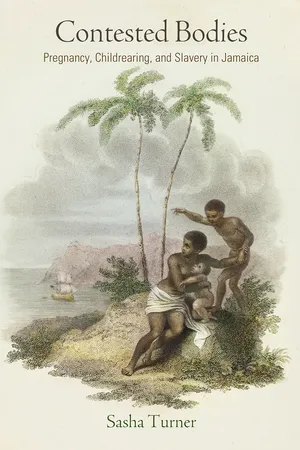
It is often thought that slaveholders only began to show an interest in female slaves' reproductive health after the British government banned the importation of Africans into its West Indian colonies in 1807. However, as Sasha Turner shows in this illuminating study, for almost thirty years before the slave trade ended, Jamaican slaveholders and doctors adjusted slave women's labor, discipline, and health care to increase birth rates and ensure that infants lived to become adult workers. Although slaves' interests in healthy pregnancies and babies aligned with those of their masters, enslaved mothers, healers, family, and community members distrusted their owners' medicine and benevolence. Turner contends that the social bonds and cultural practices created around reproductive health care and childbirth challenged the economic purposes slaveholders gave to birthing and raising children.
Through powerful stories that place the reader on the ground in plantation-era Jamaica, Contested Bodies reveals enslaved women's contrasting ideas about maternity and raising children, which put them at odds not only with their owners but sometimes with abolitionists and enslaved men. Turner argues that, as the source of new labor, these women created rituals, customs, and relationships around pregnancy, childbirth, and childrearing that enabled them at times to dictate the nature and pace of their work as well as their value. Drawing on a wide range of sources—including plantation records, abolitionist treatises, legislative documents, slave narratives, runaway advertisements, proslavery literature, and planter correspondence—Contested Bodies yields a fresh account of how the end of the slave trade changed the bodily experiences of those still enslaved in Jamaica.
- 327 pages
- English
- PDF
- Available on iOS & Android
eBook - PDF
About this book
Information
Publisher
University of Pennsylvania PressYear
2017Print ISBN
9780812224603
9780812249187
eBook ISBN
9780812294057
Table of contents
- Cover
- Contents
- Introduction. Transforming Bodies
- Chapter 1. Conceiving Moral and Industrious Subjects: Women, Children, and Abolition
- Chapter 2. “The Best Ones Who Are Fit to Breed”: The Quest for Biological Reproduction
- Chapter 3. When Workers Become Mothers, Who Works? Motherhood, Labor, and Punishment
- Chapter 4. “Buckra Doctor No Do You No Good”: Struggles over Maternal Health Care
- Chapter 5. “Dead Before the Ninth Day”: Struggles over Neonatal Care
- Chapter 6. Mothers Know Best? Maternal Authority and Children’s Survival
- Chapter 7. Raising Hardworking Adults: Labor, Punishment, and Slave Childhood
- Conclusion. Transforming Slavery
- Notes
- Sources
- Index
- Acknowledgments
Trusted by 375,005 students
Access to over 1.5 million titles for a fair monthly price.
Study more efficiently using our study tools.
Frequently asked questions
Yes, you can cancel anytime from the Subscription tab in your account settings on the Perlego website. Your subscription will stay active until the end of your current billing period. Learn how to cancel your subscription
No, books cannot be downloaded as external files, such as PDFs, for use outside of Perlego. However, you can download books within the Perlego app for offline reading on mobile or tablet. Learn how to download books offline
Perlego offers two plans: Essential and Complete
- Essential is ideal for learners and professionals who enjoy exploring a wide range of subjects. Access the Essential Library with 800,000+ trusted titles and best-sellers across business, personal growth, and the humanities. Includes unlimited reading time and Standard Read Aloud voice.
- Complete: Perfect for advanced learners and researchers needing full, unrestricted access. Unlock 1.5M+ books across hundreds of subjects, including academic and specialized titles. The Complete Plan also includes advanced features like Premium Read Aloud and Research Assistant.
We are an online textbook subscription service, where you can get access to an entire online library for less than the price of a single book per month. With over 1.5 million books across 990+ topics, we’ve got you covered! Learn about our mission
Look out for the read-aloud symbol on your next book to see if you can listen to it. The read-aloud tool reads text aloud for you, highlighting the text as it is being read. You can pause it, speed it up and slow it down. Learn more about Read Aloud
Yes! You can use the Perlego app on both iOS and Android devices to read anytime, anywhere — even offline. Perfect for commutes or when you’re on the go.
Please note we cannot support devices running on iOS 13 and Android 7 or earlier. Learn more about using the app
Please note we cannot support devices running on iOS 13 and Android 7 or earlier. Learn more about using the app
Yes, you can access Contested Bodies by Sasha Turner in PDF and/or ePUB format, as well as other popular books in History & Latin American & Caribbean History. We have over 1.5 million books available in our catalogue for you to explore.