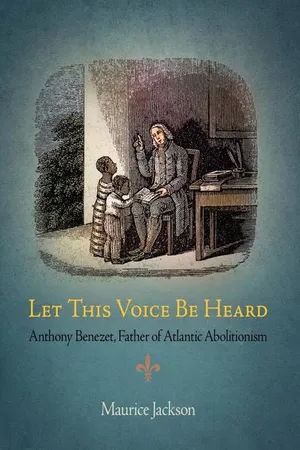
Anthony Benezet (1713-84), universally recognized by the leaders of the eighteenth-century antislavery movement as its founder, was born to a Huguenot family in Saint-Quentin, France. As a boy, Benezet moved to Holland, England, and, in 1731, Philadelphia, where he rose to prominence in the Quaker antislavery community.
In transforming Quaker antislavery sentiment into a broad-based transatlantic movement, Benezet translated ideas from diverse sources—Enlightenment philosophy, African travel narratives, Quakerism, practical life, and the Bible—into concrete action. He founded the African Free School in Philadelphia, and such future abolitionist leaders as Absalom Jones and James Forten studied at Benezet's school and spread his ideas to broad social groups. At the same time, Benezet's correspondents, including Benjamin Franklin, Benjamin Rush, Abbé Raynal, Granville Sharp, and John Wesley, gave his ideas an audience in the highest intellectual and political circles.
In this wide-ranging intellectual biography, Maurice Jackson demonstrates how Benezet mediated Enlightenment political and social thought, narratives of African life written by slave traders themselves, and the ideas and experiences of ordinary people to create a new antislavery critique. Benezet's use of travel narratives challenged proslavery arguments about an undifferentiated, "primitive" African society. Benezet's empirical evidence, laid on the intellectual scaffolding provided by the writings of Hutcheson, Wallace, and Montesquieu, had a profound influence, from the high-culture writings of the Marquis de Condorcet to the opinions of ordinary citizens. When the great antislavery spokesmen Jacques-Pierre Brissot in France and William Wilberforce in England rose to demand abolition of the slave trade, they read into the record of the French National Assembly and the British Parliament extensive unattributed quotations from Benezet's writings, a fitting tribute to the influence of his work.
- 400 pages
- English
- ePUB (mobile friendly)
- Available on iOS & Android
eBook - ePub
About this book
Information
Table of contents
- Cover
- Title Page
- Copyright Page
- Contents
- Introduction
- 1. A Life of Conscience
- 2. The Early Quaker Antislavery Movement
- 3. An Antislavery Intellect Develops
- 4. Visions of Africa
- 5. Building an Antislavery Consensus in North America
- 6. Transatlantic Beginnings and the British Antislavery Movement
- 7. Benezet and the Antislavery Movement in France
- 8. African Voices
- Epilogue: Anthony Benezet’s Dream
- Chronology of Atlantic Abolitionism
- Notes
- Primary Sources
- Index
- Acknowledgments
Trusted by 375,005 students
Access to over 1.5 million titles for a fair monthly price.
Study more efficiently using our study tools.
Frequently asked questions
Yes, you can cancel anytime from the Subscription tab in your account settings on the Perlego website. Your subscription will stay active until the end of your current billing period. Learn how to cancel your subscription
No, books cannot be downloaded as external files, such as PDFs, for use outside of Perlego. However, you can download books within the Perlego app for offline reading on mobile or tablet. Learn how to download books offline
Perlego offers two plans: Essential and Complete
- Essential is ideal for learners and professionals who enjoy exploring a wide range of subjects. Access the Essential Library with 800,000+ trusted titles and best-sellers across business, personal growth, and the humanities. Includes unlimited reading time and Standard Read Aloud voice.
- Complete: Perfect for advanced learners and researchers needing full, unrestricted access. Unlock 1.5M+ books across hundreds of subjects, including academic and specialized titles. The Complete Plan also includes advanced features like Premium Read Aloud and Research Assistant.
We are an online textbook subscription service, where you can get access to an entire online library for less than the price of a single book per month. With over 1.5 million books across 990+ topics, we’ve got you covered! Learn about our mission
Look out for the read-aloud symbol on your next book to see if you can listen to it. The read-aloud tool reads text aloud for you, highlighting the text as it is being read. You can pause it, speed it up and slow it down. Learn more about Read Aloud
Yes! You can use the Perlego app on both iOS and Android devices to read anytime, anywhere — even offline. Perfect for commutes or when you’re on the go.
Please note we cannot support devices running on iOS 13 and Android 7 or earlier. Learn more about using the app
Please note we cannot support devices running on iOS 13 and Android 7 or earlier. Learn more about using the app
Yes, you can access Let This Voice Be Heard by Maurice Jackson in PDF and/or ePUB format, as well as other popular books in History & Historical Biographies. We have over 1.5 million books available in our catalogue for you to explore.