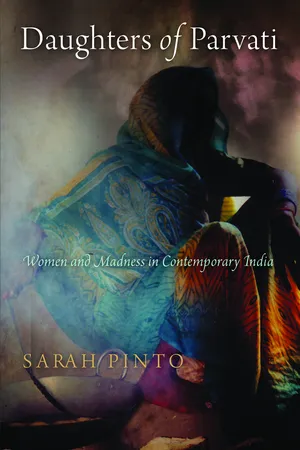
In her role as devoted wife, the Hindu goddess Parvati is the divine embodiment of viraha, the agony of separation from one's beloved, a form of love that is also intense suffering. These contradictory emotions reflect the overlapping dissolutions of love, family, and mental health explored by Sarah Pinto in this visceral ethnography.
Daughters of Parvati centers on the lives of women in different settings of psychiatric care in northern India, particularly the contrasting environments of a private mental health clinic and a wing of a government hospital. Through an anthropological consideration of modern medicine in a nonwestern setting, Pinto challenges the dominant framework for addressing crises such as long-term involuntary commitment, poor treatment in homes, scarcity of licensed practitioners, heavy use of pharmaceuticals, and the ways psychiatry may reproduce constraining social conditions. Inflected by the author's own experience of separation and single motherhood during her fieldwork, Daughters of Parvati urges us to think about the ways women bear the consequences of the vulnerabilities of love and family in their minds, bodies, and social worlds.
- 294 pages
- English
- PDF
- Available on iOS & Android
eBook - PDF
About this book
Information
Publisher
University of Pennsylvania PressYear
2014Print ISBN
9781512823745
9780812245837
eBook ISBN
9780812209280
Table of contents
- Cover
- Contents
- Note on Transliterations
- Introduction: Love and Affliction
- 1. Rehabilitating Ammi
- 2. On Dissolution
- 3. Moksha and Mishappenings
- 4. On Dissociation
- 5. Making a Case
- 6. Ethics of Dissolution
- Bibliography
- Index
- Acknowledgments
Trusted by 375,005 students
Access to over 1.5 million titles for a fair monthly price.
Study more efficiently using our study tools.
Frequently asked questions
Yes, you can cancel anytime from the Subscription tab in your account settings on the Perlego website. Your subscription will stay active until the end of your current billing period. Learn how to cancel your subscription
No, books cannot be downloaded as external files, such as PDFs, for use outside of Perlego. However, you can download books within the Perlego app for offline reading on mobile or tablet. Learn how to download books offline
Perlego offers two plans: Essential and Complete
- Essential is ideal for learners and professionals who enjoy exploring a wide range of subjects. Access the Essential Library with 800,000+ trusted titles and best-sellers across business, personal growth, and the humanities. Includes unlimited reading time and Standard Read Aloud voice.
- Complete: Perfect for advanced learners and researchers needing full, unrestricted access. Unlock 1.5M+ books across hundreds of subjects, including academic and specialized titles. The Complete Plan also includes advanced features like Premium Read Aloud and Research Assistant.
We are an online textbook subscription service, where you can get access to an entire online library for less than the price of a single book per month. With over 1.5 million books across 990+ topics, we’ve got you covered! Learn about our mission
Look out for the read-aloud symbol on your next book to see if you can listen to it. The read-aloud tool reads text aloud for you, highlighting the text as it is being read. You can pause it, speed it up and slow it down. Learn more about Read Aloud
Yes! You can use the Perlego app on both iOS and Android devices to read anytime, anywhere — even offline. Perfect for commutes or when you’re on the go.
Please note we cannot support devices running on iOS 13 and Android 7 or earlier. Learn more about using the app
Please note we cannot support devices running on iOS 13 and Android 7 or earlier. Learn more about using the app
Yes, you can access Daughters of Parvati by Sarah Pinto in PDF and/or ePUB format, as well as other popular books in Social Sciences & Psychopathology. We have over 1.5 million books available in our catalogue for you to explore.