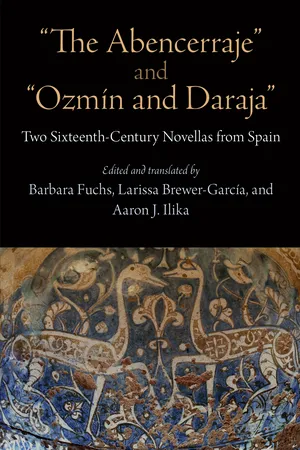
Since its publication in 1561, an anonymous tale of love, friendship, and chivalry has captivated readers in Spain and across Europe. "The Abencerraje" tells of the Moorish knight Abindarráez, whose plans to wed are interrupted when he is taken prisoner by Christian knights. His captor, a Spanish governor, befriends and admires the Moorish knight, ultimately releasing him to marry his beloved. Their enormously popular tale was repeated or imitated in numerous ballads and novels; when the character Don Quixote is wounded in his first sortie, he imagines himself as Abindarráez on the field.
Several decades later, in the tense years leading up to the expulsion of the Moriscos from Spain, Mateo Alemán reprised themes from this romance in his novel Guzmán de Alfarache. In his version, the Moorish lady Daraja is captured by the Catholic monarchs Ferdinand and Isabel; she and her lover Ozmín are forced to engage in a variety of ruses to protect their union until they are converted to Christianity and married. Though "Ozmín and Daraja" is more elaborate in execution than "The Abencerraje," both tales show deep sympathy for their Moorish characters.
Faithfully translated into modern, accessible English, these finely wrought literary artifacts offer rich imaginings of life on the Christian-Muslim frontier. Contextualized with a detailed introduction, along with contemporary legal documents, polemics, and ballads, "The Abencerraje" and "Ozmín and Daraja" reveals early modern Spain's profound fascination with the Moorish culture that was officially denounced and persecuted. By recalling the intimate and sympathetic bonds that often connected Christians to the heritage of Al-Andalus, these tales of romance and companionship offer a nuanced view of relationships across a religious divide.
This is a living portrait of virtue, generosity, valor, nobility, and loyalty, composed of Rodrigo de Narváez1 and the Abencerraje and Jarifa,2 as well as her father and the king of Granada. Although the two make up the body of this work, the others adorn the canvas and have left their own marks on it. And just as a precious diamond, whether set in gold or silver or lead, retains its fair value according to its carats and its luster, so too virtue shines and shows its qualities in any flawed subject, just like the seed that grows when it falls on fertile soil and in the barren soil is lost.3
“The Abencerraje”
The story goes that in the time of Prince Ferdinand, who conquered Antequera, there was a knight named Rodrigo de Narváez, famous for his virtue and feats of arms. He fought the Moors with great valor, and especially in the campaign and the battle for Antequera he performed deeds worthy of eternal memory, were it not that our Spain takes such skill for granted. For it is so natural to Spain and so common here that anything one does seems too little; unlike for the Greeks and Romans, who in their writings turned men who once risked death into immortals and set them among the stars. This knight, then, did so much in the service of his king and his faith that after the town was conquered he was named governor, so that having played such a great role in taking it, he would now do the same in defending it. He was also made governor of Álora, and so commanded both garrisons, dividing his time between the two and always attending to the greater need. He was usually to be found in Álora, where he had fifty noble squires in the king’s service for the defense and safety of the town. And none was ever found lacking, for, like the immortal knights of King Darius, whenever one died, they set another in his place. They all had such great faith in their captain’s virtue and took such strength from it that nothing was ever difficult for them: they never ceased to attack their enemies and defend themselves against them. They triumphed every time they skirmished, winning honor and profit, which enriched them always.
One night when the weather was very mild, the governor spoke these words to his squires after supper:
“It seems to me, noblemen, my brothers and lords, that nothing so rouses the hearts of men as the continual exercise of arms, through which we gain experience with our own weapons and lose fear of the enemy’s. There is no need for me to invoke distant examples of this, as you yourselves are the best proof. I mention this because it has been many a day since we have done anything to increase our renown, and I would not be doing my duty to my office and my person if I let the time go to waste with such virtuous men and valiant troops at my command. It seems to me, if you are all in agreement, that with this clear and safe night beckoning to us, we should let our enemies know that the guardians of Álora do not sleep. That is my wish; do what you will.”
They answered that he should lead and all would follow him. He chose nine of them and had them armed. Once ready, they left through a hidden door so that they would not be noticed and the fortress would remain safe. Setting out on their way, they came to a fork in the road, where the governor addressed them:
“If we all take one path, our prey might escape on the other. You five take this one, and I will take the other with these four. If by chance any of you find enemies that you cannot defeat, blow your horn, and the sound of it will call the others to your aid.”
The five squires set out on their path, speaking of various things, when one of them said, “Hold on, friends, for unless I am mistaken, there is someone coming.”
They hid in a thicket by the road and heard noises. Taking a closer look, they saw a gallant Moor coming toward them on a roan horse. He was of powerful build and had a beautiful face, and he looked very fine in the saddle. He wore a crimson cloak and a damask burnoose of the same color, all embroidered in gold and silver. His right sleeve was turned back, with a beautiful lady embroidered on it, and he held a fine and sturdy lance with two points. He carried a shield and a scimitar, and wore a Tunisian head wrap with many folds that served to both adorn and protect him.4 So dressed, the Moor advanced with a noble air, singing a song he had composed in fond memory of his love, and which went like this: “Born in Granada, raised in Cártama, I fell in love in Coín, bordering Álora.”
Although the music lacked artistry, the Moor did not lack for happiness, and his heart, which was full of love, gave charm to his every word. The squires, transported by the sight of him, almost let him through before they set upon him. Finding himself ambushed, he bravely came to his senses and waited to see what they would do.
Four of the five squires rode off to the side while one attacked him. But since the Moor was more skilled in those matters, with a stroke of his lance he forced the squire and his horse to the ground. Seeing this, three of the four remaining attacked him at the same time, for he seemed to them very strong. Now there were three Christians, any one of whom could take on ten Moors, against this one Moor, and yet all of them together could not defeat him. Soon the Moor found himself in great danger, as his lance broke and the squires pressed him hard. Feigning flight, he spurred his horse on with his legs and rushed toward the squire he had unhorsed. Like a bird he swooped from his saddle and grabbed the man’s lance, and with it he turned upon the enemies who chased him as he pretended to flee. He fought so skillfully that in a short time he had two of the three on the ground. The last one, seeing his companions’ dire need, sounded his horn as he rode to help them. Now the skirmish became very fierce, for they were affronted to have one knight last so long against them, while he fought for his life and more. Then one of the squires struck him on the thigh with his lance, in a blow so hard that, had it not landed askew, it would have gone right through him. Furious at finding himself wounded, the Moor turned and struck him with the lance, throwing both horse and rider to the ground, badly wounded.
Rodrigo de Narváez drew near, sensing that his companions needed help. As he rode the best horse, he took the lead. When he witnessed the Moor’s bravery, he was astonished: the Moor had four of the five squires on the ground and the fifth one on the way.
“Moor, ride against me,” he said, “and if you defeat me, I will vouch for the others.” They joined in a bitter fight, but since the governor was fresh and the Moor and his horse were injured, Narváez pressed him so that he could not keep up. Yet seeing that his life and happiness hung on this one battle, the Moor threw such a blow at Narváez that it would no doubt have killed him, had he not stopped it with his shield. Parrying the blow, Narváez charged against him and wounded him on his right arm. Closing in, he grappled with him and threw him from his saddle to the ground. Then, leaning over him, he said, “Sir, concede defeat, or I shall kill you.”
“You may well kill me,” said the Moor, “for I am in your hands, but I cannot be vanquished except by the one who once vanquished me.”
The governor did not remark on the mystery of these words; with his usual decency, he helped the Moor to his feet, for the wound that the squire had given him on his thigh and the other one on his arm (though not severe), coupled with his great exhaustion and the fall from his horse, had quite drained him. With supplies he took from the squires, Rodrigo bound up the Moor’s wounds. Then he helped him onto one of the squires’ horses, for his own was wounded, and they took the road back to Álora. While they all rode along, discussing the Moor’s good bearing and bravery, he let out a great deep sigh and spoke a few words in Arabic that none of them could make out.5 Observing the Moor’s fine build and bearing, and recalling what he had seen him do, Rodrigo de Narváez suspected that such great sadness in such a brave heart could hardly come from what had just occurred.
To learn more, he said to him, “Sir, consider that the prisoner who loses all hope forfeits his right to liberty. Consider, too, that in war knights must both win and lose, for the better part of their battles are subject to fortune. For one who has just shown such valor, it seems like weakness to show so little now. If you sigh from the pain of your wounds, know that you are on your way to a place where you will soon be cured. If you lament your imprisonment, know that these are the ways of war, to which all who wage it are subject. And if you suffer some other secret torment, confide in me, for I promise you on my honor as a knight to do all in my power to remedy it.”
The Moor, lifting his gaze from the ground, said, “What is your name, knight, you who show such understanding of my plight?”
He responded, “They call me Rodrigo de Narváez; I am the governor of Antequera and Álora.”
The Moor, whose face brightened a bit at this, said, “Truly now some of my sorrow lifts, since though fortune was against me, it has left me in your hands. For although I have never seen you before, I have heard of your virtue and experienced your strength. So that you will not think that the pain from my wounds is what makes me sigh, and since it seems to me that you could keep any secret, send off your squires so that I may have two words with you.”
The governor had them fall back. When they were alone, the Moor said to him with a great sigh:
“Rodrigo de Narváez, renowned governor of Álora, listen to what I shall tell you now, and you shall see whether my misfortunes are enough to break the heart of a captive man. They call me Abindarráez the Younger, to distinguish me from an uncle of mine, my father’s brother, of the same name. I come from the line of the Abencerrajes of Granada, of whom you must have often heard—although my present grief is quite enough, without recalling sorrows past, I want to tell you that story.
“In Granada there lived a line of noblemen called the Abencerrajes who were the finest in the kingdom: in their elegance, good grace, disposition, and bravery they excelled all others. They were favored by the king and all the nobles and well-loved by the common people. They emerged as victors from any combat they entered and distinguished themselves in all tournaments; they devised all the finery and costumes. So one could truly say that in times of peace as in war they were a model and example for the entire kingdom. It is said that there was never an Abencerraje who was miserly or cowardly or ill disposed. A man was not considered an Abencerraje if he did not serve a lady, nor was a woman considered a lady if she had no Abencerraje as a suitor.
“Yet fortune, their great enemy, decreed that they should fall from this excellence, as you will now hear. The King of Granada, led on by false information he had received against them, did a great wrong to two of these noblemen, the bravest of them all. And it was said, though I don’t believe it, that these two and ten others at their request conspired to kill the King and divide the kingdom among themselves, avenging their insult. This conspiracy, whether true or false, was discovered, and so as not to scandalize the kingdom that loved them so, the King had them all beheaded in one night, for had he delayed his injustice, he would not have been able to carry it out. The King was offered huge ransoms for their lives, but he would not even hear of it. When the people saw that there was no hope for their lives, they began to lament anew. The fathers who had sired them wept, as did the mothers who had given birth to them; the ladies whom they served wept, as did the knights who were their companions. The common people raised such a great and lasting outcry it was as though enemies had invaded the city. If their lives could have been bought with tears, the Abencerrajes would not have died so miserably.
“Behold what became of such a distinguished lineage and its famous knights! Consider how long it takes for Fortune to raise a man and how quickly she cuts him down; how long it takes for a tree to grow and how quickly it goes to the fire; how difficult it is to build a house and how rapidly it burns! How many could learn from those wretched men, who blamelessly suffered their public disgrace! Even though they were so numerous and so important and had enjoyed the favor of the King himself, their houses were destroyed, their estates given to others, and their name proclaimed treasonous throughout the kingdom. Because of this unfortunate episode, no Abencerraje was allowed to live in Granada, except for my father and uncle, who were found innocent of this crime, on the condition that any sons born to them be raised outside the city, never to return, and any daughters married outside the kingdom.”
Rodrigo de Narváez, who observed the suffering with which the Abencerraje related his misfortunes, said to him:
“Yours is certainly a strange story, sir, and a great injustice was done to the Abencerrajes, for it is hard to believe that men such as they could have committed treason.”
“It is just as I have told you,” answered the Abencerraje, “Wait and you shall hear how, from that time on, all the Abencerrajes were unfortunate. When I came into the world from my mother’s womb, my father sent me to the governor of Cártama, his close friend, in order to fulfill the king’s decree. The governor had a daughter about my age, whom he loved more than himself, for not only was she his only child and most beautiful, but she had cost him his wife, who had died giving birth to her. She and I were as brother and sister in our childhood because that is what we heard people call us. I cannot recall a moment when we were not together. We were raised together, walked together, ate and drank together. From this closeness came a natural affection that increased with age. I remember that one afternoon when I walked into the place they call the Garden of Jasmine, I found her seated by the fountain, arranging her lovely hair. I gazed at her, vanquished by her beauty, and she seemed to me like Salmacis.6 I said to myself, ‘O to be Hermaphroditus and appear before this beautiful goddess!’ How I regretted that she was my sister! Yet I rushed to her, and when she saw me, she hurried to meet me with arms outstretched. Seating me by her side, she said to me,
‘Brother, why did you leave me alone for so long?’
‘My lady,’ I replied, ‘I have been searching for you for a long time, and no one could say where you were, until my heart told me. But tell me now, how certain are you that we are brother and sister?’
‘I only know it from the great love I have for you, and from the fact that everyone calls us that,’ she said.
‘And if we were not,’ said I, ‘would you love me as much?’
‘Can you not see,’ she said, ‘that if we were not, my father would never let us spend so much time alone together?’
‘Well, if it would mean the loss of that good fortune,’ I said, ‘I would rather have my present sorrow.’
Then she began to blush, and said, ‘What do you lose from our being brother and sister?’
‘I lose myself and you,’ I said.
‘I don’t understand you,’ she said. ‘In fact, it seems to me that simply being brother and sister naturally compels us to love one another.’
‘Only your beauty compels me. The kinship actually seems to discourage me sometimes.’
“Lowering my eyes in embarrassment at what I had said, I saw her exact likeness in the waters of the fountain. Wherever I turned my head, I saw her image, and most of all in my heart. I said to myself (for I would not have wanted anyone to hear me), ‘If I were to drown myself in the fountain where I see my lady, I would have a better excuse than Narcissus!7 If she loved me as I love her, how happy I would be! And if fortune allowed us to live together always, what a life I could lead!’
“Saying this, I stood up and gathered some of the jasmine that surrounded the fountain, threading it with myrtle to make a beautiful garland. Placing it on my head, I turned to her, both crowned and vanquished. She looked at me, more sweetly it seemed than usual, took the garland from me and placed it on...
Table of contents
Cover
Half title
Title
Copyright
Contents
Chronology
Introduction
Part I The Novellas
Part II Contexts
Bibliography
Acknowledgments
Trusted by 375,005 students
Access to over 1.5 million titles for a fair monthly price.
Study more efficiently using our study tools.
Frequently asked questions
Yes, you can cancel anytime from the Subscription tab in your account settings on the Perlego website. Your subscription will stay active until the end of your current billing period. Learn how to cancel your subscription
No, books cannot be downloaded as external files, such as PDFs, for use outside of Perlego. However, you can download books within the Perlego app for offline reading on mobile or tablet. Learn how to download books offline
Perlego offers two plans: Essential and Complete
Essential is ideal for learners and professionals who enjoy exploring a wide range of subjects. Access the Essential Library with 800,000+ trusted titles and best-sellers across business, personal growth, and the humanities. Includes unlimited reading time and Standard Read Aloud voice.
Complete: Perfect for advanced learners and researchers needing full, unrestricted access. Unlock 1.5M+ books across hundreds of subjects, including academic and specialized titles. The Complete Plan also includes advanced features like Premium Read Aloud and Research Assistant.
Both plans are available with monthly, semester, or annual billing cycles.
We are an online textbook subscription service, where you can get access to an entire online library for less than the price of a single book per month. With over 1.5 million books across 990+ topics, we’ve got you covered! Learn about our mission
Look out for the read-aloud symbol on your next book to see if you can listen to it. The read-aloud tool reads text aloud for you, highlighting the text as it is being read. You can pause it, speed it up and slow it down. Learn more about Read Aloud
Yes! You can use the Perlego app on both iOS and Android devices to read anytime, anywhere — even offline. Perfect for commutes or when you’re on the go. Please note we cannot support devices running on iOS 13 and Android 7 or earlier. Learn more about using the app
Yes, you can access "The Abencerraje" and "Ozmín and Daraja" by Barbara Fuchs, Larissa Brewer-Garcia, Aaron J. Ilika, Barbara Fuchs,Larissa Brewer-Garcia,Aaron J. Ilika in PDF and/or ePUB format, as well as other popular books in Littérature & Collections littéraires européennes. We have over 1.5 million books available in our catalogue for you to explore.