How psychology explains why a leader is willing to use military force to protect or salvage reputation
In Who Fights for Reputation, Keren Yarhi-Milo provides an original framework, based on insights from psychology, to explain why some political leaders are more willing to use military force to defend their reputation than others. Rather than focusing on a leader's background, beliefs, bargaining skills, or biases, Yarhi-Milo draws a systematic link between a trait called self-monitoring and foreign policy behavior. She examines self-monitoring among national leaders and advisers and shows that while high self-monitors modify their behavior strategically to cultivate image-enhancing status, low self-monitors are less likely to change their behavior in response to reputation concerns.
Exploring self-monitoring through case studies of foreign policy crises during the terms of U.S. presidents Carter, Reagan, and Clinton, Yarhi-Milo disproves the notion that hawks are always more likely than doves to fight for reputation. Instead, Yarhi-Milo demonstrates that a decision maker's propensity for impression management is directly associated with the use of force to restore a reputation for resolve on the international stage.
Who Fights for Reputation offers a brand-new understanding of the pivotal influence that psychological factors have on political leadership, military engagement, and the protection of public prestige.
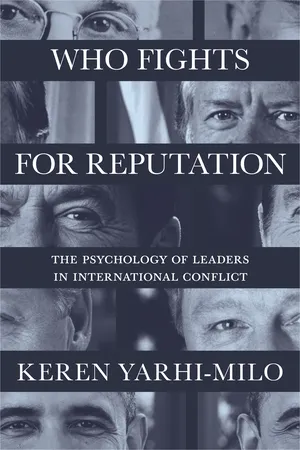
eBook - ePub
Who Fights for Reputation
The Psychology of Leaders in International Conflict
- 344 pages
- English
- ePUB (mobile friendly)
- Available on iOS & Android
eBook - ePub
About this book
Information
Publisher
Princeton University PressYear
2018Print ISBN
9780691181288
9780691180342
eBook ISBN
9781400889983
1
Introduction
“Some countries’ leaders play chicken because they have to, some because of its efficacy.”
—THOMAS SCHELLING, ARMS AND INFLUENCE
In August 2012, an armed rebellion against the Syrian government escalated into civil war. Reporters quizzed President Barack Obama about whether he would deploy military force to prevent chemical weapons in the hands of the Syrian military from being used against the rebels or stolen by extremist groups. The president famously replied that use or transport of chemical weapons by the Assad government would constitute “a red line” for the US government.1 A year later, a neighborhood in Damascus was attacked with sarin gas, killing more than fourteen hundred civilians. The US government had evidence of the Syrian government’s responsibility.2 President Obama reportedly ordered the Pentagon to prepare an attack on the Syrian military’s chemical weapons facilities but then had second thoughts. In an unexpected move, Obama sought congressional authorization for the strike, knowing full well that in the gridlock of Washington, such authorization would not be forthcoming. According to one analyst, “the president having drawn that red line realized that he had no appetite for direct military engagement in Syria.”3 Having engaged the United States’ reputation for resolve, the president was unwilling to use military force and stand firm.
In the end, Russia brokered a deal with the regime of Bashar al Assad whereby the latter would hand over its chemical weapon stockpiles to an international agency. Although Washington proclaimed this outcome a victory, the episode invited strong criticism of the US president from various domestic and international quarters. In March 2015, when the Syrian government used chlorine gas against civilians, many were quick to point out that Assad had been emboldened by Obama’s failure to follow through on the “red line” declaration two years prior.4 In recent decades, even when the United States has not made commitments or drawn any explicit red lines, it has faced criticism for weak responses to crises, such as Putin’s intervention in Crimea or China’s provocative actions in the South China Sea.5
Without access to primary documents that detail Obama’s decision making, we should be prudent in our assessments about the role reputation for resolve played in his decision making during the crisis with Syria.6 In an interview with Jeffrey Goldberg in the Atlantic, published in April 2016, President Obama offered readers a glimpse into his thinking when he dismissed the importance of fighting for face. As Goldberg notes, Obama would argue within the White House that “dropping bombs on someone to prove that you’re willing to drop bombs on someone is just about the worst reason to use force.”7 And yet, the contrast between Obama’s reasoning and that voiced by other Democratic presidents is stark: in 1993, when President Clinton attempted to bolster public support for the military operation in Somalia, he did so on reputational grounds, arguing that if the United States were to “cut and run,”8 its “credibility with friends and allies would be severely damaged,” and “our leadership in the world would be undermined.”9 The United States must leave only “on our own terms,” he argued, and show the world that “when Americans take on a challenge, they do the job right.”10 Similarly, in the midst of the Vietnam War, President Lyndon Johnson responded to the private pleas of George Ball and other advisors to withdraw the troops by stating, “But, George, wouldn’t all these countries say that Uncle Sam was a paper tiger?”11
Leaders in other countries and other eras have differed in their concerns about saving face. British leaders in the interwar period, for example, were deeply divided over whether their country should oppose the growing encroachments of Germany and Japan. While some, such as Neville Chamberlain, rarely raised concerns about Britain’s reputation for resolve in the mid-1930s, other members of his cabinet, as well as Winston Churchill, often raised such concerns when debating policy choices. The historical record suggests, too, that leaders and their closest foreign policy advisors often hold divergent views about whether reputation for resolve is worth fighting for.
What explains such variations in concern about reputation for resolve? Most existing explanations have focused on features of the strategic environment or the specific crisis situation.12 This book provides an alternative analytical framework that focuses on psychological dispositions and beliefs of national leaders.13 Importantly, by attributing variation in willingness to fight for reputation to variation in individuals’ self-monitoring—a stable trait with both genetic and early childhood environmental influences—I show that fighting for reputation has prepolitical origins. Leaders and publics, I argue, take foreign policy personally. International relations constructs, such as the inclination to fight for face, are built on this foundation.14
Explaining variations in willingness to fight for reputation for resolve is not a mere academic exercise, but one that has important implications for understanding US conflict history as well as contemporary policy debates about military interventions and the application of military coercion. A leader-level theory on the psychology of leaders also has some predictive value: it allows us to form expectations about the crisis behavior not only of acting leaders but also of presidential candidates and lower-level policy makers who might assume that position in the future. Such expectations about which leaders will fight for reputation could significantly affect their opponents’ decisions about whether and when to challenge them. Moreover, as a function of the psychological nature of the theory, it can be easily applied to understanding what segment of the electorate cares about reputation for resolve and would therefore impose costs on leaders who fail to fight for reputation. The theory and its findings thus allow us to identify more precisely which types of citizens are likely to be successfully mobilized to support “contests of face”; it thereby yields a richer understanding of how reputational considerations shape public opinion toward the use of force.
Scholarly work in international relations has long debated the question of whether a nation’s reputation for resolve should matter. But in so doing, scholars have failed to reconcile the answers they offer with the equally important observation that leaders vary in their concern for reputation for resolve. Thus, a better understanding of the sources of such variation sheds important light on when reputation would matter, and in whose eyes. The novel theory I offer, grounded in individual dispositions, is thus an attempt to revisit the psychological roots of reputation, while focusing on the actors that matter most in international crises.
How Leaders Matter
At the core of this book is the claim that the dispositions or psychological traits of individuals significantly shape their understanding of “the logic of images” in international relations, as Robert Jervis laid out in his seminal work.15 Consequently, their dispositions also affect the willingness of those individuals to fight for “face.” This book is a part of the renaissance of the study of the psychology of leaders in international politics, but it also diverges in important ways.16
Tracing policy preferences back to leaders and their decision making is not a new exercise in the field of international relations.17 Individual leaders have always played a central role in the work of historians of diplomacy, foreign policy, war, and international crises. Scholarly work has long established that leaders are especially influential during international crises where there is a strong role for authority at the highest levels of government.18 In such times, choices are likely to be made by the key decision makers and are likely to be less affected by bureaucratic compromise or by the preferences of mass publics and special interests.19 During crises, the latitude with which a leader can make decisions grows as the institutional and normative restraints that usually operate in a democracy wane. A leader’s behavior during a crisis, then, aligns more closely with his or her own dispositions, beliefs, and perceptions of the nature of the crisis.20 This is not to argue that other actors or organizations are irrelevant to the crisis decision-making process, but that they are best seen as moderating the effect of a leader’s own preferences. Hermann and Kegley write that, “[as] even a cursory reading of diplomatic history will attest, leaders’ personal characteristics can reinforce or downplay the effect of formal governmental institutions or cultural norms in crises.”21 In the case of the United States, which is the focus of this book, strong informational advantages coupled with the unique ability to act unilaterally in the international arena make the president “the most potent political force in the making of foreign policy.”22
Still, for many years scholars have treated individual-level explanations of international politics as “reductionist,” while leaving open the question of the extent to which leaders can explain the foreign policy of states.23 Political scientists, though writing about the importance of leaders during the 1970s and 1980s, only recently began to find a new appreciation for the role of leaders, delving deeper into the psychology of leadership to understand the microfoundations of first-image explanations of international politics. While there is a growing consensus that leaders can play a decisive role in foreign policy outcomes, the manner in which they affect these outcomes remains contested.24 Byman and Pollack set the stage for the most recent wave of scholarship on leaders by arguing that “the goals, abilities, and foibles of individuals are crucial to the intentions, capabilities, and strategies of a state.”25 Scholars have sought to unpack how leaders’ beliefs have shaped the strategic choices of states. For example, Kennedy examines the individual-level sources of “bold leadership” among states, using the examples of Nehru and Mao;26 Saunders demonstrates how presidential causal beliefs about the nature of threats have shaped the contours of US military interventions.27 My own work demonstrates how leaders’ beliefs shape their selection and interpretation of interstate signals of intentions.28 More recently, Horowitz and colleagues look at a much larger set of cases to find how leaders’ backgrounds affect their behavior in international conflict.29
Rather than focus on a leader’s background, causal beliefs, psychological biases, or bargaining skills, as many do in the recent scholarship, I set forth an argument here that draws a causal link between a particular psychological trait called self-monitoring and foreign policy behavior. Numerous other psychological traits might also be associated with certain types of decision making. Similarly, there is likely more than one characteristic that can affect the foreign policy behavior of a president. Indeed, much of the earlier work on leadership styles has focused on how the interactions of several characteristics of leaders30—such as openness to information, sensitivity to political contexts, and underlying motivation—or their background31 or formative experiences32 shape a range of foreign policy behaviors33 and processes.34 Yet, as significant as those studies have been in establishing leaders as authoritative decision units that should be taken seriously, they were limited by the methodology and research designs they employed to test the theory.35 In trying to build on these studies’ core insights, the researcher’s task, as Jervis aptly puts it, is to develop careful theoretical expectations about which particular trait or characteristic should influence a particular outcome; derive hypotheses about how it should affect a leader’s decision making; and measure it carefully and independently of the outcome we wish to explain.36
With those guidelines in mind, this book sets out to explain why some leaders fight for face while others do not. Importantly, this book is utterly agnostic about whether leaders were correct to worry about reputation for resolve or whether their policies were effective in shaping others’ beliefs about their resolve.
What Is Reputation for Resolve?
In international relations, reputation refers to the belief that others hold about a particular actor. A state’s reputation for resolve is the belief that during crises, the state’s leaders will take actions that demonstrate willingness to pay high costs and run high risks, and will thus stand firm in crises.37 Leaders who project or protect a reputation for resolve signal that they are willing to use military instruments in order to affect others’ beliefs about their willingness to stand firm. Reputation for resolve is important in crisis bargaining because it portrays an image of toughness and strength that, in and of itself, can help the leader to be more effective at coercing or compelling the other side into submission.
As conceived in this book, the primary audience to which a leader signals resolve is his or her country’s adversaries, potential challengers, and allies. Other audiences are important as well. Maintaining a good reputation for resolve should also bolster the credibility of the leader in the eyes of allies who are looking for evidence that he or she will stand firmly in their favor in a crisis that affects their interests.38 Finally, prior research has shown that domestic audiences are likely to punish leaders who seem to undermine their country’s reputation for resolve under particular circumstances. At the heart of the theory of audience costs—defined as “the domestic price that a leader would pay for making foreign threats and then backing down”—is the notion that by backing down, they put at stake the nation’s reputation for resolve.39 While recent literature has called into question the premise that domestic audiences punish leaders for being inconsistent, there is also plenty of evidence that domestic audiences care about national honor and reputation for resolve, and that domestic audiences are willing to impose costs more generally on incompetent or inconsistent leaders.40
For all those reasons, maintaining “face” or a “reputation for action,” according to Thomas Schelling, is “one of the few things worth fighting over.”41 Thus, the United States committed to the defense of Berlin, for example, to avoid losing face with the Soviets—in other words, to avoid the “loss of Soviet belief that we will do, elsewhere and subsequently, ...
Table of contents
- Cover
- Half Title
- Title
- Copyright
- Dedication
- CONTENTS
- List of Illustrations and Tables
- Acknowledgments
- 1 Introduction
- 2 What Types of Leaders Fight for “Face”?
- 3 Microfoundations: Evidence from Cross-National Survey Experiments
- 4 Self-Monitoring, US Presidents, and International Crises: A Statistical Analysis
- 5 Approaches to Testing the Theory with Case Studies
- 6 Jimmy Carter and the Crises of the 1970s
- 7 Ronald Reagan and the Fight against Communism
- 8 Bill Clinton and America’s Credibility after the Cold War
- 9 Conclusion
- Notes
- Index
Trusted by 375,005 students
Access to over 1.5 million titles for a fair monthly price.
Study more efficiently using our study tools.
Frequently asked questions
Yes, you can cancel anytime from the Subscription tab in your account settings on the Perlego website. Your subscription will stay active until the end of your current billing period. Learn how to cancel your subscription
No, books cannot be downloaded as external files, such as PDFs, for use outside of Perlego. However, you can download books within the Perlego app for offline reading on mobile or tablet. Learn how to download books offline
Perlego offers two plans: Essential and Complete
- Essential is ideal for learners and professionals who enjoy exploring a wide range of subjects. Access the Essential Library with 800,000+ trusted titles and best-sellers across business, personal growth, and the humanities. Includes unlimited reading time and Standard Read Aloud voice.
- Complete: Perfect for advanced learners and researchers needing full, unrestricted access. Unlock 1.5M+ books across hundreds of subjects, including academic and specialized titles. The Complete Plan also includes advanced features like Premium Read Aloud and Research Assistant.
We are an online textbook subscription service, where you can get access to an entire online library for less than the price of a single book per month. With over 1.5 million books across 990+ topics, we’ve got you covered! Learn about our mission
Look out for the read-aloud symbol on your next book to see if you can listen to it. The read-aloud tool reads text aloud for you, highlighting the text as it is being read. You can pause it, speed it up and slow it down. Learn more about Read Aloud
Yes! You can use the Perlego app on both iOS and Android devices to read anytime, anywhere — even offline. Perfect for commutes or when you’re on the go.
Please note we cannot support devices running on iOS 13 and Android 7 or earlier. Learn more about using the app
Please note we cannot support devices running on iOS 13 and Android 7 or earlier. Learn more about using the app
Yes, you can access Who Fights for Reputation by Keren Yarhi-Milo in PDF and/or ePUB format, as well as other popular books in Politics & International Relations & Military & Maritime History. We have over 1.5 million books available in our catalogue for you to explore.