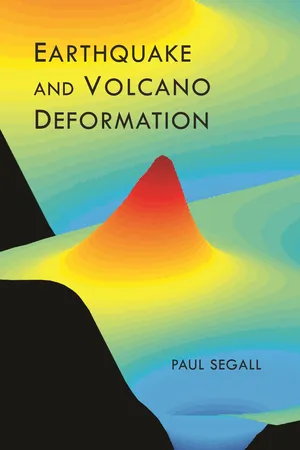
Earthquake and Volcano Deformation is the first textbook to present the mechanical models of earthquake and volcanic processes, emphasizing earth-surface deformations that can be compared with observations from Global Positioning System (GPS) receivers, Interferometric Radar (InSAR), and borehole strain- and tiltmeters. Paul Segall provides the physical and mathematical fundamentals for the models used to interpret deformation measurements near active faults and volcanic centers.
Segall highlights analytical methods of continuum mechanics applied to problems of active crustal deformation. Topics include elastic dislocation theory in homogeneous and layered half-spaces, crack models of faults and planar intrusions, elastic fields due to pressurized spherical and ellipsoidal magma chambers, time-dependent deformation resulting from faulting in an elastic layer overlying a viscoelastic half-space and related earthquake cycle models, poroelastic effects due to faulting and magma chamber inflation in a fluid-saturated crust, and the effects of gravity on deformation. He also explains changes in the gravitational field due to faulting and magmatic intrusion, effects of irregular surface topography and earth curvature, and modern concepts in rate- and state-dependent fault friction. This textbook presents sample calculations and compares model predictions against field data from seismic and volcanic settings from around the world.
Earthquake and Volcano Deformation requires working knowledge of stress and strain, and advanced calculus. It is appropriate for advanced undergraduates and graduate students in geophysics, geology, and engineering.
Professors: A supplementary Instructor's Manual is available for this book. It is restricted to teachers using the text in courses. For information on how to obtain a copy, refer to: http://press.princeton.edu/class_use/solutions.html
- 465 pages
- English
- PDF
- Available on iOS & Android
eBook - PDF
Earthquake and Volcano Deformation
About this book
Information
Topic
Physical SciencesSubtopic
GeophysicsTable of contents
- Cover
- Contents
- Preface
- Acknowledgments
- Deformation, Stress, and Conservation Laws
- Dislocation Models of Strike-Slip Faults
- Dip-Slip Faults and Dislocations in Three Dimensions
- Crack Models of Faults
- Elastic Heterogeneity
- Postseismic Relaxation
- Volcano Deformation
- Topography and Earth Curvature
- Gravitational Effects
- Poroelastic Effects
- Fault Friction
- Interseismic Deformation and Plate Boundary Cycle Models
- APPENDIX A: Integral Transforms
- APPENDIX B: A Solution of the Diffusion Equation
- APPENDIX C: Displacements Due to Crack Model of Strike-Slip Fault by Contour Integration
- Index
Trusted by 375,005 students
Access to over 1.5 million titles for a fair monthly price.
Study more efficiently using our study tools.
Frequently asked questions
Yes, you can cancel anytime from the Subscription tab in your account settings on the Perlego website. Your subscription will stay active until the end of your current billing period. Learn how to cancel your subscription
No, books cannot be downloaded as external files, such as PDFs, for use outside of Perlego. However, you can download books within the Perlego app for offline reading on mobile or tablet. Learn how to download books offline
Perlego offers two plans: Essential and Complete
- Essential is ideal for learners and professionals who enjoy exploring a wide range of subjects. Access the Essential Library with 800,000+ trusted titles and best-sellers across business, personal growth, and the humanities. Includes unlimited reading time and Standard Read Aloud voice.
- Complete: Perfect for advanced learners and researchers needing full, unrestricted access. Unlock 1.5M+ books across hundreds of subjects, including academic and specialized titles. The Complete Plan also includes advanced features like Premium Read Aloud and Research Assistant.
We are an online textbook subscription service, where you can get access to an entire online library for less than the price of a single book per month. With over 1.5 million books across 990+ topics, we’ve got you covered! Learn about our mission
Look out for the read-aloud symbol on your next book to see if you can listen to it. The read-aloud tool reads text aloud for you, highlighting the text as it is being read. You can pause it, speed it up and slow it down. Learn more about Read Aloud
Yes! You can use the Perlego app on both iOS and Android devices to read anytime, anywhere — even offline. Perfect for commutes or when you’re on the go.
Please note we cannot support devices running on iOS 13 and Android 7 or earlier. Learn more about using the app
Please note we cannot support devices running on iOS 13 and Android 7 or earlier. Learn more about using the app
Yes, you can access Earthquake and Volcano Deformation by Paul Segall in PDF and/or ePUB format, as well as other popular books in Physical Sciences & Geophysics. We have over 1.5 million books available in our catalogue for you to explore.