Why policymaking in the United States privileges the rich over the poor
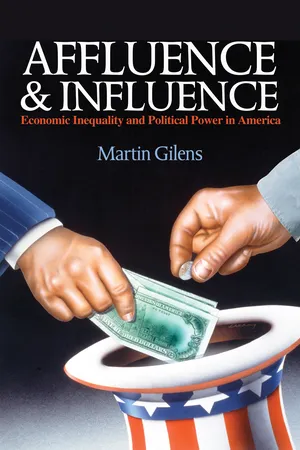
Can a country be a democracy if its government only responds to the preferences of the rich? In an ideal democracy, all citizens should have equal influence on government policy—but as this book demonstrates, America's policymakers respond almost exclusively to the preferences of the economically advantaged. Affluence and Influence definitively explores how political inequality in the United States has evolved over the last several decades and how this growing disparity has been shaped by interest groups, parties, and elections.
With sharp analysis and an impressive range of data, Martin Gilens looks at thousands of proposed policy changes, and the degree of support for each among poor, middle-class, and affluent Americans. His findings are staggering: when preferences of low- or middle-income Americans diverge from those of the affluent, there is virtually no relationship between policy outcomes and the desires of less advantaged groups. In contrast, affluent Americans' preferences exhibit a substantial relationship with policy outcomes whether their preferences are shared by lower-income groups or not. Gilens shows that representational inequality is spread widely across different policy domains and time periods. Yet Gilens also shows that under specific circumstances the preferences of the middle class and, to a lesser extent, the poor, do seem to matter. In particular, impending elections—especially presidential elections—and an even partisan division in Congress mitigate representational inequality and boost responsiveness to the preferences of the broader public.
At a time when economic and political inequality in the United States only continues to rise, Affluence and Influence raises important questions about whether American democracy is truly responding to the needs of all its citizens.
- 352 pages
- English
- ePUB (mobile friendly)
- Available on iOS & Android
eBook - ePub
About this book
Information
Publisher
Princeton University PressYear
2012Print ISBN
9780691162423
9780691153971
eBook ISBN
9781400844821
Table of contents
- Cover
- Half title
- Title
- Copyright
- Dedication
- Contents
- List of Tables
- List of Figures
- Acknowledgments
- Introduction
- Chapter 1 Citizen Competence and Democratic Decision Making
- Chapter 2 Data and Methods
- Chapter 3 The Preference/Policy Link
- Chapter 4 Policy Domains and Democratic Responsiveness
- Chapter 5 Interest Groups and Democratic Responsiveness
- Chapter 6 Parties, Elections, and Democratic Responsiveness
- Chapter 7 Democratic Responsiveness across Time
- Chapter 8 Money and American Politics
- Appendix
- Notes
- References
- Index
Trusted by 375,005 students
Access to over 1.5 million titles for a fair monthly price.
Study more efficiently using our study tools.
Frequently asked questions
Yes, you can cancel anytime from the Subscription tab in your account settings on the Perlego website. Your subscription will stay active until the end of your current billing period. Learn how to cancel your subscription
No, books cannot be downloaded as external files, such as PDFs, for use outside of Perlego. However, you can download books within the Perlego app for offline reading on mobile or tablet. Learn how to download books offline
Perlego offers two plans: Essential and Complete
- Essential is ideal for learners and professionals who enjoy exploring a wide range of subjects. Access the Essential Library with 800,000+ trusted titles and best-sellers across business, personal growth, and the humanities. Includes unlimited reading time and Standard Read Aloud voice.
- Complete: Perfect for advanced learners and researchers needing full, unrestricted access. Unlock 1.5M+ books across hundreds of subjects, including academic and specialized titles. The Complete Plan also includes advanced features like Premium Read Aloud and Research Assistant.
We are an online textbook subscription service, where you can get access to an entire online library for less than the price of a single book per month. With over 1.5 million books across 990+ topics, we’ve got you covered! Learn about our mission
Look out for the read-aloud symbol on your next book to see if you can listen to it. The read-aloud tool reads text aloud for you, highlighting the text as it is being read. You can pause it, speed it up and slow it down. Learn more about Read Aloud
Yes! You can use the Perlego app on both iOS and Android devices to read anytime, anywhere — even offline. Perfect for commutes or when you’re on the go.
Please note we cannot support devices running on iOS 13 and Android 7 or earlier. Learn more about using the app
Please note we cannot support devices running on iOS 13 and Android 7 or earlier. Learn more about using the app
Yes, you can access Affluence and Influence by Martin Gilens in PDF and/or ePUB format, as well as other popular books in Politics & International Relations & American Government. We have over 1.5 million books available in our catalogue for you to explore.