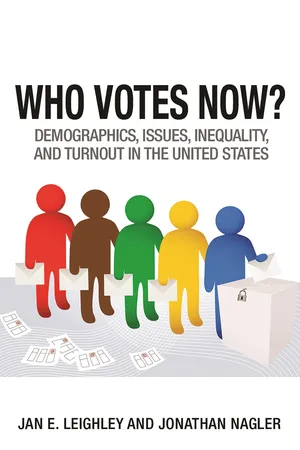
Who Votes Now? compares the demographic characteristics and political views of voters and nonvoters in American presidential elections since 1972 and examines how electoral reforms and the choices offered by candidates influence voter turnout. Drawing on a wealth of data from the U.S. Census Bureau's Current Population Survey and the American National Election Studies, Jan Leighley and Jonathan Nagler demonstrate that the rich have consistently voted more than the poor for the past four decades, and that voters are substantially more conservative in their economic views than nonvoters. They find that women are now more likely to vote than men, that the gap in voting rates between blacks and whites has largely disappeared, and that older Americans continue to vote more than younger Americans. Leighley and Nagler also show how electoral reforms such as Election Day voter registration and absentee voting have boosted voter turnout, and how turnout would also rise if parties offered more distinct choices.
Providing the most systematic analysis available of modern voter turnout, Who Votes Now? reveals that persistent class bias in turnout has enduring political consequences, and that it really does matter who votes and who doesn't.
eBook - ePub
Who Votes Now?
Demographics, Issues, Inequality, and Turnout in the United States
- 232 pages
- English
- ePUB (mobile friendly)
- Available on iOS & Android
eBook - ePub
Who Votes Now?
Demographics, Issues, Inequality, and Turnout in the United States
About this book
Information
Publisher
Princeton University PressYear
2013Print ISBN
9780691159355
9780691159348
eBook ISBN
9781400848621
Index
abortion, 160, 161, 161n5, 172
Abrajano, Marisa, 69
absentee voting, 10, 76, 90, 93–94, 95, 119–20; effect of on voter turnout, 96–97, 107, 107nn11–12, 109, 111–12, 115, 117
Adams, James, 123, 124
African Americans, 26, 80; bivariate evidence that African Americans are less likely to vote than whites, 68, 68n19; changes in voter turnout for, 53–54; gap in voter turnout between whites and African Americans, 68, 68nn19–20, 70–71, 70n25; higher levels of education and income among, 53; increase in the population of, 17; increase in voter turnout of, 31
age, as a factor in voter turnout, 27, 29, 52, 72–73, 76, 76n28, 105n9; conditional effect of on voter turnout, 54, 57, 70, 72; and the life-cycle model of age effects, 72–73; net group effect of EDR across age groups in Wave 1, Wave 2, and Wave 3 states, 105, 107, 107n10. See also demographics, of voter turnout
Aldrich, John H., 55, 122–23
alienation, 9, 123–24; measurement of, 147–51, 153; multivariate analysis of perceived policy alienation and policy difference, 128–31, 133–35; perceived policy alienation, 125, 125n5; perceived policy alienation and difference across income groups, 135, 137–39; policy-based concepts of indifference and alienation, 125
Alvarez, Michael, 69
American Association of Retired Persons (AARP), 73, 76
American National Election Studies (NES), 12, 14, 19, 22, 58, 147, 151, 156, 158, 161, 167; NES-validated vote measures, 20, 20n12; question wording of survey items, 177–79
American Voter, The (Campbell, Converse, Miller, and Stokes), 16
Anglos (non-Hispanic whites), 13, 13n16, 26; decline in the population of, 17; differences in voter turnout compared to that of African Americans, 68, 68nn19–20, 70–71, 70n25; voter turnout among, 31, 38, 69, 81
Ashenfelter, Orley, 123
at-risk effects. See election day registration (EDR): at-risk effects of on voter population
Bartels, Larry, 157
Beck, Paul Allen, 73
Bennett, Stephen Earl, 156
Berelson, Bernard, 16
Biden, Joe, 4
Brady, Henry E., 187
Brians, Craig Leonard, 96
Brox, Brian J., 97
Burris, Arthur L., 69, 69n24
Bush, George W., 169
Campbell, Angus, 16
causality, establishment o...
Table of contents
- Cover Page
- Title Page
- Copyright Page
- Dedication Page
- Contents
- List of Figures
- List of Tables
- Preface
- Acknowledgments
- One: Introduction
- Two: Demographics of Turnout
- Three: Theoretical Framework and Models
- Four: The Legal Context of Turnout
- Five: Policy Choices and Turnout
- Six: On the Representativeness of Voters
- Seven: Conclusion
- References
- Index
Trusted by 375,005 students
Access to over 1.5 million titles for a fair monthly price.
Study more efficiently using our study tools.
Frequently asked questions
Yes, you can cancel anytime from the Subscription tab in your account settings on the Perlego website. Your subscription will stay active until the end of your current billing period. Learn how to cancel your subscription
No, books cannot be downloaded as external files, such as PDFs, for use outside of Perlego. However, you can download books within the Perlego app for offline reading on mobile or tablet. Learn how to download books offline
We are an online textbook subscription service, where you can get access to an entire online library for less than the price of a single book per month. With over 1.5 million books across 990+ topics, we’ve got you covered! Learn about our mission
Look out for the read-aloud symbol on your next book to see if you can listen to it. The read-aloud tool reads text aloud for you, highlighting the text as it is being read. You can pause it, speed it up and slow it down. Learn more about Read Aloud
Yes! You can use the Perlego app on both iOS and Android devices to read anytime, anywhere — even offline. Perfect for commutes or when you’re on the go.
Please note we cannot support devices running on iOS 13 and Android 7 or earlier. Learn more about using the app
Please note we cannot support devices running on iOS 13 and Android 7 or earlier. Learn more about using the app
Yes, you can access Who Votes Now? by Jan E. Leighley,Jonathan Nagler in PDF and/or ePUB format, as well as other popular books in Politics & International Relations & American Government. We have over 1.5 million books available in our catalogue for you to explore.