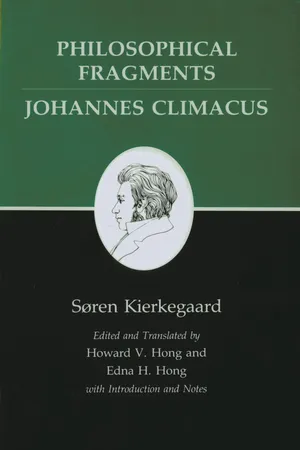
This volume contains a new translation, with a historical introduction by the translators, of two works written under the pseudonym Johannes Climacus. Through Climacus, Kierkegaard contrasts the paradoxes of Christianity with Greek and modern philosophical thinking. In Philosophical Fragments he begins with Greek Platonic philosophy, exploring the implications of venturing beyond the Socratic understanding of truth acquired through recollection to the Christian experience of acquiring truth through grace. Published in 1844 and not originally planned to appear under the pseudonym Climacus, the book varies in tone and substance from the other works so attributed, but it is dialectically related to them, as well as to the other pseudonymous writings.
The central issue of Johannes Climacus is doubt. Probably written between November 1842 and April 1843 but unfinished and published only posthumously, this book was described by Kierkegaard as an attack on modern speculative philosophy by "means of the melancholy irony, which did not consist in any single utterance on the part of Johannes Climacus but in his whole life. . . . Johannes does what we are told to do--he actually doubts everything--he suffers through all the pain of doing that, becomes cunning, almost acquires a bad conscience. When he has gone as far in that direction as he can go and wants to come back, he cannot do so. . . . Now he despairs, his life is wasted, his youth is spent in these deliberations. Life does not acquire any meaning for him, and all this is the fault of philosophy." A note by Kierkegaard suggests how he might have finished the work: "Doubt is conquered not by the system but by faith, just as it is faith that has brought doubt into the world!."
eBook - ePub
Philosophical Fragments, or a Fragment of Philosophy/Johannes Climacus, or De omnibus dubitandum est. (Two books in one volume)
- 400 pages
- English
- ePUB (mobile friendly)
- Available on iOS & Android
eBook - ePub
Philosophical Fragments, or a Fragment of Philosophy/Johannes Climacus, or De omnibus dubitandum est. (Two books in one volume)
About this book
Information
Publisher
Princeton University PressYear
2013Print ISBN
9780691020365
9780691072739
eBook ISBN
9781400846962
Topic
PhilosophieSubtopic
ReligionsphilosophieEDITORIAL APPENDIX
Acknowledgments
Collation of Philosophical Fragments in the
Danish Editions of Kierkegaard’s Collected Works
Danish Editions of Kierkegaard’s Collected Works
Notes to Philosophical Fragments
Notes to Johannes Climacus
Notes to Supplement
Bibliographical Note
Index
ACKNOWLEDGMENTS
Preparation of manuscripts for Kierkegaard’s Writings is supported by a genuinely enabling grant from the National Endowment for the Humanities. The grant includes gifts from the Danish Ministry of Cultural Affairs, the Augustinus Fond, the Konsul George Jorck og Hustru Emma Jorcks Fond, the A. P. Møller og Hustru Chastine Mc-Kinney Møllers Fond, and the Lutheran Brotherhood Foundation.
The translators-editors are indebted to the late Gregor Malantschuk, Grethe Kjær, and Julia Watkin for their knowledgeable observations on crucial concepts and terminology.
John Elrod, Per Lønning, and Sophia Scopetéa, members of the International Advisory Board for Kierkegaard’s Writings, have given valuable criticism of the manuscript on the whole and in detail. Rune Engebretsen, Jack Schwandt, Pamela Schwandt, Michael Daugherty, Steven Knudson, Robert Roberts, Craig Mason, and Kevin Swan have helpfully scrutinized the manuscript. The Greek has been checked by Lloyd Gunderson and James May. Translations of German quotations are by Rune Engebretsen. The index was prepared by Kennedy Lemke. The entire work has been facilitated by George Coulter and Lavier Murray.
Acknowledgment is made to Gyldendals Forlag for permission to absorb notes to Søren Kierkegaards Samlede Værker.
Inclusion in the Supplement of entries from Søren Kierkegaard’s Journals and Papers is by arrangement with Indiana University Press.
The book collection and the microfilm collection of the Kierkegaard Library, St. Olaf College, have been used in preparation of the text, Supplement, and Editorial Appendix. The Royal Library, Copenhagen, has provided photographs of selected manuscript pages.
The manuscript, typed by Dorothy Bolton, has been guided through the press by Gretchen Oberfranc.
COLLATION OF PHILOSOPHICAL FRAGMENTS IN THE DANISH EDITIONS OF KIERKEGAARD’S COLLECTED WORKS
Vol. IV Ed. 1 Pg | Vol. IV Ed. 2 Pg | Vol. VI Ed. 3 Pg |
174 | 198 | 8 |
175 | 199 | 9 |
176 | 199 | 9 |
177 | 200 | 10 |
178 | 201 | 11 |
179 | 203 | 15 |
180 | 203 | 15 |
181 | 204 | 16 |
182 | 205 | 17 |
183 | 206 | 17 |
184 | 207 | 18 |
185 | 209 | 19 |
186 | 210 | 20 |
187 | 211 | 21 |
188 | 212 | 22 |
189 | 213 | 23 |
190 | 214 | 24 |
191 | 215 | 25 |
192 | 216 | 26 |
193 | 217 | 26 |
194 | 218 | 27 |
195 | 219 | 28 |
196 | 220 | 29 |
197 | 221 | 30 |
198 | 223 | 31 |
199 | 224 | 32 |
200 | 225 | 33 |
201 | 226 | 34 |
202 | 227 | 35 |
203 | 228 | 36 |
204 | 230 | 37 |
205 | 231 | 38 |
206 | 231 | 39 |
207 | 232 | 40 |
208 | 233 | 41 |
209 | 234 | 41 |
210 | 235 | 42 |
211 | 236 | 43 |
212 | 237 | 44 |
213 | 238 | 4$ |
214 | 239 | 46 |
215 | 241 | 47 |
216 | 242 | 48 |
217 | 243 | 49 |
218 | 244 | 50 |
219 | 245 | 50 |
220 | 246 | 51 |
221 | 247 | 52 |
222 | 248 | 53 |
223 | 249 | 54 |
224 | 250 | 55 |
225 | 251 | 56 |
226 | 252 | 57 |
227 | 254 | 58 |
228 | 255 | 59 |
229 | 256 | 60 |
230 | 257 | 61 |
231 | 259 | 62 |
232 | 260 | 63 |
233 | 261 | 64 |
234 | 262 | 65 |
235 | 264 | 67 |
236 | 264 | 67 |
237 | 265 | 68 |
238 | 266 | 69 |
239 | 267 | 69 |
240 | 268 | 70 |
241 | 269 | 71 |
242 | 270 | 72 |
243 | 271 | 72 |
244 | 272 | 73 |
245 | 273 | 74 |
246 | 274 | 75 |
247 | 275 | 76 |
248 | 276 | 76 |
249 | 277 | 77 |
250 | 278 | 79 |
251 | 279 | 80 |
252 | 281 | 81 |
253 | 281 | 81 |
254 | 282 | 82 |
255 | 284 | 83 |
256 | 285 | 84 |
257 | 286 | 85 |
258 | 287 | 86 |
259 | 288 | 87 |
260 | 289 | 88 |
261 | 290 | 89 |
262 | 291 | 89 |
263 | 292 | 90 |
264 | 293 | 91 |
265 | 294 | 92 |
266 | 295 | 93 |
267 | 297 | 94 |
268 | 298 | 95 |
269 | 299 | 96 |
270 | 300 | 97 |
271 | 301 | 98 |
272 | 302 | 99 |
NOTES
PHILOSOPHICAL FRAGMENTS
TITLE PAGE AND EPIGRAPHS
TITLE PAGE. See Supplement, p. 177 (Pap. V B 39), for changes in the title page in draft and final copies; see Historical Introduction, pp. xvi-xvii.
EPIGRAPHS, happiness. The Danish Salighed has a richness of meaning (happiness, bliss, felicity, blessedness, salvation) such that some scholars prefer to keep the word as an especially significant term without translation. Here Salighed is translated as “happiness,” in keeping with Socratic-Platonic terminology in English. Εὐδαιμονία is usually rendered as “happiness” in the sense of complete well-being, the fulfillment of one’s essential human nature rather than pleasurable satisfaction or joyousness. See, for example, Plato, Phaedo, 81 a; Platonis quae exstant opera, I-XI, ed. Friedrich Ast (Leipzig: 1819-32; ASKB 1144-54), I, pp. 530-31; Udvalgte Dialoger af Platon, I-VIII, tr. Carl Johan Heise (Copenhagen: 1830-59; ASKB 1164-67, 1169 [I-VII]), I, p. 49; The Collected Dialogues of Plato, ed. Edith Hamilton and Huntington Cairns (Princeton: Princeton University Pr...
Table of contents
- Cover Page
- Title Page
- Copyright Page
- Contents
- HISTORICAL INTRODUCTION
- SUPPLEMENT
- EDITORIAL APPENDIX
Trusted by 375,005 students
Access to over 1.5 million titles for a fair monthly price.
Study more efficiently using our study tools.
Frequently asked questions
Yes, you can cancel anytime from the Subscription tab in your account settings on the Perlego website. Your subscription will stay active until the end of your current billing period. Learn how to cancel your subscription
No, books cannot be downloaded as external files, such as PDFs, for use outside of Perlego. However, you can download books within the Perlego app for offline reading on mobile or tablet. Learn how to download books offline
Perlego offers two plans: Essential and Complete
- Essential is ideal for learners and professionals who enjoy exploring a wide range of subjects. Access the Essential Library with 800,000+ trusted titles and best-sellers across business, personal growth, and the humanities. Includes unlimited reading time and Standard Read Aloud voice.
- Complete: Perfect for advanced learners and researchers needing full, unrestricted access. Unlock 1.5M+ books across hundreds of subjects, including academic and specialized titles. The Complete Plan also includes advanced features like Premium Read Aloud and Research Assistant.
We are an online textbook subscription service, where you can get access to an entire online library for less than the price of a single book per month. With over 1.5 million books across 990+ topics, we’ve got you covered! Learn about our mission
Look out for the read-aloud symbol on your next book to see if you can listen to it. The read-aloud tool reads text aloud for you, highlighting the text as it is being read. You can pause it, speed it up and slow it down. Learn more about Read Aloud
Yes! You can use the Perlego app on both iOS and Android devices to read anytime, anywhere — even offline. Perfect for commutes or when you’re on the go.
Please note we cannot support devices running on iOS 13 and Android 7 or earlier. Learn more about using the app
Please note we cannot support devices running on iOS 13 and Android 7 or earlier. Learn more about using the app
Yes, you can access Philosophical Fragments, or a Fragment of Philosophy/Johannes Climacus, or De omnibus dubitandum est. (Two books in one volume) by Søren Kierkegaard, Edna H. Hong, Howard V. Hong, Edna H. Hong,Howard V. Hong in PDF and/or ePUB format, as well as other popular books in Philosophie & Religionsphilosophie. We have over 1.5 million books available in our catalogue for you to explore.