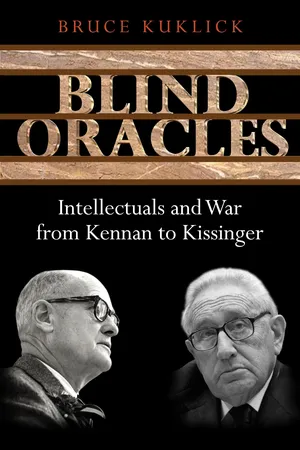
In this trenchant analysis, historian Bruce Kuklick examines the role of intellectuals in foreign policymaking. He recounts the history of the development of ideas about strategy and foreign policy during a critical period in American history: the era of the nuclear standoff between the United States and the Soviet Union.
The book looks at how the country's foremost thinkers advanced their ideas during this time of United States expansionism, a period that culminated in the Vietnam War and détente with the Soviets. Beginning with George Kennan after World War II, and concluding with Henry Kissinger and the Vietnam War, Kuklick examines the role of both institutional policymakers such as those at The Rand Corporation and Harvard's Kennedy School, and individual thinkers including Paul Nitze, McGeorge Bundy, and Walt Rostow.
Kuklick contends that the figures having the most influence on American strategy--Kissinger, for example--clearly understood the way politics and the exercise of power affects policymaking. Other brilliant thinkers, on the other hand, often played a minor role, providing, at best, a rationale for policies adopted for political reasons. At a time when the role of the neoconservatives' influence over American foreign policy is a subject of intense debate, this book offers important insight into the function of intellectuals in foreign policymaking.
- 258 pages
- English
- PDF
- Available on iOS & Android
eBook - PDF
About this book
Information
Publisher
Princeton University PressYear
2013Print ISBN
9780691133874
9780691123493
eBook ISBN
9781400849468
Topic
GeschichteSubtopic
Nordamerikanische GeschichteTable of contents
- Cover
- Title
- Copyright
- Dedication
- Contents
- List of Illustrations
- Note on Citations
- INTRODUCTION: The Social Role of the Man of Knowledge
- CHAPTER 1: Scientific Management and War, 1910–1960
- CHAPTER 2: Theorists of War, 1945–1953
- CHAPTER 3: RAND in Opposition, 1946–1961
- CHAPTER 4: Accented and Unaccented Realism, 1946–1961
- CHAPTER 5: RAND and the Kennedy Administration, 1961–1962
- CHAPTER 6: Cuba and Nassau, 1962
- CHAPTER 7: Intellectuals in Power, 1961–1966
- CHAPTER 8: The Kennedy School of Government, 1964–1971
- CHAPTER 9: The Pentagon Papers
- CHAPTER 10: Henry Kissinger
- CHAPTER 11: Diplomats on Foreign Policy, 1976–2001
- Conclusion
- Acknowledgments and Methodological Note
- Index
Trusted by 375,005 students
Access to over 1.5 million titles for a fair monthly price.
Study more efficiently using our study tools.
Frequently asked questions
Yes, you can cancel anytime from the Subscription tab in your account settings on the Perlego website. Your subscription will stay active until the end of your current billing period. Learn how to cancel your subscription
No, books cannot be downloaded as external files, such as PDFs, for use outside of Perlego. However, you can download books within the Perlego app for offline reading on mobile or tablet. Learn how to download books offline
We are an online textbook subscription service, where you can get access to an entire online library for less than the price of a single book per month. With over 1.5 million books across 990+ topics, we’ve got you covered! Learn about our mission
Look out for the read-aloud symbol on your next book to see if you can listen to it. The read-aloud tool reads text aloud for you, highlighting the text as it is being read. You can pause it, speed it up and slow it down. Learn more about Read Aloud
Yes! You can use the Perlego app on both iOS and Android devices to read anytime, anywhere — even offline. Perfect for commutes or when you’re on the go.
Please note we cannot support devices running on iOS 13 and Android 7 or earlier. Learn more about using the app
Please note we cannot support devices running on iOS 13 and Android 7 or earlier. Learn more about using the app
Yes, you can access Blind Oracles by Bruce Kuklick in PDF and/or ePUB format, as well as other popular books in Geschichte & Nordamerikanische Geschichte. We have over 1.5 million books available in our catalogue for you to explore.