States are more likely to engage in risky and destabilizing actions such as military buildups and preemptive strikes if they believe their adversaries pose a tangible threat. Yet despite the crucial importance of this issue, we don't know enough about how states and their leaders draw inferences about their adversaries' long-term intentions. Knowing the Adversary draws on a wealth of historical archival evidence to shed new light on how world leaders and intelligence organizations actually make these assessments.
Keren Yarhi-Milo examines three cases: Britain's assessments of Nazi Germany's intentions in the 1930s, America's assessments of the Soviet Union's intentions during the Carter administration, and the Reagan administration's assessments of Soviet intentions near the end of the Cold War. She advances a new theoretical framework—called selective attention—that emphasizes organizational dynamics, personal diplomatic interactions, and cognitive and affective factors. Yarhi-Milo finds that decision makers don't pay as much attention to those aspects of state behavior that major theories of international politics claim they do. Instead, they tend to determine the intentions of adversaries on the basis of preexisting beliefs, theories, and personal impressions. Yarhi-Milo also shows how intelligence organizations rely on very different indicators than decision makers, focusing more on changes in the military capabilities of adversaries.
Knowing the Adversary provides a clearer picture of the historical validity of existing theories, and broadens our understanding of the important role that diplomacy plays in international security.
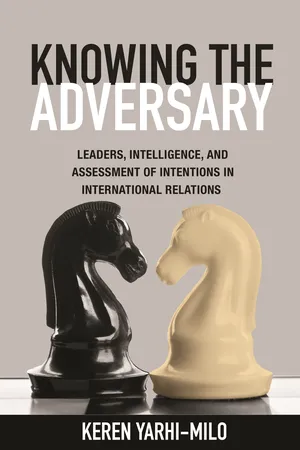
eBook - ePub
Knowing the Adversary
Leaders, Intelligence, and Assessment of Intentions in International Relations
- 360 pages
- English
- ePUB (mobile friendly)
- Available on iOS & Android
eBook - ePub
Knowing the Adversary
Leaders, Intelligence, and Assessment of Intentions in International Relations
About this book
Trusted by 375,005 students
Access to over 1.5 million titles for a fair monthly price.
Study more efficiently using our study tools.
Information
Publisher
Princeton University PressYear
2014Print ISBN
9780691159164
9780691159157
eBook ISBN
9781400850419
CHAPTER 1

Theories of Intentions and the Problem of Attention
THE ADVERSARY’S INTENTIONS: WHAT PERCEPTIONS MATTER?
In this study, perception of an adversary’s intentions refers to the set of beliefs held by observers in a state about its adversary’s foreign policy goals (political intentions) with regard to changing or maintaining the status quo, and to a lesser extent, about the adversary’s inclination to use military force to achieve these objectives (military intentions).1 This study is primarily concerned with the perceptions of an adversary’s long-term intentions, since these are likely to affect a state’s own foreign policy and strategic choices.2 Further, this study examines peacetime assessments of intentions between adversaries. Thus, in all the periods I analyze, the perceiving state has already defined the other country as one of its main sources of threat.
While perceived political intentions can range anywhere along a continuum from benign to hostile, I simplify matters by dividing such intentions into five ideal-type categories based on the degree to which the enemy is believed to have the determination required to revise the status quo and the extent of its revisionist intentions.3 These categories are: unlimited expansionist, limited expansionist, unlimited opportunistic, limited opportunistic, and status quo powers.
Expansionist Intentions, Limited or Unlimited
An adversary is perceived to have expansionist intentions if it is believed to have a strong determination to expand its power and influence beyond its territorial boundaries. Expansionism could consist of an active plan to achieve a hegemonic international position (unlimited expansionist) or effect a change in the distribution of power that while significant, is more limited in scope (limited expansionist). Such an adversary is perceived as difficult to deter, as it is believed to actively and consistently seek to revise the status quo, and its leadership is believed to place a high priority on achieving its revisionist political goals (whether limited or unlimited in scope). Outside observers may therefore view it as unconstrained and extremely dangerous.
Opportunistic Expansionist Intentions, Limited or Unlimited
A state that is perceived to be opportunistic is believed to desire a favorable change in the distribution of power, whether limited or unlimited in geo-graphic scope, but is not believed to be actively seeking change. Rather, the enemy is viewed as having a moderate level of determination to change the status quo; it may have contingent plans to seize revisionist opportunities, but is currently not willing or capable of acting on its revisionist goals when the cost of doing so appears to be high.4 While expansionist and opportunistic states differ only in their determination to execute their revisionist designs, such a distinction is significant for those who are trying to gauge intentions and formulate a responsible policy toward their adversary. A state that faces an opportunistic adversary must hedge against the possibility that this adversary will act on contingent plans to expand. A state may thus pursue coercive diplomacy against this type of adversary, combining threats to dissuade the adversary from taking advantage of opportunities as well as offering assurances if the adversary maintains the status quo. Facing an adversary determined on expansion, however, requires assertive balancing and confrontational policies, or even force—if a country has the means—aimed at denying the adversary its revisionist objectives.5
Status Quo Intentions
The perception of an adversary’s intentions as essentially supportive of the status quo does not entail a normative belief that the status quo is morally just, only a strategic belief that the adversary seeks “preservation” versus “aggrandizement.”6 We should expect to see that those state decision makers who perceive their adversary’s intentions as oriented toward the status quo will support this belief with arguments that the adversary is mainly interested in maintaining its current position in the international system, and that it is unlikely to create or take advantage of opportunities to expand its power as well as influence.
In addition to political intentions, I also examine perceptions of military intentions—that is, whether the adversary is perceived as likely to use military force to support its political goals or is instead more likely to rely on nonmilitary means, such as the use of verbal or written propaganda, political subversion, and economic assistance or sanctions.7
THE SELECTIVE ATTENTION THESIS
The point of departure of the selective attention approach I develop and test in this book is that individual decision makers and bureaucratic organizations, such as the state’s intelligence community, process information differently. Civilian decision makers are human beings, and their selection and interpretation of signals will be influenced by their own theories, needs, and expectations. Meanwhile, the organizational context in which intelligence analysts operate along with the organizational mission of a state’s intelligence apparatus channel attention and affect the selection of information as well as the preference for certain interpretations. In light of these inherent differences between the two sets of perceivers, I offer a set of hypotheses as to how these different actors assess the adversary’s intentions.
How Do Decision Makers Infer Intentions?
Information about intentions is often complex, ambiguous, and subject to manipulation and deception, thereby requiring much interpretative work. Cognitive limitations in processing innumerable stimuli, coupled with the need to distinguish usefully and correctly between credible signals and meaningless noise, require the use of some inference strategies or shortcuts (heuristics). These simplified models of reality frequently have the unintended effect of focusing perceivers’ attention toward certain pieces of information, or indicators, of the adversary’s intentions and away from others. Building on some prominent insights from psychology on information processing and attitude change, I offer two hypotheses, which are not mutually exclusive—the vividness and subjective credibility hypotheses—to explain how vivid information as well as decision makers’ theories, expectations (unmotivated biases), and needs (motivated biases) shape what indicators of intentions they will attend to and value as credible.8
THE VIVIDNESS HYPOTHESIS
At the heart of the vividness hypothesis is the idea that people give inferential weight to information in proportion to its vividness. Vividness refers to the “emotional interest of information, the concreteness and imaginability of information, and the sensory, spatial, and temporal proximity of information.”9 Recent work in psychology and political science has shown that our emotional responses shape the certainty of our beliefs and preferences for certain choices.10 This finding dovetails with earlier work on information salience.11 As Eugene Borgida and Richard Nisbett classically argued, “There may be a kind of ‘eyewitness’ principle of the weighing of evidence, such that firsthand, sense-impression data is assigned greater validity.”12 In the words of Chaim Kaufmann, “Information that is highly salient (vivid, concrete, immediate, emotionally interesting or exciting) will receive greater weight than its evidentiary value warrants…. People pay more attention to, and are more influenced by, especially salient information than less vivid information.”13 Accordingly, information about intentions that is vivid, personalized, and emotionally involving is more likely to be remembered, and hence to be disproportionately available for influencing inferences. Conversely, studies have shown that information that lacks vividness, such as information that is abstract, colorless, and less concrete, is more likely to be neglected or ignored.14
Two forms of vivid information are emphasized in this study: decision maker’s impressions from personal interactions with members of an adversary’s leadership, and a decision maker’s perception of the adversary’s response to a litmus test that they believed they have communicated to the adversary. An adversary’s failure to comply with such a test can be expected to result in perceptions of hostile intentions; behavior that appears to pass the test (even if it is not, in fact, meant by the adversary as a response to it) is similarly vivid information that is, I predict, likely to result in perceptions of more benign intentions.
I argue that these practices contain affective reactions to vivid stimuli, occurring automatically, and influencing decisions and judgments. As such, this inference process may be more or less rational depending on the extent to which decision makers are analytic and deliberative in how they use vivid information to infer intentions. At the same time, more recent discoveries in neuroscience have shown that the reliance on affect and emotion is a quicker, easier, and more efficient way to navigate in a complex, uncertain, and sometimes-dangerous world. Or as Antonio Damasio explains, rationality is not only a product of the analytic mind but the experiential mind as well.15 That is, without the ability to reference emotion, people remain incapable of making so-called rational decisions. Viewed in this way, there is little value in debating whether the use of personal impressions from personal meetings or litmus tests are fully rational, as various studies demonstrate that affect is a strong conditioner of preference whether or not the cause of that affect is consciously perceived.16
Decision makers can and frequently do treat personal impressions, garnered from personal observations of the behavior of their adversary’s leaders in summit meetings or private conversations, as highly salient indicators of those leaders’ sincerity. Consequently, they view these opportunities as providing important evidence about the intentions of their adversary. The affective nature of personal impressions of the adversary’s behavior, being both personal and personally felt, makes them more likely to be treated as highly salient information. Such impression formation reduces cognitive burdens, given that individuals can quickly form and later invoke established stereotypes rather than having to assimilate a wide variety of complex, abstract information. Consider, for example, the comments President George W. Bush made in reference to the intentions of the Russian leader Vladimir Putin following their 2001 meeting: “I looked the man in the eye. I found him to be very straightforward and trustworthy. We had a very good dialogue. I was able to get a sense of his soul.”17 Bush is certainly not the only world leader to draw on personal impressions to judge the sincerity of his counterparts. Indeed, notable figures such as Winston Churchill, Anthony Eden, and Franklin Roosevelt were all strongly influenced by their personal impressions of Joseph Stalin.18 Churchill at one point even stated, “Poor Neville Chamberlain believed he could trust Hitler. He was wrong. But I don’t think that I am wrong about Stalin.”19
Decision makers’ attentiveness and responsiveness to this kind of information has a certain justification and confers occasional advantages. Interpersonal interaction provides a setting in which leaders exchange information not only through the content of what they say but also via a myriad of other channels. These include facial expressions, attitude, body language, tone of voice, and even unconscious movements or reactions. “When an actor is able to directly observe one of his adversaries he will … scrutinize those presumably uncontrolled aspects of personal behavior that are indices to the adversary’s goals, estimate of the situation, and resolve.”20 Robert Frank has asserted that emotional predispositions—as evidenced through cues in expression, voice, and posture, for instance—supply real information about intentions.21 Because these behaviors are not fully under the individual’s control, they help us as human beings distinguish “cooperators” from “defectors.” The adversary’s emotional behavior in these circumstances is, according to Jervis, a signal that is hard to manipulate and accordingly could be perceived as inextricably linked to the adversary’s intentions, or what Jervis calls an index.22
Impressions derived from private meetings, however, can be misleading and potentially risky. Alexander Groth notes that most politicians tend to be overconfident about their own ability to judge others and as such may be too tempted to use their personal impressions as credible information about intentions. This is most risky in instances where the adversary chooses to be deceitful and is skillful at it.23 Thus, personal encounters can produce impressions based on certain behavioral indicators of our interlocutor that are retained not only as explicit assessments but also as affective evaluations. Such impressions form the intuitive basis for negative or positive judgments about others’ intentions. These feelings are not objective facts; nevertheless, they do form a type of subjectively experienced information. Further, these impressions are not static; during the process of interaction we continuously and unconsciously update the affective impressions we have of the adversary based on negative or positive experiences.24
It is difficult to forecast exactly what behavior leaders will pay attention to and what impressions they will take away from meetings with their counterparts. By their very nature, personal impressions are contingent on highly personal and contextual factors. I hypothesize, though, that personal impressions of the adversary’s behavior will likely influence assessments of intentions under three conditions. First, all else being equal, leaders institutionally endowed with the power to make independent judgment calls will have more discretionary freedom to draw on their own personal impressions in making decisions. Conversely, should leaders perceive their counterparts to be under strong institutional constraints and hence relatively powerless, they may give their personal impressions of those counterparts less weight. Second, situations where information is scarce, ambiguous, or contradictory can push leaders to rely on personal impressions for lack of other sources. Leaders may also fall back on instinctual personal impressions in situations when they experience reduced cognitive processing capacity—for instance, due to crisis-induced stress.25 Third, certain leaders’ personal attributes may also play a role. Leaders highly confident of their own judgment, and distrusting or dismissive of bureaucratically produced assessments, will be more likely to draw on their own impressions. Actors with strong preconceptions or prejudices about their opposite numbers may be slower to adjust their explicit evaluations in response to personal interactions.26
...Table of contents
- Cover Page
- Title Page
- Copyright Page
- Dedication Page
- Contents
- Acknowledgments
- Introduction
- Chapter 1. Theories of Intentions and the Problem of Attention
- Chapter 2. Indicators of Nazi Germany’s Intentions and the Coming of World War II, 1934– 39
- Chapter 3. British Decision Makers’ Perceptions of Nazi Germany’s Intentions
- Chapter 4. The British Intelligence Community’s Assessments of Nazi Germany’s Intentions
- Chapter 5. The Carter Era and the Collapse of Détente, 1977– 80
- Chapter 6. US Decision Makers’ Perceptions of Soviet Intentions: The Collapse of Détente
- Chapter 7. The US Intelligence Community’s Assessments of Soviet Intentions: The Collapse of Détente
- Chapter 8. Indicators of Soviet Intentions and the End of the Cold War, 1985– 88
- Chapter 9. US Decision Makers’ Perceptions of Soviet Intentions: The End of the Cold War
- Chapter 10. The US Intelligence Community’s Assessments of Soviet Intentions: The End of the Cold War
- Chapter 11. Summary and Implications
- Appendix: Summary of Hypotheses
- Notes
- Index
Frequently asked questions
Yes, you can cancel anytime from the Subscription tab in your account settings on the Perlego website. Your subscription will stay active until the end of your current billing period. Learn how to cancel your subscription
No, books cannot be downloaded as external files, such as PDFs, for use outside of Perlego. However, you can download books within the Perlego app for offline reading on mobile or tablet. Learn how to download books offline
Perlego offers two plans: Essential and Complete
- Essential is ideal for learners and professionals who enjoy exploring a wide range of subjects. Access the Essential Library with 800,000+ trusted titles and best-sellers across business, personal growth, and the humanities. Includes unlimited reading time and Standard Read Aloud voice.
- Complete: Perfect for advanced learners and researchers needing full, unrestricted access. Unlock 1.5M+ books across hundreds of subjects, including academic and specialized titles. The Complete Plan also includes advanced features like Premium Read Aloud and Research Assistant.
We are an online textbook subscription service, where you can get access to an entire online library for less than the price of a single book per month. With over 1.5 million books across 990+ topics, we’ve got you covered! Learn about our mission
Look out for the read-aloud symbol on your next book to see if you can listen to it. The read-aloud tool reads text aloud for you, highlighting the text as it is being read. You can pause it, speed it up and slow it down. Learn more about Read Aloud
Yes! You can use the Perlego app on both iOS and Android devices to read anytime, anywhere — even offline. Perfect for commutes or when you’re on the go.
Please note we cannot support devices running on iOS 13 and Android 7 or earlier. Learn more about using the app
Please note we cannot support devices running on iOS 13 and Android 7 or earlier. Learn more about using the app
Yes, you can access Knowing the Adversary by Keren Yarhi-Milo in PDF and/or ePUB format, as well as other popular books in Politics & International Relations & 20th Century History. We have over 1.5 million books available in our catalogue for you to explore.