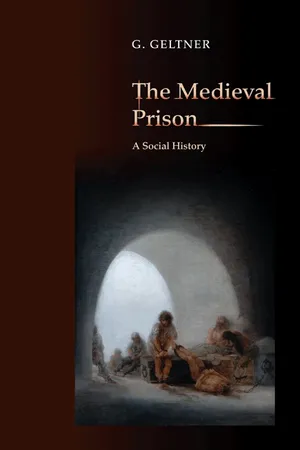
The modern prison is commonly thought to be the fruit of an Enlightenment penology that stressed man's ability to reform his soul. The Medieval Prison challenges this view by tracing the institution's emergence to a much earlier period beginning in the late thirteenth century, and in doing so provides a unique view of medieval prison life.
G. Geltner carefully reconstructs life inside the walls of prisons in medieval Venice, Florence, Bologna, and elsewhere in Europe. He argues that many enduring features of the modern prison--including administration, finance, and the classification of inmates--were already developed by the end of the fourteenth century, and that incarceration as a formal punishment was far more widespread in this period than is often realized. Geltner likewise shows that inmates in medieval prisons, unlike their modern counterparts, enjoyed frequent contact with society at large. The prison typically stood in the heart of the medieval city, and inmates were not locked away but, rather, subjected to a more coercive version of ordinary life. Geltner explores every facet of this remarkable prison experience--from the terror of an inmate's arrest to the moment of his release, escape, or death--and the ways it was viewed by contemporary observers.
The Medieval Prison rewrites penal history and reveals that medieval society did not have a "persecuting mentality" but in fact was more nuanced in defining and dealing with its marginal elements than is commonly recognized.
- 218 pages
- English
- PDF
- Available on iOS & Android
eBook - PDF
About this book
Information
Publisher
Princeton University PressYear
2018Print ISBN
9780691162058
9780691135335
eBook ISBN
9780691187686
Table of contents
- Cover
- Title Page
- Copyright Page
- CONTENTS
- List of Illustrations
- Acknowledgments
- A Note on Dates and Money
- Prologue
- Introduction
- Chapter One: Italian Prisons: Three Profiles
- Chapter Two: Aspects of Imprisonment
- Chapter Three: Prison Life
- Chapter Four: The Prison as Place and Metaphor
- Conclusion: “Marginalizing” Institutions, Instituting Marginality
- Appendix One: A Prison Inventory from Bologna, 1305
- Appendix Two: Poems from the Prison
- Appendix Three: Le Stinche, a Reconstruction
- Abbreviations and Archives
- Notes
- Bibliography
- Index
Trusted by 375,005 students
Access to over 1.5 million titles for a fair monthly price.
Study more efficiently using our study tools.
Frequently asked questions
Yes, you can cancel anytime from the Subscription tab in your account settings on the Perlego website. Your subscription will stay active until the end of your current billing period. Learn how to cancel your subscription
No, books cannot be downloaded as external files, such as PDFs, for use outside of Perlego. However, you can download books within the Perlego app for offline reading on mobile or tablet. Learn how to download books offline
Perlego offers two plans: Essential and Complete
- Essential is ideal for learners and professionals who enjoy exploring a wide range of subjects. Access the Essential Library with 800,000+ trusted titles and best-sellers across business, personal growth, and the humanities. Includes unlimited reading time and Standard Read Aloud voice.
- Complete: Perfect for advanced learners and researchers needing full, unrestricted access. Unlock 1.5M+ books across hundreds of subjects, including academic and specialized titles. The Complete Plan also includes advanced features like Premium Read Aloud and Research Assistant.
We are an online textbook subscription service, where you can get access to an entire online library for less than the price of a single book per month. With over 1.5 million books across 990+ topics, we’ve got you covered! Learn about our mission
Look out for the read-aloud symbol on your next book to see if you can listen to it. The read-aloud tool reads text aloud for you, highlighting the text as it is being read. You can pause it, speed it up and slow it down. Learn more about Read Aloud
Yes! You can use the Perlego app on both iOS and Android devices to read anytime, anywhere — even offline. Perfect for commutes or when you’re on the go.
Please note we cannot support devices running on iOS 13 and Android 7 or earlier. Learn more about using the app
Please note we cannot support devices running on iOS 13 and Android 7 or earlier. Learn more about using the app
Yes, you can access The Medieval Prison by G. Geltner in PDF and/or ePUB format, as well as other popular books in History & European Medieval History. We have over 1.5 million books available in our catalogue for you to explore.