The real history of the Amazons in war and love
Amazons—fierce warrior women dwelling on the fringes of the known world—were the mythic archenemies of the ancient Greeks. Heracles and Achilles displayed their valor in duels with Amazon queens, and the Athenians reveled in their victory over a powerful Amazon army. In historical times, Cyrus of Persia, Alexander the Great, and the Roman general Pompey tangled with Amazons.
But just who were these bold barbarian archers on horseback who gloried in fighting, hunting, and sexual freedom? Were Amazons real? In this deeply researched, wide-ranging, and lavishly illustrated book, National Book Award finalist Adrienne Mayor presents the Amazons as they have never been seen before. This is the first comprehensive account of warrior women in myth and history across the ancient world, from the Mediterranean Sea to the Great Wall of China.
Mayor tells how amazing new archaeological discoveries of battle-scarred female skeletons buried with their weapons prove that women warriors were not merely figments of the Greek imagination. Combining classical myth and art, nomad traditions, and scientific archaeology, she reveals intimate, surprising details and original insights about the lives and legends of the women known as Amazons. Provocatively arguing that a timeless search for a balance between the sexes explains the allure of the Amazons, Mayor reminds us that there were as many Amazon love stories as there were war stories. The Greeks were not the only people enchanted by Amazons—Mayor shows that warlike women of nomadic cultures inspired exciting tales in ancient Egypt, Persia, India, Central Asia, and China.
Driven by a detective's curiosity, Mayor unearths long-buried evidence and sifts fact from fiction to show how flesh-and-blood women of the Eurasian steppes were mythologized as Amazons, the equals of men. The result is likely to become a classic.
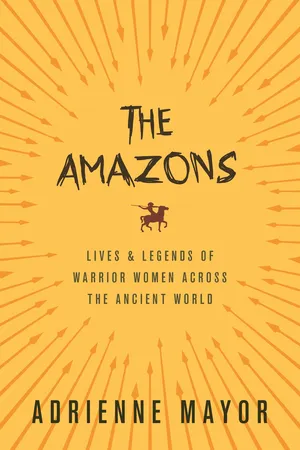
- 536 pages
- English
- ePUB (mobile friendly)
- Available on iOS & Android
eBook - ePub
About this book
Information
Publisher
Princeton University PressYear
2014Print ISBN
9780691170275
9780691147208
eBook ISBN
9781400865130
PART 1
WHO WERE THE AMAZONS?
1
ANCIENT PUZZLES AND MODERN MYTHS
In olden times, the earth thundered with the pounding of horses’ hooves. In that long ago age, women would saddle their horses, grab their lances, and ride forth with their men folk to meet the enemy in battle on the steppes. The women of that time could cut out an enemy’s heart with their swift, sharp swords. Yet they also comforted their men and harbored great love in their hearts…. After the frenzied battle, Queen Amezan leaned down from her saddle and realized in despair that the warrior she had killed was her beloved. A choking cry filled her throat: My sun has set forever!
—Caucasus tradition, Nart Saga 26
Achilles removed the brilliant helmet from the lifeless Amazon queen. Penthesilea had fought like a raging leopard in their duel at Troy. Her valor and beauty were undimmed by dust and blood. Achilles’ heart lurched with remorse and desire…. All the Greeks on the battlefield crowded around and marveled, wishing with all their hearts that their wives at home could be just like her.
—Quintus of Smyrna, The Fall of Troy
IF QUEEN AMEZAN AND QUEEN PENTHESILEA COULD somehow meet in real life, they would recognize each other as sister Amazons. Two tales, two storytellers, two sites far apart in time and place, and yet one common tradition of women who made love and war. The first tale arose outside the classical Greek world, in the northern Black Sea–Caucasus region among the descendants of the steppe nomads of Scythia. The other tale originated within the ancient Greek world, in epic poems about the legendary Trojan War. In the two traditions the male and female roles are reversed, yet the stories resonate in striking ways—sharing similar characters, dramatic battle situations, emotions, tragic themes—and even the word “Amazon.”
Recently translated from the Circassian language, the first story tells of the mythic leader of a band of women warriors, Amezan. It is one of many “Nart” sagas, oral traditions about heroes and heroines of the heart of ancient Scythian—and Amazon—territory (now southern Russia). The Caucasus tales preserve ancient Indo-European myths combined with the folk legends of Eurasian nomads, first encountered by Greeks who sailed the Black Sea in the seventh century BC. The sagas not only describe strong horsewomen who match the descriptions of Amazons in Greek myth, but they also suggest a possible Caucasian etymology for the ancient Greek loanword “amazon.”1
The second vignette, about Achilles and Penthesilea, is an episode from the archaic Trojan War epic cycles, one of which was the Iliad. Many oral traditions about Amazons were already circulating before Homer’s day, the eighth/seventh century BC, around the time when the first recognizable images of Amazons appeared in Greek art. The Iliad covered only two months of the great ten-year war with Troy. At least six other epic poems preceded or continued the events in the Iliad, but they survive only as fragments. Many other lost oral traditions about the Trojan War are alluded to the Iliad and other works, and they are illustrated in ancient art depicting Greeks fighting Amazons. The lost poem Arimaspea by the Greek traveler Aristeas (ca. 670 BC) contained Amazon stories. Another wandering poet, Magnes from Smyrna (said to be Homer’s birthplace), recited tales in Lydian about an Amazon invasion of Lydia in western Anatolia in the early seventh century BC. Some scholars suggest that there was once a freestanding epic poem about Amazons, along the lines of the Iliad, a tantalizing possibility.2
One of the lost Trojan War epics, the Aethiopis (attributed to Arctinos of Miletos, eighth/seventh century BC), was a sequel to the Iliad, taking up the action where Homer left off. The Aethiopis described the arrival of Queen Penthesilea and her band of Amazon mercenaries who came to help the Trojans fight the Greeks. Scenes from this poem were very popular in Greek vase paintings. In the third century AD, the Greek poet Quintus of Smyrna drew on the Aethiopis to retell the story of Penthesilea’s duel with the Greek champion Achilles, in his Fall of Troy, quoted in this chapter’s second epigraph.
Both of the tales quoted above—one from Scythia and the other from the Greek homeland—feature women whose fighting skills matched those of men. Their heroic exploits were imaginary, but their characters and actions arose from a common historical source: warrior cultures of the steppes where nomad horsemen and -women could experience parity at a level almost unimaginable for ancient Hellenes.
Myth and reality commingled in the Greek imagination, and as more and more details came to light about Scythian culture, the women of Scythia were explicitly identified as “Amazons.” Today’s archaeological and linguistic discoveries point to the core of reality that lay behind Greek Amazon myths. But in fact, the newfound archaeological evidence allows us to finally catch up with the ancient Greeks themselves. The Amazons of myth and the independent women of Scythia were already deeply intertwined in Greek thinking more than twenty-five hundred years before modern archaeologists and classicists began to realize that women warriors really did exist and influenced Greek traditions.
Amazons of classical literature and art arose from hazy facts elaborated by Greek mythographers and then came into sharper focus as knowledge increased. Rumors of warlike nomad societies—where a woman might win fame and glory through “manly” prowess with weapons—fascinated the Greeks. The idea of bold, resourceful women warriors, the equals of men, dwelling at the edges of the known world, inspired an outpouring of mythic stories, pitting the greatest Greek heroes against Amazon heroines from the East. Every Greek man, woman, boy, and girl knew these adventure stories by heart, stories illustrated in public and private artworks. The details of the “Amazon” lifestyle aroused speculation and debate. Many classical Greco-Roman historians, philosophers, geographers, and other writers described Amazonian-Scythian history and customs.
The early Greeks received their information about northeastern peoples from many different sources, including travelers, traders, and explorers, and from the indigenous, migrating tribes around the Black Sea, Caucasus Mountains, Caspian Sea, and Central Asia. The tribes’ accounts of themselves and culturally similar groups were transmitted (and garbled) by layers of translations over thousands of miles. Another probable source was the high population of household slaves in Greece who hailed from Thrace and the Black Sea region.3 Selection bias was a factor. Accounts of “barbarian” customs that piqued Greek curiosity or matched Greek expectations might have been chosen over others. Yet a surprising number of accurate details, confirmed by archaeology, managed to sneak through all these obstacles.
The Scythians themselves left no written records. Much of our knowledge about them comes from the art and literature of Greece and Rome. But the Scythians did leave spectacular physical evidence of their way of life for archaeologists to uncover. Dramatic excavations of tombs, bodies, and artifacts illuminate the links between the women called Amazons and the warlike horsewomen archers of the Scythian steppes. According to one leading archaeologist, “All of the legends about Amazons find their visible archaeological reflection within the grave goods” of the ancient Scythians.4 That is an overstatement, yet recent and ongoing discoveries do offer astonishing evidence of the existence of authentic women warriors whose lives matched the descriptions of Amazons in Greek myths, art, and classical histories, geographies, ethnographies, and other writings. Scythian graves do contain battle-scarred skeletons of women buried with their weapons, horses, and other possessions. Scientific bone analysis proves that women rode, hunted, and engaged in combat in the very regions where Greco-Roman mythographers and historians once located “Amazons.”
Archaeology shows that Amazons were not simply symbolic figments of the Greek imagination, as many scholars claim. Nor are Amazons unique to Greek culture, another common claim. In fact, Greeks were not the only people to spin tales about Amazon-like figures and warrior women ranging over the vast regions east of the Mediterranean. Other literate cultures, such as Persia, Egypt, India, and China, encountered warlike nomads in antiquity, and their narratives drew on their own knowledge of steppe nomads through alliances, exploration, trade, and warfare. Their heroes also fought and fell in love with Amazon-like heroines. Moreover, vestiges of the tales told in antiquity by Scythian peoples about themselves are preserved in traditional oral legends, epic poems, and stories of Central Asia, some only recently committed to writing.
Who were the Amazons? Their complex identity is enmeshed in history and imagination. To see them clearly, we first need to cast away murky symbolic interpretations and spurious popular beliefs.
POPULAR MISCONCEPTIONS
The single most notorious “fact” often used to describe Amazons is wrong. The idea that each Amazon removed one breast so that she could shoot arrows with ease is based on zero evidence. It was refuted in antiquity. Yet this bizarre belief, unique to the ancient Greeks, has persisted for more than twenty-five hundred years since it was first proposed in the fifth century BC by a Greek historian dabbling in etymology. The origins of the “single-breasted” Amazon and the controversies that still surround this false notion are so complex and fascinating that Amazon bosoms have their own chapter.
Some fallacies about Amazons can be traced to inconsistencies, gaps—and wild speculations—in the ancient Greek and Latin sources. Other modern misconceptions originate in attempts to explain Amazons solely in terms of their symbolic meaning for the Greeks, especially male Athenians.5 Conflicting claims in antiquity are still debated today, like the single-breast story. Were the Amazons a true gynocracy, a society of self-governing women living apart from men? Some pictured a tribe of man-hating virgins or domineering women who enslaved weak men and mutilated baby boys, a vision that led to speculations on how Amazon society reproduced.
AMAZONS, A TRIBE KNOWN FOR STRONG WOMEN
The notion that Amazons were hostile toward men was controversial even in antiquity. The confusion begins with their name. Linguistic evidence suggests that the earliest Greek form of the non-Greek name Amazon designated an ethnic group distinguished by a high level of equality between men and women. Rumors of such parity would have startled the Greeks, who lived according to strictly divided male and female roles. Long before the word “Scythian” or specific tribal names appeared in Greek literature, “Amazons” may have been a name for a people notorious for strong, free women.6
The earliest reference to the Amazons in Greek literature appears in Homer’s Iliad in the formulaic phrase Amazones antianeirai. Modern scholars are unanimous that the plural noun Amazones was not originally a Greek word. But it is unclear which language it was borrowed from and what its original meaning was. What is known for certain is that Amazon does not have anything to do with breasts (chapter 5 for probable origins of the name).
There is something remarkable about Homer’s earliest use of Amazones in the Iliad. The form of the name falls into the linguistic category of ethnic designations in epic poetry (another Homeric example is Myrmidones, the warriors led by Achilles at Troy). This important clue tells us that Amazones was originally a Hellenized name for “a plurality, a people,” as in Hellenes for Greeks and Trooes for the Trojans. The Greeks used distinctive feminine endings (typically -ai) for associations made up exclusively of women, such as Nymphai (Nymphs) or Trooiai for Trojan women. But Amazones does not have the feminine ending that one would expect if the group consisted only of women. Therefore, the name Amazones would originally have been “understood as … a people consisting of men and women.” As classicist Josine Blok points out in her discussion of this puzzle, without the addition of the feminine epithet antianeirai “there is no way of telling that this was a people of female warriors.”7 The inescapable conclusion is that Amazones was not a name for a women-only entity, as many have assumed. Instead Amazones once indicated an entire ethnic group.
So the earliest literary references to Amazons identified them as a nation or people, followed by antianeirai, a descriptive tag along the lines of “the Saka, Pointed Hat Wearers,” or “the Budini, Eaters of Lice.” Indeed, many ancient Greek writers do treat Amazons as a tribe of men and women. They credit the tribe with innovations such as ironworking and domestication of horses. Some early vase paintings show men fighting alongside Amazons.8
But what about the meaning of the epithet attached to Amazones? That word is slippery and complex. Antianeirai is often translated in modern times as “opposites of men,” “against men,” “opposing men,” “antagonistic to men,” or “man-hating.” In fact, however, in ancient Greek epic diction the prefix anti- did not ordinarily suggest opposition or antagonism as the English prefix “anti-” does today. Instead anti- meant “equivalent” or “matching.” Accordingly, antianeirai is best translated as “equals of men.”
Such ethnonyms, names of tribes, are typically masculine, with the understanding that the female members are included in the collective name (as in “man” for all humans or “les Indiens d’Amérique” for an entire ethnic group). But the curious formation aneirai is a unique feminine plural compound that included the Greek masculine noun “man,” aner. A parallel formation occurs in the Amazon name Deianeira, “Man-Destroyer,” in which aner is the object of the verb stem dei (destroy) with the suffix -ia. If there had been a group of women named thus, the plural would...
Table of contents
- Cover Page
- Title Page
- Copyright Page
- Dedication Page
- Contents
- Illustrations
- Acknowledgments
- Prologue: Atalanta, the Greek Amazon
- Part 1: Who Were the Amazons?
- Part 2: Historical Women Warriors and Classical Traditions
- Part 3: Amazons in Greek and Roman Myth, Legend, and History
- Part 4: Beyond the Greek World
- Appendix: Names of Amazons and Warrior Women in Ancient Literature and Art from the Mediterranean to China
- Notes
- Bibliography
- Index
Trusted by 375,005 students
Access to over 1.5 million titles for a fair monthly price.
Study more efficiently using our study tools.
Frequently asked questions
Yes, you can cancel anytime from the Subscription tab in your account settings on the Perlego website. Your subscription will stay active until the end of your current billing period. Learn how to cancel your subscription
No, books cannot be downloaded as external files, such as PDFs, for use outside of Perlego. However, you can download books within the Perlego app for offline reading on mobile or tablet. Learn how to download books offline
We are an online textbook subscription service, where you can get access to an entire online library for less than the price of a single book per month. With over 1.5 million books across 990+ topics, we’ve got you covered! Learn about our mission
Look out for the read-aloud symbol on your next book to see if you can listen to it. The read-aloud tool reads text aloud for you, highlighting the text as it is being read. You can pause it, speed it up and slow it down. Learn more about Read Aloud
Yes! You can use the Perlego app on both iOS and Android devices to read anytime, anywhere — even offline. Perfect for commutes or when you’re on the go.
Please note we cannot support devices running on iOS 13 and Android 7 or earlier. Learn more about using the app
Please note we cannot support devices running on iOS 13 and Android 7 or earlier. Learn more about using the app
Yes, you can access The Amazons by Adrienne Mayor in PDF and/or ePUB format, as well as other popular books in History & Ancient History. We have over 1.5 million books available in our catalogue for you to explore.