A global journey showing how philosophy can transform our biggest disagreements
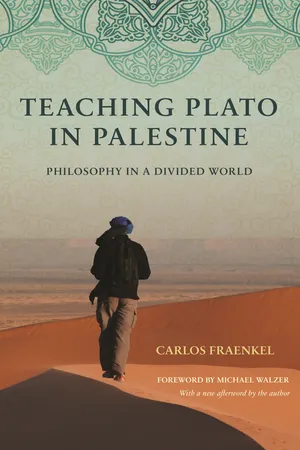
Teaching Plato in Palestine is part intellectual travelogue, part plea for integrating philosophy into our personal and public life. Philosophical toolkit in tow, Carlos Fraenkel invites readers on a tour around the world as he meets students at Palestinian and Indonesian universities, lapsed Hasidic Jews in New York, teenagers from poor neighborhoods in Brazil, and the descendants of Iroquois warriors in Canada. They turn to Plato and Aristotle, al-Ghaz?l? and Maimonides, Spinoza and Nietzsche for help to tackle big questions: Does God exist? Is piety worth it? Can violence be justified? What is social justice and how can we get there? Who should rule? And how shall we deal with the legacy of colonialism? Fraenkel shows how useful the tools of philosophy can be—particularly in places fraught with conflict—to clarify such questions and explore answers to them. In the course of the discussions, different viewpoints often clash. That's a good thing, Fraenkel argues, as long as we turn our disagreements on moral, religious, and philosophical issues into what he calls a "culture of debate." Conceived as a joint search for the truth, a culture of debate gives us a chance to examine the beliefs and values we were brought up with and often take for granted. It won't lead to easy answers, Fraenkel admits, but debate, if philosophically nuanced, is more attractive than either forcing our views on others or becoming mired in multicultural complacency—and behaving as if differences didn't matter at all.
- 240 pages
- English
- ePUB (mobile friendly)
- Available on iOS & Android
eBook - ePub
About this book
Information
Publisher
Princeton University PressYear
2016Print ISBN
9780691173368
9780691151038
eBook ISBN
9781400883493
Topic
PhilosophySubtopic
Ethics & Moral Philosophy
PART I

1
TEACHING PLATO IN PALESTINE
Can philosophy save the Middle East? It can. This, at least, is the thesis of Sari Nusseibeh as I learn from a friend upon arriving in Israel in February 2006. Nusseibeh is not only a prominent Palestinian intellectual and the Palestinian Liberation Organization’s former chief representative in Jerusalem, but also a philosopher by training (and, I think, by nature, too). “Only philosophy,” the friend tells me he argued during the Shlomo Pines memorial lecture in West Jerusalem three years before (aptly titled “On the Relevance of Philosophy in the Arab World Today”). By the time I leave Israel, I’m convinced that he’s on to something.
I am here to teach a seminar at Al-Quds University, the Palestinian university in Jerusalem, together with Nusseibeh, who has been president of Al-Quds since 1995. My idea is to discuss Plato’s political thought with the students and then examine how medieval Muslim and Jewish philosophers built on this thought to interpret Islam and Judaism as philosophical religions. I hope to raise some basic questions about philosophy and its relationship to politics and religion, and also to open a new perspective on the contemporary Middle East.
The texts, I suspect, will resonate quite differently with my Palestinian students than they do with my students in Montreal. Unfortunately, the available Arabic translations of Plato are based on Benjamin Jowett’s nineteenth-century English version, itself more a paraphrase than an accurate rendering, which translators sometimes painfully butcher. No doubt, in this respect, things have changed for the worse since the Middle Ages. From the eighth century to the tenth, excellent translations were made of Greek scientific and philosophical texts. It was an impressive achievement: one civilization appropriated the knowledge of another and turned it into the basis of its own vibrant intellectual culture. This, moreover, was not the project of some isolated intellectuals; it was a large-scale enterprise carried out under the patronage of the political, social, and economic elite of the Abbasid caliphate (the second Sunni dynasty that ruled the Muslim empire; it seized power from the Umayyads in 750).1 After the Greeks, the next significant period in the history of philosophy and science thus unfolded within Islamic civilization. Its main intellectual centers were Baghdad, the residence of the Abbasid caliphs, and al-Andalus (Muslim Spain), the last stronghold of the Umayyads.
I arrive in Jerusalem with the course syllabus, the texts, and an introductory lecture. After a few failed attempts to contact “Doctor Sari” (as Nusseibeh is called here), I decide to simply show up at his office in East Jerusalem. How well, I wonder, is my classroom fuṣḥā—the high Arabic of the Quran, the media, and literature that nobody actually speaks—going to work in the street? “Can you tell me where Al-Quds University is?” I venture to ask two passing girls. At first they look puzzled, then they giggle. “You mean Al-Uds University, right?” (The Palestinian dialect, like the Egyptian, almost always drops the “q.”) At the administrative office of “Al-Uds” University I drink a coffee with Hanan, Sari Nusseibeh’s secretary. It turns out that Doctor Sari is traveling in India and Pakistan and will be back only for the second week of classes. “So I’ll have to teach the first class alone?” I ask, a little surprised and a little worried. “I’m afraid yes,” Hanan answers. Then she prints out the information about philosophy seminar 0409438, to be taught by “Doctor Sari and Doctor Carlos.”
I choose to live in Rehavia, one of the oldest quarters in Jewish Jerusalem, known as the quarter of the professors because many European academics and intellectuals (Martin Buber, Shlomo Pines, and Gershom Scholem, among others) settled here—scholars “with a worldwide reputation,” as Israeli writer Amos Oz recalls his father whispering into his ear every time they spotted one on their walks through the neighborhood. “I thought that having a worldwide reputation was somehow related to having weak legs,” writes Oz in his memoir, “because the person in question was often an elderly man who felt his way with a stick and stumbled as he walked along.”2 Although as of yet I have neither a stick nor a worldwide reputation, I’m again renting an apartment here, having already spent three years in the neighborhood as a graduate student, each of them living on a different street: Ibn Ezra, Ben Maimon, and Alfasi. The streets in Rehavia are named after prominent Jewish scholars of another time and place: medieval thinkers whose intellectual world was decisively shaped by Islamic civilization.
The street called Rehov ben Maimon is named after Maimonides, whom many consider to be the greatest Jewish philosopher. Like Averroes, his equally famous Muslim colleague, Maimonides was born in twelfth-century Córdoba, which two centuries before had been the most sophisticated place in Europe. Maimonides and Averroes received the same philosophical-scientific education and became the last two major representatives of Arabic philosophy in medieval Spain. Averroes interpreted Islam as a philosophical religion; Maimonides did the same for Judaism. They are religions founded by philosopher-prophets that not only form the moral character of those who live according to their laws, but also direct them to the intellectual love of God—to physics, the study of God’s wisdom in nature, and to metaphysics, the study of God’s attributes.3 Maimonides wrote his philosophical works in Arabic, the idiom of science and philosophy of his time. In the instructions he left to a student about which philosophical works are worth studying, he recommends not a single Jewish author. After the Greeks, in particular Aristotle and his commentators, the philosophers he praises are all Muslims: al-Fārābī (d. ca. 950), who “excelled in wisdom,” for example, and Ibn Bājja (d. 1138), whose “treatises are all good for the person who understands.”4 Of course Maimonides does not praise them because they are Muslims, but because they are good philosophers. “One must,” he claims, “listen to al-Ḥaqq from whoever says it.”5 (Al-Ḥaqq means “the truth” in Arabic; it is also one of God’s names.) If someone proposes a definition of an animal species, explains the meaning of justice, or works out a proof for God’s existence, what matters is not whether he is Jewish, Muslim, Christian or something else, but whether what he says is true.
This is an idea I also later discuss with the five young men and three young women who signed up for the class. Does philosophy provide a language with which people can communicate even if they do not accept each other’s religious commitments? Can we say that they are able to do so because as rational beings they can understand and evaluate an argument without regard to the background of the one who makes it? After some debate, most of the students agree that this seems no less valid now than it was at the time of Maimonides and Averroes. They also point to a genre of apologetic literature widespread in the Islamic world today: books that through interpretation locate modern scientific insights in verses of the Quran without regard to the scientist’s background. “Can you give me an example?” I ask. “For example, the theory of relativity,” Ahmed answers. Einstein, I remind them, was Jewish and had been offered the presidency of Israel.
It is interesting to note in this context that Nusseibeh himself taught Islamic philosophy at the Hebrew University in 1979–80. Promoting collaboration with Israeli universities is important to him. In reaction to the boycott of Israeli academic institutions declared by the British Association of University Teachers in 2005, Nusseibeh signed a joint statement with Menachem Magidor, the president of the Hebrew University, in which they “insist on continuing to work together in the pursuit of knowledge.”6 On the Palestinian side, this stance meets with little appreciation. A week before I leave, Nusseibeh tells me about a declaration by the Palestinian Union of University Teachers that he should be dismissed from Al-Quds for “normalizing ties with Israel” and “serving Israeli propaganda interests.” “The next thing,” he tells me, “is that they will put me on trial.” It’s not the first attempt to ostracize him. Among the more absurd rumors I hear on campus is that he maintains his position only because the Israeli Security Service, the Shin Bet, protects him. (In 1991, in fact, he was briefly jailed by the Shin Bet for allegedly telling the Iraqi ambassador to Tunisia on the phone where in Israel Saddam Hussein’s Scud missiles landed!)7
The controversy about Nusseibeh’s commitment to speaking with the “enemy” is old. In 1987, he was severely beaten after helping to arrange the first meeting between PLO members and members of Israel’s right-wing Likud. The masked aggressors belonged to his own political party, the Fataḥ faction of the PLO. The beating occurred on the campus of Birzeit University, near Ramallah, where he was a professor of philosophy, after a lecture on John Locke, liberalism, and tolerance.8 (So it’s not surprising that I never see him without his bodyguards. They inspect the classroom before he comes in and guard the door during class.) The controversy reached a climax after Nusseibeh claimed in an article (“What Next?”) that “all rational people” in the region must admit that peace can be achieved only under three conditions: that Israel withdraws to the 1967 borders, that Palestinians concede the right to return to Israel, and that both sides agree on a shared government of Jerusalem.9 This position underlies a further joint effort: the proposal for a resolution of the Israeli-Palestinian conflict that he signed in 2002 with Ami Ayalon, the former head of the Shin Bet.10 Saying in public that reason demands that the land be shared made Nusseibeh (whose mother’s family lost everything in the 1948 war) a traitor in the eyes of many Palestinians.11
My first class is scheduled for the same Saturday as the first session of the new Palestinian Parliament, in which Hamas has an absolute majority (a most unwelcome surprise for Israel and the West, although a legitimate democratic decision). In the end the Parliament convenes, but the class is cancelled. Al-Quds University is on strike because salaries have not been paid. For now the more basic needs of material life have halted the dissemination of wisdom.
I try to set up a first meeting with Nusseibeh, who has returned from his travels to mediate the strike. I call his secretary, who informs me that he’s in a meeting and gives me the number of his assistant, who likewise informs me that he’s in a meeting and gives me the number of another assistant, who again informs me that he’s in a meeting. But it pays to be persistent. The secretary calls me back; we arrange (what else?) a meeting at Nusseibeh’s office. He holds lots of meetings. The administration of the university is not a light burden; it does not leave much time for philosophy. “But I’ve found ways to integrate the two,” he explains, “by analyzing philosophically the problems I encounter every day.” Administering Al-Quds under the present circumstances is a permanent exercise in practical reasoning. “Nothing is predictable,” he says. That’s the challenge that keeps him going. “If things would work just fine I’d be happy to go back to a life of contemplation.” It makes him a bit jealous when I tell him that I’m sometimes bored with too much time for contemplation in peaceful Montreal. But he hasn’t given up on inquiring into God and nature. At age fifty-seven, he says, “I do want to understand for myself how it all hangs together before the end.”
During the meeting (and also later in class) the prayer beads of a subḥa run through his fingers—not, I think, because he’s reciting al-asmāʾ al-ḥusnā (the “Beautiful Names,” or ninety-nine names of God). It looks more like a way to relieve tension, like the cigarettes he chainsmokes. He remains silent while his son, Absal, and Huda Imam, the director of the Center for Jerusalem Studies, relate in detail how, on the way back to Jerusalem from a poetry reading in Ramallah, they were interrogated for hours by Israeli soldiers. Despite Nusseibeh’s silence, the complaints about Israeli soldiers’ behavior at roadblocks are a recurring theme throughout my stay. For the Palestinians this is a particularly painful experience of the imbalance of power. (More than half of the students miss the class after Israel’s Independence Day. Because it is the most symbolic time for attacks, control is correspondingly tight.)
A week later the strike ends and classes begin. Getting to the campus at Abu Dis, a suburb of East Jerusalem, turns out to be a challenge in itself. (Al-Quds also has a campus in the Old City; the problem is that Israel doesn’t let the students from the territories cross the border.) It’s only ten minutes away from the center of East Jerusalem, but now you need to take two taxis to get there: the first brings you as far as al-jidār, the controversial separation wall Israel is building. A massive, nearly five-meter-high piece of this construction suddenly grows out of the street. Nasr, an employee of the university’s administration, shows me how to climb over a neighboring garden wall to the other side of al-jidār. We wait for a moment while a group coming the opposite way makes it safely to our side. When it’s our turn, I’m warned to be careful. (Rehavia scholars with weak legs and worldwide reputations would run into difficulties here, I’m afraid.) From there, a second taxi takes you to the university.
At our first class meeting I don’t get very far with my prepared introduction. After a couple of sentences, Nusseibeh interrupts me, asks critical questions, and presents arguments for the contrary position. The students are confused—precisely the effect he’s intended. He aims to get them thinking, not just writing down Dr. Carlos’s words of wisdom, and there’s no better way to achieve that than by having two professors disagree in the classroom.
Nusseibeh likes to challenge the students’ intellectual habits. During the semester visiting lectures are presented by several top scholars and artists, such as Joseph Raz, a leading philosopher of law, and theater director Peter Brook, who brings in his troupe from the Bouffes du Nord theater in Paris to stage a South African play—half comedy, half tragedy—about life under apartheid. “Ideally I would like to see the students travel and discover the world for themselves,” Nusseibeh tells me, “spend a month in Florence, learning Italian, visiting art galleries and monuments, and reading Italian literature.” But these students cannot even get to Jerusalem or Gaza. So he tries his best to bring the world to Abu Dis.
At first view, much here seems adverse to a life of contemplation. I wonder, though, if the permanent state of collision, affecting all aspects of life, might not ignite philosophical inquiry into concepts like justice, rights, power, and so forth. Couldn’t clarifying these concepts help navigate the conflict and move toward a solution? I left Jerusalem after completing my doctorate in 2000, shortly before Arafat, Barak, and Clinton met at Camp David. Back then there was real optimism; the solution of the conflict seemed possible—it was actually poised to happen. In the end, distrust prevailed. Now, in order to eat lunch at the Hebrew University, I have to pass a fourfold control: at the entrance to the university a guard inspects the bus looking for suspicious passengers; after I leave the bus, another guard checks my passport and the letter attesting that I’m a visiting scholar; next my bag is examined and I’m given an electronic body check; finally my bag is examined again at the entrance to the student restaurant. About five young security officers participate in the procedures. At my last visit, more than three years ago, only one old man briefly looked at the bag and asked, “Are you armed?”
The first text we look at is Plato’s Apology, discussing Socrates’s claim that “it is the greatest good for man to talk about virtue every day and those other things about which you hear me testing myself and others; for the unexamined life is not worth living.”12 (Even Socrates’s excitement about the afterlife stems from the opportunity it will offer to “examine” the great poets and heroes of the Greek past!)13 Socrates’s idea of a good time sounds as strange to my Palestinian students as it does to my students in Montreal. What does Socrates mean by the “examined life,” and why is it so important? I suggest to them that in Socrates’s view living a virtuous life depends on grounding one’s life on knowledge. In order to act justly, for example, you must understand justice. “Why can’t we rely on the notion of justice transmitted by religion?” Shirin, one of the students, asks. “Can you be sure that this notion is correct without examining it?” I ask in reply. We go through some standard examples from the Israeli-Palestinian conflict, where things were done that the agents claimed to be just and religiously motivated, but whose justice is obviously doubtful: from Baruch Goldstein’s 1994 massacre of Palestinians in Hebron and the assassination of Yitzhak Rabin by Yigal Amir in 1995, to the 2002 suicide bombing at Rehavia’s Café Moment where I’d often gone for dinner or drinks as a graduate student.
To illustrate what may have led someone like Socrates to question traditional moral norms, I recount a friend’s description of the beginning of her philosophical quest. She was born into a Jewish family in Jerusalem. Her father worked full-time, and when she was three months old, her mother returned to her work as a flight attendant. With her mother gone f...
Table of contents
- Cover Page
- Title Page
- Copyright Page
- Dedication Page
- Contents
- Foreword
- Preface
- Part I
- Part II
- Afterword to the Paperback Edition
- Acknowledgments
- Notes
- Bibliography
- Index
Trusted by 375,005 students
Access to over 1.5 million titles for a fair monthly price.
Study more efficiently using our study tools.
Frequently asked questions
Yes, you can cancel anytime from the Subscription tab in your account settings on the Perlego website. Your subscription will stay active until the end of your current billing period. Learn how to cancel your subscription
No, books cannot be downloaded as external files, such as PDFs, for use outside of Perlego. However, you can download books within the Perlego app for offline reading on mobile or tablet. Learn how to download books offline
Perlego offers two plans: Essential and Complete
- Essential is ideal for learners and professionals who enjoy exploring a wide range of subjects. Access the Essential Library with 800,000+ trusted titles and best-sellers across business, personal growth, and the humanities. Includes unlimited reading time and Standard Read Aloud voice.
- Complete: Perfect for advanced learners and researchers needing full, unrestricted access. Unlock 1.5M+ books across hundreds of subjects, including academic and specialized titles. The Complete Plan also includes advanced features like Premium Read Aloud and Research Assistant.
We are an online textbook subscription service, where you can get access to an entire online library for less than the price of a single book per month. With over 1.5 million books across 990+ topics, we’ve got you covered! Learn about our mission
Look out for the read-aloud symbol on your next book to see if you can listen to it. The read-aloud tool reads text aloud for you, highlighting the text as it is being read. You can pause it, speed it up and slow it down. Learn more about Read Aloud
Yes! You can use the Perlego app on both iOS and Android devices to read anytime, anywhere — even offline. Perfect for commutes or when you’re on the go.
Please note we cannot support devices running on iOS 13 and Android 7 or earlier. Learn more about using the app
Please note we cannot support devices running on iOS 13 and Android 7 or earlier. Learn more about using the app
Yes, you can access Teaching Plato in Palestine by Carlos Fraenkel in PDF and/or ePUB format, as well as other popular books in Philosophy & Ethics & Moral Philosophy. We have over 1.5 million books available in our catalogue for you to explore.