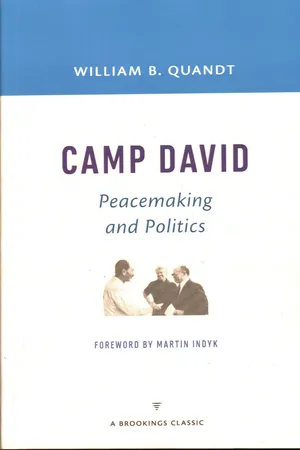
In September 1978, William Quandt, a member of the White House National Security Council staff, spent thirteen momentous days at Camp David, the presidential retreat in Maryland, where three world leaders were holding secret negotiations. When U.S. President Jimmy Carter, Egyptian President Anwar Sadat, and Israeli Prime Minister Menachem Begin emerged on September 17, they announced a monumental accomplishment: the first peace agreement between Israel and one of its Arab neighbors.
Praised by some for laying the foundations for peace between Egypt and Israel, the accords have also been criticized for failing to achieve a comprehensive settlement, including a resolution of the Palestinian question. But supporters and critics alike recognize the importance of what happened at Camp David, and both groups acknowledge the vital role played by the United States in reaching an agreement.
There are few eyewitness accounts of the Camp David negotiations. Of the three leaders present, only Jimmy Carter wrote specifically of the talks in Keeping Faith: Memoirs of a President (1982). Neither Sadat nor Begin ever wrote about Camp David.
Quandt's book is not only an eyewitness account but a scholar's reconstruction of the event, with insights into the people, politics, and policies. His Camp David has provided a comprehensive and lasting guide to the difficult negotiations surrounding the talks, including the fraught scenario leading up to the meetings at the presidential retreat and the accord that would lead to Sadat and Begin jointly receiving the 1978 Nobel Peace Prize.
Praise for Camp David: Peacemaking and Politics ""The most authoritative account of a major historic event, written with scrupulous scholarship by a key behind-the-scenes participant."" —Zbigniew Brzezinski, Adviser to the President for National Security Affairs, 1977–81
""An excellent piece of work... will represent a major contribution to the academic literature on American Middle East policy during the Carter administration. No one but Bill Quandt could, in my view, write so knowledgeable, yet so judiciously balanced, an account."" —Hermann Frederick Eilts, Director, Boston University Center for International Relations, and ambassador to Egypt, 1973–79
""Quandt writes as a participant in the process and as a thoughtful, proven scholar, an expert on international diplomacy and on the Middle East."" — Foreign Affairs
- 538 pages
- English
- ePUB (mobile friendly)
- Available on iOS & Android
eBook - ePub
About this book
Information
INDEX
Aaron, David, 200
Abd al-Magid, Ismat, 163
Administrative Council (Palestinian self-governing authority), 160–61, 206, 253, 393, 422, 446n24
Afghanistan, 26, 29
Aid programs, Saudi Arabia to Egypt, 280, 458n15
Aid programs, U.S.: bilateral commitments, 304; to Egypt, 325; to Israel, 8, 41, 72–73, 85, 324; to Middle East, 348; settlements and, 306; Sinai withdrawal and, 288. See also Arms sales, U.S.
Airborne warning and control system (AWACS), 21
Aircraft. See Arms sales, U.S.
Airfields: Camp David Accords on, 262; Israeli withdrawal from, 233, 243, 244; in Negev, 248, 286; in Sinai, 228, 247, 309; U.S. aid to Israel for, 324; as U.S. buffer, 249; U.S.-Israeli, 272, 275
Al-Arish, Sinai, Israeli withdrawal from, 204, 206, 208, 282
Algerian National Liberation Front, 48
Ali, Kamal Hassan, 279, 282, 290
Allon, Yigal, 43
Ambassadors, exchange of: Carter on, 316, 319; discussion of, with Sadat, 215, 216; linkage issue and, 306; negotiations over, 282–83, 295–96; possibility of, in Camp David Accords, 265; Sadat on, 53, 244, 277, 324; summit proposal on, 238; timing of, 290, 291, 304
American Israel Public Affairs Committee, 71. See also Jews, American
Arabi, Nabil al-, 452n12
Arab-Israeli wars: Arab territory seized during, 215; Begin on, 81; Carter on, 59–60; Carter's attention to, 4; cease-fires, 22, 107; electoral cycles and, 9–11; June 1967, 19, 34; October 1973, 34, 79; Operation Litani, 188; U.S. policy on, 34–35, 64. See also names of wars and regions
Arab League, 90, 127, 285, 289, 441n6
Arabs: Arab League, 127, 285, 289; Arafat, pressure on, 105; Baghdad summit, 268, 283, 288–89; Camp David Accords and, 268, 270; Egypt and, 156, 277; Geneva conference and, 44–45, 76, 81–82, 91, 95, 116–20, 124–25, 129; Iran revolution and, 301; Israel, recognition of, 64, 72; land ownership, in Israel, 160; moderate coalitions, 1, 39, 69, 74, 85; Muslim militancy, 347; nationalism, 58; negativity, U.S. response to, 275; peace treaty and, 301, 323, 340–41; Reagan administration and, 340–41; regional economic development, 59; United States and, 35, 345–51; U.S.-Israeli Working Paper and, 133, 142, 146, 157; as West Bank and Gaza trustees, 72, 92, 96, 105. See also Palestinians; names of specific countries and rulers
Arafat, Yasir: Camp David Accords, opposition to, 340; Camp David II with,...
Table of contents
- Cover Page
- Title Page
- Copyright Page
- Dedication Page
- Contents
- Foreword
- Preface to the Classic Edition
- Authors Preface
- One - Introduction
- Two - American Politics and Foreign Policy
- Three - Getting Started, Getting Acquainted
- Four - Meeting Menachem Begin
- Five - The Unraveling of the Grand Design
- Six - Changing Course
- Seven - Inching toward Camp David
- Eight - The First Ten Days
- Nine - Success
- Ten - Interpretations
- Eleven - The Treaty
- Twelve - Conclusion
- Appendixes
- Chronology
- Notes
- Bibliography
- Index
- Back Cover
Trusted by 375,005 students
Access to over 1.5 million titles for a fair monthly price.
Study more efficiently using our study tools.
Frequently asked questions
Yes, you can cancel anytime from the Subscription tab in your account settings on the Perlego website. Your subscription will stay active until the end of your current billing period. Learn how to cancel your subscription
No, books cannot be downloaded as external files, such as PDFs, for use outside of Perlego. However, you can download books within the Perlego app for offline reading on mobile or tablet. Learn how to download books offline
Perlego offers two plans: Essential and Complete
- Essential is ideal for learners and professionals who enjoy exploring a wide range of subjects. Access the Essential Library with 800,000+ trusted titles and best-sellers across business, personal growth, and the humanities. Includes unlimited reading time and Standard Read Aloud voice.
- Complete: Perfect for advanced learners and researchers needing full, unrestricted access. Unlock 1.5M+ books across hundreds of subjects, including academic and specialized titles. The Complete Plan also includes advanced features like Premium Read Aloud and Research Assistant.
We are an online textbook subscription service, where you can get access to an entire online library for less than the price of a single book per month. With over 1.5 million books across 990+ topics, we’ve got you covered! Learn about our mission
Look out for the read-aloud symbol on your next book to see if you can listen to it. The read-aloud tool reads text aloud for you, highlighting the text as it is being read. You can pause it, speed it up and slow it down. Learn more about Read Aloud
Yes! You can use the Perlego app on both iOS and Android devices to read anytime, anywhere — even offline. Perfect for commutes or when you’re on the go.
Please note we cannot support devices running on iOS 13 and Android 7 or earlier. Learn more about using the app
Please note we cannot support devices running on iOS 13 and Android 7 or earlier. Learn more about using the app
Yes, you can access Camp David by William B. Quandt in PDF and/or ePUB format, as well as other popular books in History & 20th Century History. We have over 1.5 million books available in our catalogue for you to explore.