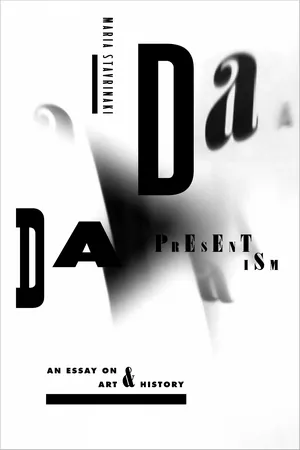
Dada is often celebrated for its strategies of shock and opposition, but in Dada Presentism, Maria Stavrinaki provides a new picture of Dada art and writings as a lucid reflection on history and the role of art within it. The original (Berlin-based) Dadaists' acute historical consciousness and their modern experience of time, she contends, anticipated the formulations of major historians such as Reinhart Koselleck and, more recently, François Hartog. The book explores Dada temporalities and concepts of history in works of art, artistic discourse, and in the photographs of the Berlin Dada movement. These photographs—including the famous one of the First International Dada Fair—are presented not as simple, transparent documents, but as formal deployments conforming to a very concrete theory of history. This approach allows Stavrinaki to link Dada to more contemporary artistic movements and practices interested in history and the archive. At the same time, she investigates what seems to be a real oxymoron of the movement: its simultaneous claim to the ephemeral and its compulsive writing of its own history. In this way, Dada Presentism also interrogates the limits between history and fiction.
- 120 pages
- English
- ePUB (mobile friendly)
- Available on iOS & Android
eBook - ePub
About this book
Information
Publisher
Stanford University PressYear
2016Print ISBN
9780804798129
9780804794244
eBook ISBN
9780804798150
NOTES
Introduction
1. Oscar Wilde, “The Decay of Lying” (1891), in Wilde, Intentions, 42.
2. Woolf, Orlando, 235.
3. Woolf, Orlando, 307.
4. Woolf, Orlando, 219.
I
1. Huelsenbeck, “En Avant Dada,” 40. Originally published as En Avant Dada: Eine Geschichte des Dadaismus (Hanover: Paul Steegemann Verlag, 1920).
2. Koselleck, Futures Past, 22.
3. See Walter Benjamin, “Experience and Poverty,” in Benjamin, Selected Writings, 2: 731–36.
4. Of course, postwar Futurism did not create projects for building “cathedrals” as Expressionism did; the reference here is synecdochical. The understanding of apocalypse held by both the Expressionists and the Futurists caused them to envision a total and coherent construction of reality after the catastrophe, even if, for one, the model was in the past, and for the other, in the future.
5. Huelsenbeck, “Dadaco,” 99.
6. According to Huelsenbeck, this was in contrast to the Latin nations, whose “tradition” provided succor in troubled times; he referred to France’s many “returns to order.” This contrast between the weighty tradition of the Latins and the painful, though potentially productive and even salutary, nonexistence of the Germans as such is a constant in German aesthetic and philosophical thought. See Lacoue-Labarthe, “Histoire et mimésis.” The English translation is Lacoue-Labarthe, “History and Mimesis,” 209–30.
7. “They overlook that the basic instinct of all the laws in the world has stayed the same” (Huelsenbeck, “Dadaco,” 103).
8. Hartog, Regimes of Historicity, 17–18.
9. The expression “regimes of historicity” was coined by Hartog, who saw it as a heuristic tool “that can help us reach a better understanding not of time itself—of all times or the whole of time—but principally of moments of crisis of time, as they have arisen whenever the way in which past, present, and future are articulated no longer seems self-evident” (Hartog, Regimes of Historicity, 16).
10. Walter Benjamin, “Theses on the Philosophy of History,” in Benjamin, Illuminations, 261, para. xiv; 262, para. xvi.
11. Huelsenbeck, “Dadaco,” 102.
12. Koselleck explained historicism and the philosophy of history as two sides of the same coin: excess of future for one, excess of past—as reaction—for the other.
13. Hausmann, “Dada in Europa,” 93.
14. See H. White, “Burden of History.”
15. Pinthus, “Rede für die Zukunft,” 1: 411. This conception of the past as a dead entity did not entirely dominate Expressionist thought. For Ernst Bloch—whose admiration for the movement is well-known and whose book The Spirit of Utopia is in many respects an Expressionist declaration of faith—the past is never entirely dead but rather contains an unachieved potential, which the spirit of utopia must catch hold of.
16. Siegfried Kracauer, “Über den Expressionismus: Wesen und Sinn einer Zeitbewegung” (1918), cited in Frisby, “Social Theory,” 104.
17. Pinthus, “Rede für die Zukunft,” 411.
18. Pinthus, “Rede für die Zukunft,” 411.
19. Pascal, Pensées, 16.
20. By “Expressionism” I do not mean only German Expressionism, as is often the case, but rather, in keeping with the different definitions of the term at the time, all the European movements that converged around the principle of the semiotic equivalence of but substantial difference between art and nature; in addition, all these movements were hesitant to make the leap into abstraction. On the term expressionism, see Gordon, “Origin of the Word”; Werenskiold, Concept of Expressionism; and von Wiese, “Tempest.” On the conflicting, outstretched nature of Expressionism, see Lebensztejn, “Douane-Zoll.” On the tension inherent in apocalyptic temporality, see Stavrinaki, “L’empathie est l’abstraction”; and Stavrinaki, “Messianic Pains.”
21. Marc, “Subscription Prospectus,” 47.
22. Kandinsky, “Preface,” 257.
23. See Reinhart Koselleck, “‘Space of Experience’ and ‘Horizon of Expectation’: Two Historical Categories,” in Koselleck, Futures Past, 255–75.
24. Kandinsky, Concerning the Spiritual, 19.
25. Hilberseimer, “Anmerkungen zur neuen Kunst.” A complete English translation of this article can be found in Tafuri, “U.S.S.R.–Berlin 1922,” 180n89. On Hilberseimer’s interpretation of Dada, see Hays, Modernism.
26. Jakobson, “Dada,” 39.
27. Huelsenbeck, “En Avant Dada,” 27.
28. Ball, Flight, 57 (30.III).
29. See the card “George Grosz und John Heartfield wünschen ein frohes Neujahr 1921,” reproduced in Bergius, Dada Triumphs, Figure 10. In 1922, Georg Scholz clearly formulated the decision to render all modes of plastic expression—whether high or low, ancient or modern—simultaneously: “All the modes of pictorial representation that are available to average Europeans such as ourselves—who are fully conscious of the history of all epochs and all countries, must be taken into account, including kitsch in the sense of pictorial postcards and photographic paintings” (Scholz, “Die wahre Phantasie,” 97–98).
30. Nietzsche, Beyond Good and Evil, 125.
31. Huelsenbeck, “Introduction,” 14.
32. For more on the forms of Dadaist primitivism, a subject that merits extensive exploration, see Ubl, “Wilhelm Worringer”; and Dickerman, “Zurich.”
33. Hugo Ball wrote on the subject of Arp’s abstraction that “when he advocates the primitive, he means the first abstract sketch that is aware of complexities but avoids them” (Ball, Flight, 53 [1.III]). Tristan Tzara wrote, “The influences modern painting hopes to have are among the best: calm, tranquility. Painters are moving toward an impersonal, anonymous art, and see it as medicine against human cruelty, when the angels are liquefied in a Christmas tree” (Tzara, “Note 1,” in his Oeuvres complètes, 1: 554).
34. “Naïve” in the sense of Friedrich Schiller’s essay “On Naïve and Sentimental Poetry” (1795–1796), in Schiller, Naïve and Sentimental Poetry.
35. Ball, Flight, 65 (2.VI).
36. Ball, Flight, 53 (1.III).
37. See Poley, Hans Arp.
38. Arp, Unsern täglichen Traum, 24.
39. “A world of abstract demons engulfed personal expression, swallowed individual faces into masks as tall as towers, swallowed private expression, stripped things of their names, destroyed the Self, and roused oceans of passions against each other” (Ball, “Kandinsky,” 14).
40. “This humiliating age has not succeeded in winning our respect. What could be respectable and impressive about it? Its cannons? Our big drum drowns them” (Ball, Flight, 61 [14.IV]).
41. See Tzara’s poems in his Oeuvres complètes, vol. 1.
42. See Stavrinaki, “Hugo Ball.”
43. Hal Foster analyzed Hugo Ball’s excessive mimesis as a way of adapting to the world. See Foster, “Dada Mime.”
44. For more on mimesis as therapy for the traumatic experience of war among the Berlin Dadaists (and Georg Grosz in particular), see Doherty, “We Are All Neurasthenics.”
45. Having said that, Jill Lloyd has shown that the primitive and the modern were i...
Table of contents
- Cover
- Copyright
- Title Page
- Dedication
- Contents
- Acknowledgments
- Introduction: Orlando
- I. Posthistory and Prehistory
- II. The Present as Reproducible Time
- III. Art’s Efficacy or Dada’s Use Value
- IV. The Moment of Decision: The Future-from-Now
- V. The Paradigm of Immaculate Conception: Between Fiction and History
- Notes
- Bibliography
- Index
Trusted by 375,005 students
Access to over 1.5 million titles for a fair monthly price.
Study more efficiently using our study tools.
Frequently asked questions
Yes, you can cancel anytime from the Subscription tab in your account settings on the Perlego website. Your subscription will stay active until the end of your current billing period. Learn how to cancel your subscription
No, books cannot be downloaded as external files, such as PDFs, for use outside of Perlego. However, you can download books within the Perlego app for offline reading on mobile or tablet. Learn how to download books offline
Perlego offers two plans: Essential and Complete
- Essential is ideal for learners and professionals who enjoy exploring a wide range of subjects. Access the Essential Library with 800,000+ trusted titles and best-sellers across business, personal growth, and the humanities. Includes unlimited reading time and Standard Read Aloud voice.
- Complete: Perfect for advanced learners and researchers needing full, unrestricted access. Unlock 1.5M+ books across hundreds of subjects, including academic and specialized titles. The Complete Plan also includes advanced features like Premium Read Aloud and Research Assistant.
We are an online textbook subscription service, where you can get access to an entire online library for less than the price of a single book per month. With over 1.5 million books across 990+ topics, we’ve got you covered! Learn about our mission
Look out for the read-aloud symbol on your next book to see if you can listen to it. The read-aloud tool reads text aloud for you, highlighting the text as it is being read. You can pause it, speed it up and slow it down. Learn more about Read Aloud
Yes! You can use the Perlego app on both iOS and Android devices to read anytime, anywhere — even offline. Perfect for commutes or when you’re on the go.
Please note we cannot support devices running on iOS 13 and Android 7 or earlier. Learn more about using the app
Please note we cannot support devices running on iOS 13 and Android 7 or earlier. Learn more about using the app
Yes, you can access Dada Presentism by Maria Stavrinaki in PDF and/or ePUB format, as well as other popular books in Art & Art Theory & Criticism. We have over 1.5 million books available in our catalogue for you to explore.