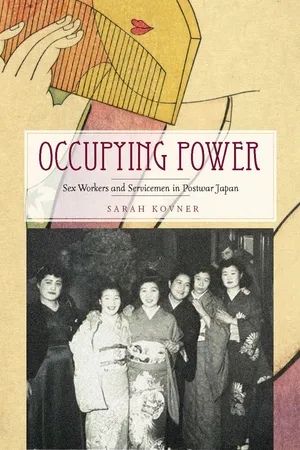
Occupying Power
eBook - ePub

Occupying Power

Sex Workers and Servicemen in Postwar Japan

  1. 240 pages
  2. English
  3. ePUB (mobile friendly)
  4. Available on iOS & Android
eBook - ePub

Occupying Power

Sex Workers and Servicemen in Postwar Japan

About this book

The year was 1945. Hundreds of thousands of Allied troops poured into war-torn Japan and spread throughout the country. The effect of this influx on the local population did not lessen in the years following the war's end. In fact, the presence of foreign servicemen also heightened the visibility of certain others, particularly panpan—streetwalkers—who were objects of their desire.

Occupying Power shows how intimate histories and international relations are interconnected in ways scholars have only begun to explore. Sex workers who catered to servicemen were integral to the postwar economic recovery, yet they were nonetheless blamed for increases in venereal disease and charged with diluting the Japanese race by producing mixed-race offspring. In 1956, Japan passed its first national law against prostitution, which produced an unanticipated effect. By ending a centuries-old tradition of sex work regulation, it made sex workers less visible and more vulnerable. This probing history reveals an important but underexplored aspect of the Japanese occupation and its effect on gender and society. It shifts the terms of debate on a number of controversies, including Japan's history of forced sexual slavery, rape accusations against U.S. servicemen, opposition to U.S. overseas bases, and sexual trafficking.

Frequently asked questions

Yes, you can cancel anytime from the Subscription tab in your account settings on the Perlego website. Your subscription will stay active until the end of your current billing period. Learn how to cancel your subscription.
No, books cannot be downloaded as external files, such as PDFs, for use outside of Perlego. However, you can download books within the Perlego app for offline reading on mobile or tablet. Learn more here.
Perlego offers two plans: Essential and Complete
  • Essential is ideal for learners and professionals who enjoy exploring a wide range of subjects. Access the Essential Library with 800,000+ trusted titles and best-sellers across business, personal growth, and the humanities. Includes unlimited reading time and Standard Read Aloud voice.
  • Complete: Perfect for advanced learners and researchers needing full, unrestricted access. Unlock 1.4M+ books across hundreds of subjects, including academic and specialized titles. The Complete Plan also includes advanced features like Premium Read Aloud and Research Assistant.
Both plans are available with monthly, semester, or annual billing cycles.
We are an online textbook subscription service, where you can get access to an entire online library for less than the price of a single book per month. With over 1 million books across 1000+ topics, we’ve got you covered! Learn more here.
Look out for the read-aloud symbol on your next book to see if you can listen to it. The read-aloud tool reads text aloud for you, highlighting the text as it is being read. You can pause it, speed it up and slow it down. Learn more here.
Yes! You can use the Perlego app on both iOS or Android devices to read anytime, anywhere — even offline. Perfect for commutes or when you’re on the go.
Please note we cannot support devices running on iOS 13 and Android 7 or earlier. Learn more about using the app.
Yes, you can access Occupying Power by Sarah Kovner in PDF and/or ePUB format, as well as other popular books in History & Japanese History. We have over one million books available in our catalogue for you to explore.

Information

Table of contents

  1. Cover
  2. Copyright
  3. Title Page
  4. Dedication
  5. Contents
  6. Acknowledgments
  7. A Note on Names and Nomenclature
  8. Introduction: A Special Business
  9. 1. “To Transship Them to Some Suitable Island”: Making Policy in the Midst of Chaos
  10. 2. Violence, Commerce, Marriage
  11. 3. When Flesh Glittered: Selling Sex in Sasebo and Tokyo
  12. 4. Legislating Women: The Push for a Prostitution Prevention Law
  13. 5. The High Politics of Base Pleasures: Regulating Morality for the Postwar Era
  14. 6. The Presence of the Past: Controversies over Sex Work Since 1956
  15. Conclusion: Beyond Victimhood
  16. Appendix
  17. Notes
  18. Bibliography
  19. Index