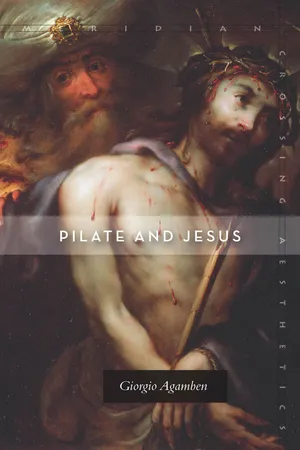
Pontius Pilate is one of the most enigmatic figures in Christian theology. The only non-Christian to be named in the Nicene Creed, he is presented as a cruel colonial overseer in secular accounts, as a conflicted judge convinced of Jesus's innocence in the Gospels, and as either a pious Christian or a virtual demon in later Christian writings. This book takes Pilate's role in the trial of Jesus as a starting point for investigating the function of legal judgment in Western society and the ways that such judgment requires us to adjudicate the competing claims of the eternal and the historical. Coming just as Agamben is bringing his decades-long Homo Sacer project to an end, Pilate and Jesus sheds considerable light on what is at stake in that series as a whole. At the same time, it stands on its own, perhaps more than any of the author's recent works. It thus serves as a perfect starting place for readers who are curious about Agamben's approach but do not know where to begin.
- 88 pages
- English
- ePUB (mobile friendly)
- Available on iOS & Android
eBook - ePub
Pilate and Jesus
About this book
Information
Publisher
Stanford University PressYear
2015Print ISBN
9780804794541
9780804792332
eBook ISBN
9780804794589
1.
The symbolon, the “creed” in which Christians summarize their faith, contains, alongside those of the “Lord Jesus Christ” and the “Virgin Mary,” a single proper name, completely extraneous—at least in appearance—to its theological context. What is more, this man is a pagan, Pontius Pilate: staurothenta te huper hēmon epi Pontiou Pilatou, “crucified for our sake under Pontius Pilate.” The “creed” that the Fathers had formulated at Nicea in 325 did not include this name. It was added in 381 by the Council of Constantinople, by all evidence in order to also fix the historical character of Jesus’s passion chronologically. “The Christian Credo,” it has been observed, “speaks of historical events. Pontius Pilate belongs there essentially. He is not just a pitiful creature who oddly ended up there” (Schmitt, 930/170).
That Christianity is a historical religion, that the “mysteries” of which it speaks are also and above all historical facts, is taken for granted. If it is true that the incarnation of Christ is “a historical event of infinite, non-appropriable, non-occupiable singularity” (ibid.), the trial of Jesus is therefore one of the key moments of human history, in which eternity has crossed into history at a decisive point. All the more urgent, then, is the task of understanding how and why this crossing between the temporal and the eternal and between the divine and the human assumed precisely the form of a krisis, that is, of a juridical trial.
2.
Why precisely Pilate? A formula of the type Tiberiou kaesaros—which one reads on the money coined by Pilate and which has in its favor the authority of Luke, who so dates John’s preaching (Luke 3:1)—or sub Tiberio (as Dante has Virgil say: “born sub Iulio,” Inferno 1.70) would certainly have been more in keeping with common usage. If the Fathers assembled at Constantinople preferred Pilate to Tiberius, the prefect—or, as Tacitus preferred to call him (Annals XV, 44), in one of the few extrabiblical testimonies that mention his name, “the procurator” of Judea—to Caesar, it is possible that over their undoubted chronographic intention there prevailed the importance that the figure of Pilate has in the narrative of the Gospels. In the punctilious attention with which John above all, but also Mark, Luke, and Matthew describe his hesitations, his evasions and changing opinion, literally relating his words, which are at times decidedly enigmatic, the evangelists reveal perhaps for the first time something like the intention to construct a character, with his own psychology and idiosyncrasies. It is the vividness of this portrait that caused Lavater to exclaim in a 1781 letter to Goethe: “I find everything in him: heaven, earth, and hell, virtue, vice, wisdom, folly, destiny, liberty: he is the symbol of all in all.” One can say, in this sense, that Pilate is perhaps the only true “character” of the Gospels (Nietzsche defined him in The Antichrist as “the only figure—Figur—of the New Testament who merits respect,” §46), a man of whom we know the passions (“he was greatly amazed,” Matthew 27:14; Mark 15:5; “he was more afraid than ever,” John 19:8), the resentment and skittishness (as when he shouts at Jesus, who is not responding to him: “Do you refuse to speak to me [emoi ou laleis]? Do you not know that I have power to release you, and power to crucify you?”), the irony (at least according to some, in the notorious reply to Jesus: “What is truth?” John 18:38), the hypocritical scruples (testimony of which is found in the raising of a question of competency with Herod as much as in the ritual washing of his hands, with which he believes he can purify himself of the blood of the just man he has condemned), and the anger (the peremptory “what I have written, I have written” to the priests who ask him to change the inscription on the cross, John 19:22). We even make a fleeting acquaintance with his wife, who during the trial sends word to him not to condemn Jesus, “for today I have suffered a great deal because of a dream about him” (Matthew 27:19).
3.
Mikhail Bulgakov, in the marvelous stories about Pilate that the devil recounts in The Master and Margarita, and Alexander Lernet-Holenia, in the grandiose theological farce inserted in The Count of Saint-Germain, both recall this vocation to become a character. But early on there is testimony, in the texts that we persist in calling New Testament “apocrypha” (the term, which has come to mean “false, nonauthentic,” in truth simply means “hidden”), to the presence of a true and proper Pilate cycle. This begins first of all in the Gospel of Nicodemus, in which the trial of Jesus is staged in a much more detailed way than in the synoptic gospels. When Jesus is introduced by Pilate, the banners that the standard bearers are holding in their hands miraculously bow down before him. In the trial twelve proselytes also intervene who testify—against the accusation that Jesus was “a son of fornication”—that Joseph and Mary entered into a legal marriage, along with Nicodemus, who also testified in favor of Jesus. In general the whole trial is dramatically rendered here as a debate between the Jewish accusers, who are named one by one (“Annas and Caiaphas, Semes, Dathaes and Gamaliel, Judas, Levi, and Nephthalim, Alexander and Jairus”; Elliott, 170) and Pilate, who often appears to be beside himself and is almost openly on Jesus’s side, also because his wife “is pious and prefers to practice Judaism with the Jews” (Elliott, 172). The dialogue with Jesus on truth, which in the canonical gospels ends abruptly with Pilate’s question, here, as we will see, continues and acquires a completely different significance. It is all the more unexpected when Pilate finally yields to the insistence of the Jews and, struck by a sudden fear, orders that Christ be flogged and crucified.
4.
The legend of Pilate (the so-called Acta or Gesta Pilati) is constituted according to two divergent lines. First there is a “white” legend, attested by the pseudepigraphal letters to Tiberius and by the Paradosis, according to which Pilate, together with his wife Procla, had comprehended Jesus’s divinity and had only yielded to the insistence of the Jews through weakness. Tertullian testifies to this legend when he writes that Pilate had been forced to have Jesus crucified by the violent pressure of the Jews (violentia suffragiorum in crucem dedi sibi extorserint), but “now in fact a Christian in his own convictions (pro sua conscientia christianus),” he had informed the emperor with a letter about Jesus’s miracles and resurrection (Apology XXI, 18–24). The Paradosis (something like the “handing over,” but also the “tradition”) of Pilate presupposes the writing of this letter (of which there exist numerous versions, obviously all false) and begins precisely with Tiberius’s indignation after reading the message (Elliott, 208–11). He has Pilate taken to Rome in chains and asks him how he could have crucified a man whom he knew to be the author of such great wonders. Pilate justifies himself by accusing the Jews and declares himself persuaded that Jesus “is greater than all the gods whom we worship” (Elliott, 210). The white legend of Pilate thus presents him, paradoxically, in some way as a secret champion of Christianity against the Jews and the pagans. Testimony of this is found in the apology that Pilate addresses to Jesus when Tiberius decides to punish him with decapitation:
Lord, do not destroy me with the wicked Hebrews, for had it not been because of the nation of the lawless Jews, I would not have raised my hand against you, because they plotted a revolt against me. You know that I acted in ignorance. Therefore do not destroy me because of this sin, but pardon me, Lord, and your servant Procla, who stands with me in this hour of my death, whom you taught to prophesy that you must be nailed to the cross. Do not condemn her also because of my sin, but pardon us and number us among your righteous ones. (Elliott, 210–11)
And when a Pilate who is by this time Christianized finishes his supplication, we hear a voice from heaven that announces his salvation:
All generations and families of the Gentiles shall call you blessed, because in your governorship everything was fulfilled which the prophets foretold about me. And you yourself shall appear as my witness at my second coming, when I shall judge the twelve tribes of Israel and those who have not confessed my name. (Elliott, 211)
At this point Pilate is decapitated, but an angel picks up his chopped-off head. Procla, at the sight of the angel who bears the head into heaven, “was filled with joy, and immediately gave up the ghost and was buried with her husband” (ibid.).
The Christianization of Pilate reaches its peak in the Gospel of Gamaliel, preserved in an Ethiopian recension. Here we read that
Pilate and his wife loved Jesus as themselves. He had him flogged to satisfy the wicked Jews, so t...
Table of contents
- Cover
- Series Page
- Title Page
- Copyright
- Contents
- Acknowledgments
- § Pilate and Jesus
- Glosses
- Bibliography
- Series List
Trusted by 375,005 students
Access to over 1.5 million titles for a fair monthly price.
Study more efficiently using our study tools.
Frequently asked questions
Yes, you can cancel anytime from the Subscription tab in your account settings on the Perlego website. Your subscription will stay active until the end of your current billing period. Learn how to cancel your subscription
No, books cannot be downloaded as external files, such as PDFs, for use outside of Perlego. However, you can download books within the Perlego app for offline reading on mobile or tablet. Learn how to download books offline
Perlego offers two plans: Essential and Complete
- Essential is ideal for learners and professionals who enjoy exploring a wide range of subjects. Access the Essential Library with 800,000+ trusted titles and best-sellers across business, personal growth, and the humanities. Includes unlimited reading time and Standard Read Aloud voice.
- Complete: Perfect for advanced learners and researchers needing full, unrestricted access. Unlock 1.5M+ books across hundreds of subjects, including academic and specialized titles. The Complete Plan also includes advanced features like Premium Read Aloud and Research Assistant.
We are an online textbook subscription service, where you can get access to an entire online library for less than the price of a single book per month. With over 1.5 million books across 990+ topics, we’ve got you covered! Learn about our mission
Look out for the read-aloud symbol on your next book to see if you can listen to it. The read-aloud tool reads text aloud for you, highlighting the text as it is being read. You can pause it, speed it up and slow it down. Learn more about Read Aloud
Yes! You can use the Perlego app on both iOS and Android devices to read anytime, anywhere — even offline. Perfect for commutes or when you’re on the go.
Please note we cannot support devices running on iOS 13 and Android 7 or earlier. Learn more about using the app
Please note we cannot support devices running on iOS 13 and Android 7 or earlier. Learn more about using the app
Yes, you can access Pilate and Jesus by Giorgio Agamben, Adam Kotsko in PDF and/or ePUB format, as well as other popular books in Philosophy & Ethics & Moral Philosophy. We have over 1.5 million books available in our catalogue for you to explore.