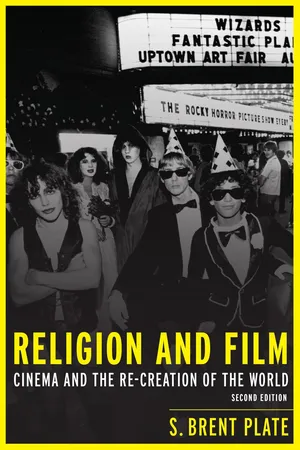
Religion and cinema share a capacity for world making, ritualizing, mythologizing, and creating sacred time and space. Through cinematography, mise-en-scène, editing, and other production activities, film takes the world "out there" and refashions it. Religion achieves similar ends by setting apart particular objects and periods of time, telling stories, and gathering people together for communal actions and concentrated focus. The result of both cinema and religious practice is a re-created world: a world of fantasy, a world of ideology, a world we long to live in, or a world we wish to avoid at all costs.
Religion and Film introduces readers to both religious studies and film studies by focusing on the formal similarities between cinema and religious practices and on the ways they each re-create the world. Explorations of film show how the cinematic experience relies on similar aesthetic devices on which religious rituals have long relied: sight, sound, the taste of food, the body, and communal experience. Meanwhile, a deeper understanding of the aesthetic nature of religious rituals can alter our understanding of film production. Utilizing terminology and theoretical insights from the study of religion as well as the study of film, Religion and Film shows that by paying attention to the ways films are constructed, we can shed new light on the ways religious myths and rituals are constructed and vice versa.
This thoroughly revised and expanded new edition is designed to appeal to the needs of courses in religion as well as film departments. In addition to two new chapters, this edition has been restructured into three distinct sections that offer students and instructors theories and methods for thinking about cinema in ways that more fully connect film studies with religious studies.
- English
- ePUB (mobile friendly)
- Available on iOS & Android
eBook - ePub
About this book
Information
Topic
Theology & ReligionSubtopic
Film History & CriticismPART I
BEFORE THE SHOW
Pulling the Curtain on the Wizard
1
AUDIO-VISUAL MYTHOLOGIZING
The penultimate scene in Tim Burton’s Big Fish (2003) reveals the truth of the tall tales told by Edward Bloom (played by Ewan McGregor and Albert Finney) over the years. To the surprise of his disbelieving son Will (Billy Crudup), as well as the viewers of the film, the scene of Edward’s funeral shows how the father’s fables actually contained within them a kernel of truth. For the most part Will, as well as the viewers, assumes he just made it all up. Early on in the film Edward recounts a story of an ostracized giant who lived in a cave on the outskirts of town and who is eventually befriended by Edward’s cheerful demeanor. Via camera angles and some computer-generated imagery, the giant, Karl (Matthew McGrory), appears at least twice the size of an average man throughout Edward’s retellings, probably at least twelve feet tall (figure 1.1).
Later on we hear the story of Edward’s stint in the army, fighting in the Korean war, where he comes upon the conjoined twins, Jing and Ping (Adai Tai and Arlene Tai), singing for the enemy troops. In the funeral scene at the end of the film, viewers are introduced to Karl through a high-angle shot that gets viewers wondering for a few seconds whether Edward’s stories were true, as Karl initially appears very tall indeed. A couple shots later there is a medium shot with the “giant” talking to other people, and it is revealed that he is no giant, just a rather tall man (figure 1.2). There really was a Karl, and he was tall, only perhaps not twelve feet tall. And a side-angle shot of the twins at the funeral at first makes it appear they are corporeally connected, but then one of them walks off with another character. Twins? Yes. Conjoined? No.

FIGURE 1.1 Still from the beginning of Big Fish. Via camera angles, Karl the giant appears at least twice the size of an average man.

FIGURE 1.2 Still from the end of Big Fish. Through a medium shot at Edward Bloom’s funeral it is revealed that Karl was indeed a very tall man, though perhaps not a “giant.”
Big Fish gets us thinking about the power of stories, the power of their fictions, and the ways they construct identities and worlds for their tellers and hearers. Furthermore, it gets us thinking about the audio-visual construction of such worlds.1 Through decidedly visual means, the stories Edward tells in Big Fish are both initially exaggerated and eventually brought back down to earth. While verbal narrative and the overall soundtrack is strong throughout the film, there is nothing verbally mentioned about the size of the giant, nor about the exact nature of the twins, yet the visual effects display Edward’s stories in larger-than-life form. The film is a tribute to storytelling, to the power of the imagination in creating identity, telling the religious-minded viewer a great deal about the importance of myth in the construction of sacred worlds. But it also shows a lot about the power of audio-visual mythologizing and its contribution to worldmaking.
With such notions in mind, this chapter explores mythologizing in the form of filmmaking, looking to the ways stories are created in and through the audio-visual medium, with particular attention to both cinematography and mise-en-scène. I discuss two mythological films, George Lucas’s Star Wars (1977) and the Wachowskis’ The Matrix (1999),2 focusing on a single scene in each in which the props, characters, framing, lighting, and overall scenario offer clues to the mythological structures given in the films as a whole. I analyze how mythological references operate in film not simply as a part of verbal narrative trajectories but also through creating a scenario in which carefully placed objects and carefully chosen characters are shown in relationship to each other on-screen, and then offered to viewers to infer deeper connections. To conclude, I return to larger theoretical questions of the relation between myth and film, with some attention to Mel Gibson’s The Passion of the Christ (2004).
MYTH AND FILM
Woven through this chapter, and picked up again in the conclusion, are two corollary questions on the relation of myth and film. First, what does an examination of film lend to the study of religion, specifically its myths? Second, how might an understanding of religious myths and world re-creation offer a more critical analysis of film than currently takes place in most film studies?
While more complete answers emerge in what follows, I suggest up front that an answer to the first question begins like this: films can show how myths operate beyond their existence as verbal stories, even as many scholars still tend to believe myths are composed of words that can simply be read and linguistically interpreted. To the contrary, myths, like films, are created in and carried out through visual, tactile, olfactory, and other sensual modes. A second part of that answer is that myths are always “mash-ups,” always assembled through bits, pieces, and found objects that have been borrowed, begged, stolen, and improvised. Film has been and continues to be a natural medium for mash-ups due to its multimedia origins in theater, photography, and focus on everyday life (Louis Lumière’s Workers Leaving the Lumière Factory [1895] and so forth). Attention to the sources of films suggests something about the sources of myths as well: both rely on establishing connections between the world out there and the world right here, and this only occurs in a mediated form, whether spoken, written, performed, or filmed.
The start of an answer to the second question would be this: thousands of years and thousands of cultural locations have provided contemporary filmmakers with a storehouse of grand stories that are endlessly adaptable into the audio-visual medium of film. Because myths are inevitably mash-ups, directors and screenwriters can cull from stories told through the ages, and told again in ever-new forms. To miss the begging, borrowing, and stealing that mythmakers/filmmakers do is to miss the compulsions of filmmaking in general to create new stories often by retelling old ones. And to deny the mythological origins of so many contemporary films is to risk denying something of the very humanity of the films as well. Unless film theorists and critics understand the power of myth, they will not understand the full power of film.
There is no space to go into extensive definitions of myth here, nor is it necessary for my interests. I start with a straightforward articulation by the historian of religions Wendy Doniger, who suggests that a myth “is a story that is sacred to and shared by a group of people who find their most important meanings in it; it is a story believed to have been composed in the past about an event in the past, or, more rarely, in the future, an event that continues to have meaning in the present because it is remembered” (1998: 2).3 Important to me, as for Doniger, is that a definition of myth must deal with the ways myths function, how they do what they do and how they do them to people. The primary functions of myths are to make meaning, make memories, and make communities.
Myths are stories loosely based on real events, or they serve as explanations of realities that are extended, enlarged, engorged, and riffed on as they are retold, like the tale of the fish that got away and every time the story is retold that fish keeps getting bigger and bigger. The moral of the big fish story is that we are all susceptible to the exaggerations of the storyteller if we were not there to witness it firsthand, and the story does not work if the fish were actually caught—for that would supply observable, tangible proof. The weird stories of humans formed from dirt, elephant-headed deities, sibling rivalries, and jealous demons all stick with us and stretch our imaginations, and we don’t always mind their untruths. Myth does not truck in scientifically verifiable proofs, which is why ancients and moderns alike have found a weakness in myth, but this is also precisely the point at which myth receives its power. It becomes “true” because it is told, because it is believed (or at least some element is believed), and more importantly, because it is acted upon.
Big Fish is not just a mundane fish story. It goes to great lengths to approximate something larger, and that is a cosmogony, an account of the creation of a world. The opening shots are from underwater, with fish swimming across the screen, and eventually the “big fish” makes its way across the film frame. The scene mimics creation stories from around the world: the Babylonian Enuma Elish begins within water associated with chaos; the chaotic waters play a critical role in the Iroquois creation story of the “woman who fell to earth”; and the Jewish-Christian account found in Genesis begins in similar fashion: “the earth was a formless void and darkness covered the face of the deep, while a wind [the spirit] from God swept over the face of the waters” (Gen. 1:2). In the beginning is water, unformed substance, potentially dangerous and potentially life-giving.
The eponymous fish in Big Fish is Edward’s own family, his own world. He is a fish who constantly needs water, while his wife Sandra (Jessica Lange) is “caught” with the glint of his wedding ring as a lure, and he ultimately catches (and soon releases) the fish on the day his son Will is born. Throughout the film, Edward’s fish stories are the stories of his world, beginning with the creation of his world (his wife and son) and ending with his own death as he returns to the water. There is an initial friction in the film between father and son, shown specifically through Will’s work as a journalist (he writes stories about “real events”) in contrast to his father’s fables. But in the end Will begins to find the power of his father’s grandiose stories through his participation in them at his father’s deathbed. Will realizes that participation in the stories is what brings life, even in and after death. Edward Bloom helped create his world, thereby creating a living cosmos for his family. In learning to believe the stories, his son Will learns something about himself, who he is, where he has come from, and he ably carries on the tradition to his children, as evidenced in the final scene.4 Myths may be fictions, but they are believed to be true in a deeper sense than historical investigations can provide because they tell something that the facts alone cannot. They are embodied, performed, and memorable.
Myths are powerful not just as cosmogonies, not just answering questions about where we come from, but because they supply answers to questions about who we should be. Prominent among such mythologies are hero myths, stories about individuals who have a world taken away from them and then battle back, often going on great and extensive journeys to do so and emerging triumphant in the face of adversity (though it is often a paradoxical view of triumph). Big Fish is more or less a hero myth: it is the big tale of Edward Bloom’s journey through life, alongside his family. Likewise, it seems that every other animated film, from Walt Disney productions to Japanese anime, seems to find its basic narrative structure in hero mythologies. From Pinocchio to Shrek, Finding Nemo to Princess Mononoke, there is something deeply relevant about the otherworldly realm of heroes. Perhaps it has to do with a normative conception of what should be “children’s stories,” something inspiring and that might be aspired to. A hero myth fosters a sense of identity, of who one might be, and of the ethics and therefore choices one must consider to become such. And in this way we quickly slip into the realm of ideology, to which mythology is closely linked. We shall return to this connection later.
In the introduction I quoted from anthropologist Mary Douglas, who indicates the framing power of story: “A ritual provides a frame. The marked off time or place alerts a special kind of expectancy, just as the oft-repeated ‘Once upon a time’ creates a mood receptive to fantastic tales” (1992: 78). Intriguingly, and critical to the personal connections involved with mythology, Douglas goes on to quote Marion Milner’s research into child psychology in relation to framing: “the frame marks off the different kind of reality that is within it from that which is outside it; but a temporal-spatial frame marks off the special kind of reality of a psychoanalytic session … makes possible the creative illusion called transference” (ibid.). Like mythology and ritual, like the psychoanalytic session, filmic worlds become manifest in viewers’ minds and bodies and offer another world that may be entered. That other world is accessible as one crosses the bordering frame, making possible the “creative illusion called transference.” Myths, like psychoanalysis, do not work unless some sort of transference occurs, some groups and individuals believe the stories to be true, or true en...
Table of contents
- Cover
- Title Page
- Copyright
- Contents
- List of Illustrations
- Preface to the Second Edition
- Preface to the First Edition
- Acknowledgments
- Introduction: Worldmaking On-Screen and at the Altar
- Part I. Before the Show: Pulling the Curtain on the Wizard
- Part II. During the Show: Attractions and Distractions
- Part III. After the Show: Re-Created Realities
- Notes
- References
- Filmography
- Index
Trusted by 375,005 students
Access to over 1.5 million titles for a fair monthly price.
Study more efficiently using our study tools.
Frequently asked questions
Yes, you can cancel anytime from the Subscription tab in your account settings on the Perlego website. Your subscription will stay active until the end of your current billing period. Learn how to cancel your subscription
No, books cannot be downloaded as external files, such as PDFs, for use outside of Perlego. However, you can download books within the Perlego app for offline reading on mobile or tablet. Learn how to download books offline
Perlego offers two plans: Essential and Complete
- Essential is ideal for learners and professionals who enjoy exploring a wide range of subjects. Access the Essential Library with 800,000+ trusted titles and best-sellers across business, personal growth, and the humanities. Includes unlimited reading time and Standard Read Aloud voice.
- Complete: Perfect for advanced learners and researchers needing full, unrestricted access. Unlock 1.5M+ books across hundreds of subjects, including academic and specialized titles. The Complete Plan also includes advanced features like Premium Read Aloud and Research Assistant.
We are an online textbook subscription service, where you can get access to an entire online library for less than the price of a single book per month. With over 1.5 million books across 990+ topics, we’ve got you covered! Learn about our mission
Look out for the read-aloud symbol on your next book to see if you can listen to it. The read-aloud tool reads text aloud for you, highlighting the text as it is being read. You can pause it, speed it up and slow it down. Learn more about Read Aloud
Yes! You can use the Perlego app on both iOS and Android devices to read anytime, anywhere — even offline. Perfect for commutes or when you’re on the go.
Please note we cannot support devices running on iOS 13 and Android 7 or earlier. Learn more about using the app
Please note we cannot support devices running on iOS 13 and Android 7 or earlier. Learn more about using the app
Yes, you can access Religion and Film by S. Brent Plate in PDF and/or ePUB format, as well as other popular books in Theology & Religion & Film History & Criticism. We have over 1.5 million books available in our catalogue for you to explore.