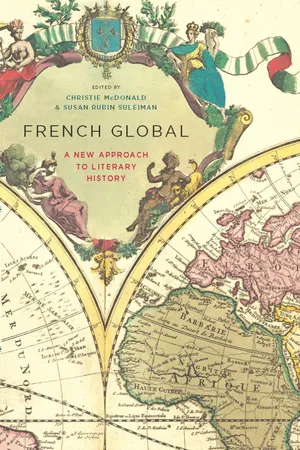
Recasting French literary history in terms of the cultures and peoples that interacted within and outside of France's national boundaries, this volume offers a new way of looking at the history of a national literature, along with a truly global and contemporary understanding of language, literature, and culture.
The relationship between France's national territory and other regions of the world where French is spoken and written (most of them former colonies) has long been central to discussions of "Francophonie." Boldly expanding such discussions to the whole range of French literature, the essays in this volume explore spaces, mobilities, and multiplicities from the Middle Ages to today. They rethink literary history not in terms of national boundaries, as traditional literary histories have done, but in terms of a global paradigm that emphasizes border crossings and encounters with "others." Contributors offer new ways of reading canonical texts and considering other texts that are not part of the traditional canon. By emphasizing diverse conceptions of language, text, space, and nation, these essays establish a model approach that remains sensitive to the specificities of time and place and to the theoretical concerns informing the study of national literatures in the twenty-first century.
eBook - ePub
French Global
A New Approach to Literary History
- English
- ePUB (mobile friendly)
- Available on iOS & Android
eBook - ePub
French Global
A New Approach to Literary History
About this book
Information
Topic
LittératureSubtopic
Critique littéraire européenne

PART I • SPACES

1
Worlding Medieval French
What does it mean to do “global French,” and how is that project related to recent initiatives in “world” and comparative literature? In the preface to the English translation of The World Republic of Letters, Pascale Casanova writes, “our literary unconscious is largely national. Our instruments of analysis and evaluation are national. Indeed the study of literature almost everywhere in the world is organized along national lines.” What she sets out to do, therefore, is to “restore a point of view that has been obscured for the most part by the ‘nationalization’ of literatures and literary histories, to rediscover a lost transnational dimension of literature that for two hundred years has been reduced to the political and linguistic boundaries of nations.”1 Her answer, however, is to define a “world republic of letters” that begins with early modernity and whose primary category of analysis remains the nation:
International literary space was formed in the sixteenth century at the very moment when literature began to figure as a source of contention in Europe, and it has not ceased to enlarge and extend itself since. Literary authority and recognition—and, as a result, national rivalries—came into existence with the formation and development of the first European states. Previously confined to regional areas that were sealed off from each other, literature now emerged as a common battleground. Renaissance Italy, fortified by its Latin heritage, was the first recognized literary power. Next came France, with the rise of the Pléiade in the mid-sixteenth century, which in challenging both the hegemony of Latin and the advance of Italian produced a first tentative sketch of transnational literary space. Then Spain and England, followed by the rest of the countries of Europe, gradually entered into competition on the strength of their own literary “assets” and traditions. (11, emphases added)
Reading as a medievalist, I cannot help but be struck by the profound binarism structuring this literary-historical vision: the sixteenth century set over and against its unnamed (medieval) other, the “internationalism” of early modernity counterposed to a tightly compartmentalized regionalism, the ascendancy of the French vernacular challenging the hegemony of the Latin-Italian heritage. Then again, there is the passage’s unexamined Eurocentrism: international literary space takes shape once literature becomes “a source of contention in Europe” (emphasis added); in this developmental model of literary history, Italy sets the pace, soon to be overtaken by France, with Spain, England, “and the rest of . . . Europe” gradually making their appearance.
This essay takes up the linked questions of the “world republic of letters” and the notion of a “littérature-monde en français,”2 arguing that a historically situated approach to medieval French literature both complicates our understanding of the role of the Middle Ages in the literary history of France and French in the literary history of Europe while opening up the question of “European” literature itself. My title, “Worlding Medieval French,” grows out of my work in world literature and cultural studies at the University of California, Santa Cruz—a collaborative effort in which “worlding” signifies a “critical stance,” an “interruption and critique of a range of field imaginaries.” Analyzing literature and cultural production in a global context, worlding seeks “not merely [to] increase representation of previously ignored or underrepresented cultures, but rather [to] present both dominant and emerging cultures as dynamically related within specific historic and economic contexts.”3 In the spirit of “refus[ing ] to allow our object of knowledge to be naturalized in advance,”4 this essay begins with a look at what it might mean to “world” our understanding of French in the high Middle Ages. From there, it takes up three topics generated by worlding French literature: twelfth-century romance and the poetics and politics of translatio; literary traces of French political involvement in the thirteenth-century Mediterranean; and the premodern world system underlying Marco Polo’s Devisement du monde (Description of the World). This last text, better known today as Marco Polo’s Travels, may seem a surprising choice. Usually assumed to have been written not in French but in Italian, it is often taken (despite its extensive representations of the commercial centers of Central Asia as well as of the riches of China and the wonders of India) as exemplifying the narrowness and incredulity of the medieval European experience. Yet, as we will see, the Devisement exemplifies many of the questions involved in the “worlding” of medieval letters. “Written in French, but not by a Frenchman” near the turn of the fourteenth century, a text in which the foreign “sometimes turns out to be curiously familiar,” it radically challenges our understanding of the place of the world in Old French letters and the place of Old French letters in the world.5
Medieval French in the World
For the Middle Ages, posing the question of a “littérature monde en français” demands an initial act of reterritorialization, defamiliarizing our idées reçues by situating medieval “Europe” in an expanded frame of reference. Told from the typical point of view (reflected in the structure of textbooks in medieval history), the history of the Middle Ages is the history of northwestern Europe—the area that eventually gives rise to the nation-states of France, England, and Germany, with the Low Countries and northern Italy playing important secondary roles. In this optic, the high and late Middle Ages, ca. 1050–1450, are synonymous with such phenomena as the Investiture Controversy, the Norman conquest of England, the Crusades, the Magna Carta, and demographic expansion and urban revival (in the twelfth and thirteenth centuries) followed (in the fourteenth) by decline: the Little Ice Age, the Great Schism, the Black Death, and the Hundred Years’ War, concluding in 1453 (the same year as the Ottoman conquest of Constantinople), bringing us to the threshold of early modernity. Key figures in this history might include Henry II, Thomas Becket, Abelard and Héloïse, Saint Francis of Assisi, Thomas Aquinas, Saint Louis IX, Dante, and Petrarch, the first “modern” man.6 Turning to cultural currents, we can cite the transition from Romanesque to Gothic and from epic to romance, twelfth-century humanism and the “discovery of the individual,” thirteenth-century scholasticism, Dante and (again) Petrarch; in the world of French literature, the Chanson de Roland, the Lais of Marie de France and the romances of Chrétien de Troyes; troubadour lyric, the fabliaux, and the “bourgeois” literature of thirteenth-century Arras; allegory (differently instantiated in the two parts of the Roman de la Rose), the great Arthurian prose cycles, and concluding with Guillaume de Machaut and Christine de Pizan, authors who—finally!—emerge from the haze of history as something like real historical figures.
In the longue durée of world history, by contrast, the medieval West remained peripheral to the tradition of the great world empires that had long dominated the eastern Mediterranean, Syrio-Mesopotamia, and Iran.7 In Eurocentrism, political theorist Samir Amin recasts the medieval West as a peripheral form of a “regional tributary system” centered in the Eastern Mediterranean; historian Richard Bulliet, for his part, has coined the provocational term “Islamo-Christian civilization” to denote “a prolonged and fateful intertwining of sibling societies enjoying sovereignty in neighboring geographical regions and following parallel historical trajectories,” with Latin Christianity and Islam as “two versions of a common socioreligious system.”8
In this perspective, to focus on the European Middle Ages is to tell the story from the margins—a shift in perspective with considerable consequences for the way we frame medieval history in general and the literary history of Old French in particular. With this realization, sites such as Iberia (both Muslim and Christian); the four Italian maritime republics of Amalfi, Pisa, Venice, and Genoa; the Crusader States and the Byzantine Empire; and island kingdoms such as Sicily or Cyprus, all typically consigned to the margins of “medieval Europe,” suddenly become privileged points of access to a Mediterranean political and cultural sphere with deep roots in western Asia. Key events in the history of this reterritorialized Europe might include the Crusader conquest of Jerusalem in 1099 and its loss in 1187; the Latin conquest of Constantinople in 1204 and the Greek reconquest of 1261; the Sicilian Vespers of 1282 (precipitating what one historian has called a “Two Hundred Years’ War” between papal and imperial factions); and the fall of Crusader Acre in 1291.9 Key figures include Roger II of Sicily, Saladin, Frederick II, Charles of Anjou, and literary and cultural figures such as Ibn Hazm, Ibn Rushd (Averroes), Maimonides, Boccaccio, and Ibn Khaldun. These two different histories were by no means mutually exclusive: Saint Francis, who in 1219 visited the Egyptian Sultan al-Kamil (Saladin’s nephew) in an unsuccessful attempt to convert him to Christianity, or Saint Louis, the pious king who spent six years (1248–54) in the eastern Mediterranean and died in 1270 on an abortive crusade to Tunis, are but two examples of the interface between the “medieval Europe” of the textbooks and that of the reterritorialized Mediterranean.
In setting out to explore the long history of the “sense of a globe that is interconnected, of cultural difference within and beyond the nation,”10 one could scarcely find a better point of departure than the Francophone Middle Ages. For one thing, when vernacular French literature first appeared in the early twelfth century, nothing resembling the modern French nation existed: the French king controlled little more than the Ile-de-France, the language spoken south of the Loire was Occitan, and the most powerful French-speaking ruler was the Norman king of England. Our earliest texts—among them the Chanson de Roland and the hagiographic Voyage of Saint Brendan—were composed not in the dialect of Paris but in Anglo-Norman (see chapter 11). Cultivated outside the borders of the nation-state that will later lend its name to both the language and the literature, Old French is extraterritorial avant la lettre. And this remains true for much of the twelfth century, in texts ranging from the Romances of Antiquity and the Lais of Marie de France to the Tristans of Béroul and Thomas of Britain. From this precocious beginning, vernacular French quickly spread, with translations of Arthurian romance appearing in German “in principalities along the lower Rhine, located in a small region around present-day Limbourg and Maastricht”—a region that “bridges, then as now, the French and German spheres politically, culturally, and linguistically” as early as the 1170s,11 and epic material in Old Norse in the thirteenth century. If one were to speak of a république européenne des lettres in the twelfth century, its center would be, if not yet in Paris, then squarely within the French-speaking world.
At this early stage, Old French was also the best developed and most prestigious of the European vernaculars in the medieval Mediterranean. In one account, Saint Francis of Assisi, composer of one of the earliest verses in vernacular Italian (the celebrated “Canticle of the Creatures,” ca. 1225) owed his nickname to his fondness for verses in French, “the language of his intimate outpourings.”12 Its currency as the prestige vernacular of Latin Europe peaked in the second half of the thirteenth century, when it became the language of choice for non-French speakers such as Brunetto Latini, Martin da Canal, and (in an example to which we will return) Marco Polo and Rustichello of Pisa.13 Farther to the east, Old French was the language of La Fleur des histories de la terre d’Orient, composed by the Armenian prince Hetoum (or Hayton) and presented to Pope Clement IV in 1307, and La Geste des Chiprois, a tripartite vernacular history of Cyprus compiled by the anonymous “Templar of Tyre.” Whether motivated by the beauty of the language, their wish to reach an “international” readership, or their desire to cultivate the political favor of a specifically French audience, these writers attest to the wide diffusion of Old French as a Mediterranean vernacular.
Romance and the Poetics and Politics of Translatio
In the early thirteenth century, the poet Jean Bodel famously divided the works of his day into three “matières,” corresponding to three stages in the rapid emergence of vernacular French literature in the previous century. Of these, the “matter of France” refers to the epic material surrounding the legendary history of Charlemagne and the “matter of Brittany” to the Celtic and Arthurian tales reworked by authors such as Chrétien de Troyes, Béroul, and Marie de France. The remaining corpus, the “matter of Rome,” refers to the Romances of Antiquity: works such as the Roman de Troie, the Roman de Thèbes, and the Roman d’Alexandre, which “translated” classical legends f...
Table of contents
- Cover
- Half title
- Title
- Copyright
- Contents
- Introduction: The National and the Global
- Acknowledgments
- Part I: • Spaces
- Part II: • Mobilities
- Part III: • Multiplicities
- Bibliography
- List of Contributors
- Index
Trusted by 375,005 students
Access to over 1.5 million titles for a fair monthly price.
Study more efficiently using our study tools.
Frequently asked questions
Yes, you can cancel anytime from the Subscription tab in your account settings on the Perlego website. Your subscription will stay active until the end of your current billing period. Learn how to cancel your subscription
No, books cannot be downloaded as external files, such as PDFs, for use outside of Perlego. However, you can download books within the Perlego app for offline reading on mobile or tablet. Learn how to download books offline
Perlego offers two plans: Essential and Complete
- Essential is ideal for learners and professionals who enjoy exploring a wide range of subjects. Access the Essential Library with 800,000+ trusted titles and best-sellers across business, personal growth, and the humanities. Includes unlimited reading time and Standard Read Aloud voice.
- Complete: Perfect for advanced learners and researchers needing full, unrestricted access. Unlock 1.5M+ books across hundreds of subjects, including academic and specialized titles. The Complete Plan also includes advanced features like Premium Read Aloud and Research Assistant.
We are an online textbook subscription service, where you can get access to an entire online library for less than the price of a single book per month. With over 1.5 million books across 990+ topics, we’ve got you covered! Learn about our mission
Look out for the read-aloud symbol on your next book to see if you can listen to it. The read-aloud tool reads text aloud for you, highlighting the text as it is being read. You can pause it, speed it up and slow it down. Learn more about Read Aloud
Yes! You can use the Perlego app on both iOS and Android devices to read anytime, anywhere — even offline. Perfect for commutes or when you’re on the go.
Please note we cannot support devices running on iOS 13 and Android 7 or earlier. Learn more about using the app
Please note we cannot support devices running on iOS 13 and Android 7 or earlier. Learn more about using the app
Yes, you can access French Global by Christie McDonald,Susan Suleiman, Christie McDonald, Susan Suleiman in PDF and/or ePUB format, as well as other popular books in Littérature & Critique littéraire européenne. We have over 1.5 million books available in our catalogue for you to explore.