In this provocative book, Anthony Hutchison challenges the belief that the American novel is "antipolitical" and condemns the relative absence of American literature in studies of the political novel. In Hutchison's view, our fiction is always informed by the complexities of the American political tradition, and to acknowledge this is to introduce a new, rewarding chapter of critical inquiry into the study of American literature.
Focusing on the works of Herman Melville, Gore Vidal, Russell Banks, Lionel Trilling, and Philip Roth, Hutchison finds a critique of liberalism put forth by classical republicanism, transcendentalism, Marxism, and neoconservatism at their respective moments of historical ascent. He shows how these authors take very specific historical periods and episodes for their subject matter and interrogate, critique, and contextualize pivotal moments in the intellectual history of American liberalism. In their work, liberalism reconstitutes itself in the face of competing ideological pressures, demonstrating that the novel is very much characterized by a "republican" concern with the health of the polity.
Considering such artists, philosophers, and theorists as Ralph Waldo Emerson, Fyodor Dostoevsky, Hannah Arendt, and John Dewey, alongside numerous contemporary commentators and historians, Hutchison repositions American novelists as serious political thinkers. He reveals Melville's Moby Dick to be the formal template for the American political novel and compares and contrasts its embodiment of "republican" fiction with the "democratic" mode Mikhail Bakhtin associates with Dostoevsky. He especially draws attention to the meaning of republicanism in the early national period, the place of abolitionism in the Civil War, and the post-1930s liberal retreat from Left radicalism.
By concentrating on the tension between issues of liberalism and morality in the political thought of these American novelists, Hutchison hopes to advance a more nuanced and textured understanding of the U.S. political tradition. He scrutinizes a number of critical studies and makes a cogent case for a more interdisciplinary approach to the American political novel that focuses less on the politics of representation and more on the representation of politics.
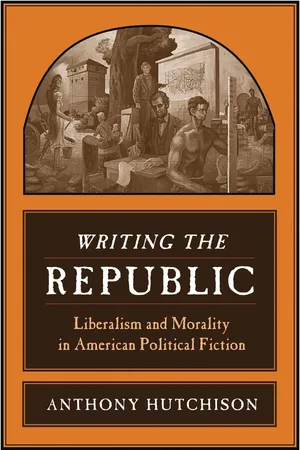
eBook - ePub
Writing the Republic
Liberalism and Morality in American Political Fiction
- English
- ePUB (mobile friendly)
- Available on iOS & Android
eBook - ePub
About this book
Trusted by 375,005 students
Access to over 1.5 million titles for a fair monthly price.
Study more efficiently using our study tools.
Information
Subtopic
North American HistoryIndex
LiteraturePART I

THE NINETEENTH-CENTURY CONTEXT
1
ELUSIVE REPUBLICANISM
Sons have generally followed in the footsteps of their fathers …
—MARTIN VAN BUREN,
Inquiry Into the Origins and Course of Political Parties in the United States
I set down as calumny every tale calculated to disturb our harmony.
—AARON BURR,
in a letter to Thomas Jefferson, February 12, 1801
The Republican Synthesis
In the immediate post–World War II period, the political tradition of the United States was explained in terms of the triumph of liberalism and, in particular, the liberal political philosophy of John Locke. America’s self-image, it was claimed, was rooted more or less exclusively in Lockean “natural rights.” Such rights were part of a contract freely entered into by citizens, the consent of the governed premised on institutionalized recognition of the private individual’s entitlement to life, liberty, and property. For its proponents, the liberal, pragmatic disdain for ideology that grew out of such a “privatized” notion of rights constituted the “genius” of American politics; less sanguine critics, meanwhile, had to be content with pointing out how this atavistic individualism at least explained the diminished appeal of socialist doctrines in the United States.1
This consensus, however, began to crack in the late 1960s with the appearance of two seminal works. Bernard Bailyn’s The Ideological Origins of the American Revolution (1967) and his former pupil Gordon Wood’s The Creation of the American Republic (1969) were the first important expressions of what ultimately came to be regarded as “a declaration of independence from older scholarship in American political history.”2 Instead of emphasizing the extent to which the fight for independence and founding of an American republic was a beginning that ushered in new organizing principles for government, Bailyn and Wood each stressed the ways in which events were interpreted via a body of thought originating in the English parliamentary crises of the seventeenth and early eighteenth centuries. Although Bailyn’s study was concerned only with the effects of this hitherto submerged ideology on the American revolution, Wood pursued the link through to the constitutional convention of 1787. It was during this critical period between 1776 and 1787, Wood claimed, that republican ideology began to dissipate as the constitution makers confronted their own crises of authority in the turbulent political climate of the 1780s. Thus, he concluded, the signing of the Constitution signaled the eclipse of classical republicanism as a major component of American political thought, the volatile historical moment forcing the delegates to embrace a more jaundiced view of human nature and consequently to place greater emphasis on those “negative” liberties associated with property rights. This shift finally brought about what Wood describes as “the end of classical politics” in the United States. In historiographical terms, it prompted what, a few years after Wood’s work appeared, would be labeled the “republican synthesis.”3
By the end of the 1970s, however, the influence of classical politics in the United States was actually being extended by scholars into the early nineteenth century. Focusing on the early national period, Lance Banning and Drew R. McCoy detected the persistence of republican ideology among both Federalists and Republicans during the first party quarrel and beyond. The main way in which this ideology found expression in the early decades of the new republic, they asserted, was in the hypersensitivity of Americans to those “corrupted” aspects of government they had previously associated with the British parliament prior to the War of Independence.4 The Glorious Revolution of 1688 in England had established the principle of a polity headed by a Protestant monarch but premised on the notion of “mixed” government. Power was divided between social groups of the one (the Crown), the few (the Lords), and the many (the Commons). This abridgement of monarchical power, combined with what was anticipated as a conclusive affirmation of parliament’s sovereignty, realigned the English political system with a premodern tradition of republican thought. The new mixed constitution, consisting of a tripartite social order with the King as first magistrate, was regarded by many as republican in spirit and was admired by Montesquieu in particular, whose Considerations on the Causes of the Greatness of the Romans and Their Decline (1734) and The Spirit of the Laws (1748) were highly regarded by many of the delegates who attended the Constitutional Convention in 1787.5
Such accounts of the continuity of republican thought in a widened Anglo-American context were bolstered further by the even broader historical sweep of J. G. A. Pocock’s The Machiavellian Moment: Florentine Political Thought and the Atlantic Republican Tradition (1975). Pocock’s work traced the meaning of a number of concepts as they appeared at various republican historical junctures. Most prominent among these was the notion of “virtue,” which, first politicized in Aristotelian civic humanism, was further cultivated in the writings of Machiavelli during the Renaissance and revived once more by the English commonwealth men and James Harrington in the seventeenth century before finally reappearing in early Enlightenment Europe and revolutionary America. By giving the “republican synthesis” such a comprehensive historical grounding, Pocock illuminated more dramatically the problems inherent in the American republic’s confrontation with modernity and its emerging capitalist economy. In this way, he was able to elaborate on an earlier assertion—resting on his “classical republican” reading of early American political thought—that the revolt of the colonies might be perceived “less as the first political act of revolutionary enlightenment than the last great act of the Renaissance.”6 Pocock’s more determined attempt to relegate the influence of Lockean thought in the early modern period as well as his explicit dependence on a Kuhnian “paradigmatic” framework, furthermore, appeared to up the stakes of the debate. Some historians now began to talk of a “republican paradigm” rather than “synthesis.”7
Central to the political and civic notion of virtue that Pocock places at the heart of his study is—in contrast to the Lockean emphasis on negative liberty and the autonomy of the private sphere—the elevation of the public sphere and the importance of preserving its capacity to generate the positive sense of liberty associated with participation in civic affairs. The health of the public sphere—which eighteenth-century republican thinkers measured in terms of “public happiness”8—is premised on the willingness of citizens to demonstrate “virtue” by subordinating private interests to a higher notion of the public good. Only a virtuous citizenry—whose virtue and autonomy are assured by their status as property holders and associated freedom from the economy—could be sufficiently “disinterested” in political matters to maintain the moral rectitude of the republic. Pocock claims that it is only with the appearance in early eighteenth-century England of an oligarchy dedicated to financial reforms designed to buttress a modern capitalist economy that a countervailing republican discourse of opposition began to engage with modernity.
This opposition disdained the economy’s “corrupting” impingement on the body politic as longstanding principles of commerce became distorted by a parasitic “mercantilism.” Such developments were attributed to the financial revolution that led to the new and unsavory phenomena of paper money, “stockjobbers” (investors in the stock exchange), and public debt. The opposition in England took the form of the “country” critics of the “court” Walpole administration who saw themselves as attempting to defend the ideals of civic virtue and “disinterested” public service in the face of a relentless “commercialization” of such values. The English oppositionists, as their American heirs would sixty years later, spanned the political spectrum of the day to include Tories such as Henry St. John, Viscount Bolingbroke, as well as the more radical “old Whigs” such as Trenchard and Gordon, the authors of Cato’s Letters.9 For Pocock, these critics were invoking the Machiavellian cry of ridurre ai principii (return to first principles), the response of those loyal to the founding values of the city-state republics whenever those values were perceived to be threatened by “corruption.” This informs Pocock’s central organizing concept, which understands this republican discourse as a response to the temporal pressures exacted on all polities founded on the ideal of civic virtue. Republics are thus to be defined by their contingency. “The Machiavellian moment,” he writes,
is a name for the moment in conceptualised time in which the republic was seen as confronting its own temporal finitude, as attempting to remain morally and politically stable in a stream of irrational events conceived as essentially destructive of all systems of secular stability. In the language which had been developed for the purpose, this was spoken of as the confrontation of “virtue” with “fortune” or “corruption.”10
The call to first principles reappears in the American colonies, most notably in Thomas Paine’s exhortations to the New World to regenerate the Old by restoring that republican virtue which had been “eaten out” of the English constitution by crown corruption. In his attack on the English MP Sir William Meredith, in probably the most widely read pamphlet of the revolution, Common Sense (1776), Paine takes up the theme. He writes of the difficulties of arriving at “a proper name for the government of England,” complaining that although Meredith calls England a republic,
in its present state it is unworthy of the name, because the corrupt influence of the crown, by having all the places at its disposal, hath so effectually swallowed up the power, and eaten out the virtue of the house of commons (the republican part in the constitution) that the government of England is nearly as monarchical as that of France or Spain. . . . it is the republican and not the monarchical part of the constitution of England which Englishmen glory in.11
Paine blames the timidity of the wealthy classes in the face of the Crown’s usurpation of parliamentary prerogative on the unprecedented stake they now possess in the financial system controlled by that corrupted body. The massive expansion in commerce thus undermines the “virtue” of the House of Commons. “With the increase of commerce,” Paine laments, “England hath lost its spirit.”12 In The Machiavellian Moment, Pocock claims that by the eighteenth century “commerce” had replaced “fortuna” (“fortune” or “the circumstantial insecurity of political life”)13 in republican perceptions of “corruption.” Invoking Montesquieu’s observation in L’Esprit de Lois he writes: “Commerce, which makes men cultured, entails luxury, which makes [man] corrupt.”14 It is this stress on the extent to which commercial expansion was seen to undermine—rather than establish—the values of the republic that the principal critics of the republican synthesis were most keen to take issue with. It is to the arguments presented by the most notable of these adherents to a Lockean-liberal interpretation that I will now turn.
The Liberal Critique
Since being self-confessedly awestruck as a young graduate student by the breadth and gravity of J. G. A. Pocock’s work, Joyce Appleby has produced a series of essays that rigorously interrogate its more ambitious claims.15 An intended effect of this has been something of a restoration of Lockean texts to their central position within the canon of American political thought. Appleby, however, does not wish Locke’s writings to reassume an earlier unassailable status as the ideological reservoir from which all political thinking in the United States has invariably drawn; she wishes, rather, only to reiterate, in the light of the new historiography, the Lockean premises she remains convinced informed the main body of political thought in the revolutionary and early national periods.
Acknowledging the new thinking and reappraisals generated by what she redescribes as the “republican hypothesis,” Appleby commends, in particular, the way in which the methodology of its proponents has served to expose liberalism as one competing ideology among others. Treating liberalism as a “cultural artefact” allows scholars “to recognise in [the] self interest [of liberalism] as conceptual a notion as classical republicanism’s civic virtue.” In a statement reminiscent of Louis Hartz she concludes: “Like fish unaware of water we American writers have moved about in a world of invisible liberal assumptions.” She goes on to make clear that her intention is not to refute the revisionist work of Pocock et alia in order to “return to the status quo ante revisionism.”16 The way such work disentangles republicanism from the political discourse of the era, rather, makes it easier for the historian to identify and trace the emergence of those new Lockean ideas that ultimately displaced it.
Still, for Appleby, the influence of republicanism in eighteenth-century England and America has undoubtedly been exaggerated. In gazing backward so as to link the American republic to the past, she contends, Pocock et alia simply fail to discern the novelty of many of its underlying principles. The significance of the American republic lay in its modernity and the significance of this modernity for political thought lay in the increasing preeminence of the liberal worldview. At the heart of this worldview was an acceptance of the “revolutionary” fact of “the replacement of the economy for the polity as the fundamental social system.”17 Classical republicanism, Appleby claims, did not have the social grammar necessary to negotiate this shift from homo politicus to homo economicus in Anglo-American societies. A new grammar, in effect, had to be invented for a
trading system that had not only moved beyond the confines of political boundaries but had created wealth essential to the conduct of politics. . . . However appealing civic humanism was to English gentlemen involved in public issues, it did not help persons who sought to understand the private transactions that were determining the shape and direction of the Anglo-American economy.18
The idea of liberty, then, began to be recast in economic as opposed to political terms. Consequently, the role of government was perceived on the basis of its capacity to facilitate access to this economic realm of freedom as opposed to its willingness to protect and promote any understanding of the political sphere, classical or otherwise. Apple-by relates this oversight to republican historians’ perpetuation of an “agrarian myth” in early American history, a notion first advanced in the work of Richard Hofstadter in the 1940s.19 This ideal, described as that of “the self-sufficient yeoman dwelling in a rural arcadia of unspoiled virtue, honest toil and rude plenty,” conveniently reinforces the republican synthesis in its overtones of English “country” republicanism. Appleby, by contrast, contends that the reality behind this myth was of an economic order within which the rewards of large-scale commercial farming—far from being the object of “virtuous” republican suspicion—were enthusiastically seized upon as “a material base for a new social vision.”20 This vision was of a democratic republic premised on a forward-looking, nonhierarchical social organism made up of individuals committed to a market economy. Such commitments were seen to erase Old World social distinctions. Moreover, the abundance of land and natural resources to the west seemed to make this possible on an unprecedented scale.
Crucial within this debate is the figure of Thomas Jefferson, whose historical and philosophical legacy both sides were eager to appropriate. Accordingly, it is to the politics of Jefferson—both in theory and practice—as well as its contested legacy that this study of republicanism and Gore...
Table of contents
- Cover
- Half title
- Title
- Copyright
- Dedication
- Contents
- Acknowledgments
- Introduction: Liberalism and the Problem of Tradition in American Literature
- Part I: The Nineteenth-Century Context
- Part II: The Twentieth-Century Context
- Conclusion: Writing the Republic: Moby Dick and the Form of American Political Fiction
- Notes
- Bibliography
- Index
Frequently asked questions
Yes, you can cancel anytime from the Subscription tab in your account settings on the Perlego website. Your subscription will stay active until the end of your current billing period. Learn how to cancel your subscription
No, books cannot be downloaded as external files, such as PDFs, for use outside of Perlego. However, you can download books within the Perlego app for offline reading on mobile or tablet. Learn how to download books offline
Perlego offers two plans: Essential and Complete
- Essential is ideal for learners and professionals who enjoy exploring a wide range of subjects. Access the Essential Library with 800,000+ trusted titles and best-sellers across business, personal growth, and the humanities. Includes unlimited reading time and Standard Read Aloud voice.
- Complete: Perfect for advanced learners and researchers needing full, unrestricted access. Unlock 1.5M+ books across hundreds of subjects, including academic and specialized titles. The Complete Plan also includes advanced features like Premium Read Aloud and Research Assistant.
We are an online textbook subscription service, where you can get access to an entire online library for less than the price of a single book per month. With over 1.5 million books across 990+ topics, we’ve got you covered! Learn about our mission
Look out for the read-aloud symbol on your next book to see if you can listen to it. The read-aloud tool reads text aloud for you, highlighting the text as it is being read. You can pause it, speed it up and slow it down. Learn more about Read Aloud
Yes! You can use the Perlego app on both iOS and Android devices to read anytime, anywhere — even offline. Perfect for commutes or when you’re on the go.
Please note we cannot support devices running on iOS 13 and Android 7 or earlier. Learn more about using the app
Please note we cannot support devices running on iOS 13 and Android 7 or earlier. Learn more about using the app
Yes, you can access Writing the Republic by Anthony Hutchison in PDF and/or ePUB format, as well as other popular books in Literature & North American History. We have over 1.5 million books available in our catalogue for you to explore.